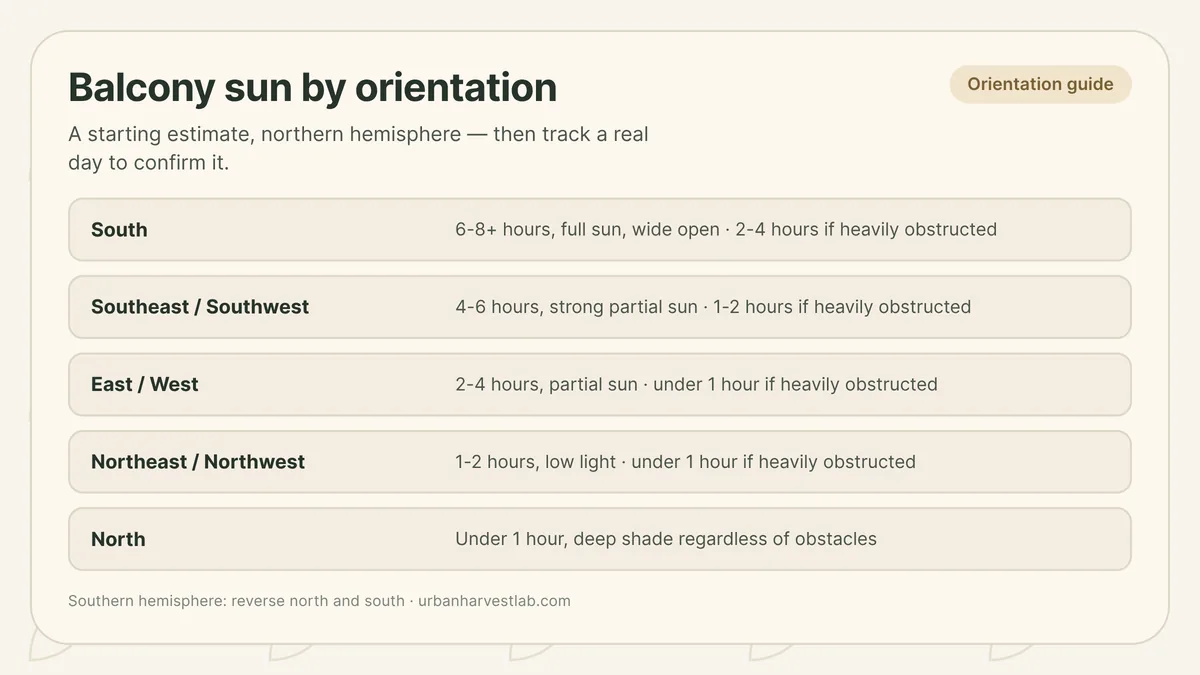
A rough starting range by orientation, before you track a real day
| Orientation (northern hemisphere) | Orientation (southern hemisphere) | Typical direct sun, wide open | Typical direct sun, heavy obstacles |
|---|---|---|---|
| South | North | 6-8+ hours (full sun) | 2-4 hours (partial sun) |
| Southeast / Southwest | Northeast / Northwest | 4-6 hours (strong partial sun) | 1-2 hours (low light) |
| East / West | East / West | 2-4 hours (partial sun) | under 1 hour (deep shade) |
| Northeast / Northwest | Southeast / Southwest | 1-2 hours (low light) | under 1 hour (deep shade) |
| North | South | under 1 hour (deep shade) | under 1 hour (deep shade) |
A balcony’s direct-sun total starts with two things you can check in a minute — which way it faces and what blocks the sky around it — then gets confirmed by tracking one representative day. Compass orientation alone is a starting range, not a final answer, because a south-facing balcony boxed in by a taller building can get less light than an open east-facing one. The estimator below turns orientation and obstacles into a rough range; the tracking method after it turns that range into your own number. For which herbs actually need which amount of light, see the by-herb sunlight chart.
Start with orientation and obstacles
Live estimate
This is a starting range built from compass direction and how open the sky is, not a measurement of your actual balcony — the bands are a geometric rule of thumb from the sun's daily path and the standard full-sun/partial-sun/shade hour labels, not figures published by an extension service; only the 6-hour herb threshold further down is sourced (Clemson, Penn State, UGA). Track one day below to confirm it.
Estimated direct sun
Full sun — about 6-8+ hours
- Orientation baseline
- Full sun — about 6-8+ hours
- After obstacles
- Full sun — about 6-8+ hours
South-facing, northern hemisphere baseline: full sun → wide open (no change) → estimated full sun
The estimate moves in two steps. Orientation sets the baseline, and the mechanism behind it is simple geometry: the sun spends the day arcing across the southern half of the sky in the northern hemisphere, so a wall facing that direction has the most hours of unobstructed exposure to it, while a wall facing north is looking away from that arc for nearly the whole day. East and west each catch one end of the arc — a morning slice or an afternoon slice — rather than the whole thing. South of the equator the arc runs across the northern sky instead, which is why every orientation in the table flips below the equator.
Obstacles interact with that baseline in a way the compass reading alone can’t capture, because very few balconies have the open view of the sky the baseline assumes. A tree two lots over or a building across the street cuts into that view for only part of the day, which is why the estimator moves the result down by a band rather than to zero. A close wall or a deep overhang is a different case: it can block the sun for most of the day regardless of which way the balcony faces, and it costs more in winter than the same obstacle does in summer, since a low winter sun barely clears an overhang that a higher summer sun sails straight over. That is why the estimator’s “heavy blockage” setting moves the estimate down two full bands — a south-facing balcony under heavy blockage lands around partial sun (2-4 hours) rather than full sun, while an orientation that already starts low bottoms out at deep shade.
Treat the result as a range to plan around, not a promise for a specific afternoon. It does not account for a specific tree’s height, a specific building’s distance, or the date on the calendar — those are exactly what the tracking method below is for.
Track one day to get your real number
Orientation and obstacles narrow the range; one day of direct observation replaces the guess with a measurement of your own balcony. The method is simple and needs no equipment beyond a clock.
- Pick a clear, representative day. A cloudless day close to today’s date, not a record from a different season, since the sun’s path shifts throughout the year.
- Check the growing surface every 30 to 60 minutes, starting shortly after sunrise and continuing until shortly before sunset. Use the same spot each time — the pot, rail section, or floor area you actually plan to grow in.
- Mark each check as direct sun or shade. Direct sun means sunlight is falling straight on the surface, not filtered through a plant, an awning’s edge, or a neighboring building’s shadow. Dappled light through a thin branch counts as shade for this purpose; it is not the same as open sky.
- Add up the direct-sun checks and convert to hours. If every check from 8:00 to 10:00 and from 14:00 to 17:00 showed direct sun, that is 5 hours total, even though the sun disappeared for the four hours in between.
- Repeat the count for a second nearby spot if the balcony has more than one plausible growing area. A railing edge and a spot against the wall a few feet back can produce noticeably different totals on the same balcony.
A phone alarm every 30 minutes makes the checks easy to keep up with, and a simple tally on paper or in a notes app is enough — there is no need for anything more precise than “sun” or “shade” at each check. A phone light-meter app can be useful for comparing two candidate spots side by side, but its reading is not a substitute for a calibrated light meter, so treat it as a way to tell which of two positions is brighter rather than as a source for the hour count itself.
Where the growing surface sits changes the total too: the wall and any roofline above it start cutting into the visible sky as soon as a pot moves back from the railing, which is why the same balcony can show two different totals a few feet apart.
Let the season shift the number
A single day’s total describes that day, not the whole year. The sun’s arc is lower and shorter in winter and higher and longer in summer, which changes both how many hours the sun is above the horizon and which surfaces it reaches at any given angle. A balcony that gets a full afternoon of sun in June can lose most of that light by December if a nearby building sits high enough to block the lower winter sun angle, even though nothing about the balcony itself changed.
The practical fix is to repeat the one-day count near the point in the year when it matters most — usually near the summer solstice for a summer vegetable plan, and again near the winter solstice or early spring if herbs are meant to run through the colder months. A reading taken in one season is a real number for that season; it is not a year-round guarantee.
What the total means for your herbs
Once a real hour count exists, it can be matched against what herbs actually need. Clemson Cooperative Extension’s baseline for the herb bed generally is that most herbs grow best with at least 6 hours of direct sun a day. Indoors, Penn State Extension gives the same 6-hour figure for most herbs, but names lemon balm, chives, and cilantro specifically as tolerating as little as 2 to 6 hours. The University of Georgia Extension’s outdoor figure agrees at 6 hours or more, with a somewhat lower indoor bar of 4 to 6 hours.
That means a balcony tracked at 6 or more hours of direct sun can support the full range of sun-loving herbs — basil, rosemary, thyme, oregano — at their best. A balcony tracked closer to 3 to 5 hours still supports a real crop; it just narrows the list toward the more tolerant herbs, and the full breakdown of which herb needs which range lives in the by-herb sunlight chart. A north-facing balcony tracked under 2 hours is closer to the situation covered in north-facing window herbs, where the realistic options are a short list of shade-tolerant herbs, a grow light, or both.
Common measurement mistakes
- Tracking a single cloudy or unusually hazy day and treating it as typical. A day with thin high cloud can read as far less sun than the balcony normally gets.
- Counting a bright, glowing sky as direct sun. A balcony can feel bright without the sun actually reaching the growing surface; the test is whether the surface itself is lit, not whether the sky looks sunny.
- Measuring once in spring and assuming that total holds through summer. A tree in leaf blocks far more light than the same tree bare in March.
- Checking only at midday. A balcony can get strong morning sun and none in the afternoon, or the reverse; checks spread across the whole day catch that, a single midday check does not.
- Ignoring a low winter sun angle. A railing that blocks nothing in June can shade the entire floor in December, because the sun sits lower in the sky and the same railing height intercepts more of its path.
- Recording sun on the pot’s rim rather than the growing surface. A pot’s edge can catch light for longer than the soil or the leaf canopy a few inches lower, so check the level plants actually grow at, not the highest point of the container.
Turn the number into a plan
A tracked hour count is most useful once it feeds into a decision: which herbs to grow, where to place them, and whether a grow light is worth adding. The balcony herb garden guide for beginners walks through matching a short herb list to a balcony’s real conditions, and a balcony garden planner can take the tracked hours as one of its inputs alongside container size and watering routine. Keep the season’s reading alongside the date it was taken, so a spring number is not mistaken for a summer one later in the year.
Sources
Turn your sun total into a herb plan
Once you know roughly how many hours of direct sun your balcony gets, these guides help you match that number to herbs and a layout.
Common questions
How much sun does my balcony get?
It depends mostly on which way the balcony faces and what blocks the sky around it. In the northern hemisphere, a south-facing balcony with a clear view of the sky often gets 6 hours or more of direct sun, while a north-facing balcony with buildings or trees nearby can run under 2 hours. The orientation estimator gives a starting range; tracking one representative day gives your own number.
What compass direction gets the most sun on a balcony?
In the northern hemisphere, south-facing balconies typically receive the most direct sun over the course of a day, with southeast and southwest close behind. In the southern hemisphere, north-facing balconies take that role instead. East- and west-facing balconies get a morning-only or afternoon-only share of the day rather than half of it outright — the estimator puts that at roughly 2-4 hours of direct sun once a wall, railing, or neighboring building shortens each end, in either hemisphere.
How do I measure how much sun my balcony actually gets?
Pick one clear day that represents the current season, then check the growing surface every 30 to 60 minutes from shortly after sunrise to shortly before sunset. Mark each check as direct sun or shade, then add up the direct-sun checks and convert to hours.
Do I need 6 hours of sun to grow herbs on a balcony?
Most culinary herbs do best with roughly 6 hours or more of direct sun, based on Clemson Cooperative Extension guidance, but several herbs tolerate less. The by-herb sunlight chart lists which ones cope with 2 to 6 hours, so a balcony that falls short of 6 hours still has workable choices.
Related guides
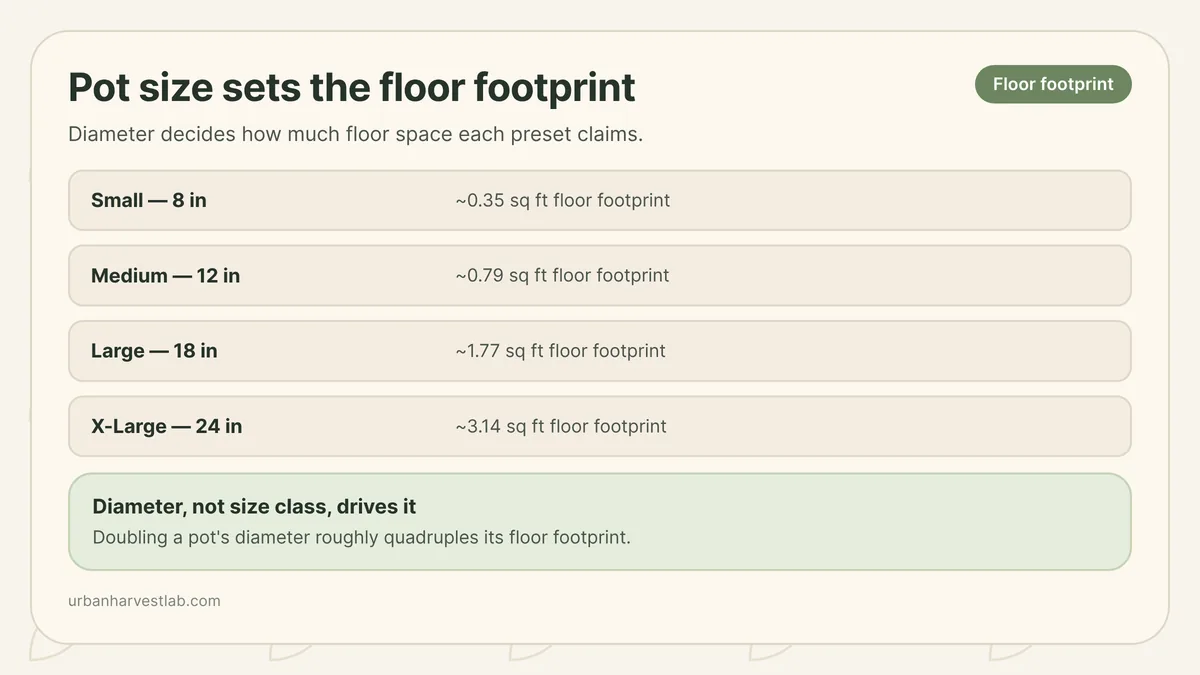
Balcony garden planner: place pots to scale and estimate sun
Type in width, depth, and orientation, then drop pots onto a to-scale diagram to see what actually fits and roughly how much sun it gets.
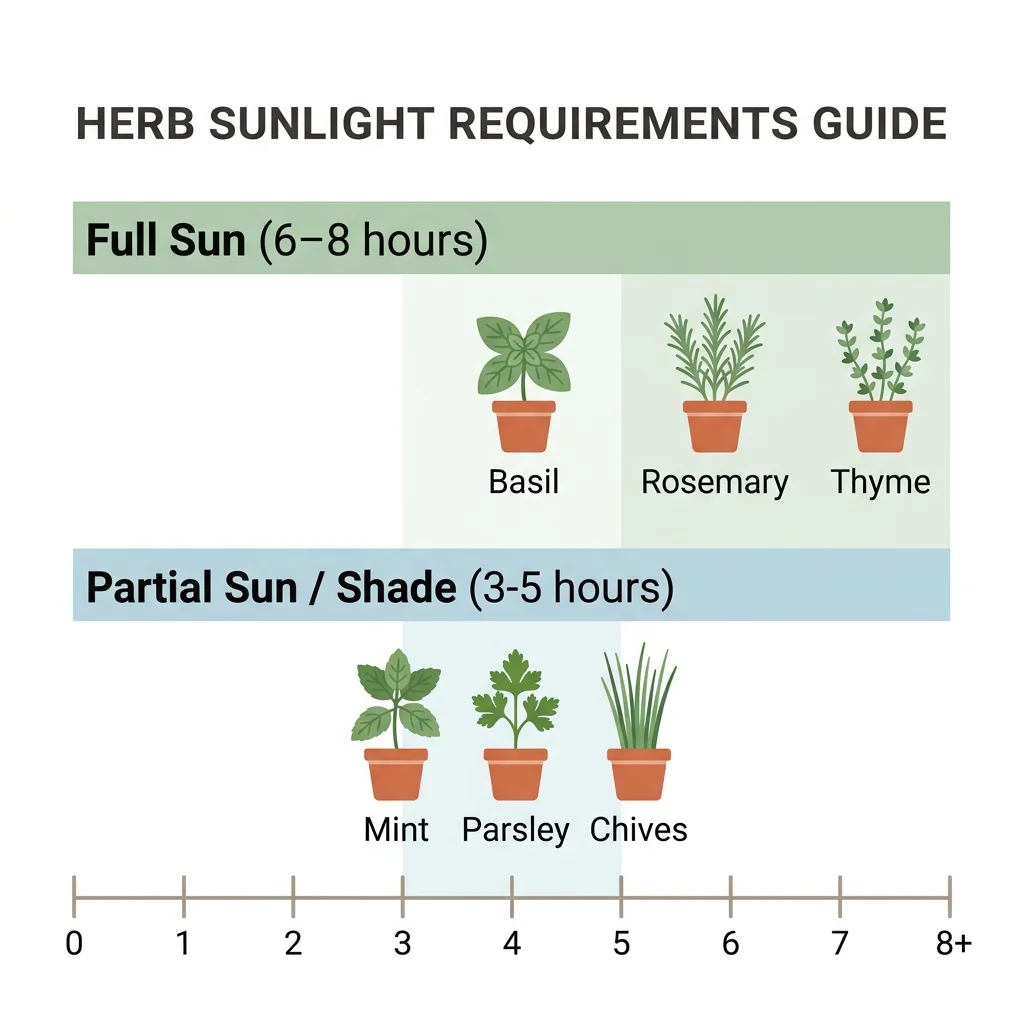
How much sun do herbs need? A by-herb sunlight chart
A simple sunlight chart for common herbs, split into full-sun, part-shade, and low-light tolerant, so you can match what you grow to the light your space actually gets.
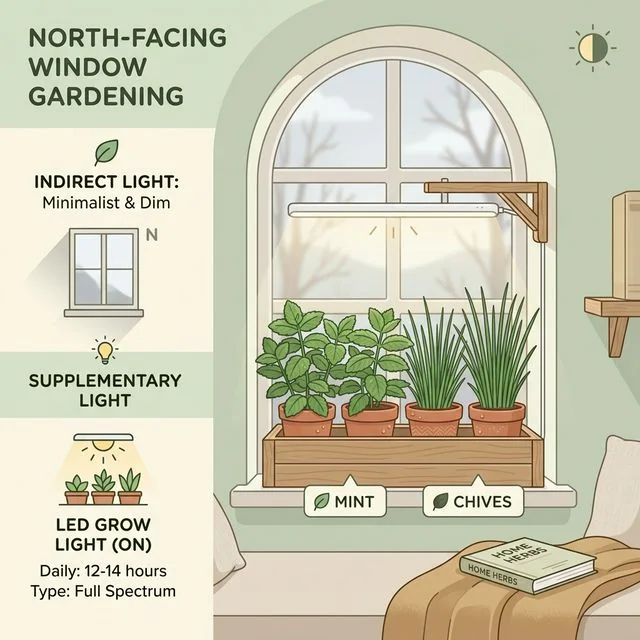
North-facing window herbs: what actually works and when you need a grow light
A north-facing window is widely considered the death sentence of an indoor garden. But with the right selection of shade-tolerant herbs and strategic placement, you can still harvest fresh greens year-round.