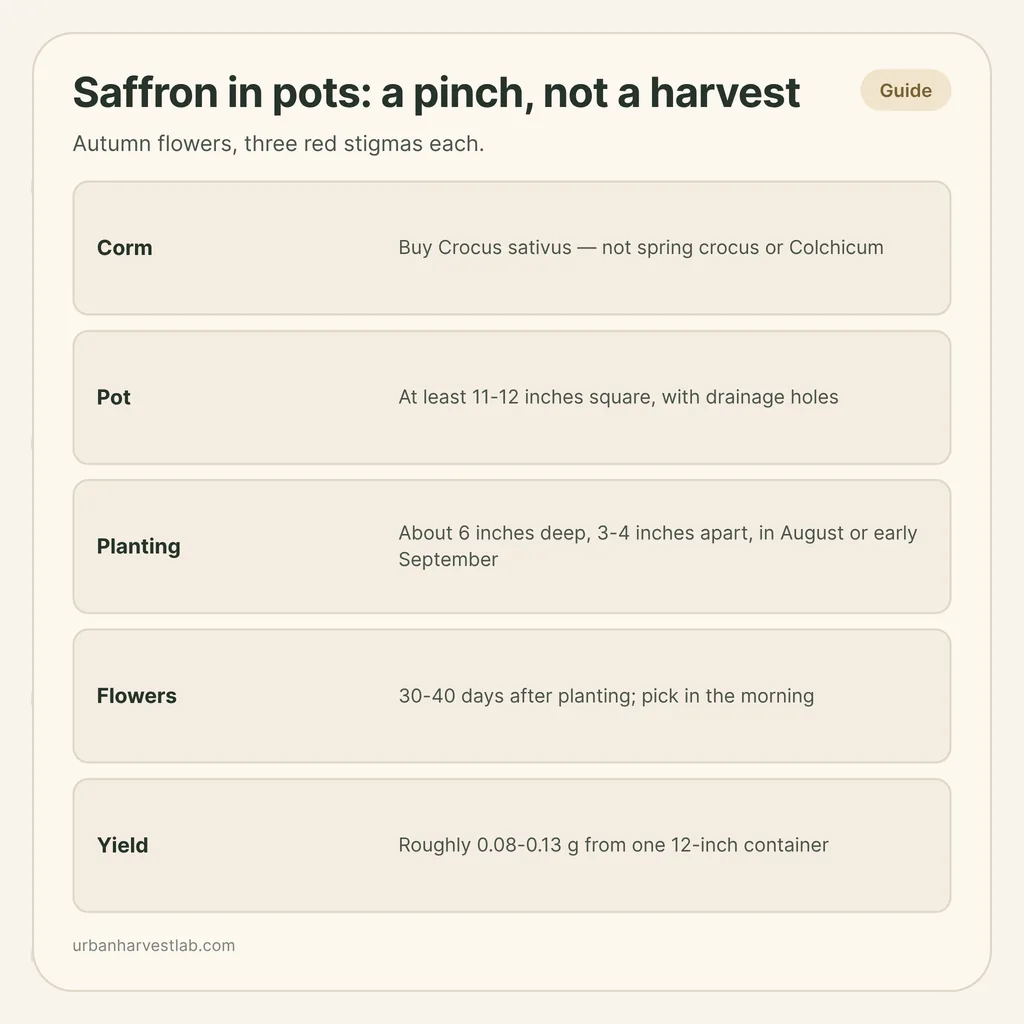
Saffron crocus (Crocus sativus) grows well in a deep pot: plant the corms about 6 inches down in August or early September, pick the red stigmas when the purple flowers appear in autumn, and expect a pinch of spice rather than a harvest. The University of Vermont’s saffron research program has grown it in lined crates, and its advice for pots is a minimum size of 11-12 inches square. It pairs well with other edible flowers in containers.
Buy the right corm
Most crocuses bloom in spring and are not a saffron source. The University of Vermont puts it plainly: “If you want to produce saffron, make sure you purchase Crocus sativus corms.”
Check the label for another reason too. Colchicum, sold as autumn crocus or meadow saffron, also flowers in fall and looks similar. The University of Washington Botanic Gardens notes it has a history of being misidentified as Crocus sativus, belongs to a different family, and says colchicine is highly toxic when ingested. Keep the corms in their labelled bag until planting.
Timing matters at the buying stage. Vermont’s researchers advise ordering in late spring, because suppliers do not deliver until August or September. If you are shopping for corms, you can browse saffron crocus corms on Amazon and check that the listing names Crocus sativus.
Pot, soil and planting depth
The University of Vermont says corms should be planted “at a depth of around 6 inches”, and notes that the highest yield is reported at 6-8 inches. Its researchers have not run replicated depth trials themselves. That depth sets your pot: you need soil beneath the corms as well as above them. Vermont’s own crates measured 12 x 12 x 11 inches, with 4 inches of topsoil below, the corms, 2 inches of topsoil over them and 4 inches of potting mix on top.
| Layer, bottom to top | Depth |
|---|---|
| Topsoil | 4 inches |
| Corms, pointed side up | 3-4 inches apart |
| Topsoil | 2 inches |
| Potting mix | 4 inches |
Density is 6-12 corms per square foot, usually 3-4 inches apart, according to the university’s home gardener sheet. A 12-inch square pot is one square foot, so it holds roughly 6-12 corms. The potting mix on top serves as mulch, supplies nutrition and insulates the corms in winter.
Drainage is not optional. Vermont says corms sitting in standing water for an extended period will rot, so use a pot with holes (see how to add drainage to a pot). Light to moderate soil texture with plenty of organic matter suits it best.
The calendar
| When | What happens |
|---|---|
| August to early September | Plant corms promptly; a first watering follows planting |
| 30-40 days later | Flowering begins and runs 5-6 weeks |
| After flowering | Grass-like leaves stay green for 6-8 months while new corms form |
| June or July | Plants go dormant |
Vermont’s trials planted in mid-late August or early September and watered the soil, saw flowering after 30-40 days, and recorded the leaves staying green for 6-8 months. After planting outdoors, its home gardener sheet says natural rainfall should be enough. In the dormant summer, corms left in the soil do not need to be watered. The same researchers say the life cycle cannot be predicted exactly, so treat the dates as a guide.
If you have grown garlic in containers, the rhythm is familiar: a fall-planted corm or clove, leaves through winter, and a summer rest.
Winter on a balcony
The leaves keep growing all winter. Vermont advises keeping containers on the ground, not on a bench, and insulating the sides so the pot does not get too cold. The university lists USDA zones 4-8 in its 2021 sheets, while an earlier 2017 summary gives zones 6-9, so the cold limit for an exposed pot is not settled by one source. Squirrels, voles and deer are listed as pests: Vermont’s raised beds had hardware cloth underneath to exclude rodents, and deer netting is suggested for leaves.
Harvesting the stigmas
Pick flowers in the morning once dew or frost has gone, just before they open, Vermont advises. In its high-tunnel trial the flowers were collected every two days, and most blooms came in a two-week window from October 16 to 31, though blooming ran into late November. Separate the red stigmas from the purple petals and yellow stamens.
To dry, Vermont’s sheet says to use an oven or dehydrator at about 200 °F until fully dry. The 2017 trial instead air-dried at room temperature. Store in a tight-lidded glass or metal jar in a dark, dry place, and wait a month before cooking with newly harvested saffron.
A realistic yield
In Vermont’s 2015-2017 trial in crates of 11 corms, first-year yield averaged 0.88-1.39 grams of dried stigmas per square metre, which the researchers noted was higher than Iran’s roughly 0.34 g and Spain’s roughly 0.6 g per square metre. A 12-inch square is about 0.09 square metres, roughly a tenth, so that works out to roughly 0.08-0.13 grams for one 12-inch container. That was a high tunnel, not a balcony, so treat it as an upper marker.
The University of Vermont found corms left in place for two years produced 75% more flowers per square metre and higher saffron yield. After flowering, the parent corm produces secondary corms that become next year’s crop, so a pot improves with time rather than needing replanting.
Is that worth the pot? For a few threads in a dish and the novelty of autumn flowers on the balcony, yes. As a way to stock a spice rack, no.
Sources
- University of Vermont, Saffron Production for Home Gardeners: Planting Depth and Density for Saffron Corms (2021)
- University of Vermont, Saffron Cultivation: Descriptions of Planting Methods (2021)
- University of Vermont, Life Cycle of Saffron (2017)
- University of Vermont, Saffron: A New Alternative Crop for Northern New England High Tunnels (2017)
- University of Washington Botanic Gardens, Is it a crocus?
More bulbs, flowers and pots
Related guides for fall-planted bulbs, edible blooms and pot drainage.
Common questions
Can you grow saffron in pots?
Yes. The University of Vermont saffron program has grown it in milk crates lined with weed cloth and says pots work if they are at least 11-12 inches square. Plant the corms in August or early September, about 6 inches deep.
How much saffron does one pot produce?
Very little. In University of Vermont high-tunnel trials, crates of 11 corms gave 0.88-1.39 grams of dried stigmas per square metre in year one, which works out to roughly 0.1 gram for a crate-sized container. Plan on a pinch for a few dishes.
When do saffron corms flower after planting?
University of Vermont trials saw flowering begin 30-40 days after planting in mid-to-late August or early September and continue for 5-6 weeks. Exact timing varies with temperature.
Is autumn crocus the same as saffron?
No. The University of Washington Botanic Gardens says Colchicum, also called meadow saffron, has a history of being mistaken for Crocus sativus and that colchicine is highly toxic when ingested. Buy corms labelled Crocus sativus.
Related guides

Edible flowers to grow in pots: nasturtium, calendula and viola
A few edible flowers do well in containers. The real question is safety: what you can eat, where it was grown, and what to leave on the plant.
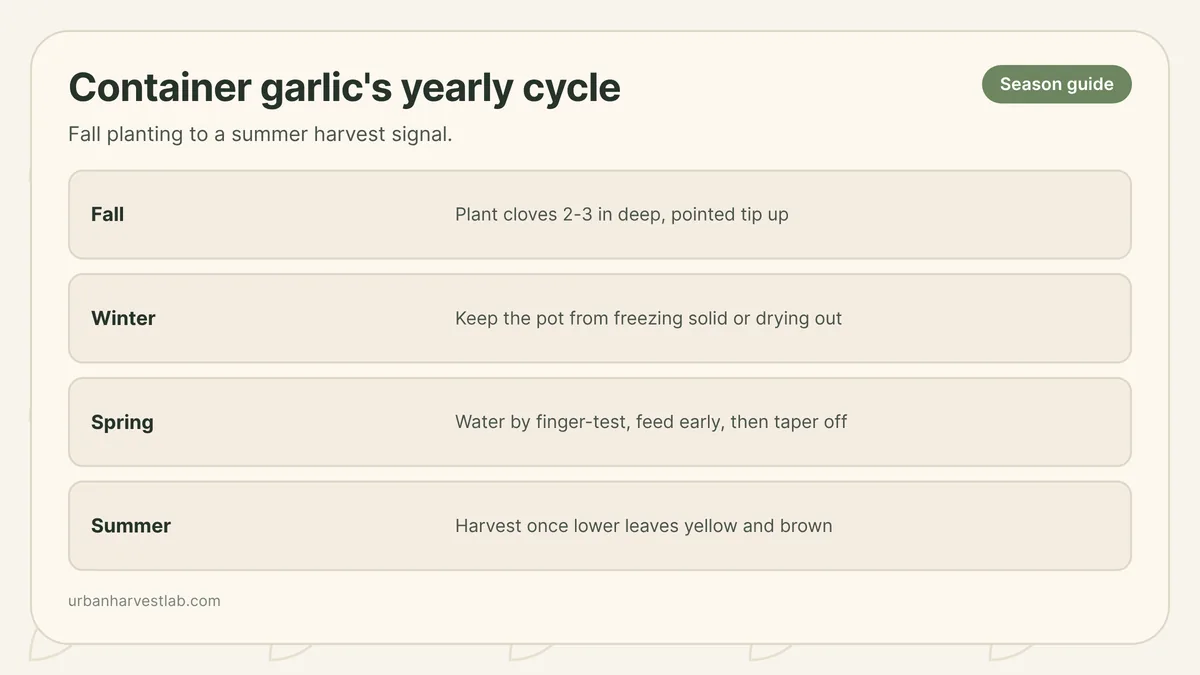
Growing garlic in containers: fall planting to summer harvest
Container garlic runs the same yearly cycle as garlic in the ground, but a pot freezes and dries out faster than garden soil. Here is the full process, season by season.
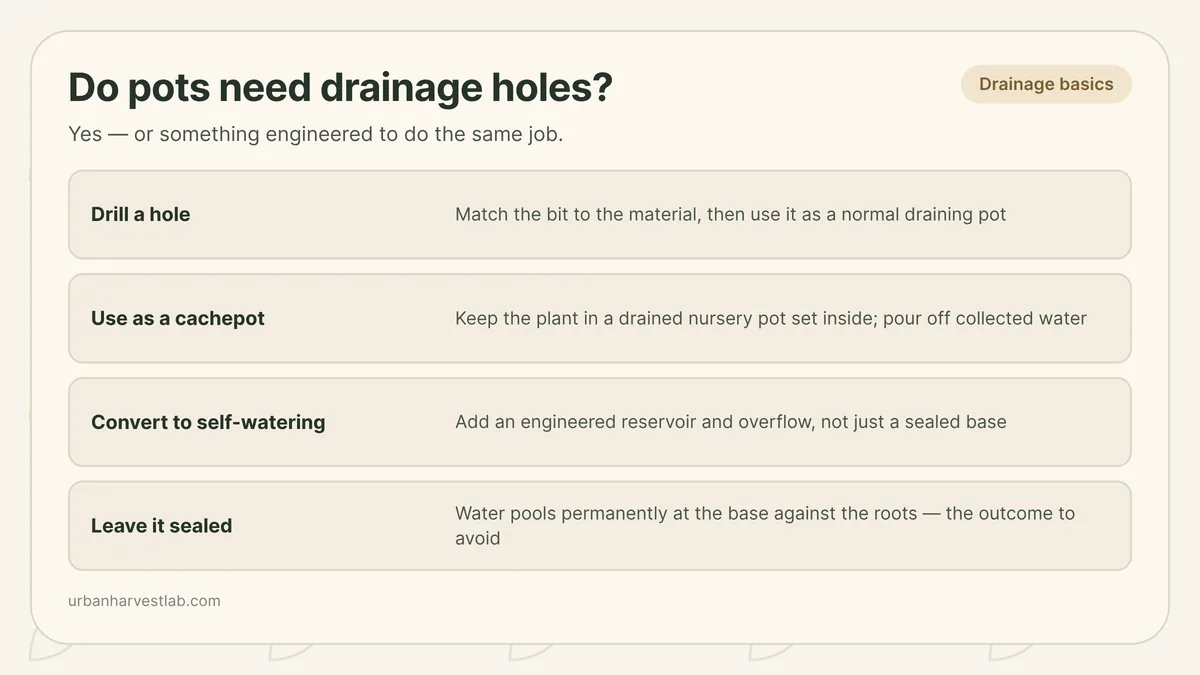
Do pots need drainage holes, and how to add one safely
A pot with no drainage hole is not a design quirk you can water around. Here is why that matters, how to drill one safely by material, and how to use a hole-less pot the right way instead.