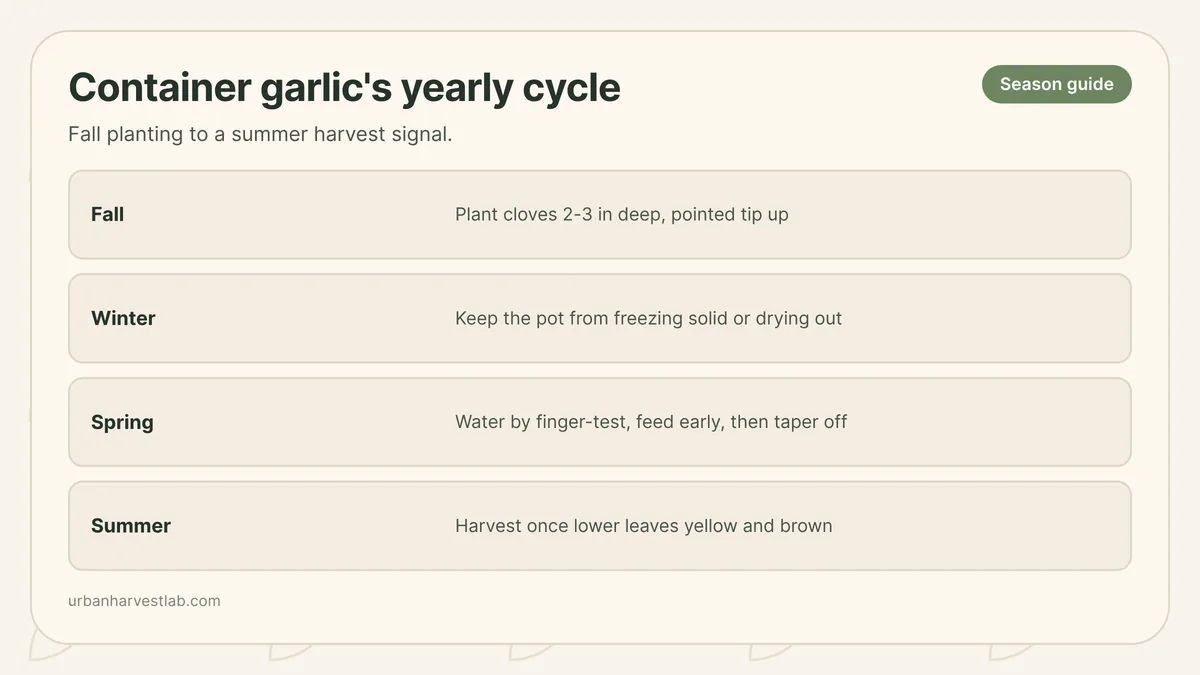
Container garlic's yearly cycle
| Season | What is happening | Your job in the pot |
|---|---|---|
| Fall (before hard frost) | Cloves are planted and begin rooting | Plant individually, 2-3 in deep (2 in per Ohio State and Cornell), in a deep container with real drainage |
| Winter | Cloves vernalize in the cold | Keep the pot from freezing solid or drying out completely |
| Spring | Shoots emerge and bulbs start forming | Pull back mulch, water by finger-test, fertilize early and taper off |
| Early-to-mid summer | Lower leaves yellow and fall over | Harvest before tops are fully dry, then cure in a shady, airy spot |
Garlic grown in a container follows the same yearly arc as garlic grown in the ground. Plant individual cloves in fall, let the pot sit through a real cold winter, water and feed through spring growth, then watch the lower leaves for the yellowing and browning that signals it is time to dig. The one thing a pot changes is exposure — a container freezes harder and dries out faster than garden soil, so the winter stretch needs more attention than a bed would. Still deciding what else belongs in the same fall container lineup? Herbs to plant in fall covers the rest of the list. The balcony vegetable garden calendar has the frost-date logic that tells you when your own planting window actually opens, rather than a fixed date that may not apply to your climate.
Hardneck or softneck changes how much cold you need
The variety decision matters more in a container than in the ground, because it determines how much cold the pot has to deliver. The University of California’s Master Gardener Program of Contra Costa County gives hardneck garlic 4 to 6 weeks of cold below 40 to 45°F to trigger proper bulb division, and describes softneck garlic as considerably less demanding of extended chill. Hardneck types also send up a flowering stalk (a scape) and tend to handle real winter cold better, which is part of why colder-climate growers lean toward them. Softneck types skip the scape, store longer after harvest, and tolerate a milder or less consistent winter more easily — a relevant point if your container sits somewhere that only gets marginal cold. Match the variety to your own climate rather than the season length alone. Pick one sold as suited to your general region, not whatever bulb happens to be in a grocery net bag — Ohio State Extension warns that store-bought garlic may have been treated to prevent sprouting, and University of Maryland Extension advises against planting it, since it can carry disease without showing symptoms.
Choose a container that can hold a full season
Garlic’s own root system is shallow, but it is growing in the same pot across University of Maryland Extension’s 250 to 270 days to maturity for a fall planting, so the container needs to buffer both moisture and temperature swings, not just fit a clove. Cornell Cooperative Extension tells growers in heavy soil to use raised beds “at least 10 to 12 inches tall,” a workable minimum soil depth for a pot too, and Utah State advises moistening the soil to a depth of 12 inches — both point at a deeper container than a single clove’s own root system would suggest. Container depth for tomatoes, peppers, and herbs covers the same volume-and-moisture-stability logic for other edible crops in pots; more soil around the roots means slower drying in summer and a slower temperature swing in winter, both of which work in garlic’s favor. Whatever container you choose, real drainage holes are not optional: garlic left sitting in trapped water is exactly the setup Clemson HGIC warns produces symptoms indistinguishable from underwatering, and a fall-to-summer planting gives root rot far more time to develop than a single season of herbs would. Use a fresh, well-draining potting mix rather than garden soil scooped from a bed; potting mix vs. raised bed soil explains why the two are not interchangeable in a container. Light matters as much as volume: University of Maryland Extension calls for at least 6 hours of direct light a day, 8 to 10 preferred, and Utah State University Extension lists garlic as a full-sun crop — worth factoring in now, since the sun sits at its lowest angle of the year for the winter stretch the pot has to sit through.
Plant individual cloves in fall
Cornell Cooperative Extension breaks the bulb apart a few days before planting and keeps the papery husk on each clove. Every source agrees on orientation: flat basal plate down, pointed tip up, one clove per hole — Ohio State Extension warns that planting a clove upside down or sideways produces small or misshapen heads. On depth, Utah State University Extension gives 2 to 3 inches of soil over the clove, while Ohio State University Extension and Cornell Cooperative Extension both give 2 inches; University of Maryland Extension instead digs a 5-inch furrow and backfills to cover the clove with just 1 to 2 inches, which lands in a similar practical place. Spacing varies more by source: Utah State gives 3 to 4 inches between cloves, University of Maryland gives 3 to 6 inches, Ohio State gives 4 to 5 inches, and Cornell Cooperative Extension gives 6 to 8 inches. In a shared container with a fixed volume of soil, treat the wider end of that range as the safer choice and plant fewer cloves rather than crowding a pot to match a garden bed’s density.
Timing sits inside a fall window rather than one fixed date. Utah State places it from late September through November, University of Maryland targets mid-to-late October so cloves grow roots and a few leaves before hard cold sets in, and Cornell Cooperative Extension frames it as roughly 6 to 8 weeks before your first expected fall frost. All three point at the same underlying test: get cloves rooted before the ground freezes, not on the calendar page. Spring-planted garlic is a fallback, not an equivalent — Utah State University Extension and the UC Master Gardener Program of Contra Costa County both describe spring planting as producing smaller bulbs than a fall start, because it compresses or skips the cold period bulbs need.
Get the container through winter
This is where a pot genuinely behaves differently than a garden bed. Garlic cloves need the cold — University of Maryland Extension gives 32 to 50°F for about two months before bulb enlargement begins — but an uninsulated container can also swing colder and drier than the soil around an in-ground planting, because it has no surrounding earth mass to buffer it. Cornell Cooperative Extension notes that young garlic shoots do not reliably survive below 20°F on their own once they have emerged, which is a real risk for a container sitting fully exposed on a balcony or patio through a hard freeze.
The RHS’s general advice for overwintering container plants applies directly here: keep pots where they cannot be frozen solid, saturated by rain, or left to dry out completely — against a wall, in a cold frame, or in an open-fronted shed — and wrap the container in bubble polythene ahead of a forecast hard freeze. Mulch helps too: Ohio State recommends about 4 inches of clean straw (not hay, which can carry weed seed) over a fall planting. Cornell Cooperative Extension recommends mulching heavily with straw for northern winters, then removing the mulch in spring once frost risk has passed; Ohio State Extension’s instruction is to rake the mulch off the emerging shoots but leave it between plants to suppress weeds. None of this removes the cold garlic needs to divide into a bulb. It only keeps the pot from swinging to the extreme that damages roots or emerging shoots.
Spring growth: water, feed, then stop
Once shoots are up and the mulch comes back off the crowns, watering shifts from a winter afterthought to an active job. Iowa State University Extension’s general container test — water when the mix is dry 1 to 2 inches down, adjusting frequency for pot size, heat, and wind — is a more reliable guide in a pot than any of the fixed-interval figures written for garden beds, because a container dries at its own rate. Those bed-based figures still tell you what garlic is asking for: Ohio State Extension targets about 1 inch of water per week through June, and Cornell Cooperative Extension gives roughly every 3 to 5 days during bulbing, switching in a very dry May or June to a deep soak to a depth of two feet every 8 to 10 days instead. A container obviously cannot hold a two-foot soak, which is why the Iowa State finger test above is the one to actually follow in a pot. All of them agree on the same taper at the other end — University of Maryland Extension and Ohio State both cut watering back as the lower leaves start to yellow, since bulbs are curing underground and excess moisture at that stage mainly invites disease.
Fertilizing follows a similar shape: feed early, then stop well before harvest. Utah State side-dresses with nitrogen in spring, and Ohio State Extension splits a balanced complete fertilizer — it gives 19-19-19 or 12-12-12 as examples — between planting and a spring application once plants are 4 to 6 inches tall, noting a nitrogen-only feed can replace it where soil phosphorus is already adequate. NC State Extension goes the other way, recommending a low-nitrogen, high-phosphorus, high-potassium product — a 3-20-20 is its example — and stopping all fertilizer by May. Cornell Cooperative Extension applies nitrogen early in spring and again just before bulbs begin to swell, typically around early May. The common thread across all four is straightforward for a container: feed while leaves are actively growing, and stop once bulb formation is underway rather than continuing on a fixed weekly schedule.
Read the harvest signal: yellowing and browning lower leaves
Watch the leaves, not the calendar. Every source agrees on the same tell, even where the exact wording differs. Utah State University Extension and Cornell Cooperative Extension both describe harvesting when tops begin to yellow or fall over, before they are completely dry. Ohio State Extension harvests once the lower leaves begin to yellow. NC State Extension gets specific about count, watching for two or three yellowed leaves per plant, usually around mid-June in its region. University of Maryland Extension uses a slightly later checkpoint, gently lifting a test plant with a garden fork once about half the foliage has turned brown, and notes that in central Maryland tops typically begin dying back from late June into early July.
None of these figures is a fixed date you can circle on a calendar, because a container’s exposure, your local climate, and the variety you planted all shift the actual week. What travels across every source is the shape of the signal: the bottom leaves go first, the color change starts as yellowing and moves toward brown, and the right moment to dig is somewhere in that window — before the tops collapse and dry out completely, which risks the outer bulb wrappers splitting and the bulb losing its stored cure time. If you pull one test plant and the outer wrapper still looks tight with a few green leaves left, it is reasonable to leave the rest a few more days and check again.
Cure and store what you harvest
Curing turns a freshly dug bulb into one that keeps. Utah State University Extension dries the whole plant in a shady, warm, well-ventilated spot for 1 to 2 weeks, until the skins turn papery and the roots dry out. Cornell Cooperative Extension gives a similar 2-week window in an airy, shady, dry location. NC State Extension cures for 10 to 14 days in a ventilated area before trimming. University of Maryland Extension dries bulbs with the tops still attached, out of direct sun, then trims the tops after 7 to 14 days and stores cured bulbs cool, around 32 to 38°F with roughly 65 percent relative humidity, stacked no more than one or two layers deep in a container that still lets air move. Skip a plastic bag or a sealed container at this stage; every one of these sources treats airflow as part of what keeps a cured bulb from rotting in storage, not an optional step.
Sources
- Utah State University Extension: How to Grow Garlic in Your Garden
- University of Maryland Extension: Growing Garlic in a Home Garden
- Ohio State University Extension (CFAES): Growing Garlic in the Garden
- Cornell Cooperative Extension, Schoharie & Otsego Counties: Guide for Growing Garlic
- NC State Extension, Henderson County Center: It’s Time for Garlic!
- University of California Master Gardener Program of Contra Costa County: Garlic, Love It or Leave It
- RHS: Growing Herbs in Containers
- Iowa State University Extension: How to Care for Plants Growing in Containers
- Clemson HGIC: Indoor Plants – Watering
Round out the fall container lineup
These guides cover what else goes in a fall container, the depth decision behind it, and the potting mix underneath.
Common questions
How deep should I plant garlic cloves in a container?
Extension sources give slightly different figures: Utah State University Extension gives 2 to 3 inches of soil over the clove, Ohio State University Extension and Cornell Cooperative Extension both give 2 inches, and University of Maryland Extension covers each clove with just 1 to 2 inches after setting it partway down a deeper furrow. Either end of that range works in a pot; go with 2 to 3 inches if you are choosing one number.
How far apart should garlic cloves be spaced in one container?
Sources range from 3 to 8 inches apart. Utah State gives 3 to 4 inches, University of Maryland gives 3 to 6 inches, Ohio State gives 4 to 5 inches, and Cornell Cooperative Extension gives 6 to 8 inches. In a shared container, spacing toward the wider end and planting fewer cloves per pot reduces competition for a fixed volume of soil.
How do I know when container garlic is ready to harvest?
Watch the lower leaves. University of Maryland Extension lifts a test plant once about half the foliage has turned brown, Ohio State Extension harvests once the lower leaves begin to yellow, and NC State Extension looks for two or three yellowed leaves per plant, usually around mid-June. Utah State and Cornell Cooperative Extension both describe the same general sign as tops beginning to yellow or fall over, before they are completely dry.
Does garlic in a container need a cold winter to form a bulb?
Yes, for hardneck types especially. University of Maryland Extension gives 32 to 50 degrees Fahrenheit for about two months before bulb enlargement begins, and the University of California's Master Gardener Program of Contra Costa County gives hardneck garlic 4 to 6 weeks of cold below 40 to 45 degrees Fahrenheit, noting that softneck types need less of it. A container that misses that cold stretch will grow leaves but is unlikely to divide into a full bulb.
Related guides
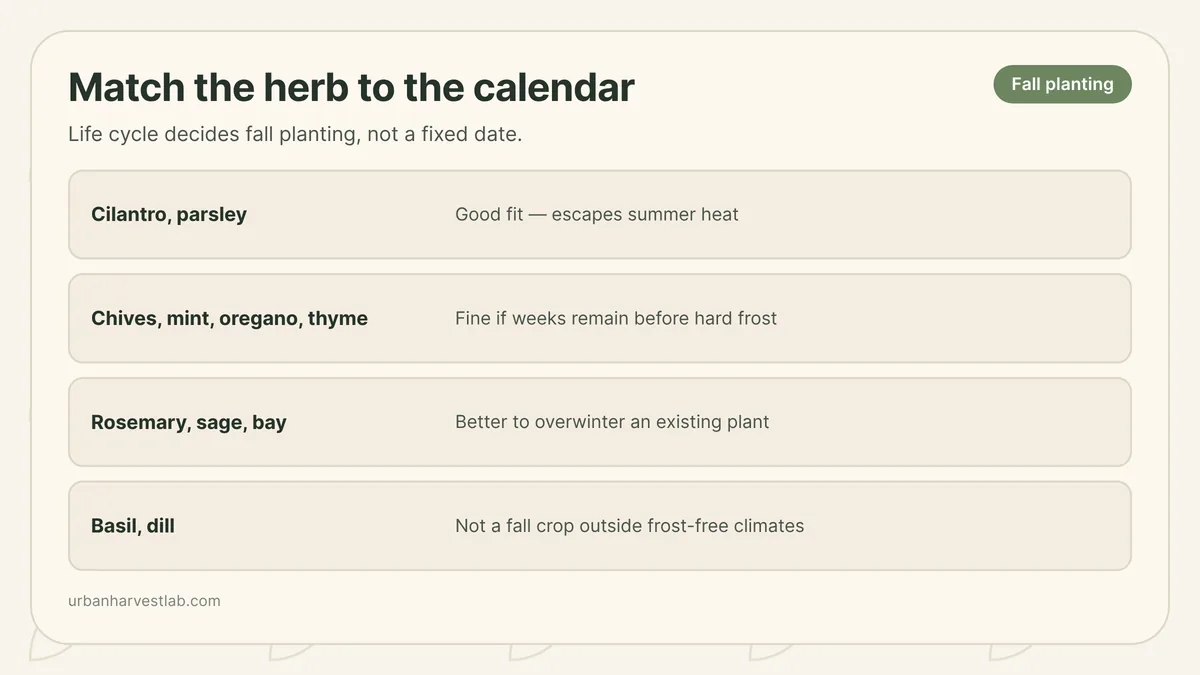
Herbs to plant in fall: what to sow now and what should wait
Fall planting suits herbs by life cycle and climate, not by calendar date. Cool-season herbs, cold-hardy perennials, and heat-loving annuals each answer the question differently.
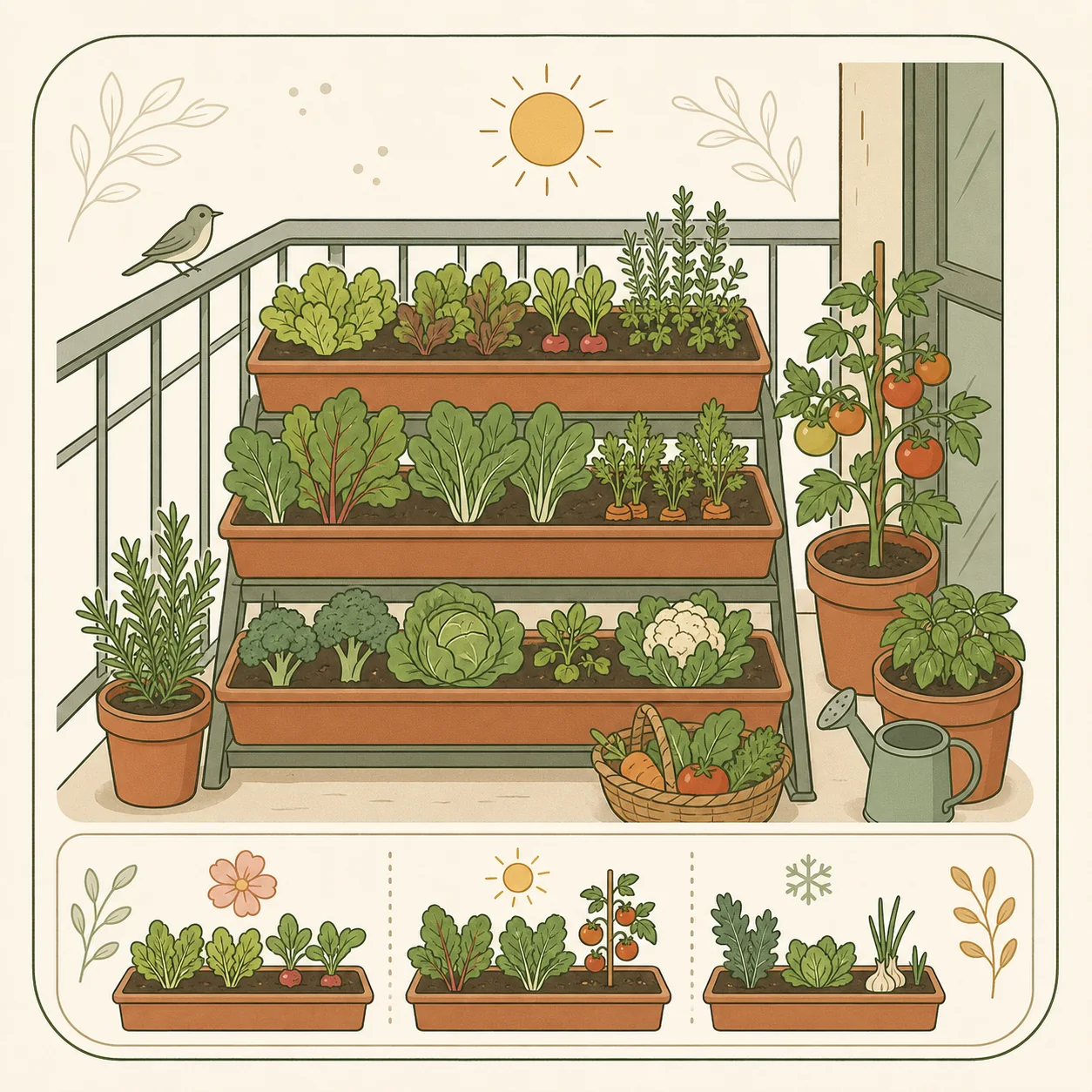
Balcony vegetable garden calendar: what to do each season
A useful balcony calendar is a set of seasonal decisions, not twelve fixed planting lists. Use temperature, light, and container conditions to decide what happens next.
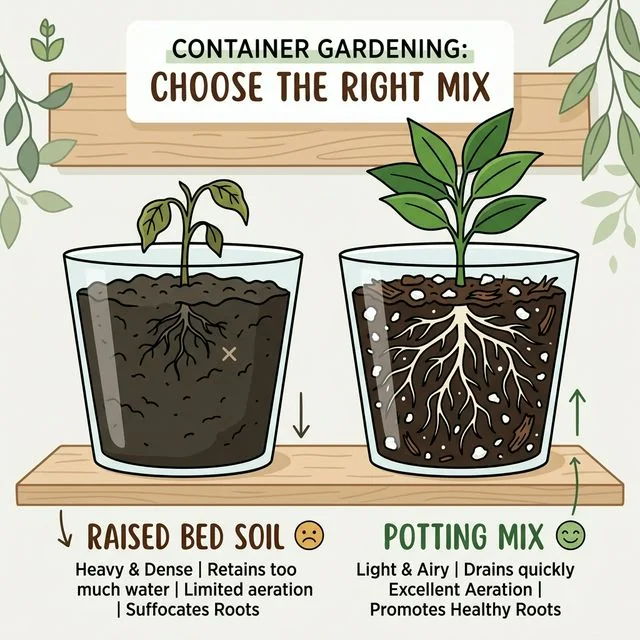
Potting mix vs raised bed soil for containers: what works in pots
Most container problems start with the wrong medium, not the wrong fertilizer. This guide explains why pots usually need a lighter mix than raised beds.