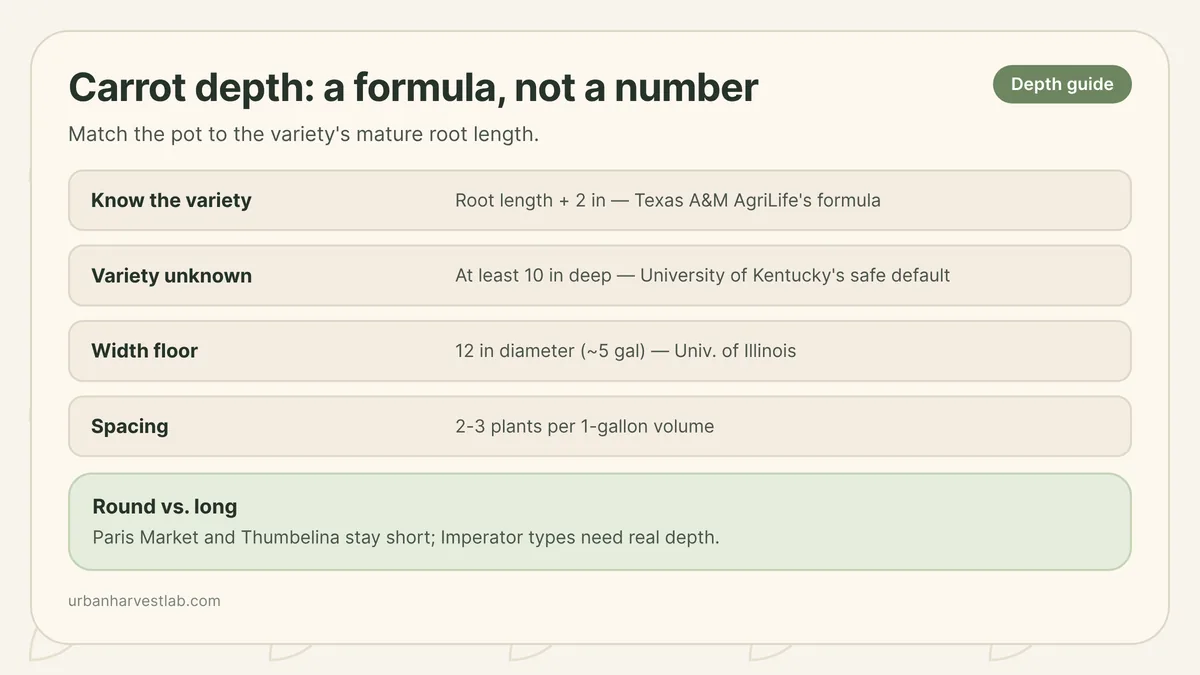
Carrot container depth and width, by source
| Source | Figure | What it covers |
|---|---|---|
| Texas A&M AgriLife Extension | Variety's mature root length + 2 in | Depth formula, when you know the variety |
| University of Kentucky Cooperative Extension | At least 10 in deep | Safe default depth when the variety is unknown |
| University of Illinois Extension | At least 12 in diameter (~5 gal) | Width floor for a full container of carrots |
| Texas A&M AgriLife Extension | 2-3 plants per 1-gallon volume | Spacing density inside that width |
Carrot container depth is the variety’s mature root length plus a margin: Texas A&M AgriLife Extension’s rule is a pot about 2 inches deeper than the variety is bred to grow. A round baby carrot and a long, tapering Imperator need pots that are not remotely the same size, so the seed packet in your hand matters more than any generic “carrots need X inches” answer.
A guide written with a stubby baby carrot in mind and one written with a long, tapering variety in mind will land on different pot depths — both can be correct for the variety they had in mind.
For the wider comparison of how carrots stack up against tomatoes, peppers, and herbs in the same container system, see container depth for tomatoes, peppers, and herbs. Carrots behave differently from all three, because the harvestable part of the plant is the root itself, not fruit or leaf growth sitting above the soil line.
Start with the variety, not the crop
Seed catalogs sort carrots into a handful of root shapes, and the shape is the whole depth question in disguise:
- Round or baby types — Paris Market and Thumbelina — mature short and about as wide as they are long. They were bred for shallow or heavy clay soil, which is exactly the container-growing problem.
- Half-long types — Danvers, Chantenay, Nantes — taper to a blunter point and mature to a middling length, shorter than a long type but longer than a round one.
- Long types — Imperator and similar slender, tapering carrots — are the ones bred for deep, loose garden soil and mature to the longest roots of the three groups.
Those three groups describe shape, not a specific inch figure to plan a container around. The number that matters is on the seed packet or catalog listing itself: it states the variety’s expected mature root length, and that is the figure to feed into the depth formula below.
The depth formula that actually works
Texas A&M AgriLife Extension states the rule plainly: use a container about 2 inches deeper than the carrot variety’s mature root length. Read the length off the packet, add 2 inches, and that is the container depth to shop for — a round variety printed at a short mature length needs only a shallow pot by this math, while a long variety printed at a much greater length needs a correspondingly deep one.
University of Kentucky Cooperative Extension gives a simpler, single figure for the crop as a whole: at least 10 inches deep, grouping carrots with green beans, collards, and peas. That works as a safe default if you have not checked the variety, but it will oversize a container for a short round carrot and can undersize one for a long variety planted at its full mature length. Use the Texas A&M formula when you know the variety; fall back to Kentucky’s 10-inch figure only when you do not.
Do not round down to save container space. A carrot that hits a hard bottom before it finishes elongating does not stop growing cleanly — it forks, stubs, or twists around the obstruction, and by the time you notice, the root shape is already set.
Width and spacing matter just as much
Depth solves only half the problem. Texas A&M’s own container guidance plants 2 to 3 carrots per 1-gallon container, and University of Illinois Extension puts carrot containers at roughly 12 inches in diameter. Crowd more roots into a narrower pot than that and they compete for the same soil volume, which produces the same forked, undersized roots as too little depth, even when the container is deep enough.
On University of Illinois Extension’s own conversion table for straight-sided round pots, that 12-inch minimum works out to roughly 5 gallons of soil. Combined with Texas A&M’s 2-to-3-plants-per-gallon figure, a 12-inch, 5-gallon pot holds roughly ten to fifteen carrots at that density — a useful number for planning how many seeds to sow before thinning. A pot you already own converts the same way; the pot size calculator handles the diameter-to-volume math for other sizes.
If you are choosing between a single deep pot and a wide, shallow trough, remember that width buys you root count while depth buys you root length — they are not interchangeable, and a wide but shallow trough will not rescue a long variety that needs the depth.
What a too-shallow container looks like at harvest
You will not see the problem until you pull the roots, and by then the container decision is already made for the season:
- Roots that stop abruptly and flare into a stubby, blunt end instead of tapering.
- Forked or split roots where the tip met resistance and split around it.
- Curled or twisted roots that grew sideways along the container wall once they ran out of straight room.
- A crop that matures noticeably smaller than the variety’s seed-packet description, even with otherwise good care.
These are not diseases or pest damage. They are the shape of a root that ran out of the vertical space it needed, and the fix for next season is a deeper container or a shorter variety, not a different feeding schedule.
Choosing a container to match your variety
If you already have a container and are choosing seed to fit it, work the Texas A&M formula in reverse: measure the container’s usable depth, subtract about 2 inches for the margin, and look for varieties whose seed packet lists a mature root length at or under that remaining number. A container bought first and a variety chosen to match it is the more reliable order of operations; buying seed first and hoping the container on hand is deep enough is how most forked-carrot container harvests happen.
This also settles the question of whether one container can grow more than one kind of carrot. A round or baby type and a half-long type planted in the same shallow pot both do fine, since neither needs more depth than the pot provides. Mixing in a long type changes the calculation for the whole container, not just its own row, because the pot has to be deep enough for the most demanding variety in it — planting a few Imperator seeds “just to try” at one end of an otherwise shallow round-carrot pot means building the whole container to the long variety’s depth, not compromising somewhere in between.
Whichever depth you land on, keep the container material and drainage in mind too — a container that dries out unevenly stresses root crops the same way a garden bed with unpredictable moisture does, which is covered from the material side in plastic vs. terracotta pots for herbs, and from the drainage side in pot drainage holes. Sow carrot seed directly into the container it will mature in, once you know the depth that variety needs.
Sources
Sizing a container for carrots? Read these next
These guides cover the wider container-depth picture, converting a pot's size to soil volume, and material and drainage choices.
Common questions
How deep does a container need to be for carrots?
It depends on the variety, not a single fixed number. Texas A&M Extension's working rule is to add about 2 inches to the mature root length printed on the seed packet. A short, round variety needs only a shallow pot; a long, tapering variety needs real depth.
Can I grow full-size carrots in a 6-inch pot?
Only if the variety's printed mature length is 4 inches or less, following Texas A&M Extension's 2-inch-margin rule. A long variety forced into a too-shallow pot will hit the bottom early and grow stubby, forked, or twisted instead of straight.
What is the best carrot variety for shallow containers?
Round or baby-type varieties, such as Paris Market and Thumbelina, are bred to mature short and round rather than long, so they are the easiest fit for a shallow container. Check the specific packet for the printed mature length before you buy the pot.
How wide should a carrot container be?
University of Illinois Extension puts carrot containers at roughly 12 inches in diameter, and Texas A&M Extension plants 2 to 3 carrots per 1-gallon container. Crowding several carrots into a narrow pot produces forked roots even when the depth is right.
Related guides
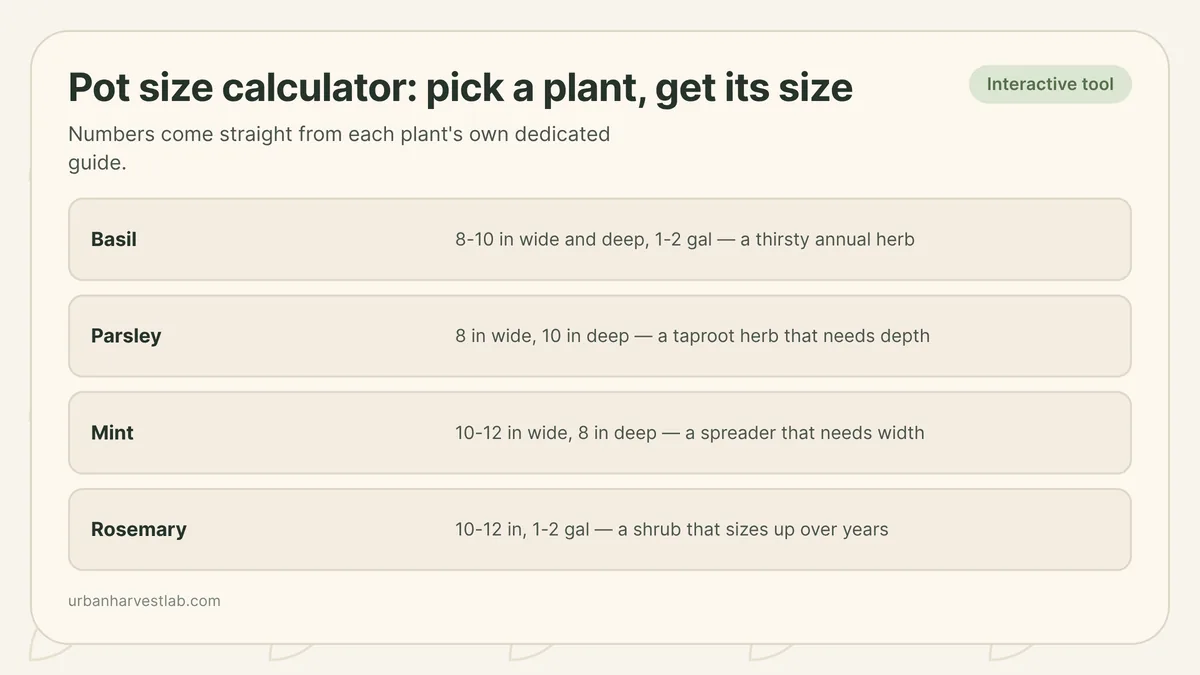
Pot size calculator: find the right container by plant and stage
A plant-and-stage picker that pulls its numbers straight from each herb's own dedicated pot-size guide, not a separate estimate.
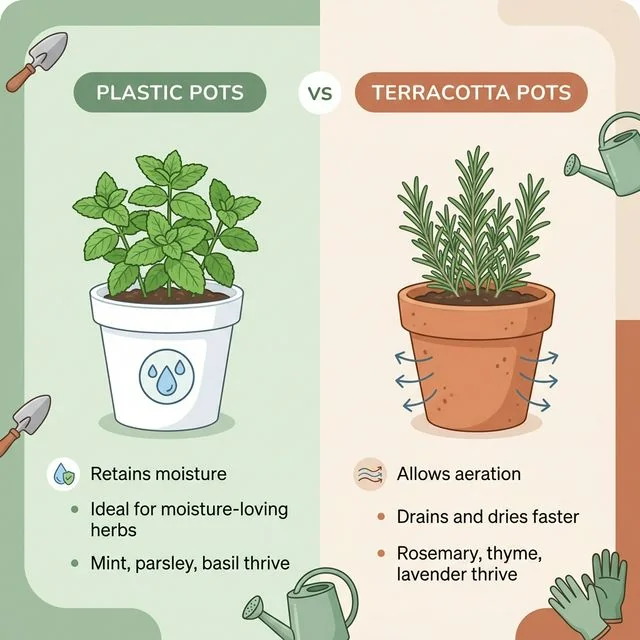
Plastic vs. terracotta pots for herbs: which makes care easier?
The material of your pot dictates how fast your soil dries out. If you put a thirsty mint plant in unglazed terracotta, you will be watering every single day. If you put rot-prone rosemary in a plastic pot, you must be extremely careful.
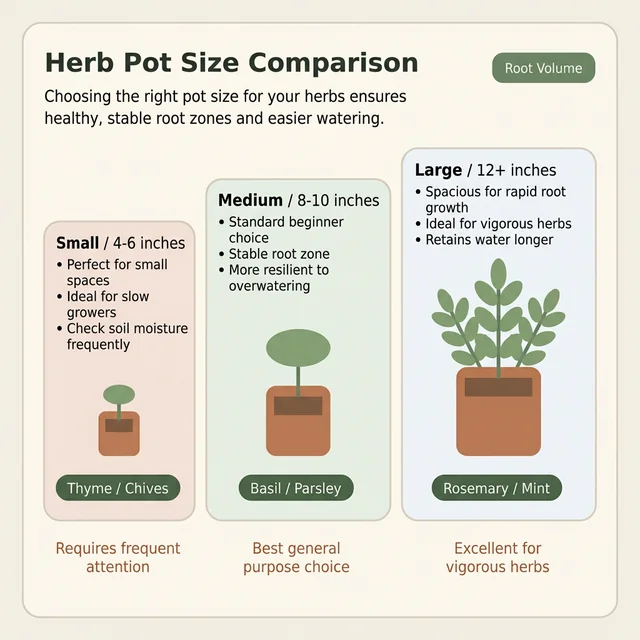
Container depth for tomatoes, peppers, and herbs: how much root space matters
Container size is one of the highest-leverage decisions in small-space gardening. When root volume is too small, every other care task becomes harder.