Container depth is not just a sizing question. It affects how quickly the root zone dries, how often nutrients need to be replenished, and how stable the plant feels during weather swings.
Use container volume as the primary planning number and depth as a constraint. A narrow, deep vessel and a broad container can share a depth while holding very different amounts of mix. Drainage holes, cultivar size, climate, and the number of plants also change the result.
| Crop | Practical starting volume per plant | Depth check | Important qualifier |
|---|---|---|---|
| Determinate tomato | At least 5 gal (19 L) | About 12 in (30 cm) or more | Larger cultivars and hot sites benefit from more buffer |
| Indeterminate tomato | Around 10 gal (38 L) or more | About 14–18 in (36–46 cm) | Requires a support anchored independently of weak plastic |
| Bell or chilli pepper | Roughly 2–5 gal (8–19 L) | About 10–14 in (25–36 cm) | Large-fruited plants are steadier toward the upper end |
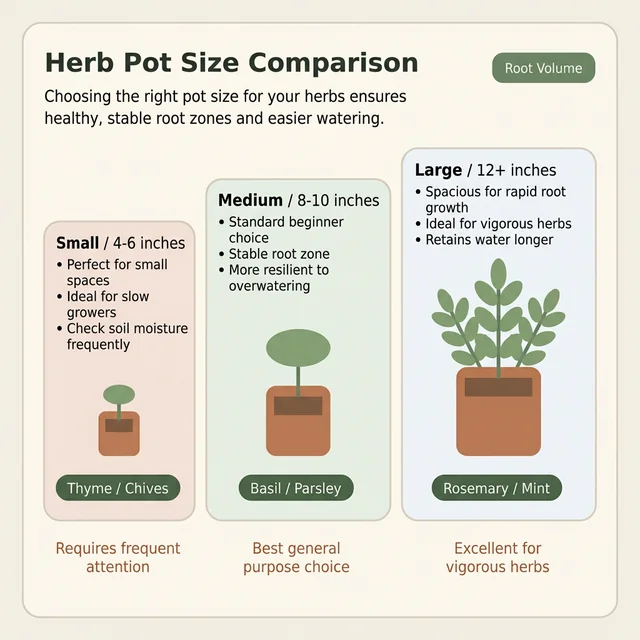
| Annual culinary herb | Often 1–2 gal (4–8 L) | Commonly 8–10 in (20–25 cm) | One mature plant; parsley and dill value depth |
| Large perennial herb | Often 3–5 gal (11–19 L) | Commonly 10–14 in (25–36 cm) | Mature rosemary and mint need different moisture management |
These are planning ranges, not guarantees. University of Georgia Extension lists at least 5 gallons for determinate tomatoes, 10 gallons for indeterminate tomatoes, 2–3 gallons for bell peppers, and 1 gallon for annual herbs. Choose upward when sun, wind, or missed watering makes stability important.
Tomatoes need buffering capacity
Tomatoes are heavy drinkers with large root demand. A small pot can force constant stress cycles: fast drying, inconsistent nutrient access, blossom issues, and reduced vigor. Even compact tomato varieties usually benefit from more root volume than beginners expect.
Do not put several full-size tomato plants into one container merely because their stems fit at planting. Competition appears later, when canopy and fruit load are largest. Dwarf or patio cultivars can be easier, but their seed or plant label still sets the final spacing and support requirement.
Peppers are slightly more forgiving, but not by much
Peppers stay tidier than tomatoes, yet they still perform better when the container can buffer water and nutrient swings. A cramped container often leads to stalled growth followed by erratic fruit set.
A deeper pot does not compensate for a tiny total volume. Prefer a stable container that cannot overturn when the fruit and support shift its centre of gravity. Dark containers in intense sun can also heat the outer root zone, so shade the pot or use a light-coloured outer cover without blocking drainage.
Herbs can stay smaller, but consistency still matters
Basil, parsley, oregano, and chives can do well in moderately sized pots, especially when they are harvested regularly. The mistake is assuming that because herbs are smaller, tiny containers are optimal. They are usually only easier for the first week.
Match the container to growth habit. Parsley and dill develop deeper roots; mint spreads laterally and is easier to control alone; rosemary can become a substantial woody plant. A mixed herb pot must satisfy the most demanding plant while keeping compatible watering needs. Use the detailed herb pot size guide for crop-level decisions.
Drainage and headspace are part of usable depth
Do not count an undrained false bottom or a deep reservoir as root volume. Leave headspace at the rim so the pot can receive a slow, thorough watering without overflowing immediately. Avoid a gravel “drainage layer”: the container needs an open exit and a structurally suitable mix, not stones occupying root space.
Before planting, place the empty pot in its final position, add the support system, and confirm that runoff can be managed. A mature 10-gallon container is difficult to move safely once wet.
Know when the container is too small
One symptom is not enough. Look for a combination:
- the pot becomes light again shortly after a thorough watering;
- roots circle densely or emerge from several drainage holes;
- growth stalls despite adequate light, temperature, and nutrition;
- the plant repeatedly wilts while neighbouring, larger containers remain stable;
- the pot or support becomes physically unstable.
Repot before severe heat if possible. Move to a modestly larger, draining container, preserve healthy roots, water the new mix evenly, and reassess feeding rather than stacking fertilizer on a stressed root ball.
Think in mature plant terms
Choose containers for the size of the crop at harvest, not for the size of the transplant today. That single change makes watering easier and gives you more margin when weather turns hot or windy.
For growers deciding what balcony crops make sense before buying planters, best vegetables for small balconies is the better planning companion.
Related Guides
Sources and further reading
If this topic is relevant to you, also read:
Use these related guides to move into setup decisions, troubleshooting, or the next logical beginner step.
Common questions
Can tomatoes grow in shallow containers?
They can survive, but shallow containers make moisture swings and nutrient stress much more likely, especially in warm weather.
Do herbs need deep containers too?
Many herbs are more flexible than tomatoes or peppers, but they still perform better when the pot is large enough to buffer drying and root crowding.