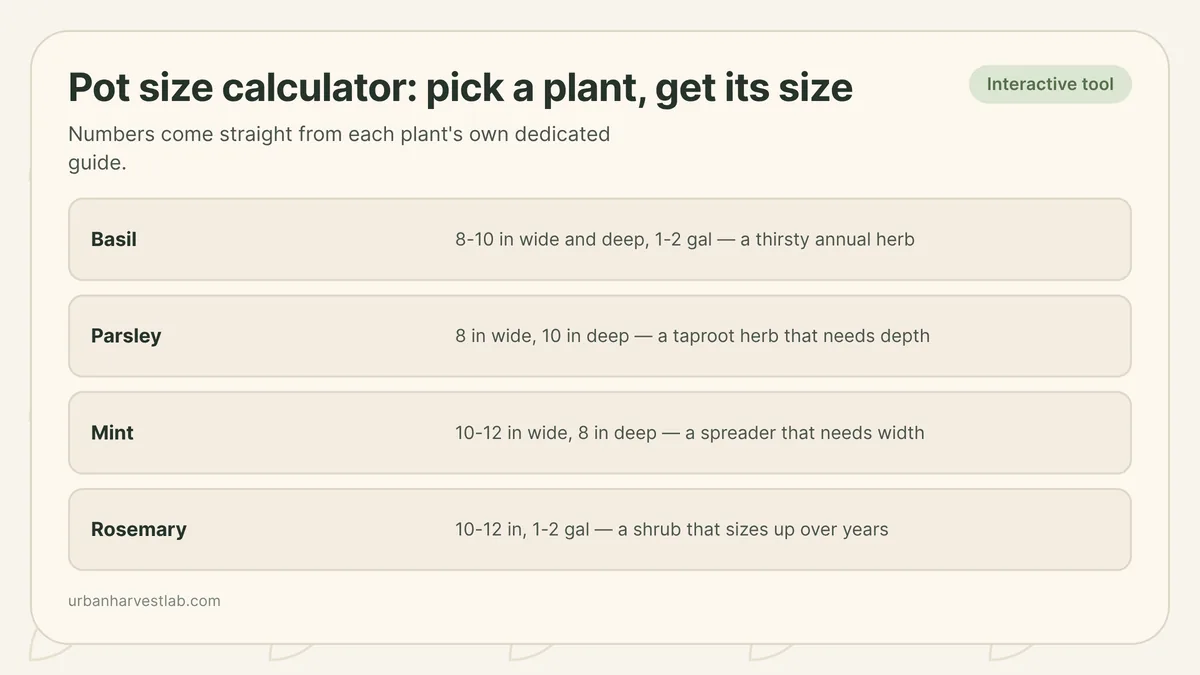
Established-stage figures at a glance
| Plant | Established-stage size | Source page |
|---|---|---|
| Basil | 8-10 in wide and deep, 1-2 gal | Basil pot size |
| Chives | 6-8 in wide and deep | Chives pot size |
| Cilantro | 8 in wide, 10 in deep | Cilantro pot size |
| Mint | 10-12 in wide, 8 in deep | Mint pot size |
| Parsley | 8 in wide, 10 in deep | Parsley pot size |
| Pepper | 10-14 in deep (site planning range), 2-5 gal (~10 gal by source) | Pepper pot size |
| Rosemary | 10-12 in, 1-2 gal (established) | Rosemary pot size |
| Thyme | 8 in wide, 6 in deep | Thyme pot size |
Pick a plant and a growth stage below to get the pot diameter, depth, and volume that plant’s own dedicated guide on this site already recommends — not a separate estimate. If you want every herb compared side by side, the herb pot size chart is the faster read; picking one plant here is for the moment you already know what is going into the pot today, and want the number without scanning a chart for it.
Get your plant’s size
Live estimate
Numbers come straight from that plant's own dedicated pot-size guide on this site — nothing here is averaged or recalculated.
Why the figures change by stage, not just by plant
Most of the eight pages behind this picker split into two sizes: a workable minimum for a plant that is just getting established, and an ideal figure for one that has filled out and is cropping steadily. Basil is the clearest case — a 6-inch pot keeps a plant alive but means watering it close to daily, while 8 to 10 inches and 1 to 2 gallons of mix is where it stops fighting the container and starts producing. That progression matches University of Georgia Fulton County Extension’s framing of basil as an annual herb that grows fast and drinks accordingly. Chives, mint, and thyme follow the same minimum-to-ideal shape at smaller numbers, because none of them carries basil’s water demand.
Rosemary breaks that two-stage pattern because it is a shrub on a multi-year clock rather than an annual that reaches a size and stops. Its dedicated guide gives three stages instead of two: a young plant, an established plant sized up to 1 to 2 gallons, and a mature woody shrub that eventually wants 2 to 3 gallons or more. Pepper sits at the other extreme: its own page gives one figure for a full-season plant rather than a staged schedule, because Texas A&M AgriLife Extension and North Carolina A&T’s cooperative extension both name roughly 5 gallons for one plant without splitting that figure by age. Picking “one full-season plant” for pepper matches what that page’s own sources actually measured.
Depth versus width is not the same question twice
The two plants that most often get sized wrong are the ones where depth and width pull in different directions. Parsley and cilantro both grow a taproot, so depth is the number that matters — a wide, shallow pot looks generous but stalls the root and can push cilantro toward early bolting. Mint runs the opposite way: it spreads by surface runners, so width buys it room while the extra inches of depth in a tall pot mostly go unused. Thyme is shallower still, wanting more width than depth because its roots stay in the top few inches, and a deep pot mostly holds a damp layer that those shallow roots rarely reach.
That is also why the calculator reports only the numbers a plant’s own page actually states. Cilantro and parsley do not show a volume figure at either stage, because neither dedicated page converts its inches into gallons.
The manual method, without picking a single plant
If you would rather work from a general rule than a picker, two extension services publish tiered guidance for culinary herbs as a group:
| Herb group | Container size | Source |
|---|---|---|
| Smaller herbs — basil, cilantro, thyme, mint, oregano, tarragon, marjoram | 2 to 5 gallons | University of Maryland Extension |
| Larger herbs — rosemary, bay leaf, sage, parsley, lavender, dill, fennel | 5 gallons or more | University of Maryland Extension |
| Annual herbs — basil, dill, cilantro, savory | 1 gallon | University of Georgia Fulton County Extension |
| Perennial herbs — sage, rosemary, lavender, mint | 5 gallons | University of Georgia Fulton County Extension |
The two services do not fully agree with each other. Dill is the clearest case: University of Georgia’s Fulton County Extension puts it in the 1-gallon annual bucket, while University of Maryland Extension lists dill in the same 5-gallon-or-more bucket as parsley, rosemary and fennel. Parsley itself shows the same split: Texas A&M gives a 1-gallon pot for three plants and a general 6-to-10-inch range, while Maryland’s 5-gallon-or-more tier sits well above that — a roughly fifteen-fold gap for the same herb. Basil, cilantro, thyme and mint show a smaller version of the same pattern: the per-plant figures this picker returns for their established stage all sit well under Maryland’s 2-to-5-gallon “smaller herbs” tier. Neither figure is wrong; they reflect different judgment calls about how much room “enough” means, and naming both is more useful than picking the one that looks tidier.
These general tiers are the reasonable fallback for a herb that does not have its own dedicated page yet. They will not tell you whether your specific plant wants depth or width the way the pages above do, but they keep you in the right order of magnitude rather than guessing a number cold.
Vegetables and root crops follow a different logic entirely
Everything above covers culinary herbs. Fruiting and vining vegetables sit on a different scale entirely: tomato, cucumber, and zucchini all run from 5 gallons up past 15 depending on growth habit, while strawberries and potatoes in grow bags have their own sizing logic again. Shallow, quick crops — lettuce, spinach, and green onion — stay small but want width over depth. Root crops are their own case again: a carrot’s container depth depends on the variety’s mature root length rather than a fixed number, which is covered separately in carrot container depth rather than folded into a herb-shaped answer here.
Turning a diameter into a volume, if you already own the pot
Sometimes the question runs backward: you already have a pot and want to know roughly how many gallons it holds. For a straight-sided round container, University of Illinois Extension publishes a conversion that is close enough for planning purposes:
| Diameter | Approximate volume |
|---|---|
| 10 in (25 cm) | ~3 gal |
| 12 in (30 cm) | ~5 gal |
| 14 in (36 cm) | ~7 gal |
| 16 in (41 cm) | ~10 gal |
| 18 in (46 cm) | ~15 gal |
| 24 in (61 cm) | ~25 gal |
| 30 in (76 cm) | ~30 gal |
This table models round pots with straight sides. A tapered pot, a square planter, or a trough will not match it exactly, because the same rim diameter can enclose noticeably different amounts of soil depending on how the walls slope and how deep the container actually is. Use it to translate a diameter you already own into an approximate volume, not to design a container from scratch.
Sizing up without overshooting
Bigger is not automatically safer. A container well beyond what a plant currently needs holds wet soil for far longer between waterings, and for Mediterranean herbs like rosemary and thyme that extra moisture around a small root ball causes rot before it causes any growth benefit. The better move for these plants is sizing up one step at a time as roots actually fill the current pot, covered in how to repot herbs without slowing growth. Thirstier herbs like basil and mint are more forgiving of extra volume, provided the pot still drains and the material does not trap moisture past what the plant can use.
Sources
Pot size, beyond the calculator
The full herb chart, the depth-versus-volume breakdown for fruiting crops, and one herb's dedicated page for the deeper reasoning.
Common questions
What does the pot size calculator use for its numbers?
Each plant's figure comes from that plant's own dedicated pot-size guide on this site, not a separate calculation. Basil, chives, cilantro, mint, parsley, pepper, rosemary, and thyme are covered so far, each sourced to the extension research behind its own page.
Why does pepper show a volume but no separate width figure?
The 10 to 14 inch depth is this site's own container-depth planning range, not an extension figure; no source in that comparison publishes a pepper depth on its own. The volume, roughly 5 gallons with sources ranging from 2 to 10, is pepper's own guide.
My herb is not in the list. What size should I use?
Start with the general tiers extension services publish: University of Maryland Extension groups basil, cilantro, thyme, mint, oregano, tarragon and marjoram as smaller herbs needing 2 to 5 gallons, and rosemary, bay leaf, sage, parsley, lavender, dill and fennel as larger herbs needing 5 gallons or more. Use whichever tier matches your herb's growth habit until a dedicated page covers it.
Is a bigger pot better than the calculator's figure?
Usually not. Going bigger than a plant needs mostly means more soil holding water for longer between waterings, which suits thirsty herbs like basil but works against rosemary and thyme, which rot faster in a large volume of slow-drying mix around a small root ball.
Related guides
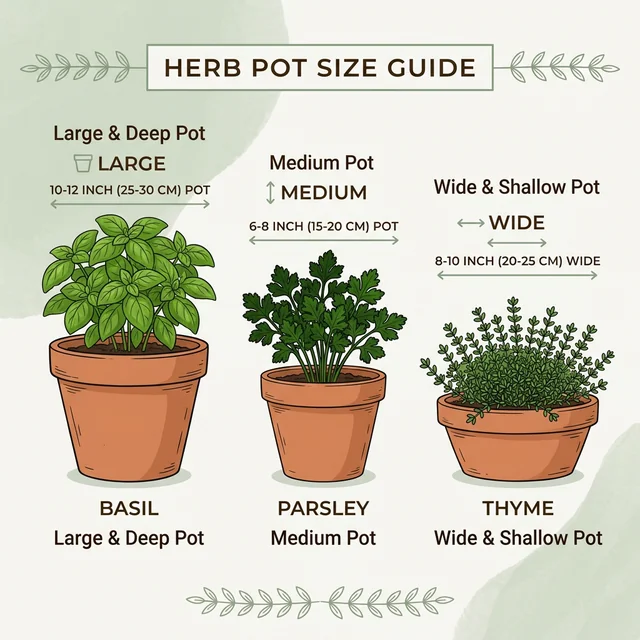
Herb pot size chart: basil, mint, parsley, thyme & chives
A practical herb pot size guide for the most common kitchen herbs, with simple size ranges that make container growing easier to read and maintain.
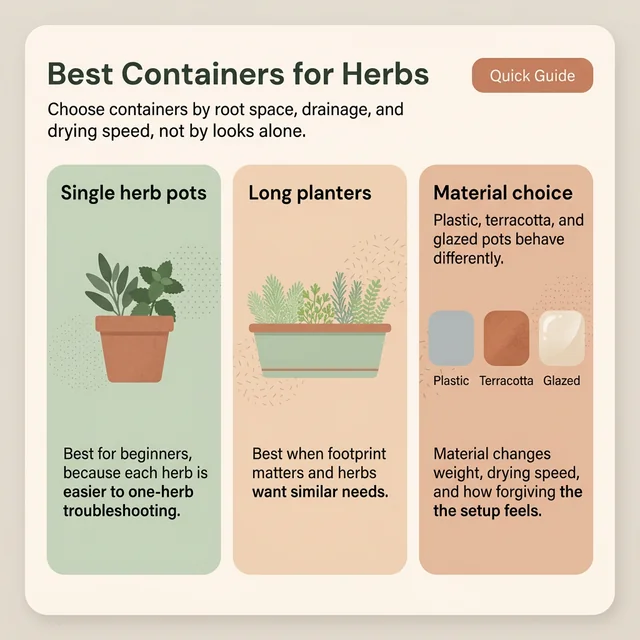
Best containers for herbs: drainage, pot size, and materials that work
A practical guide to herb containers that explains which pots work best, why drainage matters, and how material changes the way containers dry.
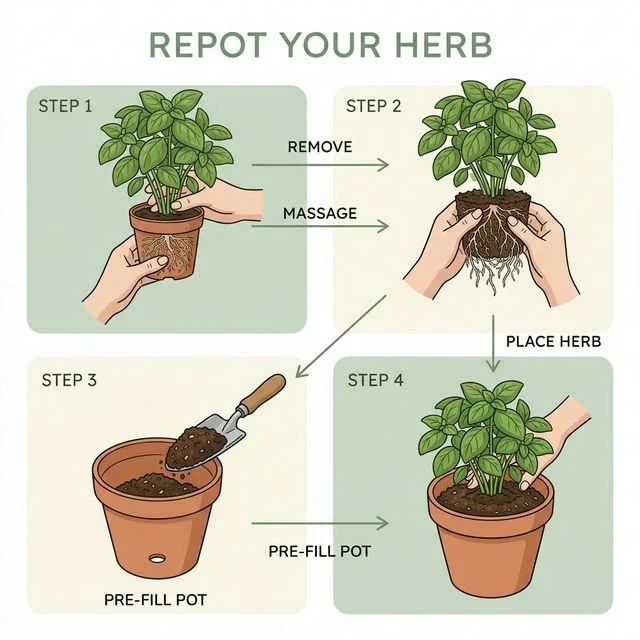
How to repot herbs without slowing growth
Moving an herb to a bigger pot should trigger a massive growth spurt. If your plants wilt and drop leaves after repotting, you are suffering from transplant shock. Here is how to upgrade your container without stressing the roots.