Root-injury temperatures published by extension services (medium temperature, °F)
| Plant | Temperature | Table and meaning |
|---|---|---|
| Saucer magnolia | 23 | Rutgers Table 1: killed more than 50% of roots |
| Flowering dogwood | 20 | Rutgers Table 1: killed more than 50% of roots |
| Common boxwood | 15 | Rutgers Table 1: killed more than 50% of roots |
| Catawba rhododendron | -10 | Rutgers Table 1: killed more than 50% of roots |
| Rosemary (cultivar Arp) | 12 | Rutgers Table 2: significant injury, unsalable regrowth |
| Hybrid sage (Stratford Blue) | 10 | Rutgers Table 2: significant injury, unsalable regrowth |
| Bee balm (Marshall's Delight) | 8 | Rutgers Table 2: significant injury, unsalable regrowth |
| Houttuynia (Chameleon) | 28 | Rutgers Table 2: significant injury, unsalable regrowth |
Roots are injured by cold at temperatures well above what the stems of the same plant tolerate, and a pot sitting above ground lets the root ball chill to near the air temperature. Extension services have measured the injury point for a limited set of species, and it runs from the mid-20s °F for tender plants to below zero for the toughest conifers and shrubs. For the shelter and plant-choice side, see overwintering perennials in pots. The numbers behind that advice are below.
Why the plant tag does not cover the roots
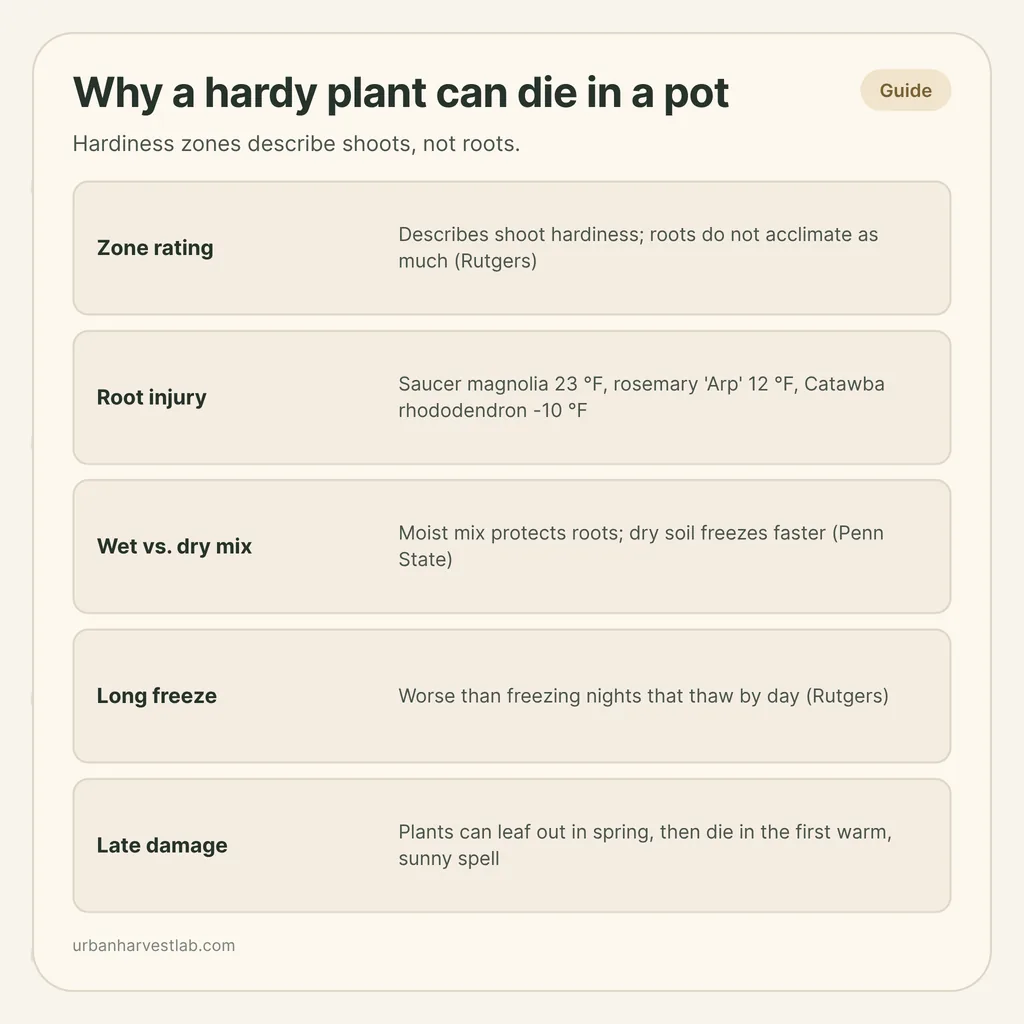
A hardiness zone describes how cold the shoots can get. Kentucky Extension puts the contrast bluntly: the USDA zone map describes shoot hardiness, while roots “rarely, if ever, will survive temperatures below -10F,” so root hardiness should be the main concern when deciding how to overwinter. Rutgers adds the mechanism: colder temperatures slow or stop root growth, but roots do not acclimate to the same extent as shoots, and day length does not seem to affect root hardiness at all.
In the ground, soil mass does the protecting. Iowa State Extension says roots of container plants are far less cold-hardy than their aboveground parts, and that the potting mix in a pot left above ground may drop into the single digits, partly because of the small soil volume. Penn State Extension says the same thing in one line: roots of above-ground container plants can be the same temperature as the winter air.
That is the main reason a plant rated for your zone can die in a pot. The rating assumed roots in the ground.
Root-injury temperatures from the tables
Two Rutgers tables are the clearest numbers for gardeners. They measure different things, so do not mix them.
In Rutgers’ Table 1, for woody plants, the value is the highest temperature that killed more than 50% of the root system and reduced top growth. Saucer magnolia sits at 23 °F, flowering dogwood and American holly at 20 °F, common boxwood at 15 °F, creeping juniper at 0 °F, and Catawba rhododendron and white spruce at -10 °F. Rutgers’ Table 2, for container-grown herbaceous perennials, gives the growing-medium temperature causing significant injury, defined as unsalable plants or unacceptable regrowth. There, a rosemary cultivar (‘Arp’) is at 12 °F, a hybrid sage (‘Stratford Blue’) at 10 °F, bee balm (‘Marshall’s Delight’) at 8 °F, daylily (‘Joan Senior’) at 15 °F, and the ornamental Houttuynia ‘Chameleon’ at 28 °F. Sedum ‘Autumn Joy’ is listed at -11 °F, and a hibiscus hybrid at above 38 °F.
Three cautions apply to every figure above.
- The figures are cultivar-specific. Rutgers lists one rosemary cultivar, not rosemary in general, and one sage hybrid, not every sage. Kentucky warns that such tables can be valid only for the plants tested, because plants from different seed or cutting origins vary in hardiness.
- Different tables use different cut-offs. Kentucky’s own table lists temperatures that injure primary and possibly secondary roots but “will not result in 100% kill of the root systems in moist soils.” Rutgers’ woody table counts injury as more than half the roots killed. A number from one table is not an equal of a number from the other.
- The research was done on nursery stock. Rutgers notes that, as a group, herbaceous perennials do not show the same hardiness as woody plants. Kentucky says all the known research on root hardiness was done with container stock, and its figures may not be exact for other situations, so treat the figures as a guide to which plants are vulnerable, not as an exact threshold for yours.
What actually damages the roots
Cold alone is not the whole story, and Rutgers lists several things that change the outcome.
Which roots freeze first. Young roots sit mostly at the outside edge of a container, so they freeze first. Kentucky found mature roots were 5 to 10 °F hardier than young roots, and says young roots of some plants do not seem able to acclimate at all. Losing young roots, Rutgers says, can mean little to some reduction in spring growth, and regeneration may be quick. Survival of the secondary roots is what decides whether the plant lives.
How long it stays frozen. Rutgers says an extended period of sub-freezing weather has greater potential for root damage than freezing nights alternating with cool, non-freezing days. A potting mix that thaws every afternoon is in better shape than one that stays frozen for a week.
How wet the mix is. Water protects the root ball because freezing it gives up heat. Rutgers explains that the medium holds at about 28 to 32 °F while it freezes, then drops to near the air temperature once the water has frozen. A dry pot has less of that buffer: Penn State Extension notes that dry soil freezes faster than moist soil, and Rutgers calls adequate media moisture the single most important factor in reducing root damage. Water before the soil freezes and check the pot through winter, without soaking it.
When the damage shows. This is the part that fools people. Rutgers reports that plants with significant damage to secondary roots will often appear to grow normally in spring, then die quickly in the first period of elevated temperature, high sunlight and low humidity. A plant that leafs out in April is not necessarily safe in June.
Reading the numbers for your own pots
Match the species to the table when you can, and treat a species that is not listed as an unknown, not as a hardy one. The tables above include only a handful of edible or herb plants, and the cultivar caveat applies to every one. Only then think about the air temperature, because the root ball in a small pot follows the air closely and the table temperatures describe the medium, not the air.
Penn State Extension’s practical advice is to go two zones colder with containerized plants, use larger pots because they insulate more, and provide some protection. The full version of that rule, with worked examples for herbs and fruit, is in overwintering perennials in pots.
Insulation is cheaper than replacement. Iowa State Extension says soil is a good insulator, and describes burying the pots in a garden bed with 6 to 12 inches of straw, pine needles or other loose mulch over them. Penn State Extension adds grouping pots together under straw or a thermal blanket, or boxing a pot in a larger container lined with bark mulch, straw, packing peanuts or bubble wrap. If you only need to wrap a few pots, you can browse bubble wrap rolls on Amazon for the lining.
Two neighbouring problems are separate pages. A pot made of clay or ceramic can crack when its contents freeze, whatever the plant: see why terracotta pots crack in winter. If a freeze is forecast tonight and your pots are still outside, go to emergency cold-snap protection for container plants.
Sources
Getting potted plants through winter
Where to go once you know how vulnerable the roots are.
Common questions
How cold can plants in pots survive?
It depends on the species. Rutgers lists the medium temperature at which roots are injured at 23 °F for saucer magnolia, 20 °F for flowering dogwood, 12 °F for a rosemary cultivar, and -10 °F for Catawba rhododendron. Kentucky Extension says roots rarely, if ever, survive below -10 °F in any species.
Why did my hardy plant die in a pot but live in the ground?
Hardiness zones describe how well the above-ground parts handle cold. Iowa State Extension says roots are far less cold-hardy than aboveground parts, and a pot above ground lets the potting mix drop towards air temperature, which Rutgers says happens once the water in the mix has frozen.
Does wet or dry potting mix freeze roots faster?
Dry mix. Penn State Extension notes that dry soil freezes faster than moist soil, and Rutgers calls adequate media moisture the single most important factor in reducing root damage. Water is not a license to flood the pot; Penn State also warns that overwatering risks root rot.
Will a damaged plant show it right away?
Often not. Rutgers describes plants with significant secondary-root damage that appear to grow normally in spring, then die quickly in the first warm, sunny, low-humidity spell.
Related guides
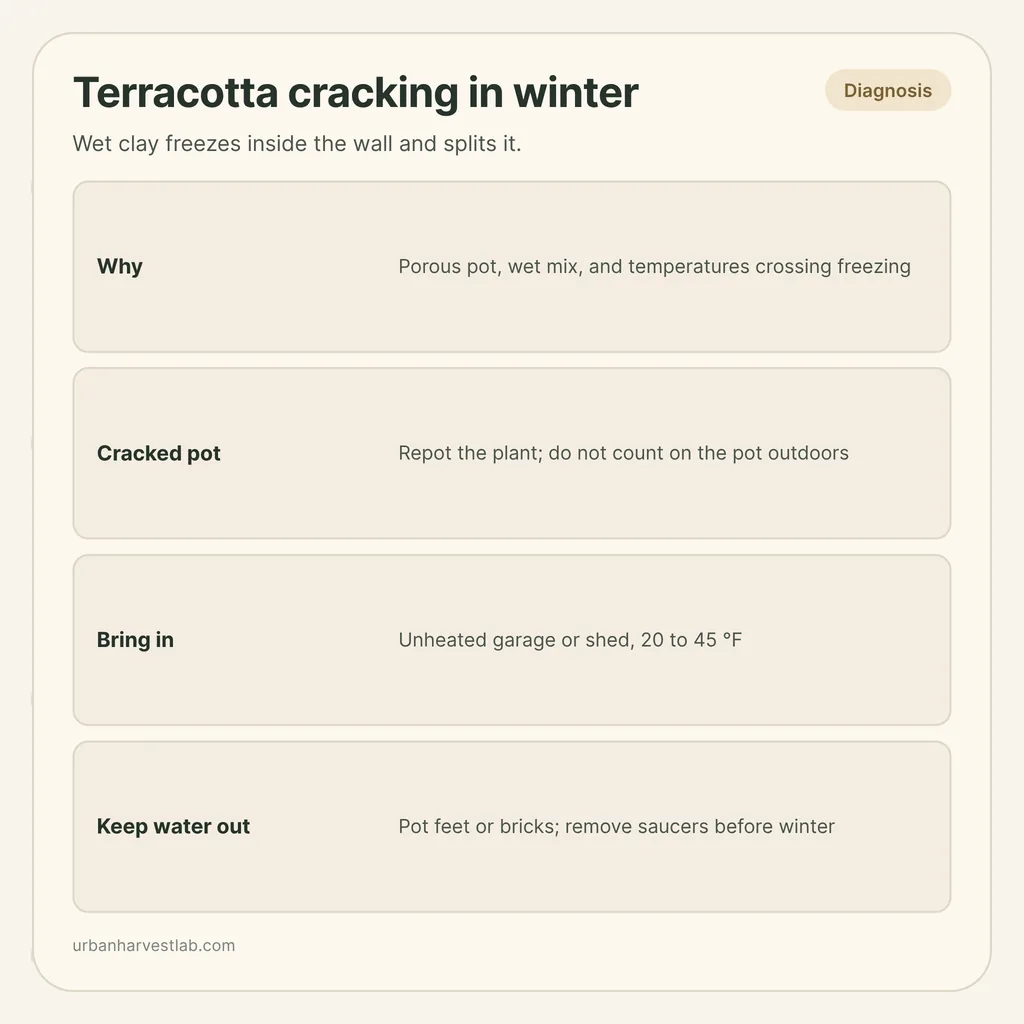
Terracotta pots cracking in winter: why it happens and what to do
A pot that was fine in October splits in January. The cause is water inside the clay, and the fix is keeping that water out or moving the pot somewhere it cannot freeze.
Best containers for herbs: drainage, pot size, and materials that work
A practical guide to herb containers that explains which pots work best, why drainage matters, and how material changes the way containers dry.
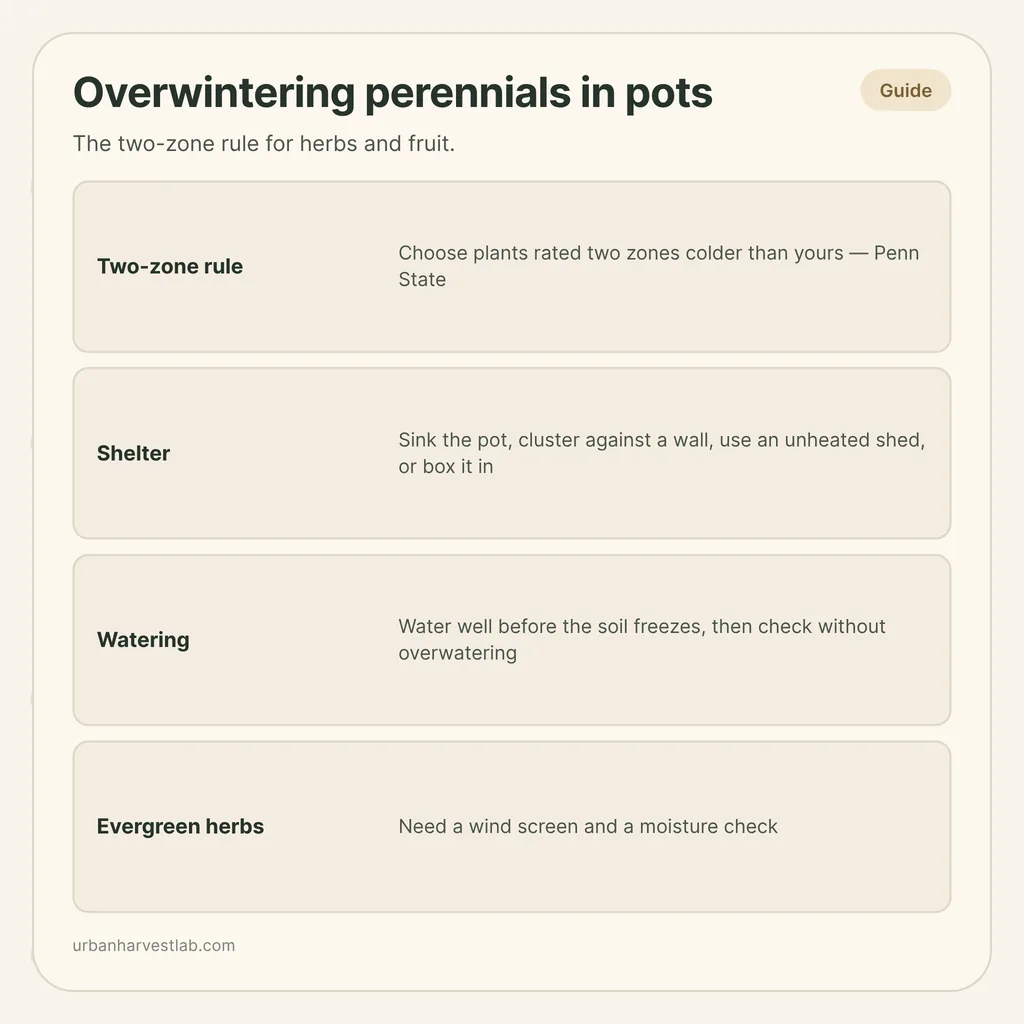
Overwintering perennials in pots: the two-zone rule for herbs and fruit
The hardiness zone on a plant tag assumes the roots are in the ground. In a pot they are not, so the rule, the shelter and the winter watering all change.