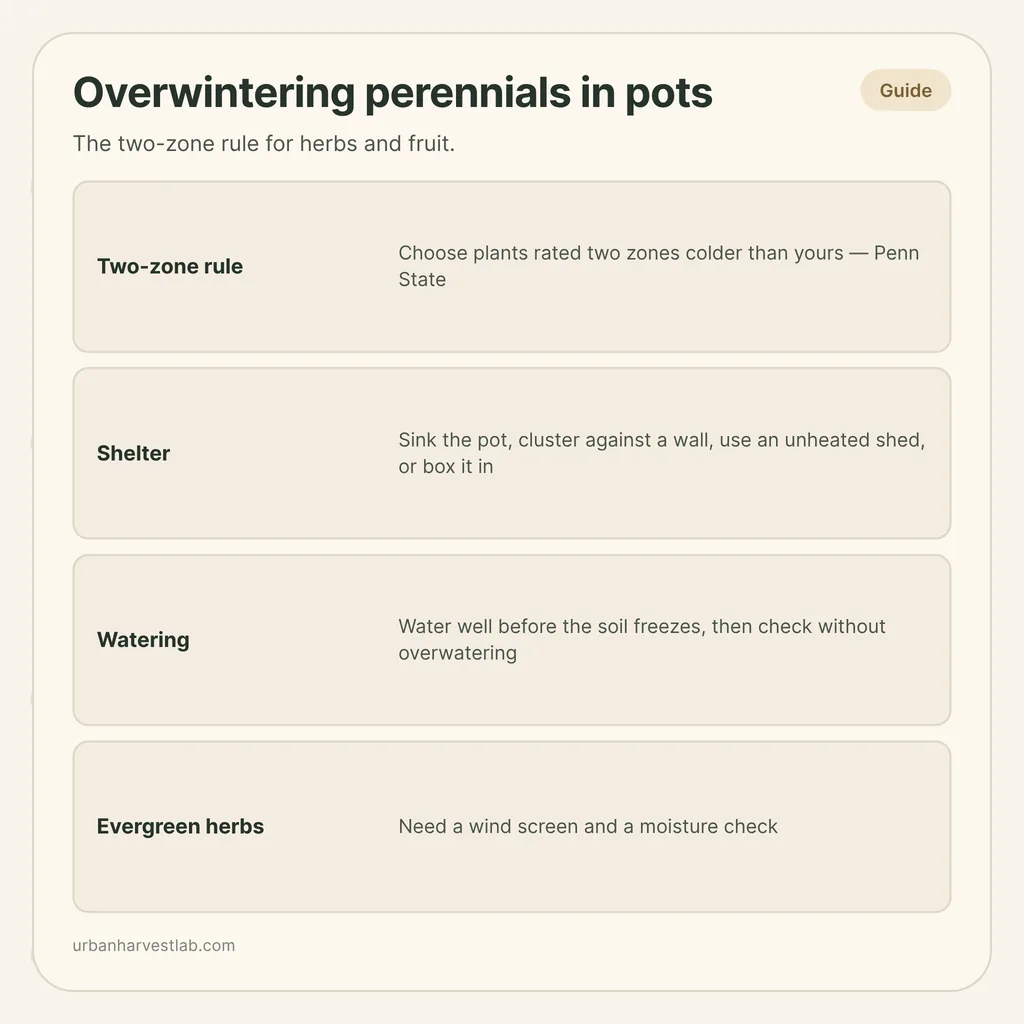
Four ways to protect a potted perennial outdoors
| Method | What it does | Source and detail |
|---|---|---|
| Sink the pot into soil | Surrounding soil insulates the root ball and evens out freeze-thaw swings | Iowa State and Colorado State: mulch over it 6 to 12 inches deep |
| Cluster pots against a wall | Pots shelter each other; mulch over and around the group | Colorado State: largest pots outside, smaller inside, north or east side |
| Unheated garage or shed | Keeps the mix from deep freezing while the plant stays dormant | Illinois: 20 to 45 F. New Hampshire: 30 to 40 F |
| Box or wire cage lined with insulation | Adds a layer around one or a few pots where nothing else is possible | Penn State: bark mulch, straw, packing peanuts or bubble wrap |
A perennial in a pot is less hardy than the tag says, because the tag assumes the roots are in the ground. Pick plants rated two USDA zones colder than yours, then shelter the pot, mulch it and check its moisture all winter. That covers mint, chives, oregano, sage, strawberries, rhubarb, raspberries and most other perennial edibles on a balcony or patio.
If you are not sure of your zone, the frost dates guide for balconies shows how to find it.
Why the label stops applying in a pot
Illinois Extension puts it plainly: most plants’ roots are far less cold-hardy than their above-ground parts, and in a landscape the soil insulates them. A pot holds a small volume of mix that gets much colder than the ground does.
Rutgers Cooperative Extension describes what happens as a pot freezes. The mix stays between 28 and 32 degrees Fahrenheit while its water turns to ice. After that, its temperature drops to near the air temperature. A pot that has been freezing for a long stretch is giving the roots no buffer at all.
Iowa State Extension gives the number that matters: the mix in a container left above ground can drop into the single digits, and single-digit temperatures may damage or destroy root systems. Rutgers adds that herbaceous perennials in general are less hardy than woody plants, which is why a potted mint or sage is not safer than a potted shrub.
University of New Hampshire Extension makes a further point: even a perennial hardy in your zone faces harsher conditions in a pot, and heaving, where freezing and thawing push roots upward, can break them up.
The two-zone rule, worked through
Penn State Extension says to go two zones colder with containerised plants, use larger pots for more insulation, and provide some protection. Illinois Extension gives the same rule with an example: central Illinois is zone 5 or 6, so there it suggests a plant hardy to zone 3 or 4.
Read it as a shopping rule and as a warning:
- Shopping. This is an inference, not a published rule: a plant rated two zones colder than yours still needs the protection Penn State recommends; one rated only to your own zone needs more of it; anything rated warmer than your zone is safer indoors.
- Pot size. Illinois Extension says large containers protect roots better than small ones. A big pot also dries out more slowly, which helps in winter.
- Where the pot sits. Illinois Extension says pots on the ground are better protected than pots up on a deck, and it advises avoiding spots with prevailing winds.
Iowa State disagrees with the others on one point. It says container-grown plants should not be left outdoors above ground over winter at all. Penn State, Illinois and Colorado State describe above-ground methods that work with enough shelter. The practical reading is to treat the open railing as the worst place and a bare, exposed pot in a hard-winter climate as a gamble.
Each plant’s own page has its own cold limit. The guides to rhubarb, raspberries, figs, bay laurel and tarragon cover those.
Choose the shelter your space allows
Sinking the pot. This is the method Iowa State calls one of the most reliable for home gardeners. Set the pots in a garden bed after the plants go dormant but before the soil freezes, and backfill soil around them. Illinois Extension says to remove the pots once the danger of a hard frost has passed. University of New Hampshire Extension sinks them level with the surrounding ground. A flat with no soil cannot do this, but a shared garden or a friend’s bed can.
Clustering against a wall. Colorado State suggests a spot under the eaves on the north or east side of the house. Put the larger pots on the outside of the group and the smaller ones inside. Illinois Extension also recommends a spot without strong wind or too much sun. The Royal Horticultural Society says grouping containers close together near a house wall helps protect the roots from the cold. Penn State covers the group with straw, bark mulch, shredded leaves, evergreen boughs or a thermal blanket. For mulch choices and depth, see mulching container plants.
An unheated garage or shed. Illinois Extension says storing pots there is the most common way to overwinter potted perennials. Its range is 20 to 45 degrees Fahrenheit, since many perennials need a cold dormancy, and a warmer space should be ruled out. University of New Hampshire Extension gives 30 to 40 degrees. Colorado State adds that you should check the moisture frequently.
An insulated box or cage. For one or a few pots, Penn State describes a wire enclosure lined with an insulating material, such as bark mulch, straw, packing peanuts, or even bubble wrap. It is the option for a balcony with no ground and no shed.
Mulch details. Colorado State and Iowa State both give 6 to 12 inches of mulch over sunk or buried pots. Iowa State says to avoid leaves because they compact and can smother plants, while Colorado State lists leaves among its mulch options. Straw is on both lists. Iowa State puts the straw layer on once plants are dormant. For an additional organic mulch, it waits until the top layer of soil has begun to freeze, because mulching too soon may delay freezing and encourage heaving.
Check the pot itself. Penn State says clay, ceramic and glazed pots should not be left exposed since they may crack, and suggests bubble wrap or other insulation if they must stay out. Pots cracking in winter explains the mechanism and what to do with a cracked pot. The RHS also advises removing saucers in winter.
Winter watering
Water is part of the insulation. Illinois Extension says moist mix freezes more slowly than dry mix, and Penn State agrees that dry soil freezes faster than moist soil. Both advise watering well before the soil freezes.
After that, go lightly:
- While it is frozen: Iowa State says supplemental irrigation is not necessary when the soil is frozen. The RHS advises avoiding watering if frost is forecast.
- During thaws: University of New Hampshire Extension says to keep watering while the temperature is above 40 degrees. Colorado State suggests checking sunk pots monthly and an above-ground mulched cluster every two weeks, watering if needed.
- If the pot is sunk: Iowa State notes that buried pots drain less readily and likely need less water than pots above ground.
- Do not overdo it: Penn State warns that overwatering in storage can cause root rot.
Evergreens need more attention than plants that have died back. Illinois Extension notes that roots keep taking up water even after above-ground growth goes dormant, and flags evergreens for winter burn. Penn State suggests an anti-desiccant spray or a screen to block the wind. The RHS says watering is seldom necessary for deciduous or other dormant plants, but advises checking evergreens at least weekly if you have moved them under cover where no rain reaches them. Rutgers explains the risk: frozen mix combined with low humidity damages foliage through lack of water.
Coming out of winter
Remove covers gradually, as Penn State advises, so plants can reacclimate. Colorado State says to take mulch off as the weather warms in late winter to early spring, not in one go. Iowa State times sunk pots to come out when the soil thaws, typically several weeks before the last frost date, and says to protect above-ground growth from rabbits, deer and mice in the meantime.
If a hard freeze arrives before the plants are sheltered, the steps in emergency cold snap protection apply for that night. Rosemary and thyme have their own routine in overwintering rosemary and thyme. Anything tender that is not a perennial in your zone belongs on the list in bringing potted plants indoors for winter.
Sources
- Penn State Extension: Overwintering Plants in Containers
- University of Illinois Extension: Overwintering potted plants
- University of Illinois Extension: Overwintering Perennial Patio Containers
- Iowa State University Extension: Overwintering Unplanted Trees, Shrubs and Perennials
- Colorado State University Extension: Overwintering Container Plants
- University of New Hampshire Extension: How Can I Overwinter Perennials Still In Containers?
- Rutgers NJAES: Management of Container Nursery Plant Material During Cold Weather
- RHS: Container maintenance
Winter plans for potted plants
The two-zone rule decides what can stay out. These pages cover the single cold night, the pot that cracks, and the plants that are better off indoors.
Common questions
What is the two-zone rule for plants in pots?
Choose perennials rated two USDA hardiness zones colder than yours if they will stay outside in a pot. Illinois Extension gives the example of central Illinois, zone 5 or 6, where it suggests a plant hardy to zone 3 or 4. Penn State Extension gives the same advice because container roots can be the same temperature as the winter air.
Can I leave potted perennials outside all winter?
Often, with protection. Penn State Extension, Illinois Extension and Colorado State all describe ways to do it: sinking pots into soil, clustering them with mulch, or using an unheated shed. Iowa State Extension is stricter and says container-grown plants should not be left above ground at all, because the mix can fall to single-digit temperatures. In a cold climate, treat an unprotected pot on a balcony railing as the riskiest option.
Should I water potted perennials in winter?
Yes, but sparingly. Penn State Extension says to water well before the soil freezes and to check moisture through winter without overwatering. Colorado State suggests checking sunk pots monthly and a mulched cluster every two weeks. Iowa State says irrigation is not needed while the soil is frozen. University of New Hampshire Extension waters only while the temperature is above 40 degrees.
Which temperature should an unheated garage or shed stay at?
Two extensions give slightly different bands. Illinois Extension says 20 to 45 degrees Fahrenheit, because many perennials need a cold dormancy. University of New Hampshire Extension describes 30 to 40 degrees as a good range. A space that stays above those figures lets plants break dormancy too early.
Related guides

Bringing potted plants indoors for winter: what to move and what to leave
Not every pot deserves a spot on the windowsill. Here is how to decide what comes in, clear the pests, and get the plants through the light drop.
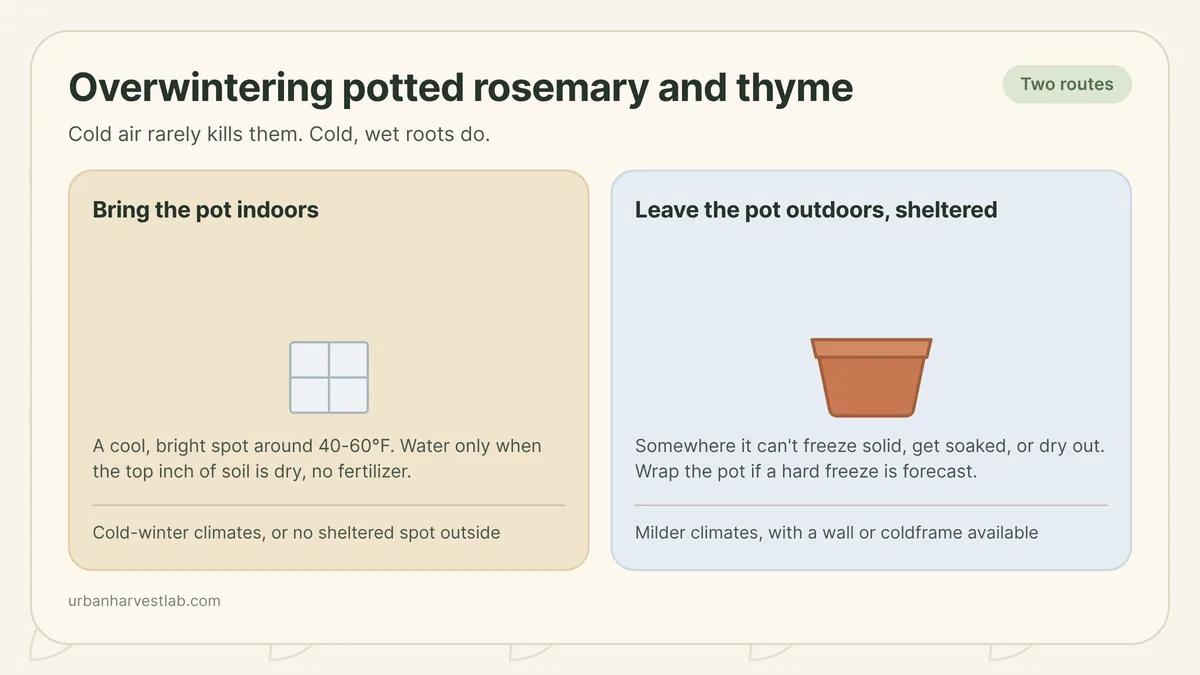
How to overwinter rosemary and thyme in pots
Winter kills more potted rosemary and thyme through mistimed watering and cold-wet roots than through cold air alone. Here is what to do indoors and out.
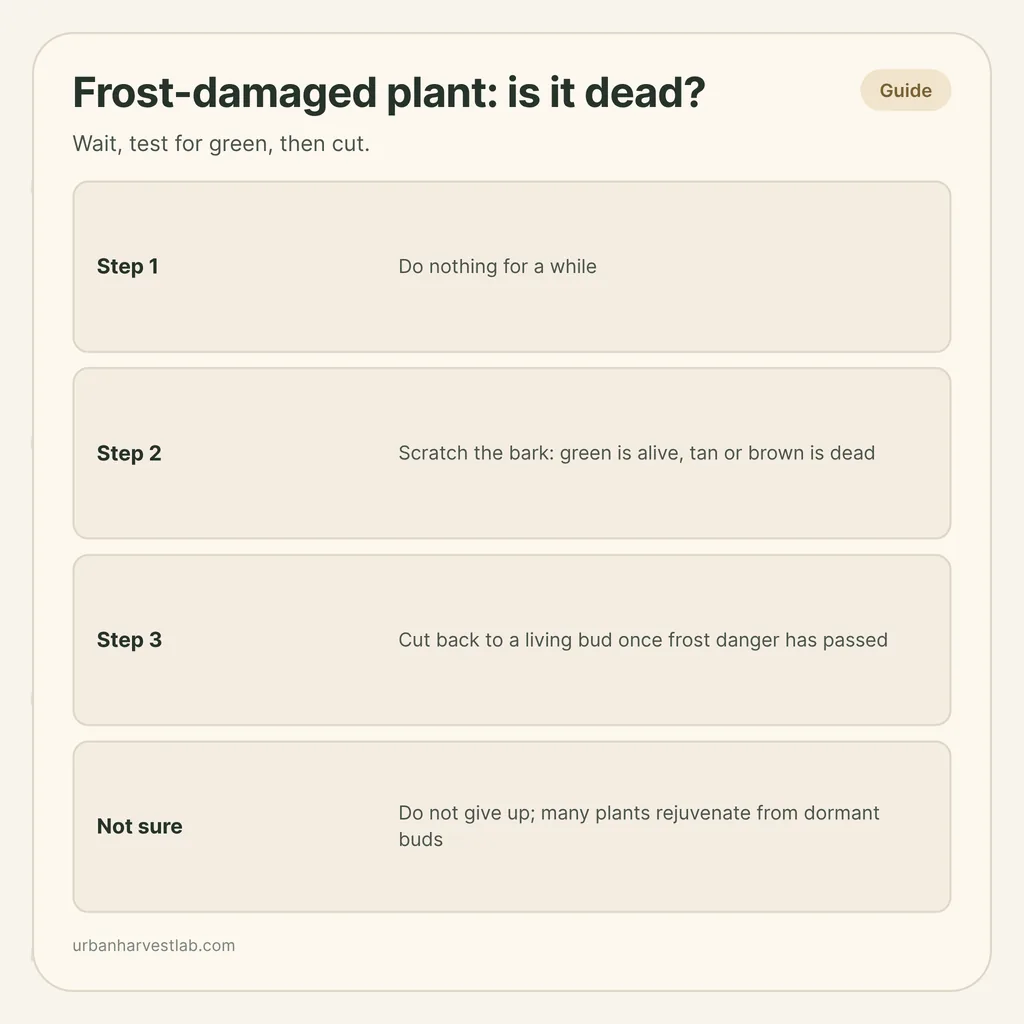
Frost-damaged container plants: is it dead, and what to cut
The morning after a frost, a potted plant can look finished and still regrow. Here is how to check, when to cut, and when to give up.