Ways to cool a black pot, from least to most effort
| Fix | What it does | Best when |
|---|---|---|
| Shade the pot wall | Stops sunlight reaching the sidewall, the main heat source | The pot sits against a rail or wall you can screen |
| Group pots closely | Pots shade each other's walls | You have several pots and foliage that will cover the gaps |
| Slip it inside a pale outer pot | Reflects light and adds an insulating air gap | You already own black nursery pots |
| Choose a lighter or fibre pot next time | Reflects more sun or conducts less heat | You are buying new containers |
| Use a larger pot | Keeps more of the root ball away from the hot wall | The plant is crowded and drying out fast |
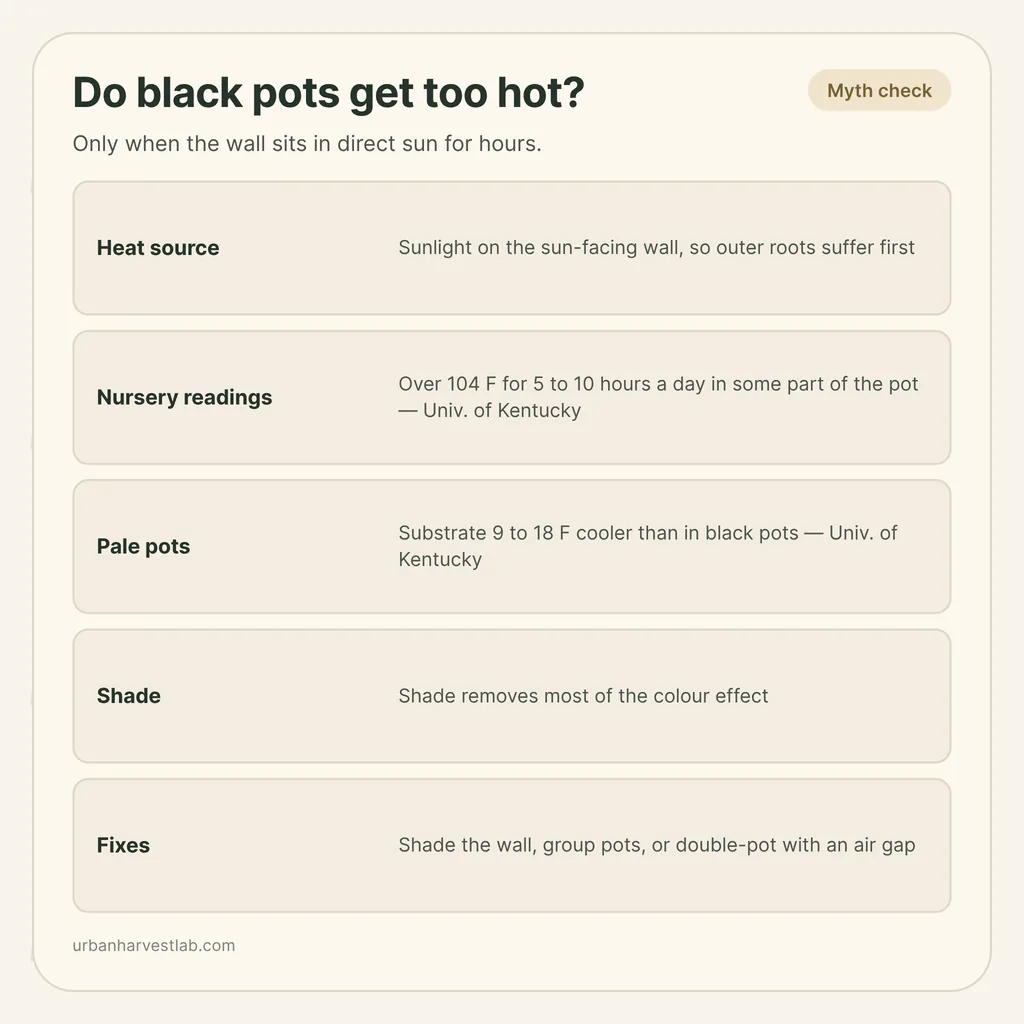
Yes, a black pot can get hot enough to hurt roots, but only when the wall sits in direct sun for hours. University of Maryland Extension warns that dark container colours can raise potting mix temperatures, potentially injuring tender roots and keeping the root system from developing fully. On a shaded balcony the colour barely matters. On a south or west-facing one in July, it can be the difference between a thriving plant and a sulking one.
If you want the wider plan for a hot spell, protecting container plants in a heatwave covers shade, watering and rescue. What follows is narrower: the pot itself, and whether its colour is worth worrying about.
How hot a container gets in the sun
The best numbers come from University of Kentucky Extension (Ingram, Ruter and Martin), which studied container nurseries. Their figures describe black nursery pots in full sun, not balcony planters, but the physics is the same: sunlight hits a thin plastic wall and warms the mix just inside it.
University of Kentucky Extension reports that root-zone temperatures for container-grown plants in full sun consistently exceed 104 F for 5 to 10 hours each day in some portion of the container. In summer, temperatures near the west wall usually exceed 120 F, and readings above 130 F have been recorded. Air temperature plays a smaller part than you would expect. Sunlight on the sidewall is the primary driver.
Those are nursery readings from the southeastern United States. Cloud cover and fewer sun hours on the wall lower the peak, but University of Kentucky Extension notes that even in northern states critically high root-zone temperatures can occur from late spring to early fall, because sun on the wall matters more than air temperature. A pot with a plant canopy shading its rim will run cooler than a bare nursery can. Treat them as what is possible, not what your pot is doing today.
What heat does to roots
Kentucky separates two kinds of damage.
Direct injury is fast. Roots exposed to a critical temperature die within minutes, and roots with direct injury do not recover. For container-grown landscape plants, University of Kentucky Extension puts that critical temperature between 113 F and 130 F after 30 minutes, depending on the species. Its table covers woody nursery plants such as hollies and maples, not tomatoes or herbs, so the exact threshold for your crop is not on it. Kentucky also says it is not aware of a critical temperature causing direct injury below 108 F, even with longer exposures.
Indirect injury is slower and easier to miss. University of Kentucky Extension notes that a 104 F root-zone temperature for 5 to 6 hours a day can impair the physiological processes of most of the woody nursery plants it studied, and that the symptoms may go unnoticed when there are no control plants for comparison. For a balcony crop the threshold is untested, but the likely sign is a plant that grows less than it should, with no obvious cause.
Because the heat enters through the wall, the outer roots suffer first. The sun-facing side of the root ball is hottest, and the hot side moves with the season: Kentucky found container root-zone temperatures peak from late August through early October, despite cool air, because the lower sun angle puts more hours of direct light on the sidewall. Roots can regrow on one side while dying on the other as the sun moves.
University of Illinois Extension gives the same warning for home gardeners: dark and metal containers absorb more heat, which heats the soil and can damage plants. Illinois also notes that in warm, dry weather you may need to water containers more than once a day, and a hot pot dries faster, so heat and thirst arrive together.
What colour and material change
Kentucky reports that under full sun the substrate inside white, green, yellow, silver or light blue containers can be 9 to 18 F cooler than inside black containers. That is a wide range, and it comes from nursery trials, so expect a real but modest gain on a balcony, not a fixed number of degrees.
Two limits matter. First, shade cancels most of the benefit: Kentucky says growing plants under shade will reduce or eliminate the effect of container colour on root-zone temperature. A pale pot in a shaded corner gains you nothing. Second, light colours can age faster. Kentucky notes that light-coloured containers might degrade and become brittle in direct sunlight sooner than black ones.
Material matters less than colour. Kentucky says container material impacts temperature, but generally less than colour or surface smoothness. Its one clear material result is fibre: maximum temperatures in fibre containers are often as much as 18 F lower than in conventional black plastic ones, because fibre conducts heat poorly. The wall questions that aren’t about colour, such as drying speed, are covered in fabric pots vs. plastic and glazed vs. terracotta pots. Note that a dark glaze or a black fabric bag still absorbs heat; the wall type does not cancel the colour.
Fixes, in order of effort
Shade the wall, not just the plant. Kentucky says sunlight on the sidewall is what matters, so a rail screen, a piece of board, or a neighbouring pot between the sun and the wall helps even if the leaves stay in full light.
Group pots. Kentucky lists close spacing for mutual shading as a way to reduce solar radiation on container walls. The catch is the one it gives for nurseries: when plants are moved apart, or pruned hard, walls that were shaded are suddenly exposed, and root injury has frequently followed.
Double-pot. Kentucky says that placing a container inside another large enough to provide an insulating air space drastically reduces absorption of solar radiation. A pale or decorative outer pot, with a gap all around the black nursery pot, is the balcony version, and it costs nothing if you own both. Keep the outer pot draining, or lift the inner one out after rain so water does not pool around the roots.
Mind the surface underneath. University of Kentucky Extension cites Texas research in which a highly reflective ground cover such as white shell or gravel raised root-zone temperature at the container sidewall by 4 to 8 F, compared with a black woven fabric surface. Light flooring is not automatically cooler for the pot beside it, because it bounces sunlight onto the wall. For other hot-surface moves, such as lifting pots off sun-baked paving, the heatwave guide has them.
Go bigger. Kentucky says larger containers can keep a greater portion of the root system at moderate temperatures than small ones, at least until roots reach the wall. If a plant in a small black pot is drying out and sulking in summer, a roomier pot, ideally a lighter one, serves it twice. The same concern shows up with vegetables in 5-gallon buckets, where a dark bucket in afternoon sun is the classic problem case.
When to bother
Skip the fixes if the pot gets only a few hours of morning sun, or sits in shade by early afternoon. Act if it faces south or west, sits against a sun-baked wall, holds a heat-sensitive crop, or belongs to a plant that wilts at midday despite wet mix.
When buying new, a lighter colour or a fibre-type wall is the choice the data favour for a sunny spot. For shade or a covered balcony, pick on drainage, size and weight instead.
Sources
Keep container roots cool
Related guides on pot materials, heatwave care, and heat in bucket gardens.
Common questions
Do black pots get too hot for plants?
They can. University of Maryland Extension says dark container colours can raise potting mix temperatures and injure tender roots. University of Kentucky Extension reports nursery containers in full sun exceeding 104 F for 5 to 10 hours a day in some part of the container, with the west wall often above 120 F. A black pot in shade, or in sun only for a few morning hours, is a much smaller problem.
How much cooler is a white pot than a black one?
University of Kentucky Extension reports that under full sun the substrate in white, green, yellow, silver or light blue containers can be 9 to 18 F cooler than in black containers. That figure comes from nursery trials, not balcony pots, and shade reduces or removes the colour effect.
Should I paint a black pot white?
A lighter surface reflects more sunlight, which is the mechanism behind the difference. The extension sources do not test painted pots, so treat it as a reasonable fix rather than a measured one. Use paint that is safe for the outside of a container holding edible plants and keep it off the soil side.
Does putting a pot inside a bigger pot help?
University of Kentucky Extension says placing a container inside another large enough to leave an insulating air space reduces absorption of solar radiation drastically. On a balcony, a decorative outer pot with a gap around the inner one does the same job.
Related guides
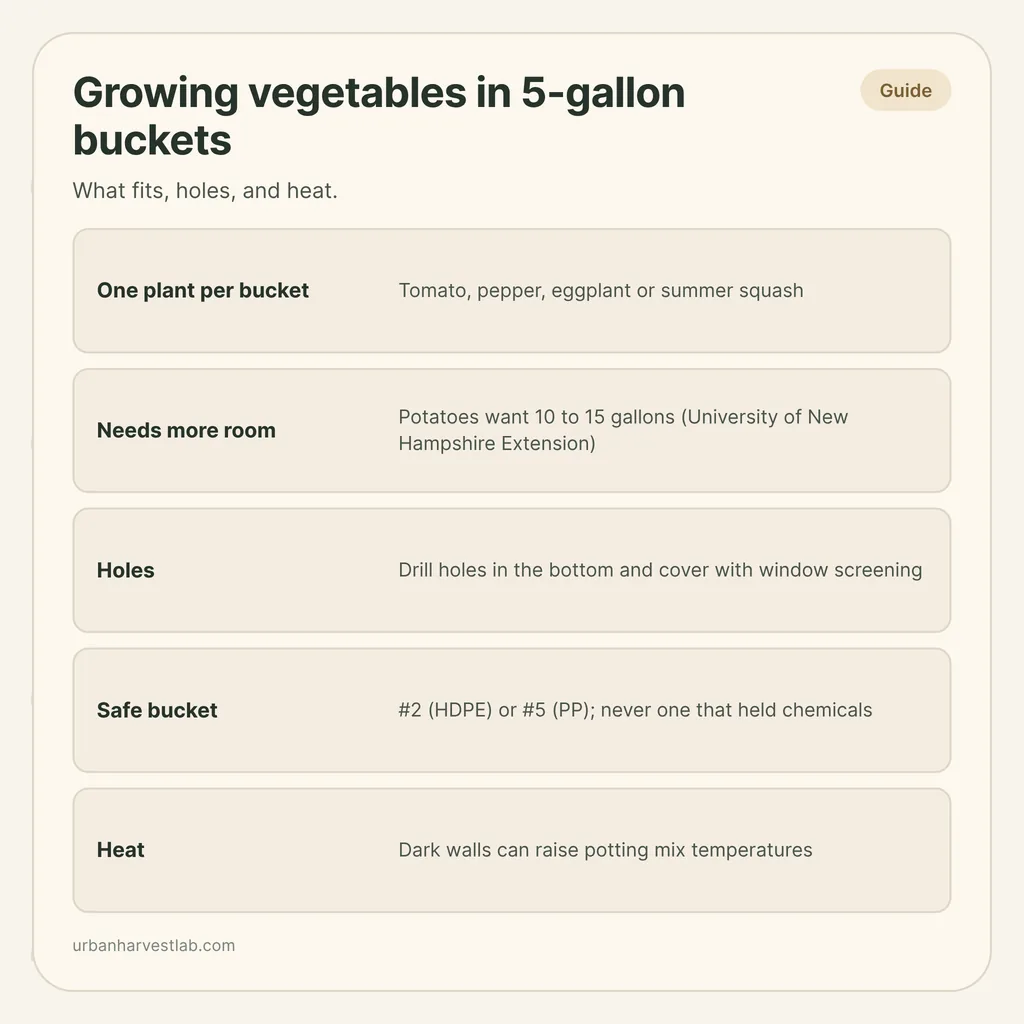
Growing vegetables in 5-gallon buckets: what fits, holes, and heat
A bucket is a cheap pot, but only some crops fit it. Here is what grows well in 5 gallons, where it falls short, how to drain it, and what colour and plastic to pick.
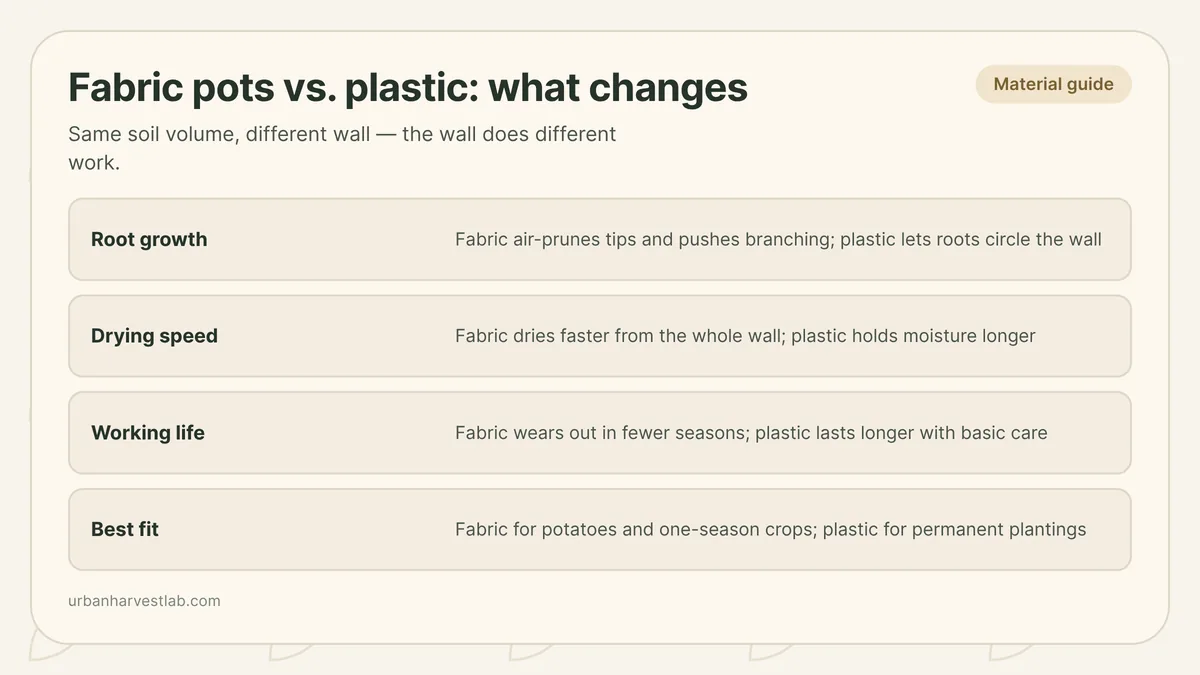
Fabric pots vs. plastic: what the wall material actually changes
A fabric pot and a plastic pot can hold the same soil volume and still grow different root systems, because the wall itself does different work.
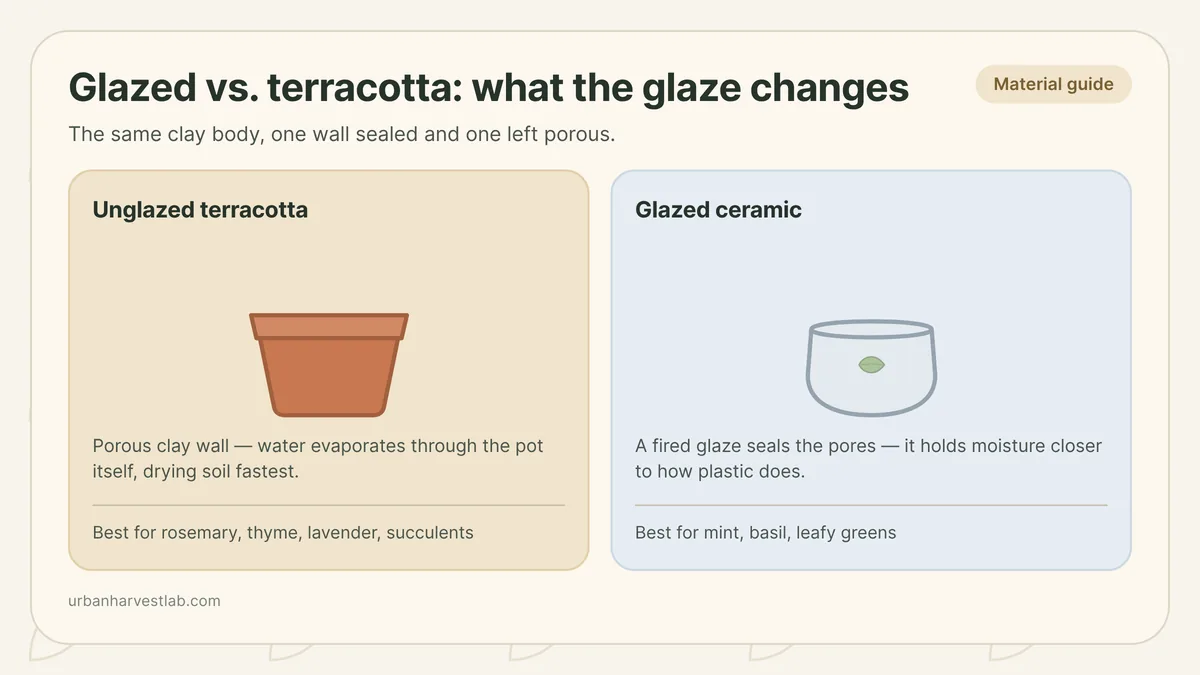
Glazed vs. terracotta pots: what the glaze actually changes
Two pots can look nearly identical and behave completely differently once you fill them with soil. The glaze on one of them is the whole difference, and it changes drying speed, weight, and winter risk all at once.