What a 5-gallon bucket holds, by crop
| Crop | Fit in one bucket | Source figure |
|---|---|---|
| Tomato (determinate or patio) | One plant | 5 gallons, 1 plant (Texas A&M); 4-5 gallons (Kentucky) |
| Pepper | One plant, two at most | 5 gallons, 1-2 plants (Texas A&M) |
| Eggplant | One plant | 5 gallons, 1 plant (Texas A&M); 4-5 gallons (Kentucky) |
| Summer squash, zucchini | One plant | 5 gallons, 1 plant (Texas A&M); 4-5 gallons (Kentucky) |
| Broccoli, cabbage | One plant | Single pots unless 15 inches apart (Kentucky) |
| Lettuce, spinach, radish, beets | Several, shallow-rooted | 6-8 inches deep is adequate (Kentucky) |
| Green beans, carrots | Several | At least 10 inches deep (Kentucky) |
| Indeterminate tomato, cucumber, potato | Borderline or too small | Sources disagree; see the sections below |
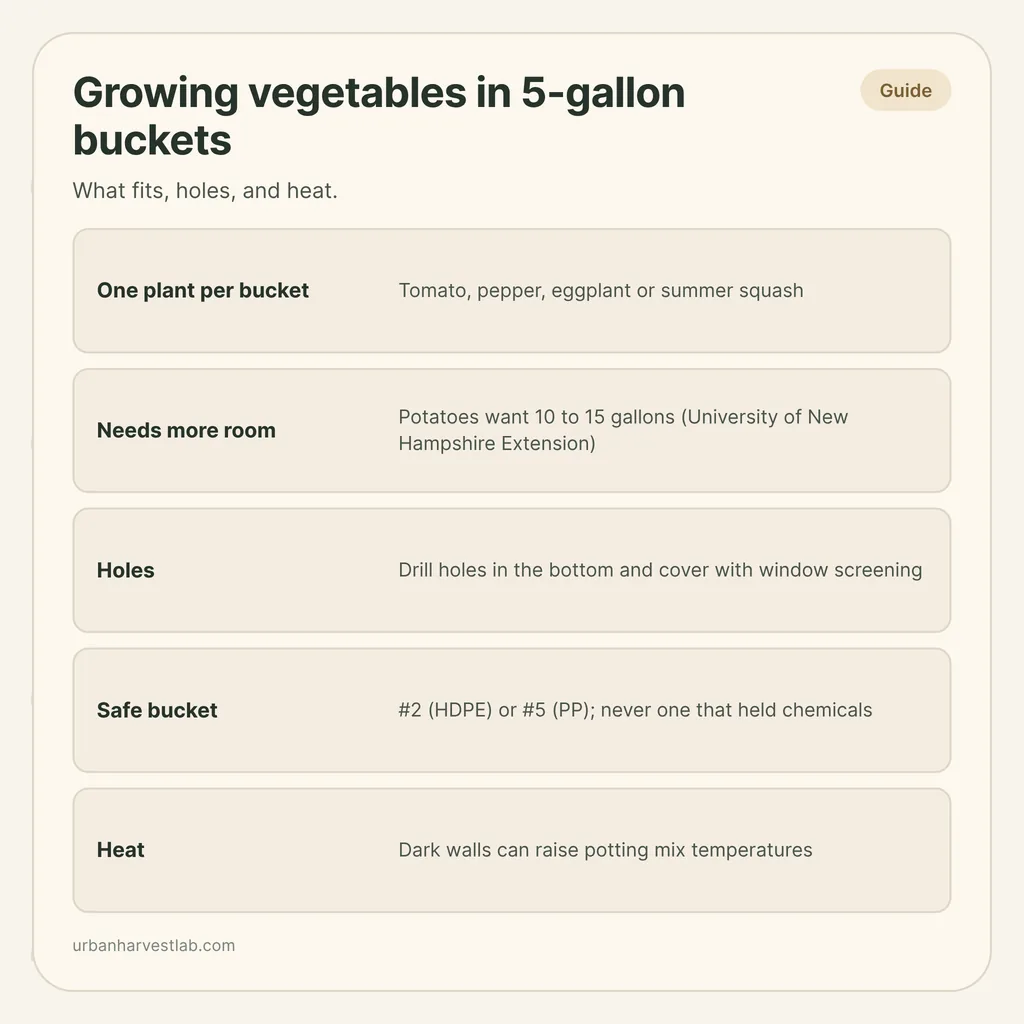
A 5-gallon bucket is a good pot for one fruiting plant, a determinate or patio tomato, a pepper, an eggplant or a summer squash, and a roomy one for greens, radishes, beans, carrots and herbs. It needs holes drilled in the bottom, a food-grade history, and a spot where a dark wall will not cook the roots. Large vining plants and potatoes are where it runs short.
What 5 gallons actually is
University of Illinois Extension’s diameter-to-volume table puts a 12-inch round container at about 5 gallons. Buckets taper, so treat that as a rough match rather than an exact one. For filling, University of Maryland Extension notes that a 2-cubic-foot bag of potting mix will fill three 5-gallon buckets. If you are comparing a bucket against pots of other shapes, the pot size calculator converts dimensions to volume.
Crops that fit one to a bucket
Texas A&M AgriLife Extension calls 5-gallon containers the most suitable size for tomatoes, peppers and eggplant. Its container table lists tomato at 5 gallons for 1 plant, pepper at 5 gallons for 1 to 2 plants, eggplant at 5 gallons for 1 plant, and squash at 5 gallons for 1 plant. University of Kentucky Cooperative Extension agrees from the other direction: a 4 to 5-gallon bucket works well for one plant of eggplant, tomato, pepper, yellow squash and zucchini.
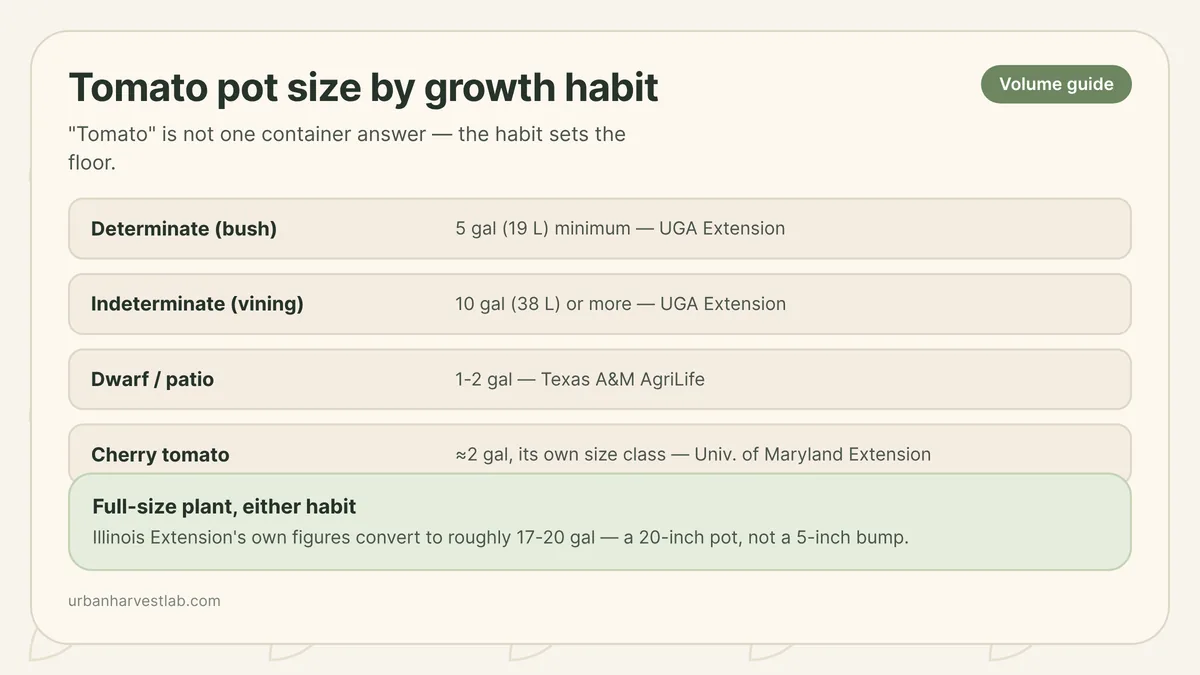
The tomato fit has a catch. Texas A&M’s tomato row is for compact varieties, and sources disagree sharply about full-size vining plants: UGA Fulton County Extension asks for 10 gallons for an indeterminate, and Clemson Cooperative Extension says an indeterminate is not successful in a 12-inch pot. Tomato pot size lays out that range by growth habit. A bucket is the safe choice for a determinate or patio tomato, and a gamble for a big indeterminate one. The same goes for peppers and zucchini, which each have their own page if you want the spread between sources.
University of Maryland Extension shows a broccoli plant ready to harvest in a 5-gallon food-grade bucket. Kentucky adds the spacing rule that applies to broccoli and cabbage: plant them in single pots if they cannot be at least 15 inches apart. In a bucket, that means one plant.
Crops that need depth, not volume
A bucket is deeper than most crops require. Kentucky Cooperative Extension says containers at least 6 to 8 inches deep are adequate for beets, broccoli, cucumbers, kale, lettuce, onions, radishes, spinach, Swiss chard and turnips. Green beans, cabbage, carrots, collards and peas want at least 10 inches. Texas A&M lists leaf lettuce at 1 gallon for 2 plants and bush green beans at 2 gallons minimum, which is why a 5-gallon bucket handles a small planting of either rather than a single plant. How many plants to put in one is the question how many plants fit in one container answers.
Carrots are the one to measure. Texas A&M’s rule is a pot 2 inches deeper than the variety’s mature length, so check the seed packet against your bucket’s inside depth. Carrot container depth works through the varieties.
Herbs suit buckets too. University of Illinois Extension says herbs need containers at least 10 inches in diameter and shows them in buckets with holes drilled into the bottoms. One herb to a bucket is the simple approach.
Where a bucket falls short
Cucumbers are the clearest disagreement: Texas A&M lists 1 gallon, University of Maryland Extension 5 gallons, and UGA Fulton County Extension 10 gallons when it groups cucumber with squash. A bucket sits in the middle of that range, and a trellised plant will dry it quickly. See cucumber container size before committing.
Potatoes are the other common mismatch. University of New Hampshire Extension asks for a container of 10 to 15 gallons, about 2 to 3 feet tall, and 5 gallons of soil per plant. A bucket meets the soil volume for one plant but not the height, which is what the hilling method depends on. Growing potatoes in grow bags covers the sizes that suit.
Drilling the holes
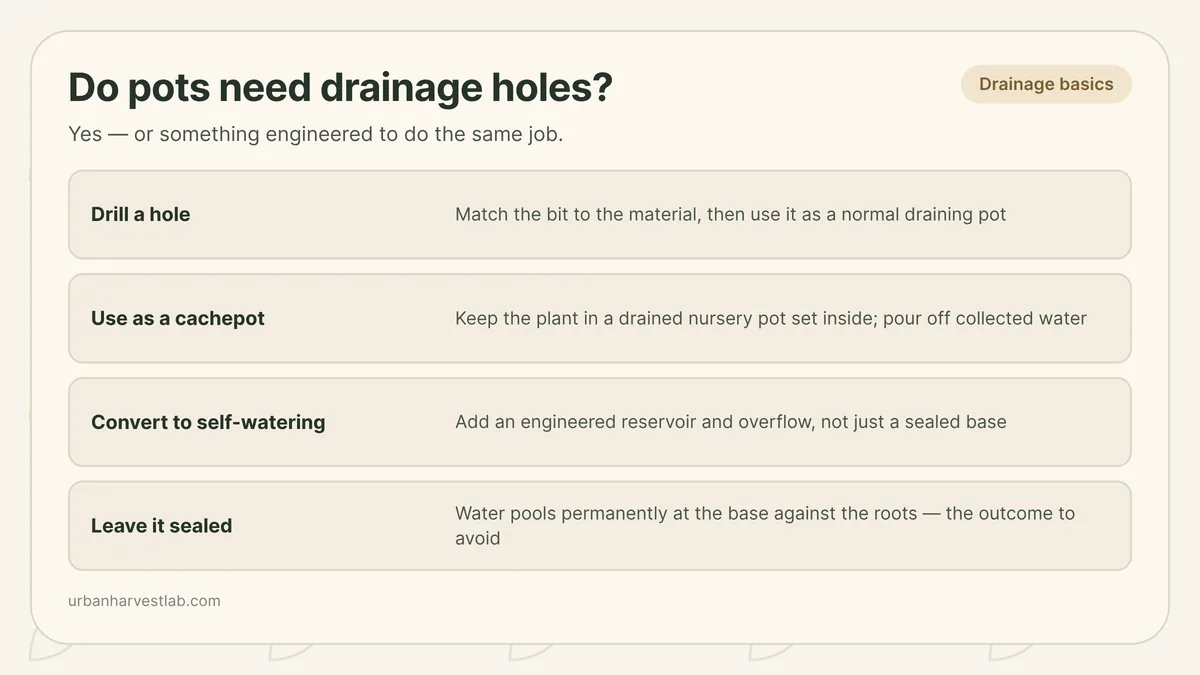
University of Maryland Extension’s instruction is short: drill holes in the bottom of the bucket, then cover the bottom with fiberglass window screening before filling it so the mix does not fall through. Kentucky Cooperative Extension says a container needs drainage holes in the bottom so roots do not stand in water, which may cause them to rot and die. Texas A&M puts it more bluntly: poor drainage will slowly kill the plants.
None of those sources gives a number of holes or a drill size. Drill enough that water runs out freely every time you water thoroughly, and test it with a full watering before you plant. University of Maryland Extension and Washington State University Extension both advise against a gravel layer; the reasoning is in drainage holes and how to add one safely, along with technique for other materials.
If you want the bucket to water itself from below, that is a different build with an overflow hole instead of bottom drainage. DIY self-watering planter from two buckets covers it.
Which bucket is safe
University of Maryland Extension recommends #2 (HDPE) plastic for food storage and lists #5 (PP) as another food-safe option, and it advises against #3, #6 and #7. It also states that any bucket that held chemicals such as paint or cleaning agents is no longer food-safe, even if it is #2 HDPE. A stamped number does not clear a bucket whose history you do not know. Food-safe containers goes through the codes and what to ask about a second-hand bucket.
Colour, sun and heat
University of Maryland Extension warns that dark container colours can raise potting mix temperatures, potentially injuring tender roots and preventing the full development of a plant’s root system. University of Illinois Extension says dark-coloured and metal containers absorb more heat, which warms the soil and can damage plants. A black bucket in afternoon sun is the case both warnings describe, and a lighter bucket is the direction to lean. Neither source measures a temperature difference, so there is no safe degree figure to quote.
Heat also drives water use. Illinois notes that in warm, dry weather you may need to water containers more than once a day, and Maryland says some containers need daily watering in hot, dry weather. A bucket is a small reservoir for a fruiting plant in summer, so check the mix with a finger before assuming yesterday’s watering is enough. Protecting container plants in a heatwave has the response when temperatures spike.
Sources
- University of Maryland Extension: Growing Vegetables in Containers and Salad Tables
- University of Kentucky Cooperative Extension: Vegetables Grown in Containers Improves Accessibility
- University of Illinois Extension: How to Grow Fruits, Vegetables, Herbs in Container Gardens
- Texas A&M AgriLife Extension: Vegetable Gardening in Containers (E-545)
- University of New Hampshire Extension: What is the best way to grow potatoes in containers?
- UGA Fulton County Extension: Container Gardening, Thinking Outside the Box
More on choosing and sizing containers
Crop-specific volume, drainage and material questions that a bucket raises.
Common questions
What vegetables grow well in a 5-gallon bucket?
One plant each of tomato (determinate or patio types), pepper, eggplant and summer squash, per Texas A&M AgriLife Extension and University of Kentucky Cooperative Extension. Lettuce, spinach, radishes, beets, green beans, carrots and herbs also grow in one, since their sources ask for 6 to 10 inches of depth or 1 to 2 gallons rather than 5.
How many drainage holes does a 5-gallon bucket need?
University of Maryland Extension says to drill holes in the bottom and line them with fiberglass window screening, and University of Illinois Extension shows buckets with holes drilled into the bottoms. Neither source gives a hole count or diameter, so drill enough that water runs out freely after a thorough watering.
Can I use an old paint bucket for vegetables?
No. University of Maryland Extension states that any bucket that held chemicals such as paint or cleaning agents is no longer food-safe, even if it is made of #2 HDPE plastic.
Does a black bucket get too hot for roots?
It can. University of Maryland Extension says dark container colours can raise potting mix temperatures and injure tender roots, and University of Illinois Extension says dark containers absorb more heat that can damage plants. Neither gives a temperature figure.
Related guides

DIY self-watering planter from two buckets
A bucket, a drilled lid, and one low overflow hole turn a free container into a planter that waters itself from below. Here is the build, the fill, and the upkeep.
Do pots need drainage holes, and how to add one safely
A pot with no drainage hole is not a design quirk you can water around. Here is why that matters, how to drill one safely by material, and how to use a hole-less pot the right way instead.
What size pot for tomatoes? Volume by growth habit
The right container for a tomato depends less on the fruit than on how the plant grows: determinate, indeterminate, or dwarf. Extension figures for the same word vary by more than three times.