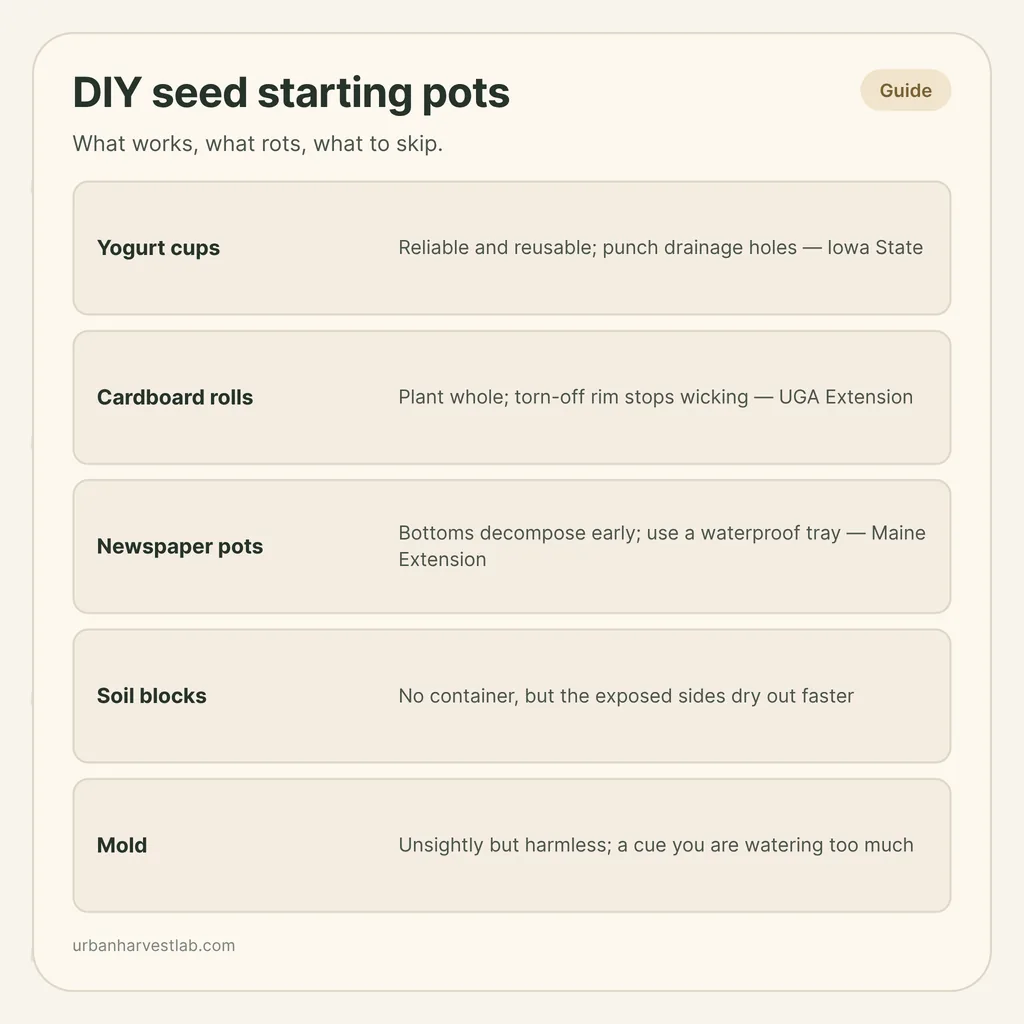
Homemade seed-starting containers at a glance
| Container | Strength | Watch for |
|---|---|---|
| Yogurt cups, deli tubs, milk cartons | Hold up for weeks; reusable after cleaning | Need holes punched in the base; not plantable |
| Toilet or paper towel rolls | Plant whole, root ball undisturbed | Rim above soil wicks water; open base needs a tray |
| Cardboard egg cartons | Free, easy to separate at transplanting | Foam cartons must be removed before planting; check cell depth against Maryland's 2-inch minimum |
| Newspaper pots | Plant whole once hardened off | Bottoms disintegrate early; use a waterproof tray |
| Soil blocks | No container; roots stop at the block edge | Need a blocker tool; edges dry fast |
Rinsed yogurt cups, deli tubs and milk cartons with holes punched in the bottom are the dependable free option; cardboard rolls, egg cartons and newspaper pots work for a few weeks and can be planted whole, but they need more careful watering. University of Maryland Extension puts the rule simply: almost any clean container will do if it drains and is at least 2 inches deep.
What goes inside matters as much as the shell. A light seed-starting mix behaves very differently from garden soil, and seed-starting mix vs. potting mix covers that choice. Here the question is only the container.
Plastic and metal: the reliable baseline
Maryland Extension lists cottage cheese and yogurt containers, milk cartons, aluminum pans and clear clamshells from the produce department or deli. Iowa State Extension adds soda bottles with the top cut off, plastic cups, a milk jug cut in half, and says any plastic container that can hold germination mix about 3 inches deep will do.
The one step that cannot be skipped is drainage. Iowa State’s instruction is to poke drainage holes in the bottom to prevent over-watering. For how to add a hole by material, see the drainage holes guide. Stand the cups in a tray as well; UGA Extension puts its seed pots on a tray, plate or bowl, and a cup with holes and no saucer drains onto the windowsill.
These containers are also the ones you can reuse next year. Iowa State says containers can be reused as long as they are thoroughly cleaned and sterilized before each use. Its method: scrub off loose soil, wash in soapy water and rinse, then soak in one part household bleach to nine parts water for a minimum of 10 minutes and rinse. Mix the bleach into water rather than water into bleach to avoid splashing, and use the solution within two hours. For a single cup, Iowa State suggests wiping all surfaces with a cloth soaked in undiluted 70% isopropyl alcohol instead.
If the seedlings will stay in a food tub until harvest, rather than being moved on, the container’s history matters; see food-safe containers for vegetables and herbs.
Cardboard rolls and egg cartons
Iowa State Extension suggests cutting toilet tissue or paper towel rolls into 2 or 3-inch sections, filling them with potting soil and sowing one seed per container. The rolls can be planted just like peat pots without disturbing the root ball. UGA Extension makes the bottom by cutting 1 to 1 1/2-inch slits about half an inch apart around one end and folding the flaps inward, and recommends standing the pots in a tray or tying them together with twine so they stay upright.
Both sources flag the same problem at planting time. Iowa State says any exposed edge acts like a wick and dries out the transplant, even in moist ground; UGA says to tear off any cardboard sticking above the soil because it will wick moisture away from the roots. Bury the whole tube.
Cardboard egg cartons work much the same way, according to Iowa State. Foam cartons can be used too, but the plant has to come out of the foam before it goes in the ground because foam does not break down in soil. Measure a carton cell against Maryland’s 2-inch depth minimum before you commit a tomato to it.
Newspaper pots
Newspaper can be folded or rolled into a small pot and planted once the seedling is hardened off, since Iowa State notes the paper decomposes. University of Maine Extension gives two patterns. The square pot starts with 4 layers of newspaper about 12 inches square. For the round pot, cut four layers into 4-inch-wide strips, wrap them around a can, leave two inches of paper below the base and fold it under.
Maine’s warning is the useful part: the bottoms of these pots decompose while your seedlings are still growing, so put them on a waterproof tray. Treat newspaper pots as a short-term container, and move seedlings on when the first true leaves are open, as described in when to pot up seedlings.
Soil blocks: no container at all
A handheld soil-block maker compresses moistened mix into firm cubes that hold together by themselves, according to Iowa State Extension. Standard blockers make 1 1/2 to 2-inch blocks, and roots stop growing at the block edge instead of circling.
The costs are real. Iowa State notes that you need to buy the tool, beginners find blocks falling apart until the mix and moisture are right, and the exposed sides dry out faster than a pot’s, so blocks need more frequent watering. Its starting point is 3 parts mix to one part warm water, about as wet as brownie batter, with a classic recipe of 3 parts peat moss or coco coir, 2 parts screened compost and 1 part coarse sand or perlite. Water blocks from the bottom, because pouring over the top can break them apart.
Mold and soggy cardboard
Iowa State Extension says the whitish or brown molds that grow on peat pots and other organic materials are unsightly but will not harm healthy seedlings. The mold is a signal: it may indicate excessive moisture, and overwatering may lead to damping-off. Its fix is to let the potting soil dry somewhat between waterings.
For soil blocks, Iowa State notes that bottom watering keeps the surface drier and lowers the risk of fungal issues. Watering into the tray rather than over the top is a reasonable way to follow Iowa State’s advice to let the mix dry somewhat between waterings in paper pots too.
Sources
- University of Maryland Extension, Containers and Potting Soil for Indoor Seed Starting
- Iowa State Extension, Containers for Starting Seeds
- Iowa State Extension, How to Clean and Disinfect Plant Containers
- Iowa State Extension, Starting Seeds in Soil Blocks
- Iowa State Extension, Will mold on peat pots harm my flower and vegetable seedlings?
- UGA Extension Paulding County, Reuse Your Trash To Start Seeds
- University of Maine Cooperative Extension, Bulletin 2763
Starting seeds? These pages go with it
The container is one decision; the mix, the move to bigger pots and drainage are covered separately.
Common questions
What can I use as seed starting pots?
University of Maryland Extension says almost any clean container works if it drains and is at least 2 inches deep, and lists cottage cheese and yogurt containers, milk cartons, aluminum pans and clear clamshells. Iowa State Extension adds toilet and paper towel rolls cut into 2 to 3 inch sections, cardboard egg cartons, and folded newspaper pots.
Can I plant toilet paper rolls straight into the ground?
Iowa State Extension says the rolls can be planted like peat pots without disturbing the root ball, as long as every part of the cardboard ends up below the soil surface. Exposed edges act like a wick and dry out the transplant.
Do newspaper pots get moldy?
Whitish or brown mold can grow on the surface of peat pots and other organic materials. Iowa State Extension says it will not harm healthy seedlings, but it can signal too much moisture, and overwatering may lead to damping-off. Let the mix dry somewhat between waterings.
How do I clean old pots before reusing them for seeds?
Iowa State Extension says to remove loose soil, wash in soapy water and rinse, then soak in one part household bleach to nine parts water for a minimum of 10 minutes and rinse. Use the bleach solution within two hours of mixing it.
Related guides
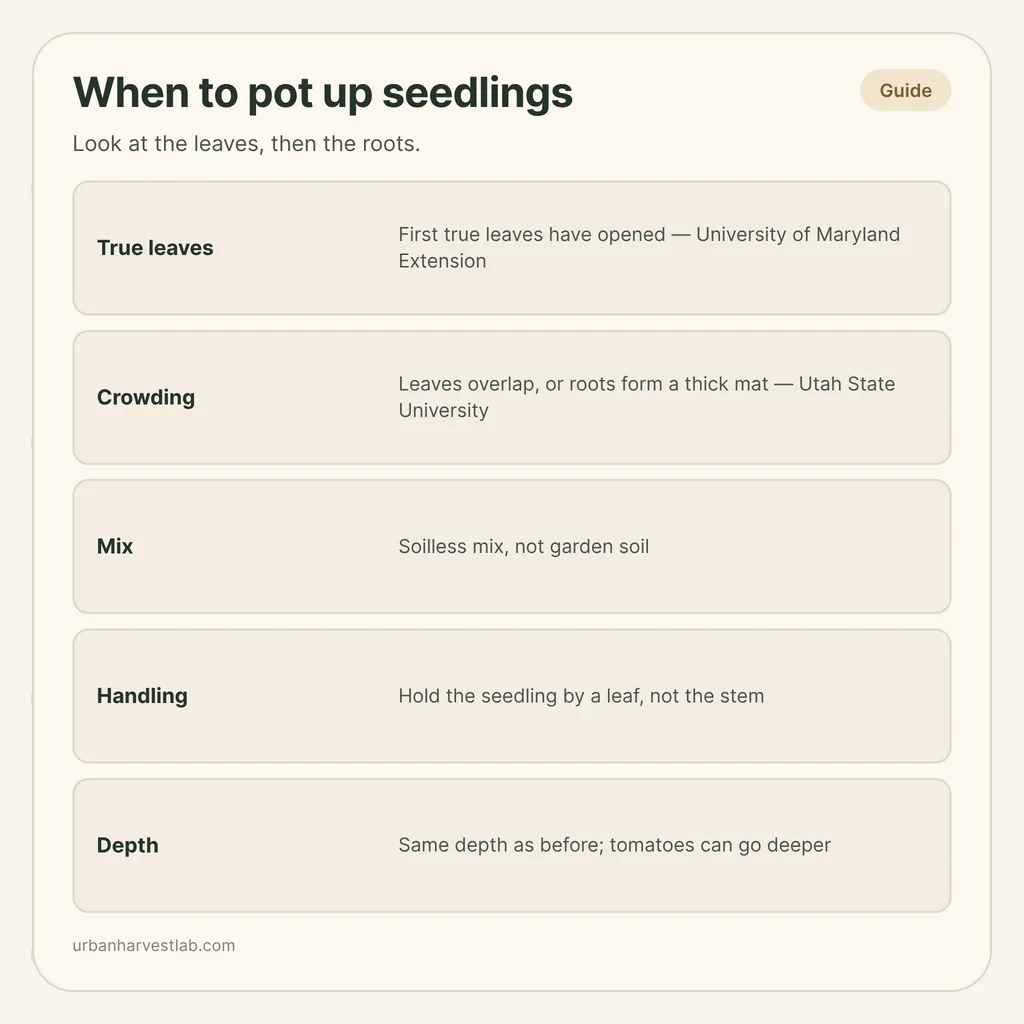
When to pot up seedlings: signs, depth and the first move
Seedlings left in the starter tray too long stall. Here is the moment to move them into their own pots indoors, how to lift them without damage, and when tomatoes can go deeper.

How to harden off seedlings: a day-by-day plan and planner
Hardening off is a week or two of gradually longer, sunnier days outside before a seedling is planted out for good. Enter your planting-out date and get the day-by-day schedule.
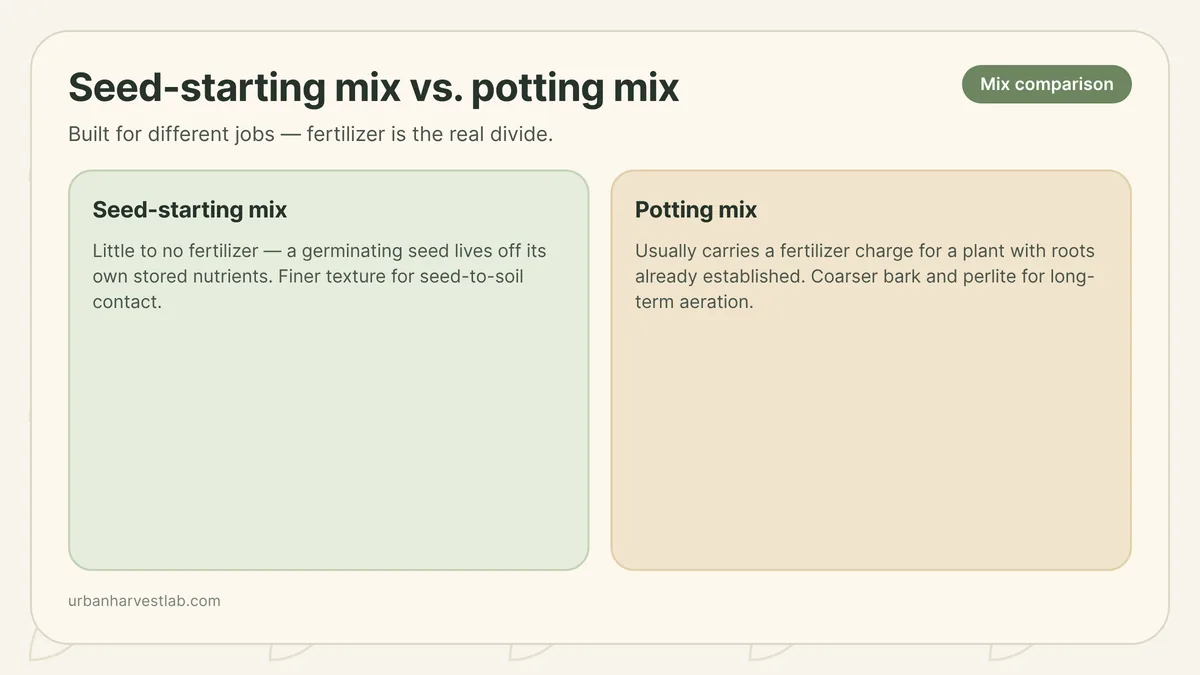
Seed-starting mix vs. potting mix: why your seedlings need a different bag
Potting mix is built to feed an established plant; seed-starting mix is built to stay out of a germinating seed's way. The difference is fertilizer content and particle size, and it matters before the first true leaf appears.