
Hardening off: cool-season and warm-season crops compared
| What to check | Cool-season crops | Warm-season crops |
|---|---|---|
| Examples given by Maryland Extension | Lettuce, cabbage | Tomato, pepper |
| Bring inside at night if the forecast is below | Freezing | 50°F (10 °C) |
| Night temperatures they prefer (Nebraska Extension) | Hardy plants take temperatures in the 40s°F | At least 60°F |
| Frost once hardened (Nebraska Extension) | Light frosts will not hurt them | Below-freezing temperatures still kill them |
| Risk of hardening too hard (Maryland Extension) | Cauliflower makes thumb-sized heads and stops developing | Cucumbers and melons stop growing |
Harden seedlings off over 7 to 14 days. Nebraska Extension starts them in shade, out of the wind, for 2 to 3 hours on day one, adds time and sun each day until they manage 10 to 12 hours, then leaves them out day and night for a couple of days before planting out. Enter the date you plan to plant out, which comes from your last frost date, and the planner counts the schedule back from it.
Put seedlings outside for the first time on
—
Enter a planting-out date and a length
- Overnight outdoors begins
- —
- Plant out on
- —
- Bring inside at night if forecast below
- —
Doing it by hand
The planner is only arithmetic and a ramp. Subtract your schedule length from the date you plan to plant out, and that is day one. A seven-day version of Nebraska Extension’s plan looks like this:
- Day 1. Pick a mild or cloudy day. Put the seedlings in a shaded spot out of the wind for 2 to 3 hours, then bring them in.
- Days 2 and 3. Add a few hours outside each day and let in a little more sun.
- Days 4 and 5. Stay at 10 to 12 hours outside, which Nebraska Extension holds for several days before the overnight stage.
- Days 6 and 7. Leave the plants out for 24 hours a day for a couple of days.
- Day 8. Plant out.
Longer schedules stretch the middle. A 14-day plan simply has more days at each stage, which is gentler on tender plants and on a cold or changeable spring.
How long you actually need
The published guidance does not agree on one number, and it should not be forced into one. Nebraska Extension gives 7 to 10 days. Penn State Extension says to begin at least two weeks before transplanting and to move plants into sunlight over 10 to 14 days. The RHS says hardening off takes 2 to 3 weeks. University of Maryland Extension gives a range of 5 to 14 days depending on the crop, and elsewhere says to begin 1 to 2 weeks before setting plants out. Clemson Cooperative Extension says to continue the routine for two to three weeks once seedlings are around three inches tall, UMass Amherst Extension says to harden off over about one week, and Purdue’s Vegetable Crops Hotline says 4 to 8 days before setting plants in the field (more on that in transplant shock in seedlings).
Read that as a spread, not a conflict. The short end suits hardy, sturdy seedlings and settled weather. The long end suits tender crops, a cool spring, and seedlings raised under lights that have not yet felt a breeze. If you are unsure, take the longer figure: an extra week costs you nothing, while a scorched tray costs you the plants.
The date you count back from matters as much as the length. It comes from your frost date and the night temperatures your crop needs, which first and last frost dates for a balcony walks through. The seed starting calculator works the other way, from that date back to sowing, and its hardening-off window gives a rough start point that this planner then turns into a day-by-day plan. That calculator counts the window back 2 to 3 weeks, following the RHS and Clemson, so if you pick 7 or 10 days here you will get a later start date than the calculator shows.
What each day is doing
Outdoors, a seedling meets four things it has not met on a windowsill or under lights. Nebraska Extension lists them as cold temperatures, wind, lower amounts of water and strong sunlight. Hardening off exposes the plant to each of them in small doses.
Sun. Nebraska Extension notes that outdoor sunlight is often more intense than light from grow lights or a greenhouse and “can easily cause sunburn” on plants that are not hardened off. Penn State says plants taken straight from the house may brown or turn white in direct sun and wind, and that even if they survive, the damage reduces their vigor and slows establishment. That is why the first days are spent in shade. University of Maryland Extension adds the increment: increase exposure to sunlight by an hour or two each day. The RHS recommends a sheltered, dappled sunny spot. If a seedling does bleach, leaf scorch after moving plants outside covers what the damage looks like and how it recovers.
Wind. Nebraska Extension warns that strong spring wind can rip or tear leaves or snap stems. Maryland and Penn State both say not to put tender seedlings out on windy days. On a balcony, that points to the inside corner or behind a solid rail rather than the open edge, and windproofing a balcony garden goes into windbreaks that stay put.
Water. Nebraska Extension says to gradually reduce how often you water during hardening off, but not to let the transplants wilt. Maryland frames it as slowing growth. A small pot outside dries faster than the same pot indoors, so check it, because the aim is firmer growth rather than stress.
Feeding. Nebraska Extension advises avoiding fertilizer before or during hardening off, then using a weak solution once the plants are in their final position to help reduce transplant shock.
Air. If you use a porch, shed or garage for the nights, Penn State asks that it be away from gas and engine exhaust.
Cool-season and warm-season crops get different nights
The daytime schedule is the same for everything. The nights are not.
Maryland Extension says cool-season crops such as lettuce and cabbage should come inside at night if the temperature is forecast below freezing, and warm-season crops such as tomato and pepper if it is forecast below 50°F. The RHS puts the same line at nights consistently above 7 °C for planting out, and above 10 °C for heat-loving crops such as tomatoes, peppers and basil. Both Maryland and Penn State say not to put tender seedlings out below 45°F. Nebraska Extension adds that warm-season plants prefer nights of at least 60°F and cannot stand below-freezing temperatures even after hardening off, while hardy cool-season plants can take temperatures in the 40s°F and, once well hardened, are not hurt by light frosts.
So the overnight stage, the last two days of the planner, is the one to postpone if the forecast turns. Nothing is lost by leaving plants in for an extra night.
Hardening has a ceiling too. Maryland Extension warns that if the process stops growth altogether, certain crops are damaged: cauliflower produces thumb-sized heads and does not develop further, and cucumbers and melons stop growing if hardened too severely. Hardening should toughen the plant, not hold it back.
Maryland also says hardening off warm-season transplants such as pepper, squash, tomato and eggplant is less important if you plant them after any danger of frost, once the soil is above 60°F, and give them the water and nutrients they need. Cabbage, broccoli and cauliflower, it says, need it most. Penn State and the RHS make no such exception, and the RHS lists tomatoes, basil, peppers and French beans among the plants for which hardening off is essential.
Bought seedlings and light-started trays
Hardening off is not only for plants you raised. Nebraska Extension says to harden off transplants whether you purchased them or grew them yourself, because garden centers and greenhouses are far milder than a spring balcony. If you are choosing between sowing and buying, herbs from seed or buying plants compares what each route costs you in time. Seedlings raised under a steady, close light are a special case, since they have felt neither direct sun nor wind, and grow lights for seedlings explains where the fixture’s job ends and the outdoors takes over.
Seedlings that are already stretched thin are more fragile than sturdy ones, and leggy seedlings covers whether they are worth saving before you put them through the schedule.
When seedlings still wilt after planting out
A drooping plant in the first days after planting out is usually the plant adjusting rather than dying, and transplant shock in seedlings covers recovery time and when to replace a plant. Hardening off cuts the odds but cannot remove them, since the roots are still disturbed by the move.
Common mistakes
- One long afternoon instead of a ramp. The first day is 2 to 3 hours in shade, not a full day in the sun.
- Starting on a harsh day. Nebraska Extension suggests a mild or cloudy day for the first outing.
- Putting tender seedlings out in the wind. Maryland and Penn State both rule out windy days.
- Leaving warm-season crops out in cold nights. Below 50°F forecast, tomatoes and peppers come in.
- Fertilizing during the process. Nebraska Extension waits until the plants are planted out.
- Letting pots dry until the plants wilt. Reduce watering, but not to the point of wilting.
Sources
- Nebraska Extension in Lancaster County: Hardening Off Transplants
- University of Maryland Extension: Hardening Off Vegetable Seedlings for the Home Garden
- University of Maryland Extension: Planting Vegetable Transplants
- Penn State Extension: Transplanting Annuals into the Garden
- RHS: When to plant out tender plants to avoid late frosts
Before and after hardening off
Work out when to sow and when it is safe to go out, then deal with what can go wrong afterwards.
Common questions
How long does it take to harden off seedlings?
Most guidance falls between 7 and 14 days. Nebraska Extension gives 7 to 10 days, Penn State Extension 10 to 14 days, University of Maryland Extension 5 to 14 days depending on the crop, the RHS 2 to 3 weeks, and Clemson Cooperative Extension two to three weeks. If your seedlings are tender or the weather is changeable, use the longer end.
Can I harden off seedlings in a few hours?
No. A single afternoon outside is the first day of the process, not the whole of it. Nebraska Extension starts with 2 to 3 hours in shade and builds to 10 to 12 hours over several days before plants stay out overnight.
Do I have to bring seedlings in at night?
At first, yes. The RHS says to bring plants in at night while hardening off. University of Maryland Extension says cool-season crops should come in if the night is forecast below freezing and warm-season crops such as tomato and pepper if it is forecast below 50°F.
Do bought seedlings need hardening off?
Yes, if they were raised indoors or in a greenhouse. Nebraska Extension says to harden off transplants whether you bought them or grew them yourself, because greenhouse and outdoor conditions differ so much.
Related guides
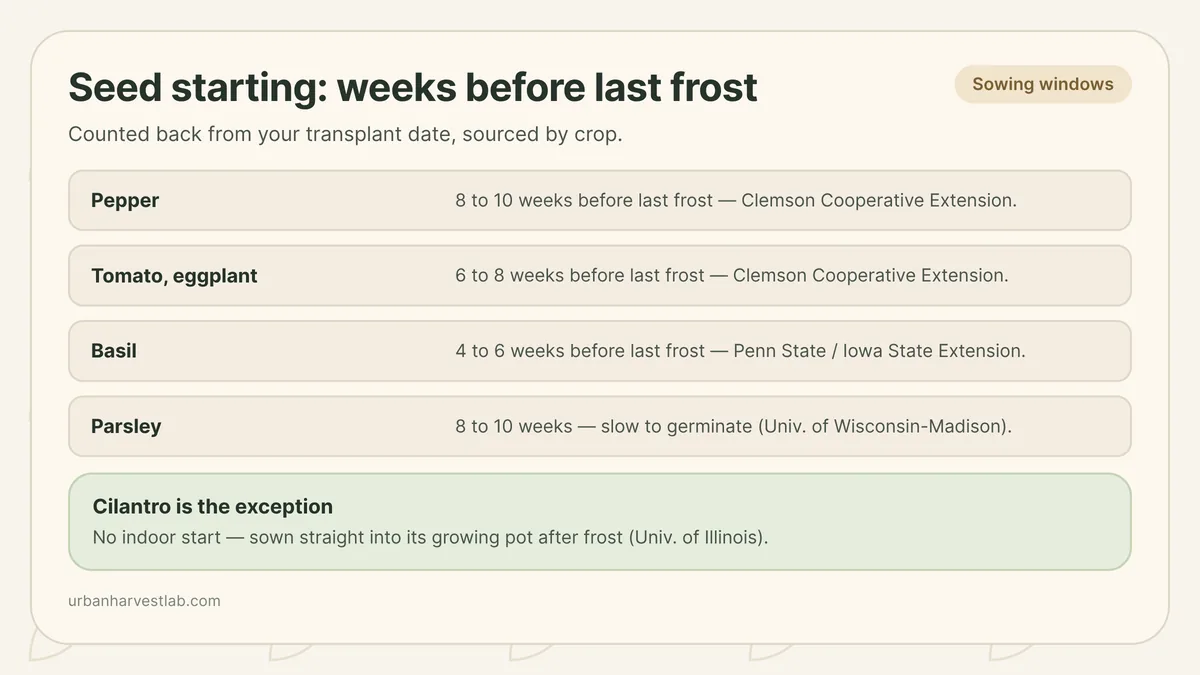
Seed starting calculator: sowing dates from your last frost date
A last frost date is only useful once you count backward from it. This works out that count crop by crop, instead of applying one week figure to everything in the seed drawer.
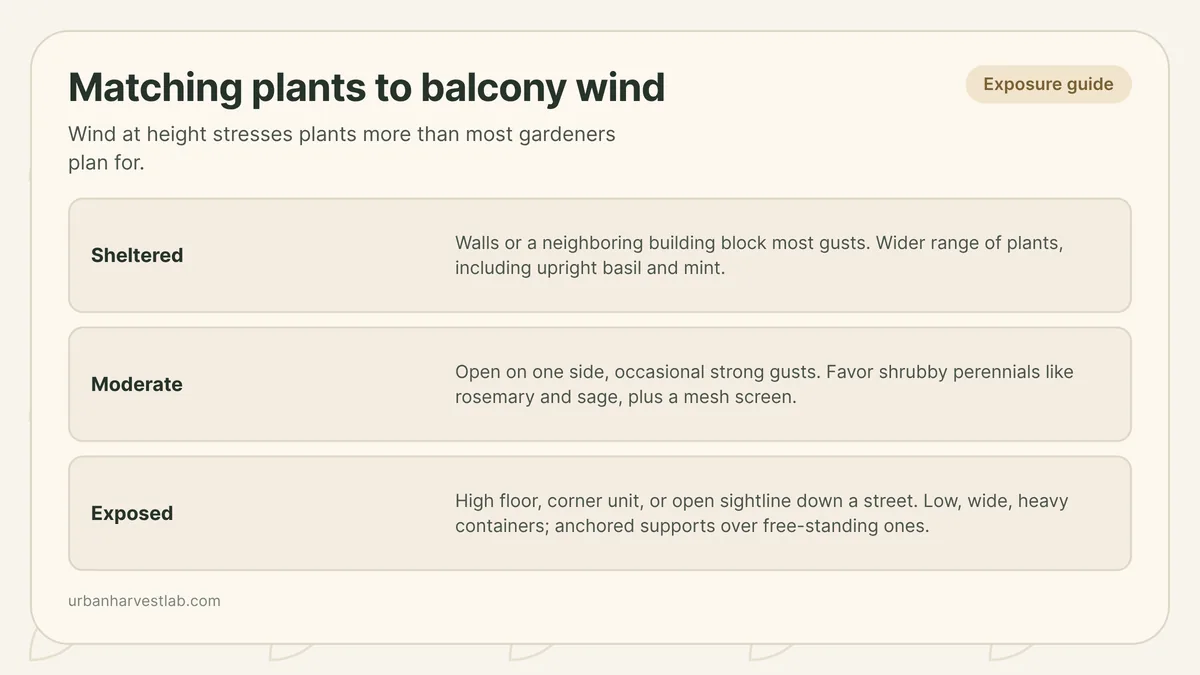
Windproof balcony garden: anchoring, plant choice, and windbreaks
A balcony catches wind differently than a yard does, and the fix is not one trick but three working together: heavier containers, plants suited to an upright or shrubby habit, and a windbreak that softens gusts instead of stopping them dead.
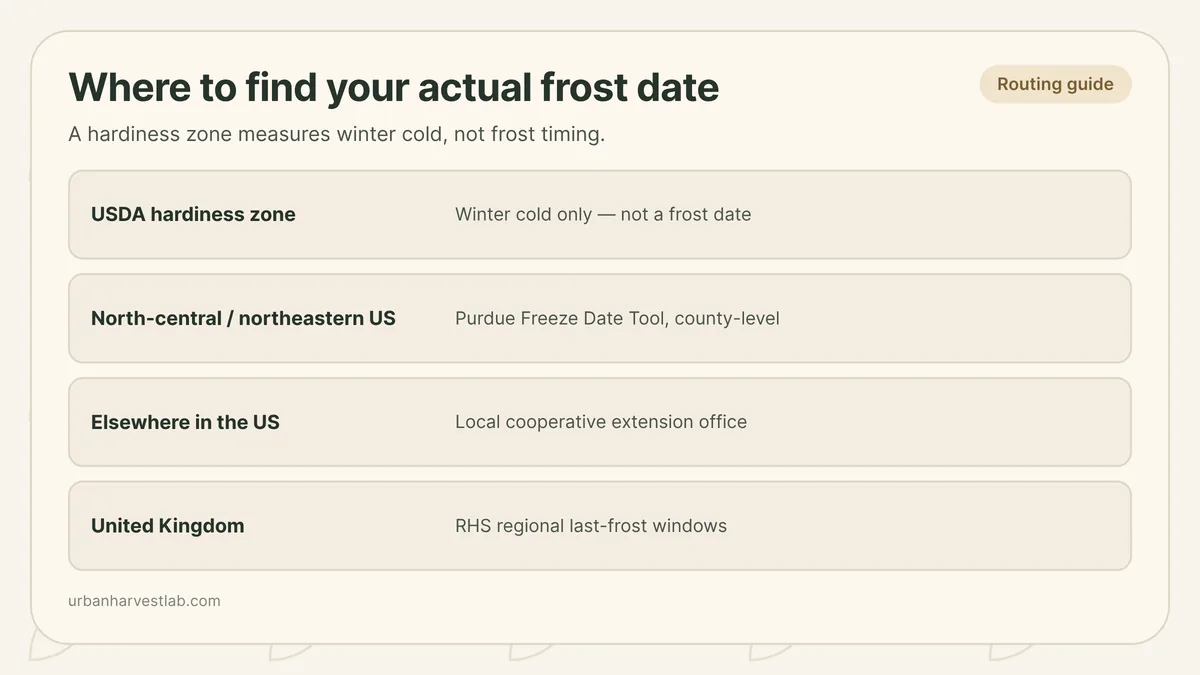
First and last frost dates for a balcony: start with your zone
Your hardiness zone tells you how cold winter gets, not when frost starts or ends. Look up the zone's temperature band, then use the tools built to answer the date question directly.