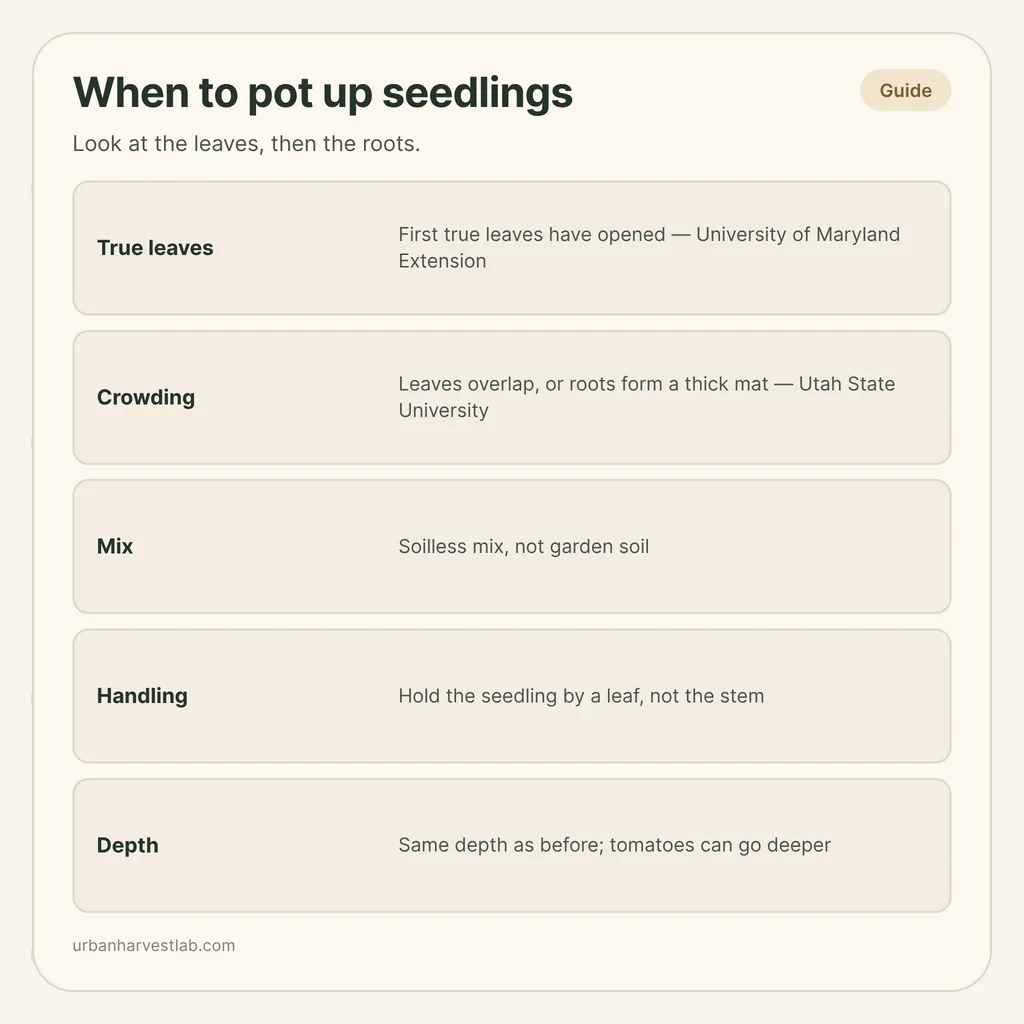
Ready to pot up, or wait?
| What you see | What it means | Source |
|---|---|---|
| Seed leaves plus the first true leaves just opening | Small and easy to move, with little danger of root-shock setback | University of Maryland Extension |
| Leaves touching or overlapping neighbours | Ready for a larger container | Utah State University Extension |
| Thick mat of roots at the bottom of the cell | Ready, and slightly late | Utah State University Extension |
| Only the seed leaves, no true leaves yet | Too early to be sure; wait for the first set | Colorado State University |
Pot up seedlings when the first true leaves have opened and their leaves start to touch, or when the roots have formed a dense mat at the bottom of the cell. That is the combined guidance of University of Maryland Extension, Colorado State University and Utah State University. Lift them by a leaf, set them in their own pot of soilless mix, and water them in.
Potting up means moving a young plant from a crowded flat or small cell into a larger container indoors. Utah State University calls it “moving plants to a larger container”, and says how many times you do it depends on the starting container, how fast the plant grows and how long it will stay inside before going out. A seedling started in a roomy cell may need fewer moves than one sown in a crowded flat.
Reading the signs
Start with the leaves. The first pair to appear are seed leaves, or cotyledons. The ones that open next, above or between them, are true leaves. University of Maryland Extension says the ideal time to move young seedlings is when they are small and there is little danger of setback from root shock, and that is usually about when the first true leaves appear. Colorado State University gives the same trigger: at least one set of true leaves.
Then look at crowding. Utah State University says seedlings are ready for a larger container when their leaves start overlapping those of neighbours, or when their roots are so dense in the current container that they form a thick mat at the bottom. You can check by gently lifting one seedling out by its leaves. If the roots are visible and holding the mix together, go. If you see a solid mat, you are late.
University of Maryland Extension calls leaving seedlings in the seed flat too long one of the most common mistakes gardeners make. Do not wait for a perfect moment.
If the seedlings are crowded in a single cell or pot, thinning is a different job from potting up: how to thin seedlings in pots covers what to cut and what to keep. If they are tall, pale and floppy, check why seedlings go leggy first, because more soil will not fix too little light.
What to pot into
Garden soil is the wrong fill. University of Maryland Extension says not to use it for transplants, because it is too dense and probably contains weed seeds and plant pathogens; it points to soilless media, which are light, porous and drain well. Typical ingredients are peat moss, vermiculite and perlite. A bag that feels heavy and is labeled planting soil should go back on the shelf. The difference between the two bag types is laid out in seed-starting mix vs potting mix.
Size is modest at this stage. Oregon State University Extension says to transplant tomatoes into containers a minimum of 2 to 3 inches in diameter when the first true leaves appear. University of Maryland Extension lists cell sizes of 1 to 2 inches square for lettuce, beets, spinach and kale, and 2 to 3 inches for squash, cucumber, broccoli and cabbage. These are the temporary homes. Final pot size is a separate question, and for tomatoes it is answered in the tomato pot size guide.
If you use peat pots, University of Maryland Extension says to tear off the top lip so the edge does not sit above the soil and draw water out of the pot.
How to lift and move them
- Fill the new pot with moist soilless mix first (Utah State University).
- Loosen, do not pull. University of Maryland Extension suggests a butter knife or wooden plant label to dig up small plants, then easing them apart in small groups so you avoid tearing roots. Utah State University says to use a pencil, knife or similar tool, and expects that some roots will break in an open flat.
- Hold the seedling by a leaf. Maryland: handle small seedlings by their leaves, not their delicate stems. Colorado State agrees that seedlings are fragile and should not be picked up by the stem.
- From a cell pack, push from below. Utah State says to use a pencil to push the root ball up from the bottom of the cell.
- Make a hole in moist mix, set the plant, firm gently and water.
How deep to set them
Utah State University says to plant the seedling at the same depth it grew in the open flat. University of Maryland Extension’s potting-up steps go deeper for every seedling: set it so the leaves and growing point are only slightly above the soil line, since most of the stem can be buried.
Tomatoes are the case where burying is safest. Tomatoes in general root along a buried stem: Utah State says they can develop roots along the stem and may be planted deeper if desired, and Iowa State University says roots will develop all along a buried stem and that tomatoes are the only vegetables that can be planted successfully in this manner. Utah State and Iowa State give this for tomatoes generally, not as a potting-up rule.
That makes potting up the cheap place to correct a lanky tomato. Bury the bare stem up to the lowest leaves. For other crops, Utah State’s same-depth rule is the cautious choice.
After the move
Put them back under strong light. University of Maryland Extension keeps lights on for 14 to 16 hours a day, with the tops of transplants 1 to 2 inches from a fluorescent fixture; a different light type will need a different distance. The same page says gently brushing the tops of transplants with a hand or stick helps control height and increase stockiness, and that ideal transplants are as wide as they are high.
Feeding is light work. Utah State University says fertilizer is necessary in any soilless medium, and that a slow-release granular fertilizer can be a good option when moving seedlings into a larger container. University of Maryland Extension adds that transplants grown for more than 6 weeks may need a soluble fertilizer, and that young seedlings are easily damaged by too much of it, especially under moisture stress.
The final move is outdoors. Before that, the plants need hardening off, which also covers how long it takes, and if they wilt after going outside, transplant shock in seedlings covers what is normal. To work out when to sow so the plants are the right size on planting day, use the seed starting calculator. A tomato grown to size in a bucket is covered in five-gallon bucket gardening.
Sources
- Utah State University Extension: Starting vegetable seeds indoors, IV. Seedling culture and transplanting
- University of Maryland Extension: Care of vegetable seedlings
- Colorado State University PlantTalk: Starting vegetable seeds indoors
- Oregon State University Extension: Grow your own tomatoes and tomatillos
- Iowa State University Extension: Growing tomatoes in the home garden
Around potting up
What comes before and after the move to a bigger pot, from thinning to hardening off.
Common questions
When should I pot up seedlings?
University of Maryland Extension puts the ideal time when seedlings are small, usually about when the first true leaves appear above the seed leaves. Colorado State University says to transplant after at least one set of true leaves. Utah State University adds two checks: leaves starting to overlap neighbours, or roots forming a thick mat at the bottom of the container.
How do I know if the roots are ready without hurting the plant?
Utah State University suggests gently lifting a seedling by its leaves out of its container to look. A healthy number of roots showing is the cue; a dense mat at the bottom means you are already late.
Can I bury the stem when I pot up seedlings?
University of Maryland Extension says to set potted-up seedlings so the leaves and growing point are only slightly above the soil line, since most of the stem can be buried; Utah State University says to keep them at the depth they grew. Tomatoes are the safest crop to bury deeper: Utah State says they root along the stem, and Iowa State University says they are the only vegetables that can be planted successfully that way.
What soil should I use to pot up seedlings?
A soilless growing mix. University of Maryland Extension says not to use garden soil for transplants because it is too dense and probably carries weed seeds and plant pathogens. It lists peat moss, vermiculite and perlite as typical ingredients and says to reject heavy bags labeled planting soil.
Related guides
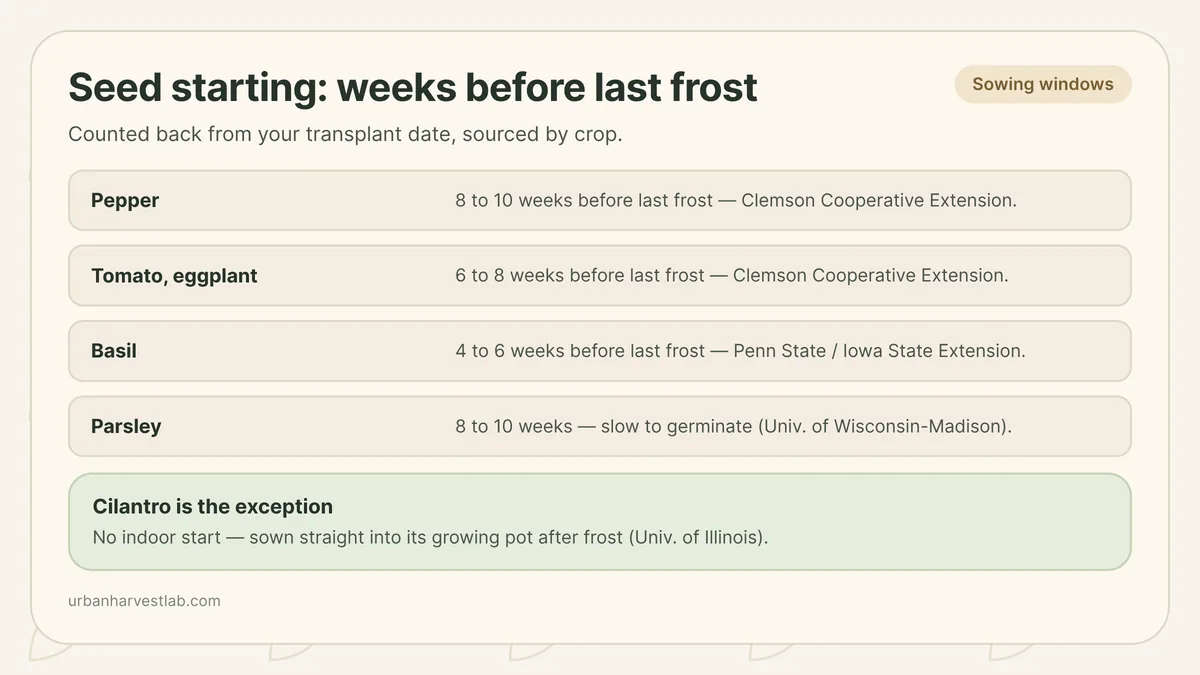
Seed starting calculator: sowing dates from your last frost date
A last frost date is only useful once you count backward from it. This works out that count crop by crop, instead of applying one week figure to everything in the seed drawer.
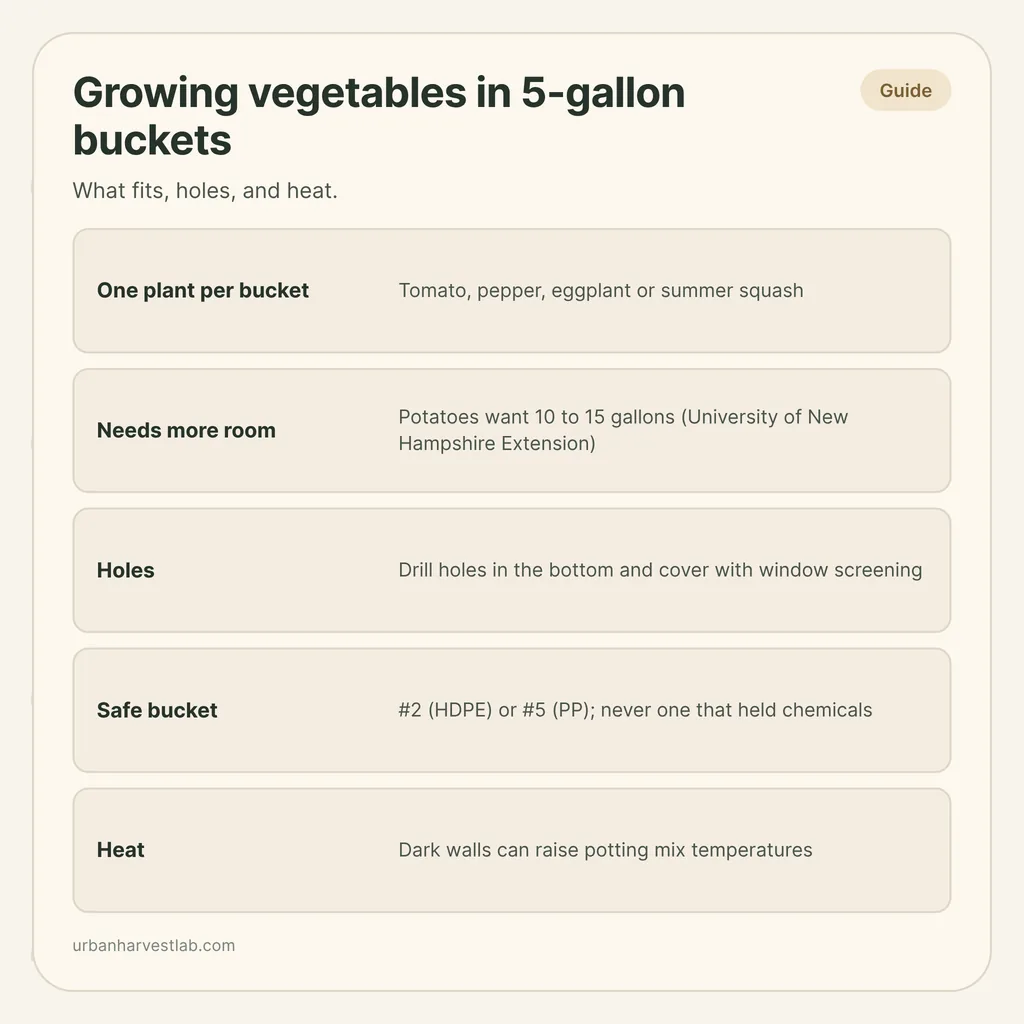
Growing vegetables in 5-gallon buckets: what fits, holes, and heat
A bucket is a cheap pot, but only some crops fit it. Here is what grows well in 5 gallons, where it falls short, how to drain it, and what colour and plastic to pick.

How to thin seedlings in pots: when to cut, what to keep
Seed packets ask you to sow thick and then remove most of what comes up. Here is when to do it in a pot, how to cut without hurting the keepers, and what to do with the extras.