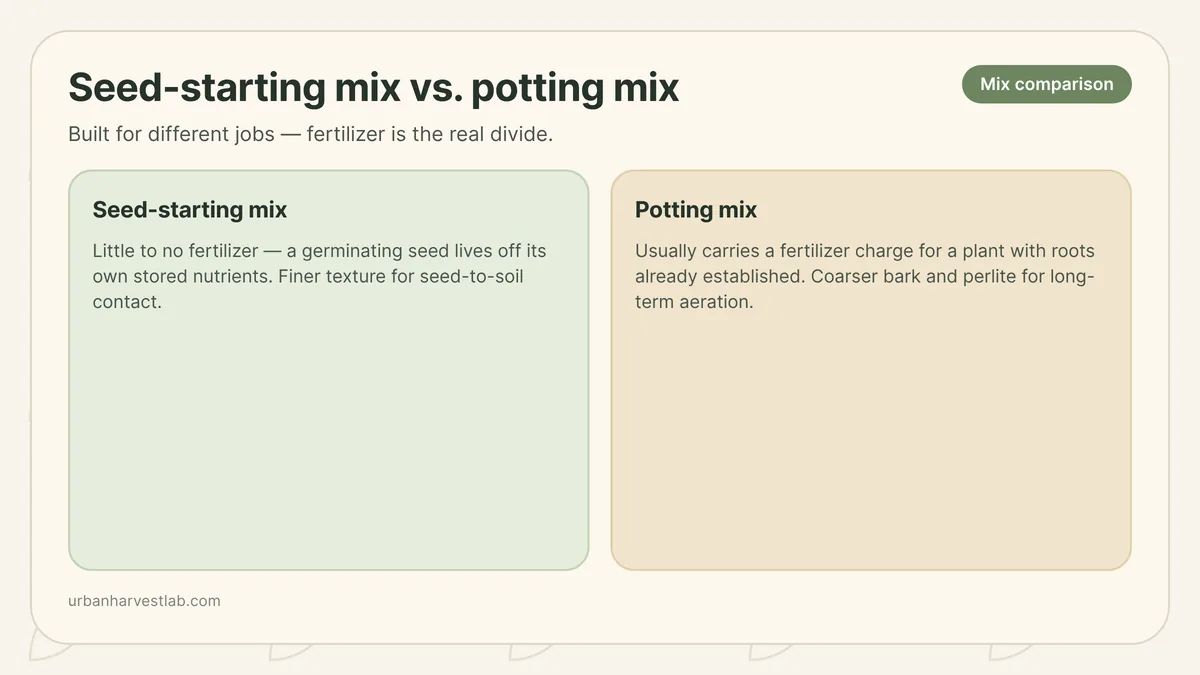
Seed-starting mix vs. potting mix
| Trait | Seed-starting mix | Potting mix |
|---|---|---|
| Fertilizer content | Little to none in most formulas; organic versions may add compost | Often carries a starter or controlled-release charge |
| Particle size | Finer, screened for seed-to-soil contact | Coarser bark, perlite, or vermiculite for long-term aeration |
| Best use | Germinating seeds, especially very small ones | Seedlings potted up, and mature container plants |
| Risk of the wrong choice | Slower nutrient supply once roots are established | Fertility the seed cannot use yet, sitting in a damp, unnecessarily rich medium |
Seed-starting mix and potting mix are built for different jobs: seed-starting mix is finer and carries little to no fertilizer, because a germinating seed still runs on nutrients stored inside itself, while potting mix is coarser and usually does carry a fertilizer charge meant for a plant that already has roots to use it. Buy the wrong one and the mismatch shows up quickly, either as a tray that struggles to get good seed-to-soil contact, or as fertility a germinating seed cannot use because it is still living off the seed itself, sitting in an unnecessarily rich, damp medium before it has grown a single true leaf.
A container needs a purpose-built medium for reasons that have nothing to do with seeds — potting mix vs. raised bed soil for containers covers the physics. Seed starting runs on the same physics under tighter constraints: a cell tray holds far less material, drains less forgivingly, and holds a plant with almost no root reserve to fall back on.
Fertilizer is the real dividing line
University of Maryland Extension states the core distinction plainly: potting mixes often contain fertilizer, “something larger plants need, but seedlings really don’t.” Seed-starting mix instead relies on moisture-retaining base ingredients and aeration components “with little to no added nutrients,” because a germinating seed is still living off the food packed inside the seed itself, not off anything in the medium around it.
That split also shows up in how the two products are marketed. University of Maryland notes that conventional seed-starting and potting mixes typically carry lime and a chemical fertilizer charge, while organic-labeled versions swap in organic fertilizers and often add compost instead. Read the ingredient panel rather than assuming “organic” means unfertilized; an organic seed-starting product can still carry more nutrient than a bare seed needs.
If you are also building your own container mix and want the fertility side worked out for a plant that is already established, how to make potting mix for container vegetables covers the compost and nutrient-bearing fraction for that later stage, which is a different target than anything here.
The second difference is particle size
Fertilizer is not the whole story. Iowa State University Extension’s breakdown of potting-media components is explicit that bark going into a seed mix should be screened to half an inch or smaller, while the coarser “orchid grade” bark that builds long-lasting air pockets in a mature potting mix is unsuitable for small seed trays. A seed making its first contact with the medium needs fine, even material pressed close around it; a chunk of bark or a piece of coarse perlite sitting next to a seed just means part of that seed’s surface is touching air instead of moisture.
University of Maryland’s own guidance narrows down exactly when the finer texture earns its keep. A standard all-purpose transplanting mix works for most seed starting, and a dedicated, finer seedling mix becomes useful specifically for very small seeds, because fine texture gives better soil contact than a coarse mix can. Sowing something like lettuce or a fine herb seed is where the finer product pays for itself. Sowing squash, beans, or anything with real seed size, an ordinary transplanting mix is already doing the job.
Building your own, and where to stop
If you would rather blend a seed-starting batch than buy one, University of Maryland Extension gives a sourced ratio: mature compost mixed with a soilless commercial mix at one part compost to two parts mix. That ratio is seedling-specific, not a general potting recipe, so do not carry it over to a mature container plant’s mix, which can run richer without the same risk. Clemson Cooperative Extension and Penn State Extension’s own seedling-mix recipes go up to 25-50% vermiculite by volume for the aeration and retention fraction; vermiculite vs perlite covers which of the two suits that role.
Watch salt as well as raw nutrient dose. Utah State University Extension sets a ceiling for compost destined for a seed bed or potting mix: its electrical conductivity should stay under 2.5 mmhos/cm without dilution, a tighter limit than the one it allows for compost used more broadly as a soil amendment. A batch of homemade compost that runs hotter than that will do more damage sitting against a fragile radicle than the same compost would do worked into a vegetable bed.
However you fill the tray, do not press the mix down. Iowa State’s own measurements show what compaction costs: tapping a filled container drops air-filled pore space from about 15% to about 9%, and pressing it firmly reduces that further to about 4%. Fill loosely, tap gently to settle, and let the first watering finish the job rather than your thumb.
Wet the mix before you fill the tray, not after sowing. Iowa State’s component breakdown notes that both peat moss and coir, the two most common water-holding bases in a soilless mix, become hydrophobic once they have fully dried out and need to be pre-wetted well ahead of use, since dry peat or coir left in a bag can shed a first watering rather than absorbing it. A tray that gets its water only after seeds are already sown risks that same repelling effect right at the seed, when even contact matters most. Mixing the dry product with water in a separate container until it is uniformly damp, then filling cells with that pre-moistened mix, avoids the dry pockets that a quick surface watering afterward will not reliably reach.
What to leave out of a seed tray entirely
Two materials are worth ruling out rather than using cautiously. University of Maryland Extension calls both heavy potting mixes and garden soil too dense for the job of seed starting, and adds a second strike against garden soil specifically: it contains weed seeds and possibly pathogens that a bagged mix does not carry. A pot that would be perfectly fine for a grown herb is still the wrong home for a seed.
After the seedlings are up
A low-fertility seed-starting medium buys time, not immunity: it does not remove the risk of a pest, damping-off, or a plain waterlogged tray, and a tray that looks like it is failing for a nutrient reason is just as often failing for one of those instead. Why herb seedlings die covers telling those causes apart. Once seedlings are large enough to move up to their own containers, do potted herbs need fertilizer? picks up right where a seed-starting mix’s nutrient reserve runs out, and grow lights for seedlings covers the light side of the same setup: fixture height, timing, and how both change week to week as roots and true leaves fill in.
Working out sowing depth, cell size, and timing before you fill a single tray removes a lot of the guesswork that a mix choice alone cannot fix. The seed-starting calculator is built for exactly that step.
Sources
Round out the seed-starting setup
The mix is one input among several - light, tray size, and what to do when a seedling struggles all change the outcome as much as the medium does.
Common questions
What is the actual difference between seed-starting mix and potting mix?
Seed-starting mix is screened finer and carries little to no added fertilizer, because a germinating seed still lives off nutrients stored inside itself. Potting mix is coarser and usually does carry a fertilizer charge, which an established plant's roots can use but a seedling can be burned by.
Can I start seeds in regular potting mix?
A standard all-purpose transplanting mix works for most seed starting, according to University of Maryland Extension. A dedicated, finer seed-starting mix matters mainly for very small seeds, where the fine texture gives better seed-to-soil contact than a coarse mix does.
Can I keep using seed-starting mix once seedlings are up or transplanted?
You can, but it runs out of fertility faster than a fertilized potting mix, since it was not built to carry a growing plant's nutrient needs. Once seedlings are up and growing, plan a feeding schedule rather than assuming the mix will keep feeding them.
Can I use garden soil or a heavy potting mix instead?
No. University of Maryland Extension calls both too dense for seed starting, and garden soil specifically carries weed seeds and possibly pathogens that a bagged mix does not.
Related guides
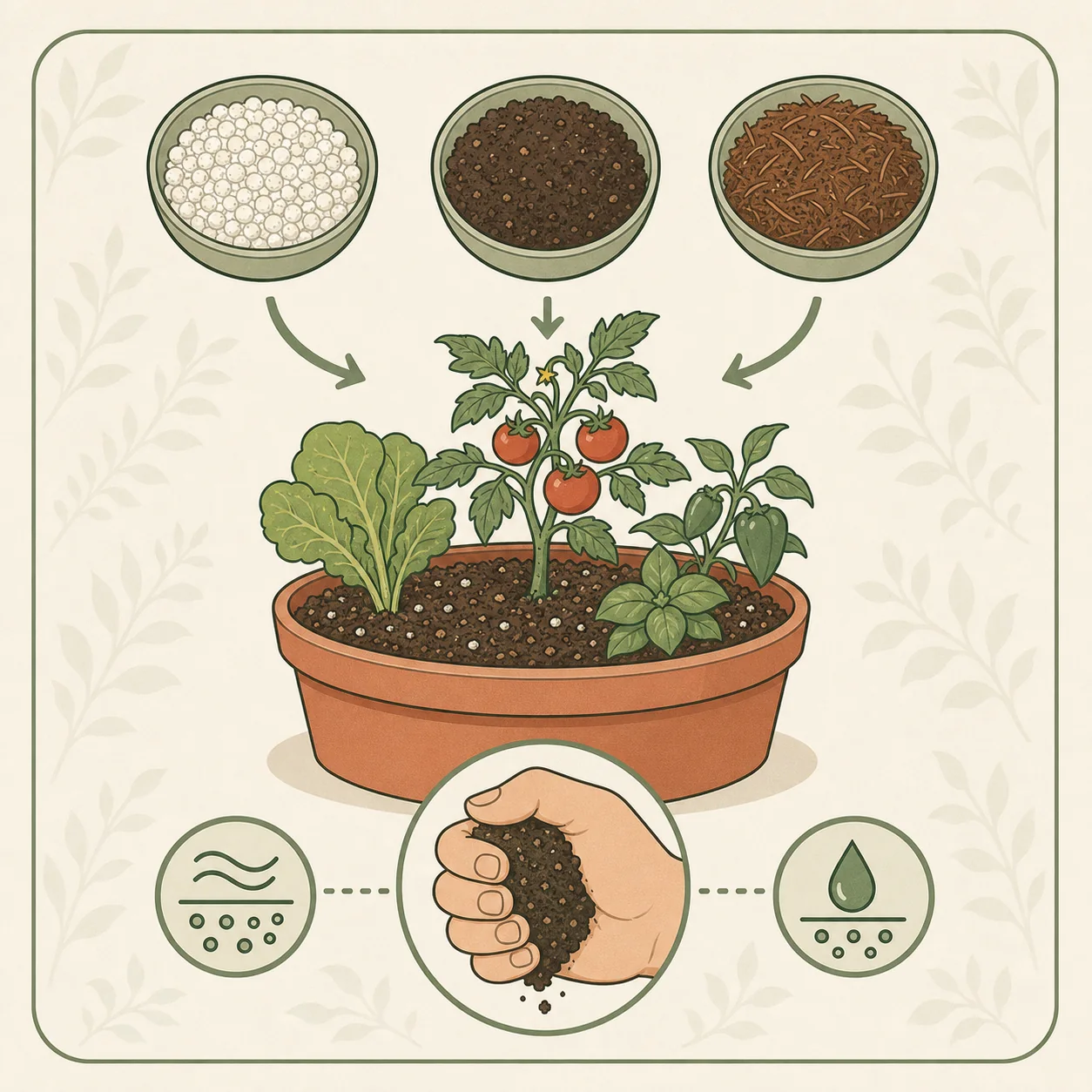
How to make potting mix for container vegetables
A useful potting mix recipe describes the job of each ingredient and gives you a way to correct the result. The goal is stable air and moisture, not a magic ratio.
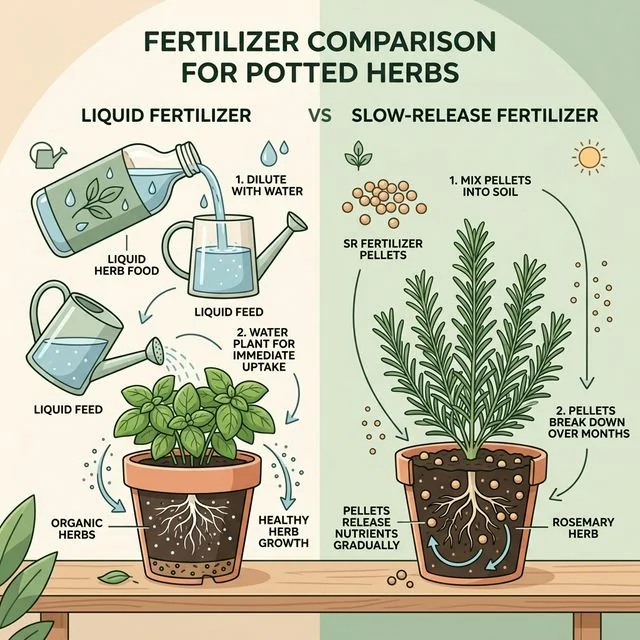
Do potted herbs need fertilizer? When to feed and avoid burn
Most potted herbs need fertilizer eventually, but timing matters. This guide explains when to feed, how often to do it, and how to avoid burning stressed roots.

Grow lights for seedlings: the complete setup
A tray of seedlings under lights needs more than a bulb overhead. It needs the right kind of fixture, a photoperiod on a timer, and a distance that changes every week as the seedlings grow.