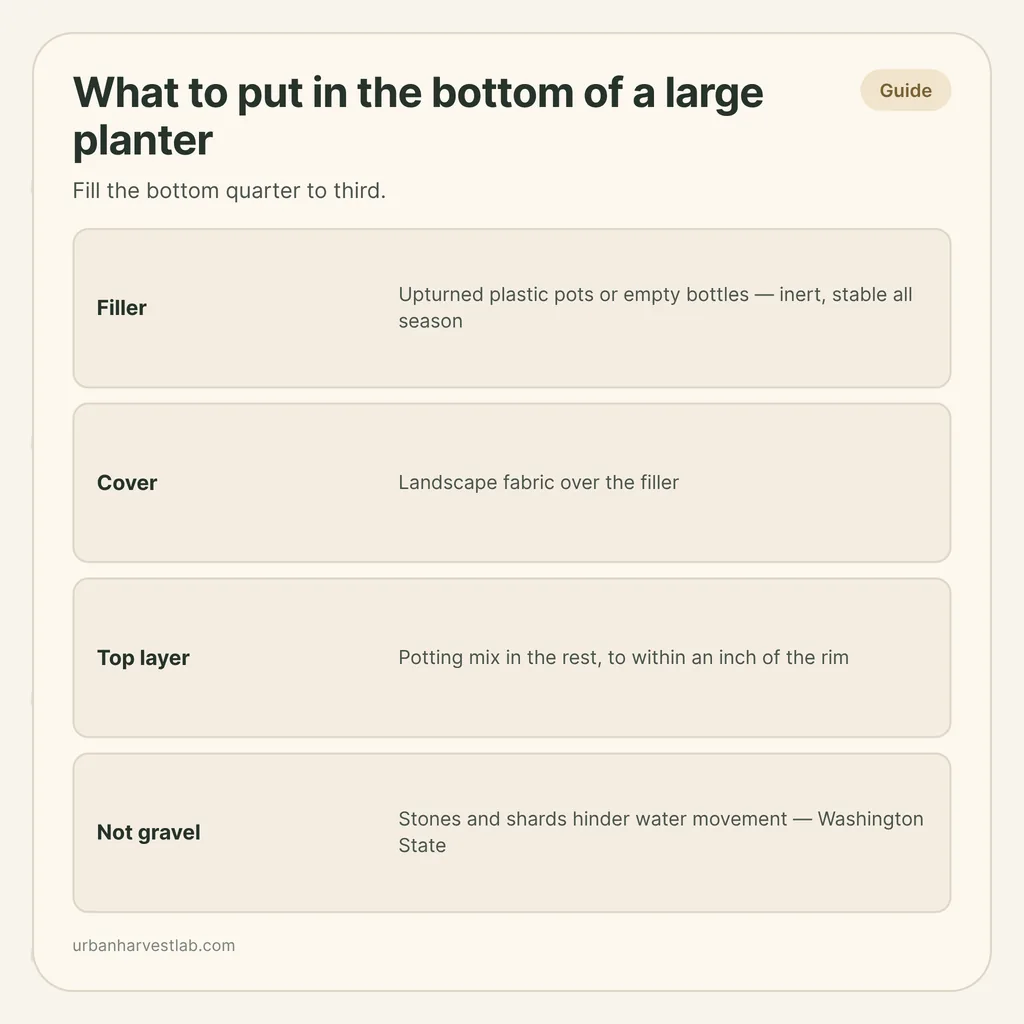
You can fill the bottom quarter to third of a deep planter with an inert, lightweight filler such as upturned plastic pots or empty bottles, cover it with landscape fabric, and put potting mix in the rest. That is the advice of University of Illinois Extension, University of Florida IFAS, Oregon State Extension and Iowa State Extension. It saves soil and weight, and it only works while the soil left above the filler is deep enough for what you are growing.
Filler is not a drainage trick. Gravel, pot shards and stones belong to a different idea, covered in the gravel-in-the-pot myth, and they do the opposite of what people hope. The question here is different: a planter so tall that filling it entirely with potting mix is expensive and heavy.
What the extension pages recommend
The pages agree on the basic move and disagree on how far to take it.
University of Illinois Extension says that to cut both the cost and the weight of a very large container, you can add “filler” to take up space. Its test for a material: it should be “inert, able to take up space and not break down over the course of the growing season.” Its examples are crushed aluminum cans, plastic milk jugs and non-biodegradable packing peanuts. The fill level it gives is the bottom one-quarter to one-third of the container, with landscape fabric laid over the top before the mix goes in.
University of Florida IFAS names packing peanuts, lava rock or empty plastic bottles, and says these materials will not affect root growth of most plants. Oregon State Extension suggests upside-down 1-gallon plastic pots at the bottom. Iowa State Extension limits the idea to containers more than 12 inches deep, and recommends putting small pieces such as peanuts in mesh bags so they are easy to empty in the fall and do not scatter around the yard.
One extension page cautions against it. A Kansas State Research and Extension (Johnson County) container guide from 2006 says not to put rock gravel or Styrofoam peanuts in the bottom of large pots, because the soil should be as deep as possible to encourage deep roots and cut down on watering. That is a fair warning for deep-rooted plants. It is also why the depth section below matters more than the choice of filler.
Pick a filler that stays put
Illinois’ three conditions (inert, space-taking, stable all season) rule out most of the wrong answers.
| Filler | Extension view | Watch for |
|---|---|---|
| Upturned plastic nursery pots | Oregon State: 1-gallon pots, upside down | Illinois wants filler that stays put all season |
| Empty plastic bottles or milk jugs | UF/IFAS, Iowa State, Illinois | Empty and clean before use |
| Crushed aluminum cans | Illinois | Practical caution (not from the extension pages): crushed cans can leave sharp edges |
| Non-biodegradable packing peanuts | UF/IFAS, Illinois, Iowa State | Put in mesh bags (Iowa State) |
| Gravel, stones, pot shards | Washington State: hinders water movement; Kansas State: avoid | Heavy, and no drainage benefit |
“Non-biodegradable” is Illinois’ word, and it matters: a filler that dissolves or compresses mid-season leaves a void under the soil. Anything rigid enough to meet the same test, such as a sturdy upturned pot, does the same job.
The fabric layer is worth a few dollars. It keeps soil from washing into the gaps while letting water through, per Illinois. If you need some, you can browse landscape fabric on Amazon.
Why the soil on top must still be deep
Plant physiologist L. Art Spomer of the University of Illinois explained that a perched water table forms at the bottom of the soil “even though it has free drainage,” and “the deeper the container soil, the lesser its surface and average water content following watering and drainage.” His figure for the same soil in three containers shows the deepest likely to be too dry and the shallowest too wet.
Apply that to a filled planter: the mix above the filler is a shorter column, and by Spomer’s finding a shorter column holds more water. Washington State’s finding adds a second concern: water will not move from fine soil into a coarser layer until the finer soil is saturated. Whether a filler layer under fabric behaves like gravel has not been measured in any of the pages above; the physics suggests it might, which is a reason to keep the soil layer generous and the watering measured. Washington State is direct that planting containers must have drainage holes for root aeration, and a filler layer does not replace them.
How deep should the soil layer be?
Work backwards from the crop, then decide how much filler fits. University of Maryland Extension says it is useful to consider both the depth and the total volume of a container. Its figures come from its Salad Table, a wide frame 3.5 inches high with a mesh bottom:
| Crop | Soil depth University of Maryland Extension uses |
|---|---|
| Lettuce, arugula, kale, spinach, chard, small herbs such as parsley, cilantro and basil | The standard Salad Table frame, 3.5 inches high |
| Bush beans | Grown to the end of harvest in a 3-inch-deep Salad Table |
| Dwarf tomato, pepper, bush cucumber | A frame 9 to 10 inches deep |
Those are minimums for compact crops in wide containers. A narrow tall pot has less surface area, and big tomatoes need far more: check container depth for tomatoes, peppers and herbs or the tomato pot size page before you decide.
Worked example, using University of Illinois Extension’s fill level. In a 24-inch-tall planter, the bottom quarter to third is 6 to 8 inches of filler, leaving 16 to 18 inches of mix. That is plenty for dwarf tomatoes or peppers and for any salad crop. In a 14-inch-tall planter, the same quarter-to-third rule leaves about 9 to 10.5 inches, which matches the 9 to 10 inches University of Maryland Extension uses for compact fruiting crops.
How much weight you save
University of Maryland Extension puts soilless potting mix at approximately 10 pounds per cubic foot, before watering. A 20-inch-wide cylinder with 6 to 8 inches of filler displaces roughly 1.1 to 1.5 cubic feet of mix, about 11 to 15 pounds dry, and more once the mix is wet, by simple multiplication of those two figures. The wet total is what your balcony carries, so run the full numbers in the balcony weight limit calculator before deciding.
If a planter is still too heavy to lift, a lower or smaller container or an elevated planter box may serve you better than more filler.
Filling the planter step by step
- Check that the planter has open drainage holes.
- Put your filler into the bottom quarter to third. Use mesh bags for small pieces.
- Lay landscape fabric over the filler, overlapping the edges.
- Add potting mix to within an inch or so of the rim, as University of Maryland Extension suggests, to leave a water reservoir.
- Water and watch the first weeks. Soggy mix over the filler is the sign the soil layer is too shallow for the crop or the watering.
Sources
- University of Illinois Extension, Soil (container gardens)
- University of Florida IFAS Gardening Solutions, Container Media
- Oregon State Extension, Container gardening basics (EM 9544)
- Iowa State University Extension (Linn County), Planting a container garden
- Kansas State Research and Extension, Johnson County, Contain Yourself: Creating a Unique Potted Garden
- Washington State University Extension, L. Chalker-Scott, The Myth of Drainage Material in Container Plantings
- L. Art Spomer, University of Illinois, Container Soils Are Different (1976), Ornamentals Northwest Archives
- University of Maryland Extension, Growing Vegetables in Containers and Salad Tables
Planter depth, drainage and weight
The physics of gravel layers, how much a filled planter weighs, and how deep each crop needs its soil.
Common questions
What can I put in the bottom of a large planter instead of soil?
Extension pages name empty plastic bottles, upturned plastic nursery pots, crushed aluminum cans, plastic milk jugs and non-biodegradable packing peanuts. University of Illinois Extension asks for something inert that will not break down over the season, and recommends covering it with landscape fabric.
How much of the planter can I fill with filler?
University of Illinois Extension fills the bottom one-quarter to one-third of the container. Iowa State Extension suggests filler only when the container is more than 12 inches deep. Whatever you use, the soil above it has to be deep enough for the crop you are growing.
Does gravel in the bottom of a planter help drainage?
No. Washington State University Extension found a gravel layer hinders water movement; drainage holes are what let water out (the gravel-in-the-pot myth page covers why).
Do vegetables grow well over a filler layer?
They can, if the soil on top is deep enough. University of Maryland Extension grows salad greens, small herbs and bush beans in a frame about 3.5 inches deep, and dwarf tomatoes, peppers and bush cucumbers in one 9 to 10 inches deep. Larger plants need more.
Related guides

Elevated planter box on a balcony: how deep, how high, how heavy
A planter box on legs is a depth decision first and a weight decision second. Here is how to size one for what you want to grow and for the floor it will stand on.
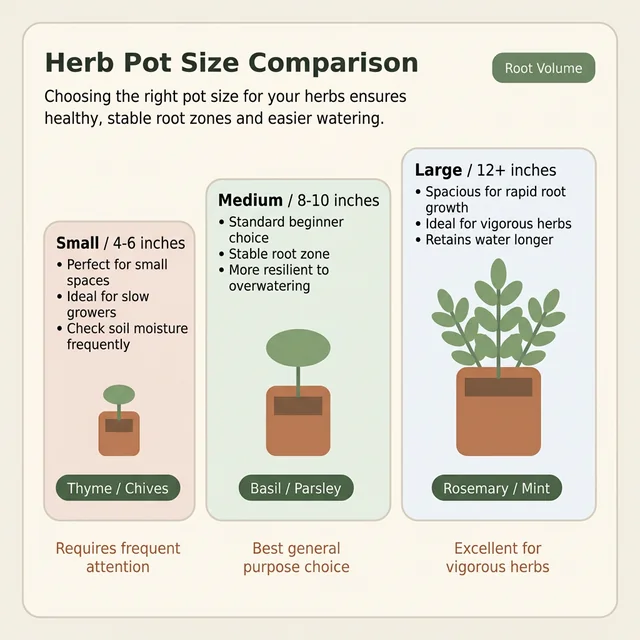
Container depth for tomatoes, peppers, and herbs: how much root space matters
Container size is one of the highest-leverage decisions in small-space gardening. When root volume is too small, every other care task becomes harder.
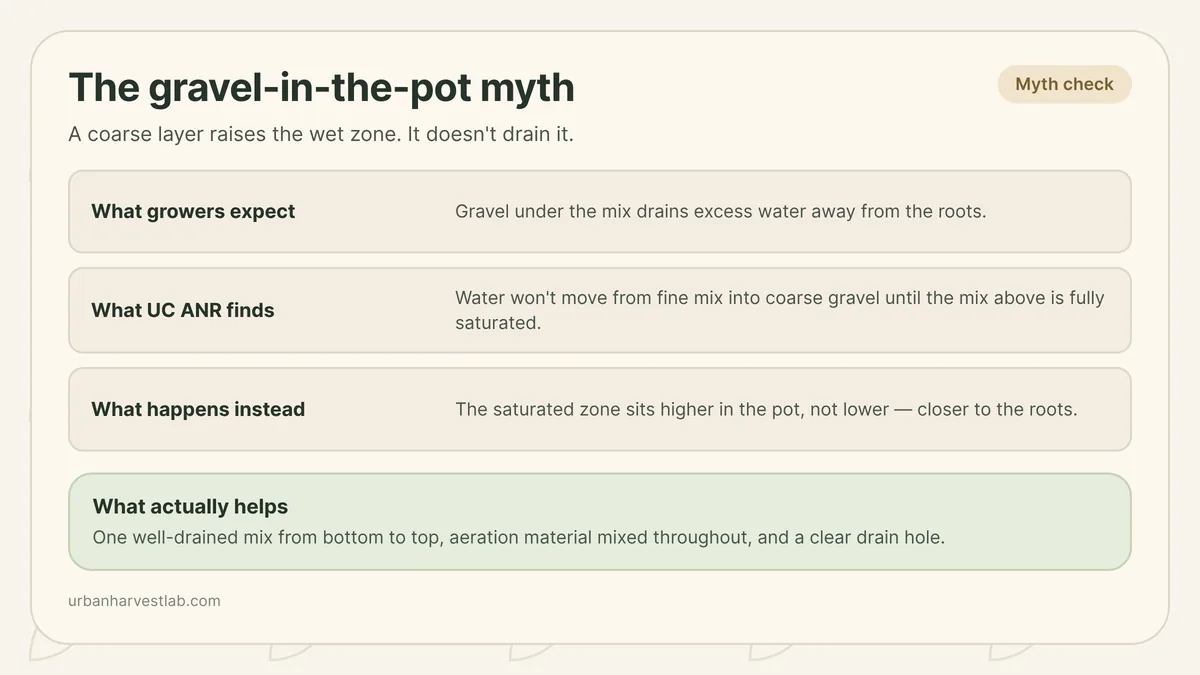
The gravel-in-the-pot myth: why it doesn't improve drainage
Putting gravel or rocks under potting mix feels like it should help drainage, but it creates a wetter zone right where roots grow, not a drier one.