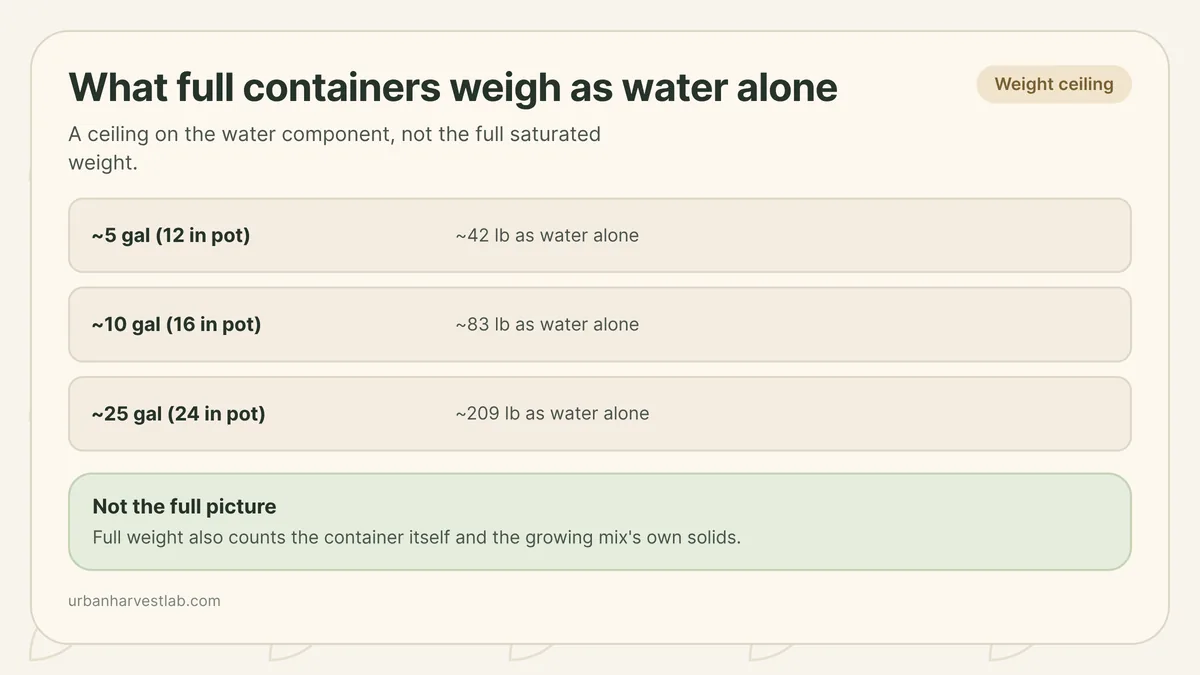
What these container volumes (University of Illinois Extension's round-pot diameter-to-volume conversion) weigh as water alone — a ceiling on the water component, not a saturated-mix estimate
| Container volume | Weight as water alone (8.34 lb/gal) |
|---|---|
| ~5 gal (12 in round pot) | ~42 lb |
| ~10 gal (16 in round pot) | ~83 lb |
| ~25 gal (24 in round pot) | ~209 lb |
A balcony’s real weight allowance is a structural fact about your specific building, not a number a web page can hand you. What you can calculate directly is your own setup’s real weight: every container’s own weight, plus the growing mix and water it holds once fully soaked, which is the heaviest a planted container gets. That total is the figure worth comparing against your building’s documentation or a professional’s assessment, and it is also the number that tells you whether a few more pots are a reasonable addition or a real increase in load. If you are still choosing which herbs and containers to start with, balcony herb garden for beginners covers that groundwork; the weight math below picks up once containers are already on the list.
Why the number varies by building, not by garden
Two balconies can look identical and carry completely different real allowances. A balcony cantilevered out from the building wall, with no post or column underneath it, is engineered around a different load path than one that rests on its own supports at the outer edge. Age and code era matter too: a balcony added or renovated under an older code, or one that has seen years of freeze-thaw cycles, water intrusion, or corrosion on its fasteners, does not necessarily carry the same reserve capacity as the day it was built, even if the original design was generous.
None of that shows up by looking at a balcony from the outside, and no combination of length, width, or railing style substitutes for the actual engineering behind it. The reliable source is the building itself: a condo or HOA’s structural documentation, the original permit and engineering drawings if they are on file with the local building department, or a structural engineer who can inspect the specific balcony and its connections. Property managers and building superintendents are often the fastest route to that paperwork, and it is worth asking before adding several large containers at once rather than after.
When you do reach a structural engineer or a building department, the more useful question is not a single weight in pounds but how that weight is meant to be spread. Engineers typically describe capacity as a load distributed over the balcony’s floor area rather than one number for the whole platform, and a cluster of heavy pots sitting on a small footprint concentrates weight in a way that spreading the same containers out does not. Asking how the design treats a concentrated cluster of containers, rather than only asking for a single limit, tends to get an answer that actually matches how a container garden sits on the floor.
The three numbers that make up your real weight
Three things add up to what a planted container actually weighs, and all three change with the seasons and the weather, not just with what you buy.
Container weight
An empty container’s own weight ranges enormously by material. A thin plastic nursery pot can weigh a couple of pounds; a glazed ceramic or concrete planter of the same size can weigh many times that before any soil goes in. Glazed vs. terracotta pots and fabric pots vs. plastic both cover how much the container material itself adds, independent of what is planted inside it. If a balcony’s load is already a concern, the container material is one of the few weight variables you control completely before you ever add soil or water.
Growing mix weight, dry versus saturated
A bag of potting mix lists its dry weight, but a container is rarely at that weight in use. Once water fills the pore space between the mix’s particles, the total climbs well past the number printed on the bag. Iowa State University Extension describes reviving a fully dried-out container by setting it in a tub of water for 20 to 30 minutes to remoisten the mix. That same rewetting process, pictured in reverse, is a useful way to think about how much lighter a container gets as it dries out between waterings, and how much heavier it gets once it is soaked through again. Planning around the saturated weight, not the weight on an average dry afternoon, is what keeps a load estimate honest, because a heavy rain or a thorough watering session pushes every container toward that saturated point at the same time.
Mix composition also shifts the number. RHS notes that herbs needing sharp drainage often get a loam-based compost built up with as much as 25 percent added coarse grit or perlite by volume. Mineral grit adds real weight; perlite is a lightweight, porous material that adds volume without adding much weight, so two mixes built for the same drainage goal can still land at different densities. A peat- or coir-based mix generally sits toward the lighter end of that range before water is even added.
Water at full saturation
Water itself is the one figure in this calculation that does not vary by brand, mix, or region: one US gallon of water weighs about 8.34 pounds. That number applies directly wherever a volume really is water — a self-watering reservoir’s fill capacity, or a pot filled with water rather than growing mix. It does not carry over cleanly to a container full of saturated mix, because the mix’s own particles occupy part of that volume and water only fills the pore space between them: a saturated 10-gallon container is neither 10 gallons of water plus the container and dry solids on top, nor simply its gallon rating times 8.34 pounds. That gap is exactly why weighing a one-gallon sample of your own soaked mix, rather than calculating from the container’s volume alone, is the only way to get a real number for your setup.
Self-watering reservoirs don’t dry out between waterings
A self-watering container’s below-soil reservoir behaves differently from the mix sitting above it. A normal pot’s weight swings between a dry day and a freshly watered one, but a self-watering reservoir is designed to stay topped up, so its water weight sits closer to a constant addition than to something that comes and goes with the week. Self-watering pots for herbs covers the tradeoffs of that wicking design on its own terms; for a weight estimate, add the reservoir’s filled volume to a container’s saturated mix weight rather than treating the two as one number.
Calculate your setup’s weight
Live estimate
Enter your own container's numbers. The water-alone figures need only the volume; the full total needs your container's weight and a sample of your own soaked mix, weighed.
Estimated total weight
—
1× this container
- Per container
- —
- Water alone, per container
- —
- Water alone, all containers
- —
To weigh your own mix, fill a one-gallon container with your growing mix after it has been thoroughly watered and left to drain for a few minutes, then weigh it on a kitchen or bathroom scale and subtract the empty container’s own weight. That single number is more useful than any general figure, because it reflects your actual bag, not an average one.
Work through one example by hand
Say a balcony holds three 16-inch ceramic planters. Each one measures about 10 gallons in volume and weighs about 18 pounds empty. A one-gallon sample of the soaked mix, weighed on a kitchen scale after draining, comes to 9.5 pounds.
Water alone in one planter: 10 gal × 8.34 lb/gal = 83.4 lb, rounded to about 83 pounds.
Full weight of one planter: 18 lb (container) + 10 gal × 9.5 lb/gal (mix) = 113 lb.
Across all three planters: 113 lb × 3 = 339 lb.
That 339-pound figure, not the water-alone figures in the table above, is the one to compare against a balcony’s documented load allowance, because it already accounts for the container and the mix’s own solids, not just the water filling the pore space between them.
A pre-planting weight checklist
- Find your building’s structural documentation — condo or HOA records, the original permit file, or a structural engineer’s assessment — before committing to several large or heavy containers, especially on an older or cantilevered balcony.
- Weigh each empty container, or use the manufacturer’s published weight if it is listed.
- Get each container’s volume in gallons; the pot size calculator includes a diameter-to-volume table for a straight-sided round pot if you only know the dimensions.
- Weigh a one-gallon sample of your own soaked growing mix rather than assuming a figure.
- Run the numbers above through the calculator for one container, then multiply by how many of that container you are planning.
- Add up every container type on the balcony separately, since a mix of pot sizes rarely averages out to one simple per-pot number.
- Recalculate whenever containers are added, swapped for larger ones, or moved to a different part of the balcony — a one-time check does not cover a setup that keeps growing.
- Plan for the fully saturated total after a heavy rain or a thorough watering, not the lighter weight on an average dry day.
Scaling beyond one balcony
The same three-part math — container, saturated mix, water — applies at any scale, but the totals climb fast once a setup covers a full rooftop rather than one balcony. Rooftop container gardening covers what changes once dozens of containers, raised beds, or larger planters are involved rather than a handful of pots along a railing.
Sources
Plan the container side of the setup
Once you know your real numbers, these guides help with sizing, materials, and scaling up to a full rooftop.
Common questions
How much weight can my balcony actually hold?
That figure comes from your building's own structural drawings, permit records, or a structural engineer who can inspect your specific balcony, because it depends on when the balcony was built, what code governed its design, and how it is physically supported. A cantilevered balcony hung off the building wall is engineered differently from one resting on its own posts or columns, so the same container garden can be fine on one and marginal on the other.
How much does potting mix weigh once it is fully saturated with water?
More than the dry bag weight suggests, because water fills the pore space between the particles. One US gallon of water alone weighs about 8.34 pounds, but that figure applies to an actual volume of water, not to a container full of saturated mix — the mix's own particles occupy part of that volume, so a soaked container is not simply its gallon rating times 8.34 pounds plus the dry solids. Weighing a one-gallon sample of your own soaked mix on a kitchen scale is the way to get an exact figure for your particular bag.
Does a bigger pot mean more weight to plan for?
Generally yes, because more volume holds more saturated mix and more water. A very free-draining mix built with extra grit or perlite changes the number somewhat, but volume is still the biggest single driver of a container's soaked weight, more than the specific plant growing in it.
Where should the heaviest pots go on a balcony?
Nearer the wall where the balcony meets the building, rather than along the outer railing, is the safer default on a cantilevered balcony. That is a reasonable precaution to apply while you are still confirming your balcony's actual documented limit, not a substitute for confirming it.
Related guides
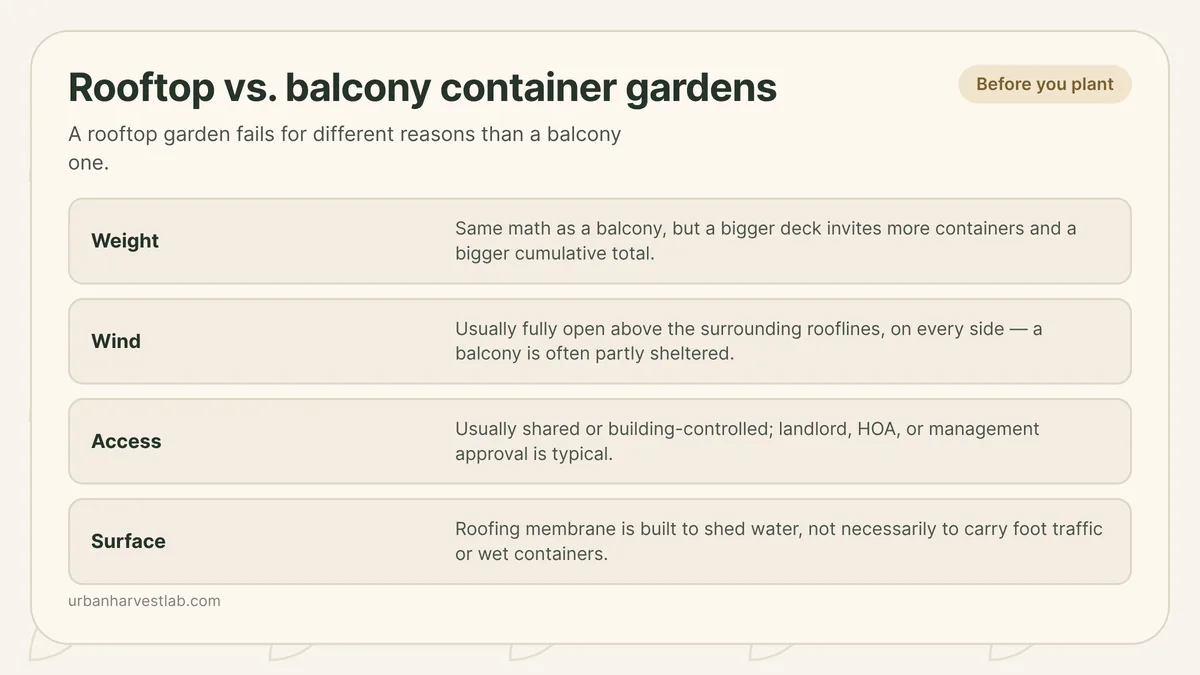
Rooftop container garden: weight, wind, and access before you plant
A rooftop looks like a bigger, sunnier balcony, but three things behave differently up there: the weight question gets more urgent, the wind gets worse, and someone else usually has to approve access before a single pot goes up.
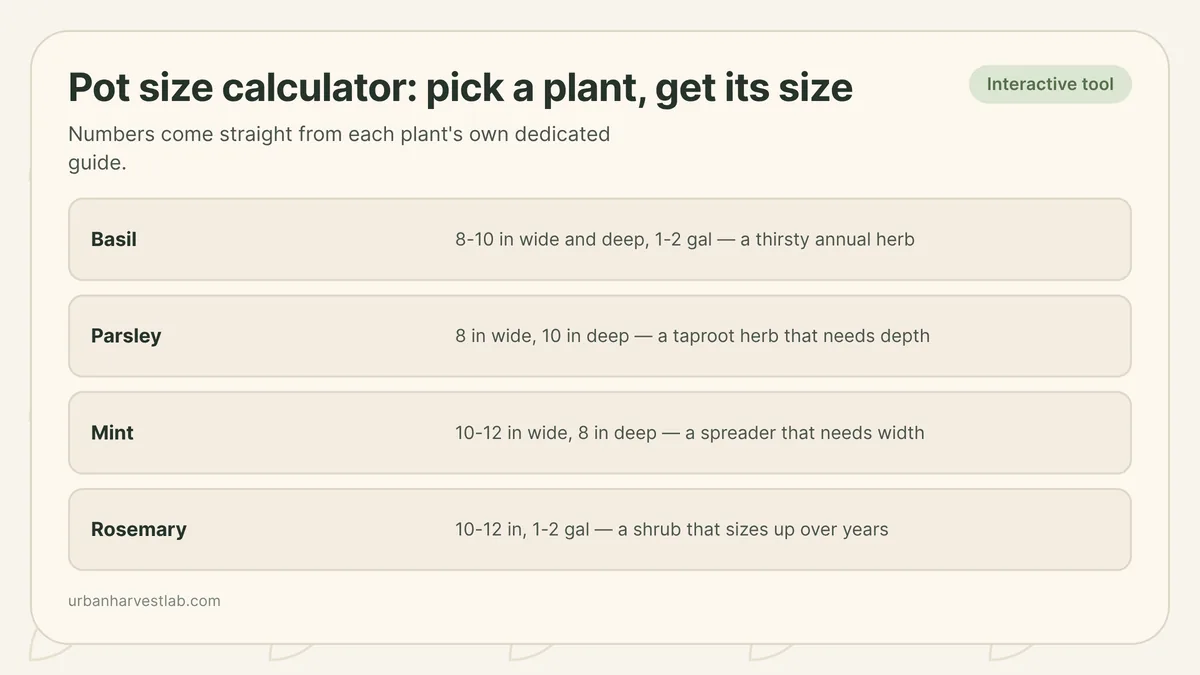
Pot size calculator: find the right container by plant and stage
A plant-and-stage picker that pulls its numbers straight from each herb's own dedicated pot-size guide, not a separate estimate.
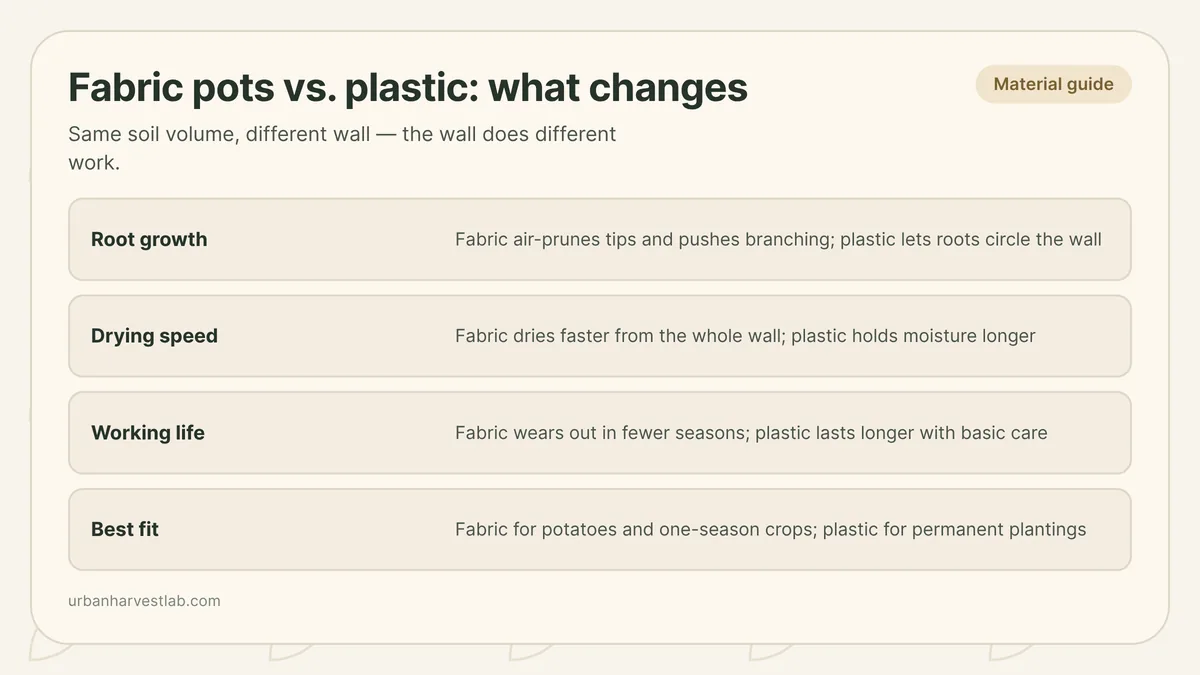
Fabric pots vs. plastic: what the wall material actually changes
A fabric pot and a plastic pot can hold the same soil volume and still grow different root systems, because the wall itself does different work.