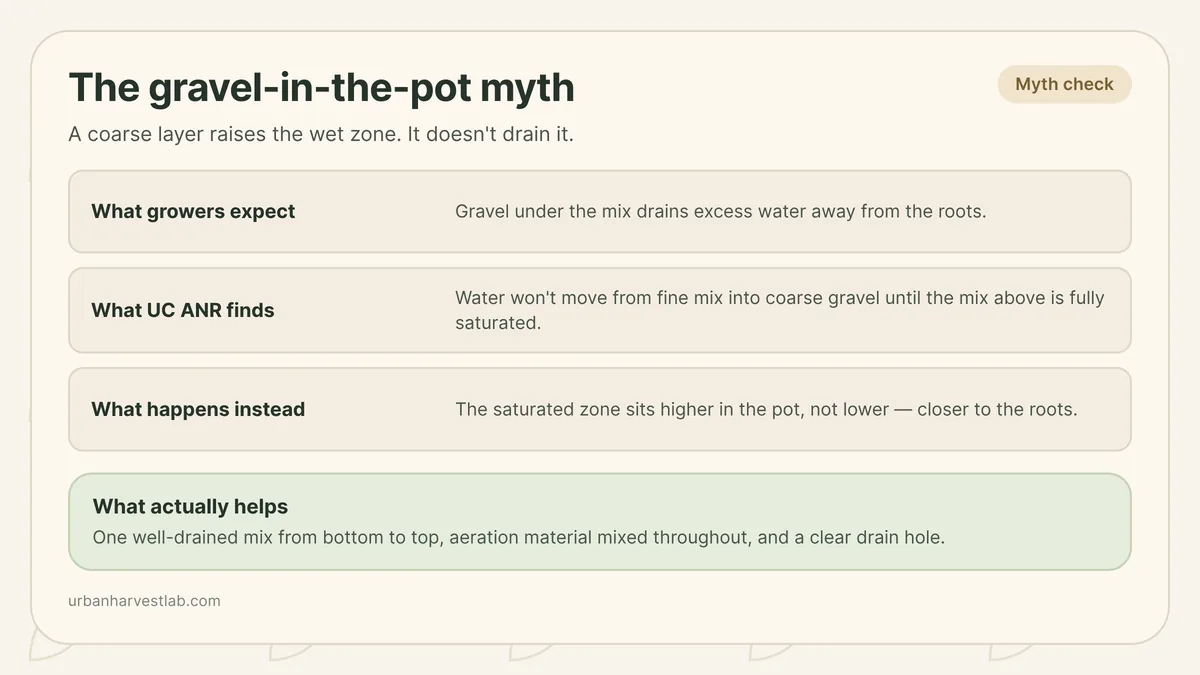
What actually happens with a gravel layer versus a single mix
| Setup | What growers expect | What happens instead |
|---|---|---|
| Gravel or rocks under potting mix | Excess water drains away from the roots faster | Water backs up above the gravel line, so the saturated zone sits higher in the pot, not lower |
| A single well-drained mix, bottom to top | Nothing to catch water on, so it should move through evenly | It does move through evenly; the mix stays wettest at the very bottom, over a much shallower depth |
| Aeration material like perlite mixed throughout the mix | More air space wherever roots are growing | Lowers the saturated zone by changing the whole mix's structure, not one isolated layer |
| A blocked or missing drain hole | Assumed to be the rare case | No layering fixes this; water has nowhere to exit no matter what sits inside the pot |
Rocks, gravel, or broken pottery shards in the bottom of a pot do not improve drainage. They raise the pot’s saturated zone higher into the root ball, not lower it, because water resists moving out of a fine-textured potting mix into a coarser material below it. The habit is old and it is intuitive, but it works against the exact problem it is meant to solve.
Getting the container and the mix right matters more than any layer inside it — the herb pot size guide covers drain-hole sizing and container proportions, and choosing a potting mix for potted herbs covers what should fill the pot instead.
Why the gravel layer feels like it should work
The logic looks sound on paper: heavy material at the bottom, lighter mix on top, water falls through the mix and collects in the gaps between the rocks, then exits the drain hole below the plant’s roots. It is the same mental model as a French drain or a gravel driveway bed, both of which do work at the scale and orientation they are built for.
A container is not that scale, and it is not built the same way. UC ANR’s Stanislaus County Master Gardeners address the claim directly: “water does not move easily from layers of fine textured materials to layers of coarser textured materials.” That single sentence is the whole mechanism, and it runs in the opposite direction from what the gravel is supposed to do.
The mechanism: a perched water table
Every container, gravel or no gravel, holds a saturated band of mix at its base once watering stops. Gravity pulls water down, but the small pores in a fine potting mix pull water sideways and up through capillary action, and the two forces settle into a boundary rather than draining the pot completely dry. That boundary is called a perched water table, and it exists in any pot at all.
Adding a coarse layer under the mix does not lower that boundary. It raises it, because water will not cross from the mix’s fine pores into the gravel’s much larger gaps until the mix directly above the gravel is completely saturated. The mix has to reach full saturation at that boundary before any of it moves into the coarse layer and out the drain hole. UC ANR is explicit that “adding such material will do just the opposite” of preventing waterlogging, and cites a study in which soil sitting above a layer of gravel held more moisture than soil sitting above a layer of sand. The gravel made the saturated band thicker and pushed it higher into the pot, not lower.
The practical result: less usable, well-aerated mix above the gravel line, and a wetter zone positioned closer to the plant’s roots than it would be without the layer at all.
What actually changes drainage in a container
None of this means containers cannot drain well. It means the fix has to change the whole profile of the mix, not add a second material underneath it. A pot that drains poorly almost always has one of these four things wrong with it, not a missing gravel layer.
- Fill the container with one well-drained mix, bottom to top. No boundary between materials means no place for the perched water table to be pushed upward.
- Mix an aeration component like perlite through the entire mix, not just into one section, so pore space and drainage are consistent at every depth roots reach. The right ratio of aeration material for herbs is a mix question, not a layering question, and it belongs with the potting mix itself rather than a base layer.
- Keep the drain hole clear. Drainage holes in pots covers a blocked or absent hole; gravel does not compensate for either.
- Match pot depth to the plant, since a shallow, wide container puts a much larger share of its total mix inside the perched, saturated zone than a taller one does at the same base saturation depth.
- Do not compact the mix while filling. Iowa State University Extension measured air-filled pore space dropping from about 15% to 9% just from tapping a filled container down, and to about 4% from pressing it firm — perlite vs pumice vs rice hulls covers that handling effect in full. Fill to level and let watering settle the mix instead.
A mesh square or a coffee filter over the drain hole, used only to stop mix from washing out, is not the same failure. That is a thin barrier, not a distinct depth of coarser material for water to accumulate against, so it does not recreate the perched-water-table problem.
Standing water compounds the same effect
A pot that sits in a saucer of standing water draws that water back up by capillary action, adding to the same saturated zone from below instead of underneath a gravel layer. Salt buildup in herb pots covers what accumulates in that zone over repeated waterings and when to flush it out. Emptying the saucer after each watering matters for the same reason removing a gravel layer does: keeping the saturated depth as shallow as possible protects the roots sitting just above it.
The same physics, in reverse, outside a container
The reason gravel fails inside a pot is the same reason garden soil struggles inside a pot in the first place. In open ground, water has nowhere to go but down, so a fine-over-coarse boundary rarely matters. Inside a container, that boundary is unavoidable at the drain hole no matter what fills the pot. University of Maryland Extension notes that garden or mineral soil “physically do[es] not hold up well under repeated watering” in a container and rapidly compacts, the same confinement effect that makes a coarse layer misbehave at the bottom of the pot. Potting mix versus raised bed soil for herb containers walks through that comparison in more depth.
Self-watering containers are a different design, not an exception
A self-watering or wicking planter, with its own built-in water reservoir below the growing mix, can look like a counterexample to everything above — deliberately keeping a wet layer under the roots, on purpose. It is not the same mechanism: it is a designed sub-irrigation system with an engineered overflow limit, not a loose layer improvised under an ordinary pot. Self-watering pots for herbs covers how the wick and reservoir actually behave. A working self-watering pot is not proof that gravel under an ordinary container does the same job — the reservoir’s engineered overflow is doing the work the myth assumes gravel does on its own.
If a pot already has gravel in it
There is no partial fix. Tip the plant out, remove the gravel entirely, and repot with a single mix filling the container from the drain hole to the surface. Trying to compensate with a thinner gravel layer, a different size of stone, or extra material on top still recreates the same fine-over-coarse boundary at whatever depth the gravel sits.
Sources
Get the container and mix right together
The gravel layer is one piece of a bigger drainage picture. These cover the pot and the mix itself.
Common questions
Do rocks in the bottom of a pot help with drainage?
No. Water moves poorly from a fine-textured potting mix into a coarser layer like gravel, so the mix above the rocks stays saturated longer, not less, before any water reaches the drain hole. UC ANR describes the effect as the opposite of what growers intend.
What is a perched water table in a pot?
It is the zone of saturated mix that sits at the bottom of any container once gravity and the pull of water into small pores reach a balance. A coarser layer under the mix raises that saturated zone higher, closer to the roots, instead of draining it away.
Should I put pot shards, packing peanuts, or a coffee filter over the drain hole?
A single piece of mesh or a coffee filter to stop mix from washing out the hole does not create the layering problem, because it is not a distinct depth of coarse material for water to catch on. A layer of shards, gravel, or foam thick enough to change the container profile behaves the same as a gravel layer.
What should I do if my pot already has gravel in the bottom?
Tip the plant out, remove the gravel, and repot with a single well-drained mix filling the container from the drain hole to the surface. There is no way to correct the perched water table without changing what is under the roots.
Related guides
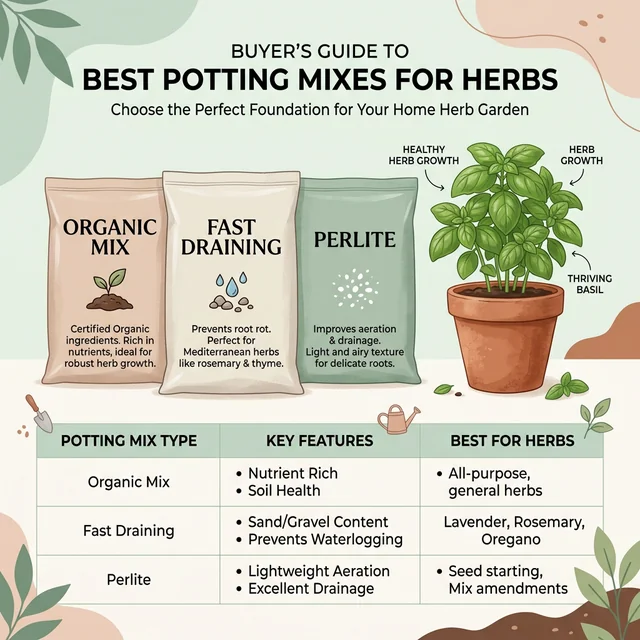
Best potting soil for potted herbs: how to pick the right mix
A practical buyer's guide to choosing potting mix for potted herbs, from richer blends for basil and parsley to faster-draining options for rosemary and thyme.
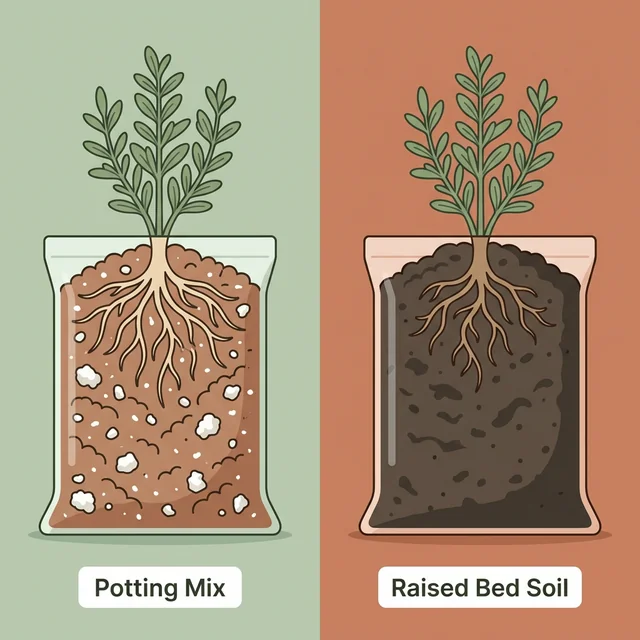
Potting mix vs. raised bed soil for herb containers
Using the wrong dirt is the fastest way to kill a potted herb. This guide explains the critical difference between indoor potting mix and outdoor raised bed soil.
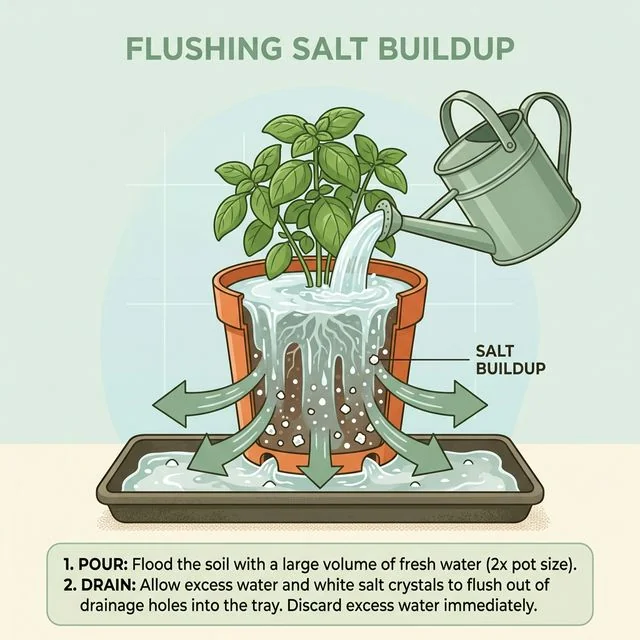
Salt buildup in herb pots: when to flush and when to repot
Every time you water your plants with liquid fertilizer, you are leaving heavy chemical salts behind. If you don't periodically wash them out, your herbs will suffer from chemical burn and nutrient lockout.