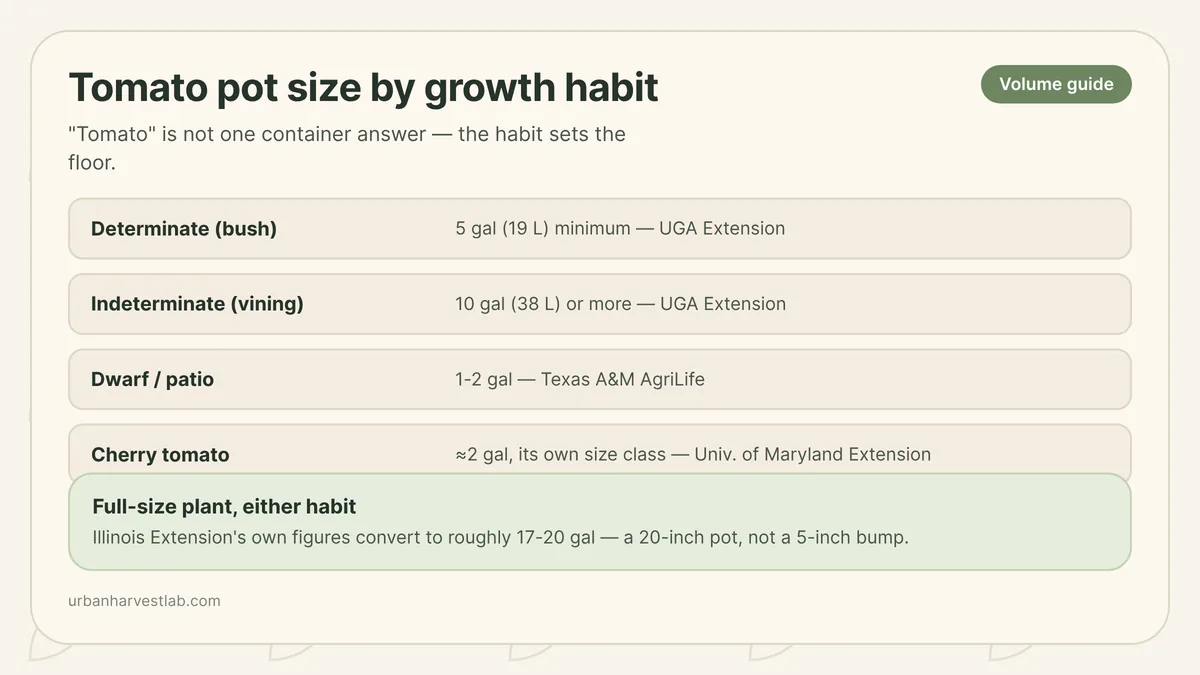
Tomato container volume by growth habit
| Growth habit | Practical minimum | Source |
|---|---|---|
| Determinate (bush) | 5 gal (19 L) | UGA Extension |
| Indeterminate (vining) | 10 gal (38 L) or more | UGA Extension |
| Standard tomato, any habit | 5 gal minimum, 15 gal for less watering | Texas A&M AgriLife |
| Full-size plant, either habit | ≈17-20 gal (20 in+ diameter) | Illinois Extension |
| Cherry tomato | ≈2 gal | University of Maryland Extension |
| Dwarf / patio | 1-2 gal | Texas A&M AgriLife |
| Compact / patio cultivar | 14-20 in diameter, or a 5-gal bucket | Clemson Extension |
Determinate tomatoes need at least 5 gallons of soil per plant, and indeterminate tomatoes need at least 10 — but that is only the middle of the range. Illinois Extension’s own figures for a full-size plant convert to closer to 17 to 20 gallons, and dwarf or patio varieties get by on a fraction of either number. The container that actually fits your tomato depends on which of these three plants you are growing, not on “tomato” as a single category. For how deep that volume needs to go, and how the same numbers compare against peppers and herbs, container depth for tomatoes, peppers, and herbs covers the depth side of the same question; the numbers below are about total soil volume, sorted by growth habit.
Check the seed packet before you pick a pot
Growth habit is printed on nearly every tomato seed packet or plant tag, usually as a single word, and it decides which figure below actually applies. “Determinate” or “bush” means the plant is bred to stop growing at a set height once it sets its first flush of flowers. “Indeterminate” or “vining” means the plant keeps producing new stems and flowers until frost or disease stops it, which is why its root demand keeps climbing all season instead of leveling off. “Dwarf,” “micro-dwarf,” or “patio” describes a plant bred to stay compact regardless of habit — a dwarf tomato can be determinate or indeterminate underneath, but its overall size, and its container requirement, is smaller either way. If the label is missing or the plant came from a friend’s saved seed, indeterminate is the safer assumption: undersizing an indeterminate plant costs a full season of stalled growth, while oversizing a determinate one costs only a slightly bigger pot to store at the end of the year.
Determinate tomatoes: 5 gallons is the floor, not the target
Determinate, or “bush,” tomatoes stop growing once they set their first flush of fruit, which caps how large the root system gets. University of Georgia Extension’s Fulton County office lists 5 gallons as the figure for a determinate plant, and North Carolina A&T’s cooperative extension agrees that tomatoes, peppers and eggplant alike need at least 5 gallons, without splitting the number by growth habit. Texas A&M AgriLife Extension frames 5 gallons as the “most suitable size” for the same three crops, but adds a caveat worth taking seriously: a 15-gallon container will result in less watering and a more productive plant than a 5-gallon one, for the identical plant. Five gallons is where a determinate tomato survives; more volume is where it stops needing daily attention.
Indeterminate tomatoes: 10 gallons, and some sources go much higher
Indeterminate, or “vining,” tomatoes keep growing until frost or disease shuts them down, so their root demand climbs through the whole season rather than leveling off. UGA Extension puts the practical minimum at 10 gallons, roughly double the determinate figure. Clemson Cooperative Extension’s household and garden information center is blunter about the downside of undersizing: an indeterminate tomato is “not successful in a 12-inch pot,” full stop.
The widest figure in the whole comparison comes from Illinois Extension, which recommends a container at least 20 inches in diameter for tomatoes. Using Illinois’s own diameter-to-volume conversion for straight-sided round pots, a 20-inch container holds roughly 17 to 20 gallons — three to four times the 5-gallon figure that gets repeated as the standard tomato answer. That is not a typo or a rounding difference between two similar sources; it is one extension service describing a materially bigger container as the real requirement for a full-size plant. Treat 5 gallons as survivable for a determinate plant and 10 as workable for an indeterminate one, and treat 17 to 20 gallons as what Illinois Extension considers correct sizing rather than a bare minimum.
Dwarf and patio tomatoes are the outlier, not the default
Compact “micro-dwarf” and patio cultivars are the one place the numbers collapse back down. Texas A&M lists dwarf and patio types as workable at 1 to 2 gallons, a fraction of the standard-size figure for the same species. Clemson’s guidance for compact and patio cultivars gives 14 to 20 inches in diameter, or a 5-gallon bucket with drainage holes — noticeably more generous than Texas A&M’s 1-to-2-gallon floor, which is worth knowing if a “dwarf tomato” pot recommendation online looks smaller than what actually keeps one productive through a full season. Choosing the variety itself, and matching pruning and support to a compact plant, is its own decision; growing dwarf tomatoes in pots on a small balcony covers that side of it. What matters here is that “dwarf” and “determinate” are not the same word — a dwarf plant is bred to stay small regardless of habit, which is why its container figure sits below even the determinate minimum.
Cherry tomatoes get their own bracket
University of Maryland Extension does not lump cherry tomatoes in with standard-size fruit: its figures are 5 gallons for standard tomatoes and roughly 2 gallons for cherry tomatoes, treating cherry as its own size class rather than a smaller version of the same number. A cherry tomato plant can still be determinate or indeterminate in habit, so a vining cherry variety benefits from more than 2 gallons even though the fruit stays small — the habit, not the fruit size, is what drives root demand.
Diameter to gallons, if you’re measuring a pot you already have
Most container labels give a diameter, not a gallon figure, so converting between the two is often the actual bottleneck. Illinois Extension’s conversion table, built for straight-sided round pots, gives the closest approximation available:
| Diameter | Approximate volume |
|---|---|
| 10 in | 3 gal |
| 12 in | 5 gal |
| 14 in | 7 gal |
| 16 in | 10 gal |
| 18 in | 15 gal |
| 20 in | ≈17-20 gal (interpolated) |
| 24 in | 25 gal |
| 30 in | 30 gal |
This table is specific to the pot shapes Illinois Extension modeled — a tapered or square container of the same listed diameter will hold a different volume, usually a bit less toward the base. The Royal Horticultural Society’s UK figure for tomatoes lines up with the low end of this table: at least a 30 cm (12 in) pot per plant, or plants spaced 35 to 45 cm (14 to 18 in) apart in a deep trough or windowbox, or two plants per standard growing bag.
A 5-gallon bucket works, if it’s food-safe
A plain plastic bucket is one of the cheapest ways to hit the 5-gallon determinate figure, but not every bucket is safe to grow food in. University of Maryland Extension identifies recycling codes #2 (HDPE) and #5 (PP) as food-safe plastics, and recommends looking for a “food grade” or “FDA approved” label, or the glass-and-fork symbol; it flags #3 (PVC), #6 (polystyrene) and #7 (polycarbonate/BPA) to avoid. A bucket that previously held anything non-food — paint, solvents, cleaning chemicals — does not become food-safe again just because it is stamped #2, according to the same source. University of Kentucky Cooperative Extension puts a 4-to-5-gallon bucket in its own recommended range for one tomato plant, and makes the same point about sourcing: a restaurant or bakery giving away used food-grade buckets is usually a safer bet than an unlabeled bucket from a hardware aisle.
Self-watering containers can hold a tomato plant
University of Maryland Extension’s own demonstration design for a self-watering, sub-irrigated container is built and shown working with a tomato plant: growing medium sits on a perforated platform above a water reservoir, with no bottom drainage hole and only a side overflow, and roots grow down toward the water while it wicks upward into the mix. Filling the reservoir takes about 2 to 3 gallons to start, and keeping it topped up during peak growth takes roughly 1 to 2 quarts a day. The reservoir sits below the growing medium in these designs, so it is not counted toward the pot’s soil-volume figure — a self-watering container still needs the same 5-to-10-gallon soil volume above the reservoir that a standard pot would.
Skip the gravel layer
A tomato pot is deep and gets watered heavily all season, so a perched water table caused by a gravel layer at the bottom sits directly under the root ball for months rather than weeks — pot drainage holes covers the mechanism and why the fix is drainage holes and a uniform mix, not gravel.
A tall plant needs a pot that will not tip
Volume is not the only thing a full-grown tomato asks of its container. A staked or caged indeterminate plant carries several feet of stem and a heavy fruit load well above the rim, and a lightweight pot sized correctly for soil volume can still go over in wind if the container itself is not heavy or wide-based enough to counter that weight. Illinois Extension notes that plastic, resin and fiberglass containers are lighter to move than clay or ceramic but more prone to tipping once a large, top-heavy plant fills them, so anchor the support stake or cage into the ground or a patio surface next to the pot rather than relying on the container alone to hold it upright. This matters more for indeterminate plants in 10-gallon-and-up containers than for a squat determinate or dwarf plant, which rarely grows tall enough for wind to become the limiting factor.
Growing more than one plant per pot
The volume figures above are all per plant, and doubling up in one container without doubling the volume recreates the same undersizing problem from a different angle. The Royal Horticultural Society’s guidance for a trough or windowbox is to space tomato plants 35 to 45 cm (14 to 18 in) apart, or to plant two per standard growing bag rather than crowding more into the same footprint. A determinate or dwarf plant tolerates closer spacing than an indeterminate one, simply because its root system stays smaller for the whole season, but neither benefits from being planted at seedling spacing and left there once the canopy fills in.
Repotting as the plant outgrows a seedling pot
A tomato seedling from a nursery six-pack does not need its final container on day one, but waiting too long to size up costs more growth than it saves in pot-shopping. Watch for roots crowding the drainage holes or the plant wilting within hours of a thorough watering — the container depth guide covers reading those signs in full. Move up toward the full determinate or indeterminate figure above rather than one size at a time; a tomato’s root system expands fast enough in warm weather that a half-measure gets outgrown again within a few weeks. For balcony growers still deciding whether a full-size tomato fits the space at all, best vegetables for small balconies is the earlier planning step. Once the pot is sized correctly, what you fill it with matters almost as much: how to make potting mix for container vegetables and a fertilizer schedule for container vegetables cover the two questions that follow.
Sources
- Texas A&M AgriLife Extension E-545, “Vegetable Gardening in Containers”
- University of Illinois Extension, “How to Grow Fruits, Vegetables, Herbs in Container Gardens”
- UGA Fulton County Extension, “Container Gardening: Thinking Outside the Box”
- University of Maryland Extension, “Growing Vegetables in Containers and Salad Tables”
- University of Maryland Extension, “Self-Watering Containers”
- Clemson Cooperative Extension HGIC, “Tomatoes in Containers”
- North Carolina A&T State University Cooperative Extension, “Growing Fruiting Vegetables in Containers: Tomato, Pepper and Eggplant”
- Washington State University Extension, “The Myth of Drainage Material in Container Plantings”
- Royal Horticultural Society, “Grow your own tomatoes in a pot”
- University of Kentucky Cooperative Extension, “Vegetables Grown in Containers Improves Accessibility”
Once the pot is sized
These guides pick up where pot size leaves off: what to fill it with, how to feed it, and how much space the plant needs on a balcony.
Common questions
What size pot do tomatoes need?
It depends on the growth habit. Determinate (bush) tomatoes need at least 5 gallons per plant. Indeterminate (vining) tomatoes need at least 10 gallons, and some extension guidance puts the real minimum for a full-size plant of either type closer to 17 to 20 gallons. Micro-dwarf tomatoes are the exception, at 1 to 2 gallons per Texas A&M AgriLife Extension; patio-cultivar dwarfs need more room, with Clemson Cooperative Extension putting them at 14 to 20 inches, roughly a 5-gallon bucket.
Is a 5-gallon bucket big enough for a tomato plant?
For a determinate variety, yes, according to most US extension figures. For an indeterminate variety, no. Clemson Cooperative Extension is explicit that an indeterminate tomato is not successful in a pot that small, and Illinois Extension's figures suggest a full-size plant of either type does better in 17 gallons or more.
How many gallons is a 20-inch pot?
Roughly 17 to 20 gallons, on the diameter-to-volume conversion Illinois Extension publishes for straight-sided round containers. That table is an approximation for that pot shape specifically, not a universal formula, so a tapered or square container will not match it exactly.
Can two tomato plants share one pot?
Only if the pot is sized for two. The Royal Horticultural Society recommends spacing tomato plants 14 to 18 inches apart in a trough or windowbox, or two plants per standard growing bag, rather than putting two full root systems into a single small pot.
Related guides
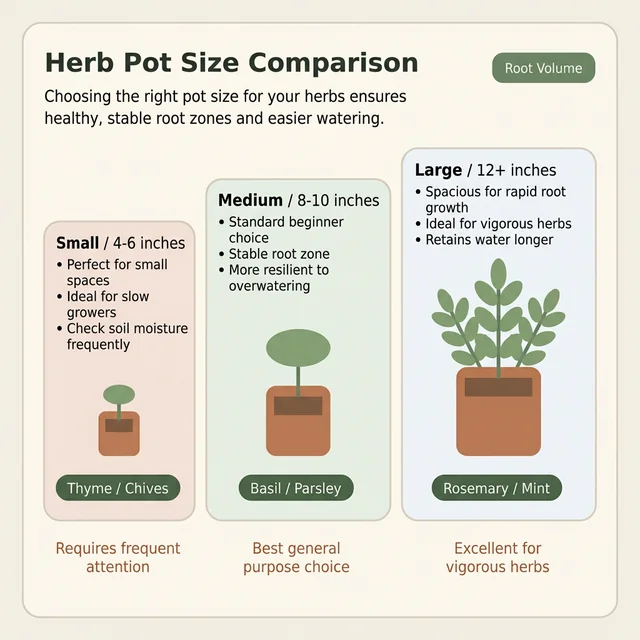
Container depth for tomatoes, peppers, and herbs: how much root space matters
Container size is one of the highest-leverage decisions in small-space gardening. When root volume is too small, every other care task becomes harder.
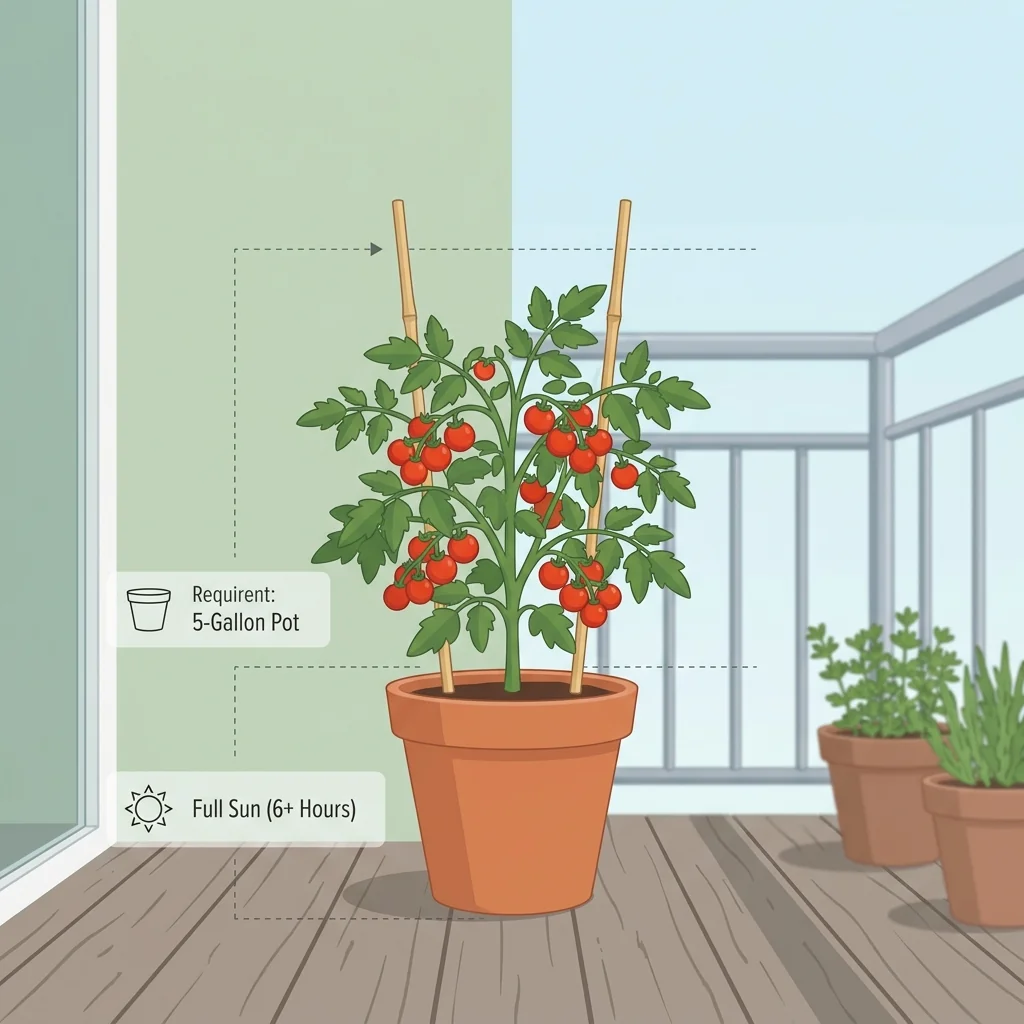
How to grow dwarf tomatoes in pots on a small balcony
Traditional tomato plants grow into massive, untameable 8-foot jungle vines that require giant cages and take over your entire balcony. But with modern 'micro-dwarf' or patio tomato varieties, you can grow heavy yields of sweet cherry tomatoes on a plant that stays under 2 feet tall. Here is the dwarf tomato container blueprint.
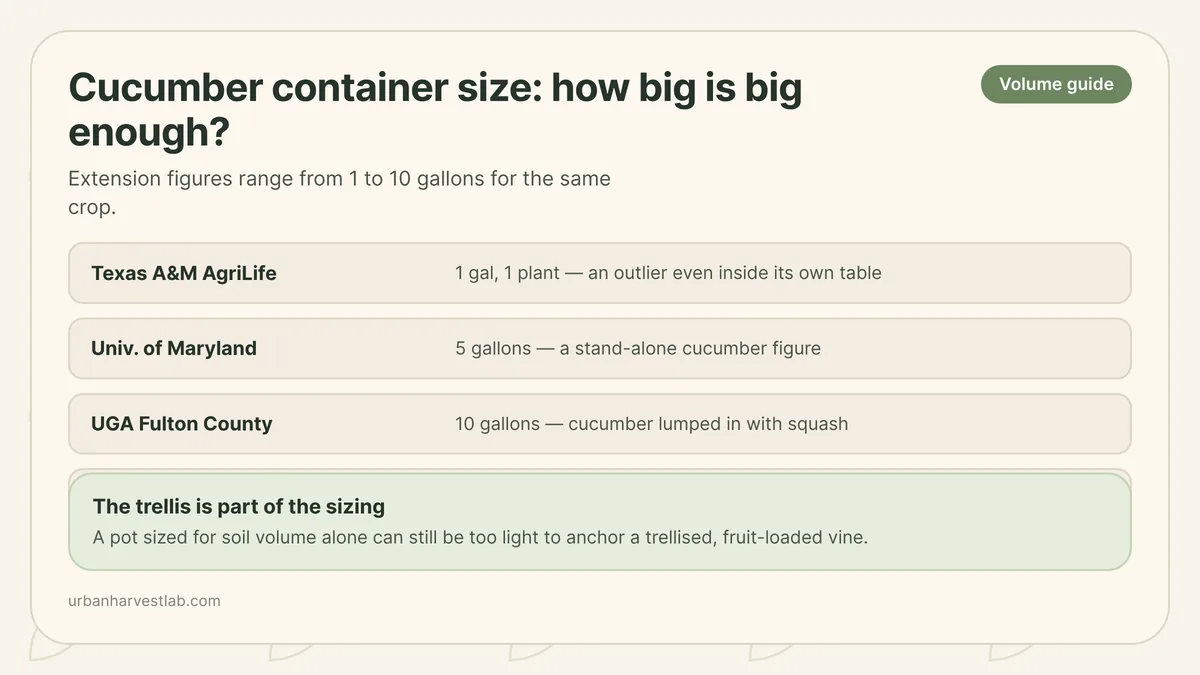
Container size for cucumbers: how big a pot do they really need
Cucumbers are vines with a fruit load to support, and extension sources disagree sharply on how much container that takes. The safer number is bigger than the smallest one you will find.