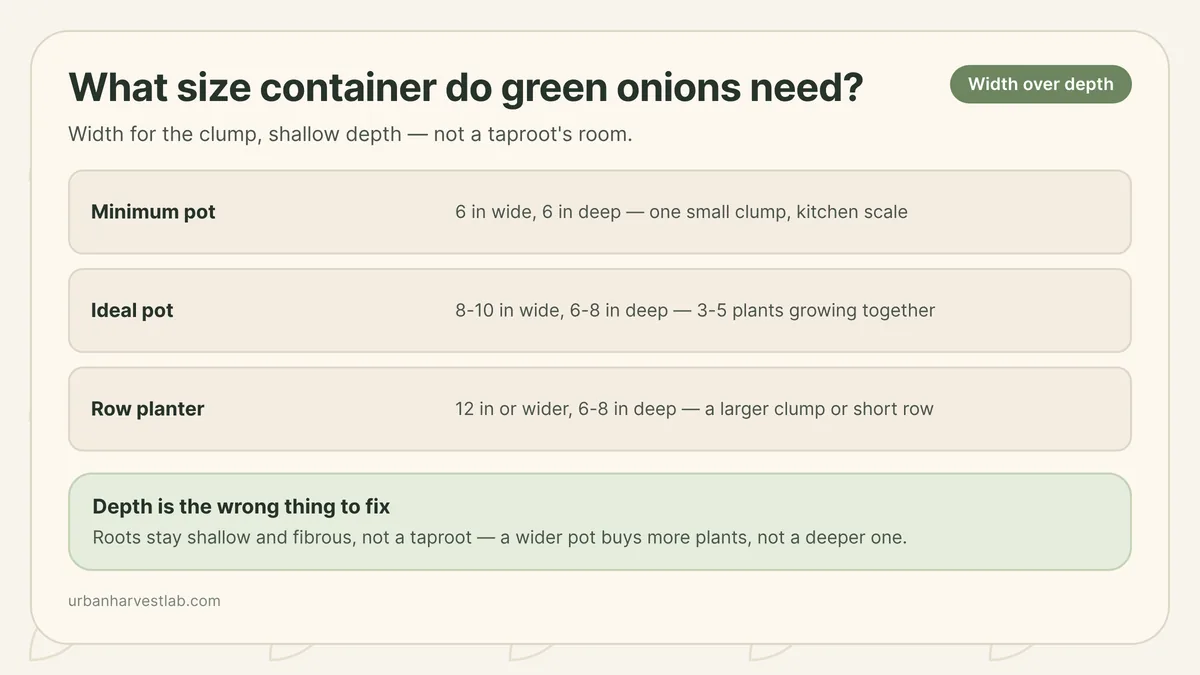
Green onion container size at a glance
| Container | Size | Best for |
|---|---|---|
| Minimum pot | 6 in wide, 6 in deep (15 cm) | One small clump, kitchen scale |
| Ideal pot | 8-10 in wide, 6-8 in deep (20-25 cm) | 3-5 plants growing together |
| Row planter | 12 in or wider, 6-8 in deep | A larger clump or short row, at Texas A&M's 3-5 plants per gallon |
A green onion plant needs a container 6 to 10 inches in diameter and 6 to 8 inches deep — figures from Texas A&M AgriLife Extension and University of Kentucky Cooperative Extension — and a single 1-gallon pot comfortably holds three to five plants. That is a smaller footprint than most kitchen herbs get credit for: green onions want width for the clump and shallow, well-drained soil, not the deep taproot room that parsley or carrots need. For where green onions sit next to the herbs that do want more depth, see the main herb pot size chart.
One gallon, three to five plants: what the extension tables say
Texas A&M AgriLife Extension’s container-vegetable table gives green onion 1 gallon of soil for three to five plants — a tight, workable number for a crop most people grow in a clump rather than one at a time. The same publication’s general note for pots in this size class, that “pots from 6 to 10 inches in size are satisfactory for green onion, parsley and herbs,” puts the low end of the range even smaller than the 1-gallon figure implies.
University of Illinois Extension gives a wider minimum: at least 10 inches in diameter for green onion, which it groups with radish, beets, and other leafy or bulb crops that share that same floor. On Illinois’s own diameter-to-volume table, a 10-inch pot holds roughly 3 gallons — more soil than Texas A&M’s figure, though the two are not contradicting each other so much as answering slightly different questions: how little pot the crop tolerates versus how much room keeps it comfortable. Either width works; a 6-inch pot is a workable minimum for one clump, and 10 inches gives a fuller row more breathing room.
On depth, University of Kentucky Cooperative Extension groups green onion with beets, kale, lettuce, radish, spinach, chard, and turnip as crops where 6 to 8 inches of soil depth is adequate. That is shallower than most people assume before checking, and it is the figure that matters most for this crop: green onions build a mat of shallow, fibrous roots rather than a single root that plunges downward, so a deep pot mostly adds soil the roots rarely reach. That extra depth then holds water longer than the root zone can use, which is the same mechanism that makes an oversized pot slower-draining rather than more forgiving.
Depth is the wrong thing to fix; width is the real lever
Because the root system is shallow and fibrous, the practical way to grow more green onions is a wider container, not a deeper one. A 6-inch pot supports one small clump. Stepping up toward the wider end of that same diameter range, at the same shallow depth, is what buys room for three to five plants side by side rather than one. A long, shallow trough extends the same logic further: a 12-inch-or-wider planter at that same depth carries Texas A&M’s 3-to-5-plants-per-gallon rate across a larger volume — a wider row rather than a fixed head count — which is closer to a cut-and-come-again kitchen supply than a single clump ever gets you.
Growing from seed or sets, versus finishing a regrown bulb in soil
Seed or sets started directly in soil should go straight into a container sized as above — there is no separate figure for starts versus mature plants once true roots are in place. A green onion regrown from the root end of a store-bought bunch is a different starting point but the same finishing pot. How to regrow green onions in water, then soil covers the water-rooting step; once that base has grown a short mat of new roots, it moves into ordinary potting soil at the same shallow depth covered above. The container it moves into matters more than people expect at that stage. A repurposed yogurt tub, disposable cup, or leftover food container is a common choice for this step, and if you are reusing one, it needs to be food-safe rather than just watertight.
University of Maryland Extension’s guidance on food-safe containers is specific: plastics stamped with recycling code #2 (HDPE) or #5 (PP), or labeled “food grade” or “FDA approved,” are the safe choices, while #3 (PVC), #6 (polystyrene), and #7 (polycarbonate, which can contain BPA) should be avoided for growing anything you plan to eat. The same guidance is blunt about one further point: a bucket or tub that ever held something non-food — paint, solvent, cleaning chemicals — is not food-safe again, even if the plastic itself is stamped #2. For a crop routinely started in whatever container is on hand, that is worth checking before the onion goes into it, not after.
Whatever the container, drainage holes are not optional. A shallow-rooted crop sitting in standing water at the bottom of a pot is one of the more common ways a promising green onion clump rots at the base instead of thickening. Container choice, materials, and the difference between plastic and unglazed clay for drying speed are covered in full in best containers for herbs; the short version for green onion is that University of Illinois Extension notes porous materials such as clay dry out faster than plastic or glazed ceramic, which at this shallow depth means less buffer against the surface drying out between waterings.
One pot, several stalks: spacing and how big a clump gets
Texas A&M’s three-to-five-plants-per-gallon figure is really a spacing rule in disguise: green onions tolerate close company far better than most vegetables, which is why a single small pot can carry a useful little harvest rather than one lonely stalk. Scale it up roughly in proportion — a 2- to 3-gallon container supports a denser row, and the 12-inch trough above works the same math at a larger size. Chives follow a nearly identical pattern for the same reason: both are clump-forming plants that grow from a cluster of small bulbs rather than a single root, which is why the chives pot size guide reaches a similar shallow, compact recommendation from a different crop.
When to thin the clump instead of upsizing the pot
A clump that has grown past Texas A&M’s three-to-five-per-gallon density is past what the pot supports, whether or not it visibly wilts. At that point the fix is not automatically a bigger pot: pulling a few stalks for the kitchen thins the row directly, and dividing a dense clump into a second small container works as well as moving the whole thing up a size, since the crop’s shallow roots handle division with little disturbance. The general technique for moving a crowded clump without setting growth back is in how to repot herbs without slowing growth.
Sources
- Texas A&M AgriLife Extension, “Vegetable Gardening in Containers”
- University of Illinois Extension, “How to Grow Fruits, Vegetables, Herbs in Container Gardens”
- University of Kentucky Cooperative Extension, “Vegetables Grown in Containers Improves Accessibility”
- University of Maryland Extension, “Growing Vegetables in Containers and Salad Tables”
Sizing a pot for green onions? These guides go with it
These guides connect green onion container size to the wider herb pot-size chart, container material, and dividing a crowded clump.
Common questions
What size pot do green onions need?
Texas A&M AgriLife Extension puts green onion in its 6- to 10-inch pot class, while University of Illinois Extension sets a floor of at least 10 inches in diameter; anywhere in that band works, with 10 inches giving a fuller clump more room. Depth of 6 to 8 inches is enough either way. A 1-gallon pot holds three to five plants growing together, so you rarely need anything larger for a kitchen-scale supply.
How many green onions can I grow in one pot?
Texas A&M AgriLife Extension gives 1 gallon of soil for three to five plants, so a 2- to 3-gallon container holds roughly six to fifteen at the same density.
Do green onions need a deep pot?
No. Their roots stay shallow and fibrous rather than forming a taproot, so 6 to 8 inches of soil depth is enough. Extra depth mostly adds unused, slow-drying soil at the bottom.
Can I plant a regrown green onion bulb straight into a small pot?
Yes, once it has grown a short mat of new roots in water. Move it into a container with drainage holes rather than leaving it in the glass, and use a food-safe container if you are repurposing a cup, tub, or jar.
Why are my potted green onions getting thin and pale?
Usually the clump has outgrown the pot. A clump past Texas A&M's three-to-five-per-gallon density is past what the pot supports, so pull a few plants for the kitchen or divide the clump into a second pot rather than waiting for it to fail outright.
Related guides
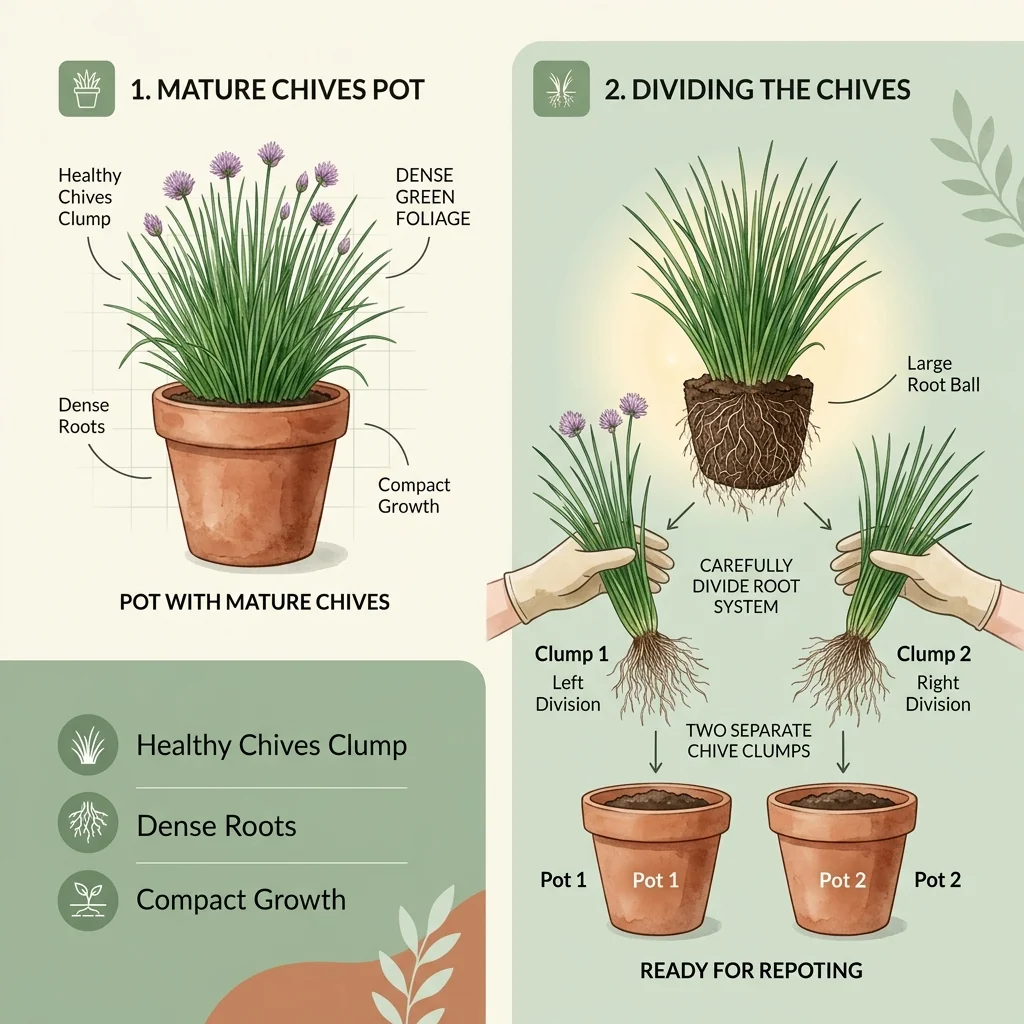
What size pot do chives need? A compact-pot guide
Chives are one of the easiest herbs to pot because their roots stay compact. A 6 inch pot is enough, and dividing the clump gives you free plants over time.
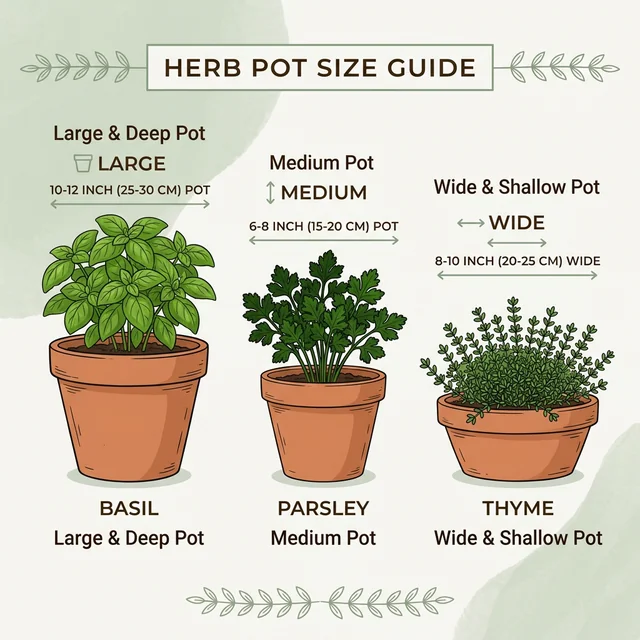
Herb pot size chart: basil, mint, parsley, thyme & chives
A practical herb pot size guide for the most common kitchen herbs, with simple size ranges that make container growing easier to read and maintain.
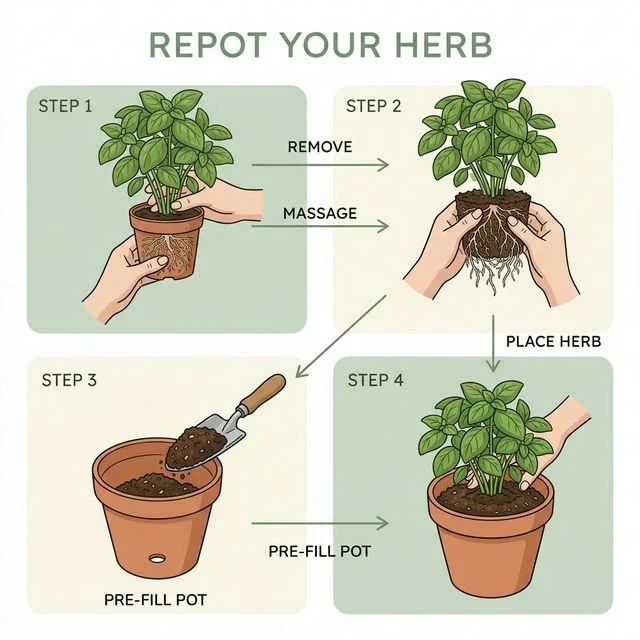
How to repot herbs without slowing growth
Moving an herb to a bigger pot should trigger a massive growth spurt. If your plants wilt and drop leaves after repotting, you are suffering from transplant shock. Here is how to upgrade your container without stressing the roots.