Regrowing a green onion base: water, soil, and starting from seed
| Stage | What is driving growth | What to expect |
|---|---|---|
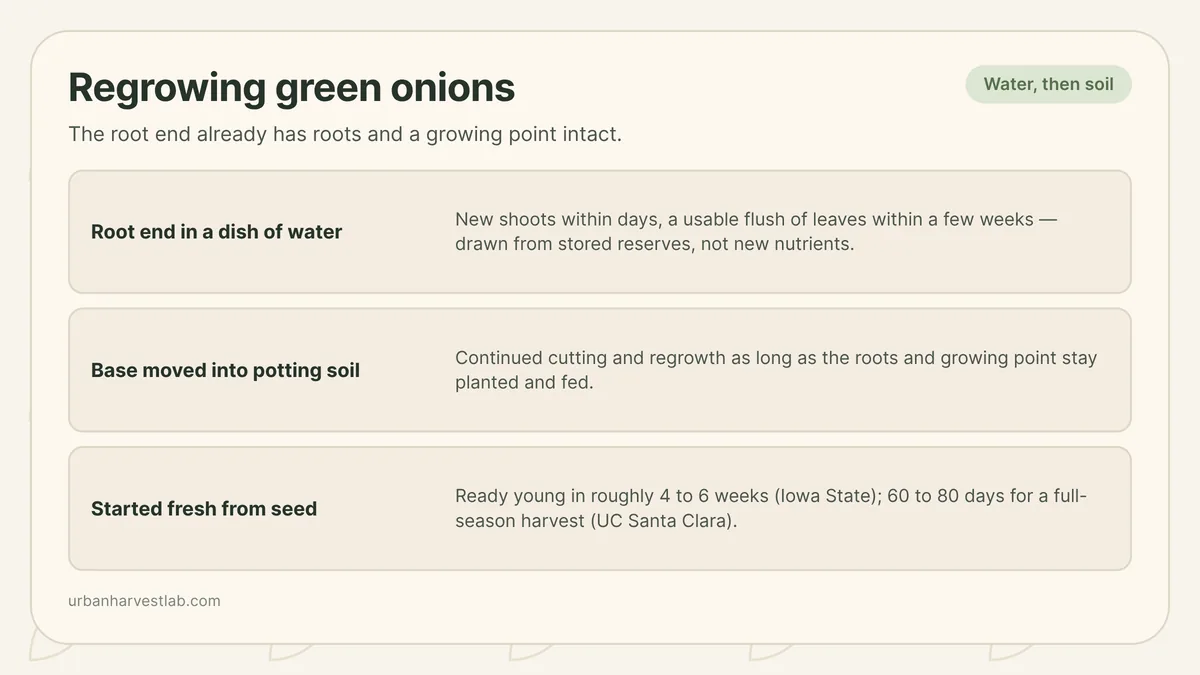
| Root end in a dish of water | Reserves already stored in the base | New shoots in under a week; a usable flush of leaves within several weeks, built from reserves rather than new nutrients |
| Base moved into potting soil | Roots feeding on soil nutrients | Continued cutting and regrowth as long as the roots and growing point stay planted and fed |
| Started from seed in soil | Normal root and leaf development from germination | Ready to harvest young, roughly 4 to 6 weeks after planting (Iowa State); 60 to 80 days for a full-season harvest (UC Santa Clara) |
Cut the green stalks off about an inch above the white base, keep the base with its roots attached, and stand it root-down in a shallow dish of water on a sunny windowsill — new green shoots grow from the top within days. That base is not a cutting waiting to form roots; it already has roots and the growing point (the basal plate) intact, which is why it resprouts so fast. It is a different process from turning a piece of stem into a whole new plant, which is what regrowing herbs from cuttings covers for basil, mint, and rosemary — those cuttings have to grow a root system before anything else happens. A green onion base skips that step entirely.
Step by step
- Cut about an inch above the base. Leave the white part and every root attached; the roots and the growing point at the base are what make regrowth possible, not the green leaves you are keeping for the kitchen.
- Set it root-down in a shallow dish or glass. Add water so it covers the roots and the very bottom of the white base, without submerging the cut top.
- Put it somewhere bright. A sunny windowsill is enough; it does not need direct midday sun all day.
- Change the water every day or two. Fresh water keeps the roots from sitting in anything stagnant. UC Master Gardeners in Solano County add one caution for the hydroponic version: skip chlorinated tap water if you can.
- Watch for new growth from the top, not the sides. A base that is going to come back usually shows a bud within the first week.
- Move it to soil once it has grown its own new roots, rather than leaving it in the dish indefinitely.
Not every scrap is a candidate. If the roots were trimmed off flush with the base before the bunch was sold, or the base already feels soft, slimy, or smells off rather than oniony, it is unlikely to come back — discard it and start with a bunch that still has visible root fibers attached.
How fast regrowth actually happens, in water or soil
Illinois Extension’s version of this technique is close to as simple as it gets: save the white bulb end with its roots, place it in a shallow dish of water, and set it in a sunny window to watch new greens emerge from the top. A UC Cooperative Extension Master Gardener in Solano County tracked a different version on her own kitchen scraps, potted directly into soil in an unheated winter greenhouse: buds emerging within six days, noticeably more growth a week and a half after that, and a full-grown plant in under two months. She also cites other growers who report full-grown plants in about a month growing scraps hydroponically on a windowsill in a warm house — a faster pace that tracks the warmer, brighter conditions rather than a fixed clock.
If you are growing the base hydroponically on a windowsill rather than eventually potting it, that same source has one specific caution: do not use chlorinated tap water for the soak.
None of this is free growth, though. The base is not attached to any soil, so every new leaf it pushes out in water alone is built from what the base already had stored, not from anything it is taking in. A base standing in plain water has no nutrient supply beyond what it stored, so anything it grows there is built from reserves, which is why the useful version of this method ends in soil.
Why this is not the stem-cutting method
Rooting a stem cutting and regrowing a green onion base solve the same general problem, turning kitchen scraps into a living plant, by two different routes. A basil or mint cutting is just a piece of stem: it has leaves and nodes but no roots of its own, so the whole point of standing it in water is coaxing an entirely new root system to form where none existed. That takes real time and does not always work, which is why rooting herb cuttings walks through choosing a healthy node and waiting for roots to appear before potting up.
A green onion base skips that stage. The root end of a bunch already carries its roots and the basal plate, the small disc of tissue at the bottom of the plant where new growth originates, intact and functional. Standing it in water does not build a new plant from a fragment; it wakes a plant that was already there back into active growth. That is also why it moves so much faster than a stem cutting does in the first week, and why the technique works on a crop like green onion that does not root from cuttings at all.
Moving the base into soil
Planting the base into potting soil, once it has grown a short mat of its own new roots in water, is what breaks that pattern. In soil, the roots can draw on nutrients and moisture from the medium instead of running down what is left in the base, which is the difference between one or two thinning rounds in a glass and a plant that keeps producing. Illinois Extension’s own guidance stops at the water dish; the Solano County trial above started its scraps in pots of soil from the outset rather than moving them there partway through. Either way, moving to soil is what gives the base an actual nutrient supply to draw on instead of its own stored reserves.
You do not have to root in water first, either. Planting a root end straight into moist potting mix, base down with the roots covered and the green tips exposed, works as a starting method in its own right — it just means you cannot watch the roots form the way you can in a glass.
Once the base is going into a container rather than a jar, sizing that container is worth doing properly: a repurposed cup or tub needs to be food-safe, not just watertight, and what size container green onions actually need covers both the food-safe material question and how much pot a growing clump needs — smaller than most people expect, since the roots stay shallow rather than reaching down. The low-stress way to make that first move from water to soil, without setting the base back, follows the same approach as repotting herbs without shocking them: settle it into pre-moistened mix, keep it out of harsh direct sun for the first few days, and hold off on fertilizer until it has settled in.
What happens after that
Once the base is established in soil, harvesting works differently than the single water-dish regrowth does. Cutting individual green leaves for the kitchen while leaving the white base and roots planted lets the plant keep pushing new growth, closer to how a clump-forming perennial like chives is managed than to a one-time regrowth trick — the chives pot size guide covers a nearly identical shallow, clump-forming case from a different crop. A true bunching onion (Allium fistulosum, sometimes labeled Welsh onion) does not form a bulb at all and can be grown on as a perennial clump that is later dug up and divided, according to the University of California Master Gardener Program of Santa Clara County. A young common onion (Allium cepa) harvested before it bulbed behaves the same way for a while in a container. UC Santa Clara notes fall-planted scallions may bolt when the weather warms in spring, and Iowa State notes that once bolting starts, quality deteriorates rapidly.
Either way, cutting individual stalks rather than the whole clump at once, and thinning a dense pot by pulling every other plant, keeps the remaining base productive longer than repeated whole-clump cuts would.
Sources
Once the base is growing again
These guides cover what to do with a regrown green onion once it needs a pot, and the related propagation methods nearby.
Common questions
How do you regrow green onions from scraps?
Cut the stalks about an inch above the white base and keep the base with its roots intact. Stand it root-down in a shallow dish or glass of water, deep enough to cover the roots and a bit of the base, on a sunny windowsill. New green shoots grow from the top within days.
How long does it take green onions to regrow in water?
New buds can appear in less than a week. A full new set of usable green leaves generally takes several weeks in water, faster in a warm, bright spot and slower in cool, low light.
How many times can you regrow a green onion in water?
There is no fixed number. Each regrowth in water draws on what the base has stored rather than rebuilding it, which is why moving the base into soil once it has its own new roots is what keeps it productive, rather than repeating the water step indefinitely.
Can you skip water and regrow a green onion straight in soil?
Yes. Planting the root end directly into moist potting soil, base down and roots covered, works as well as rooting it in water first — a UC Master Gardener in Solano County grew scraps this way in an unheated winter greenhouse and had a full-grown plant in under two months. Some growers prefer it because it skips the transplant step entirely. See what size container to use once the base goes into soil.
Related guides
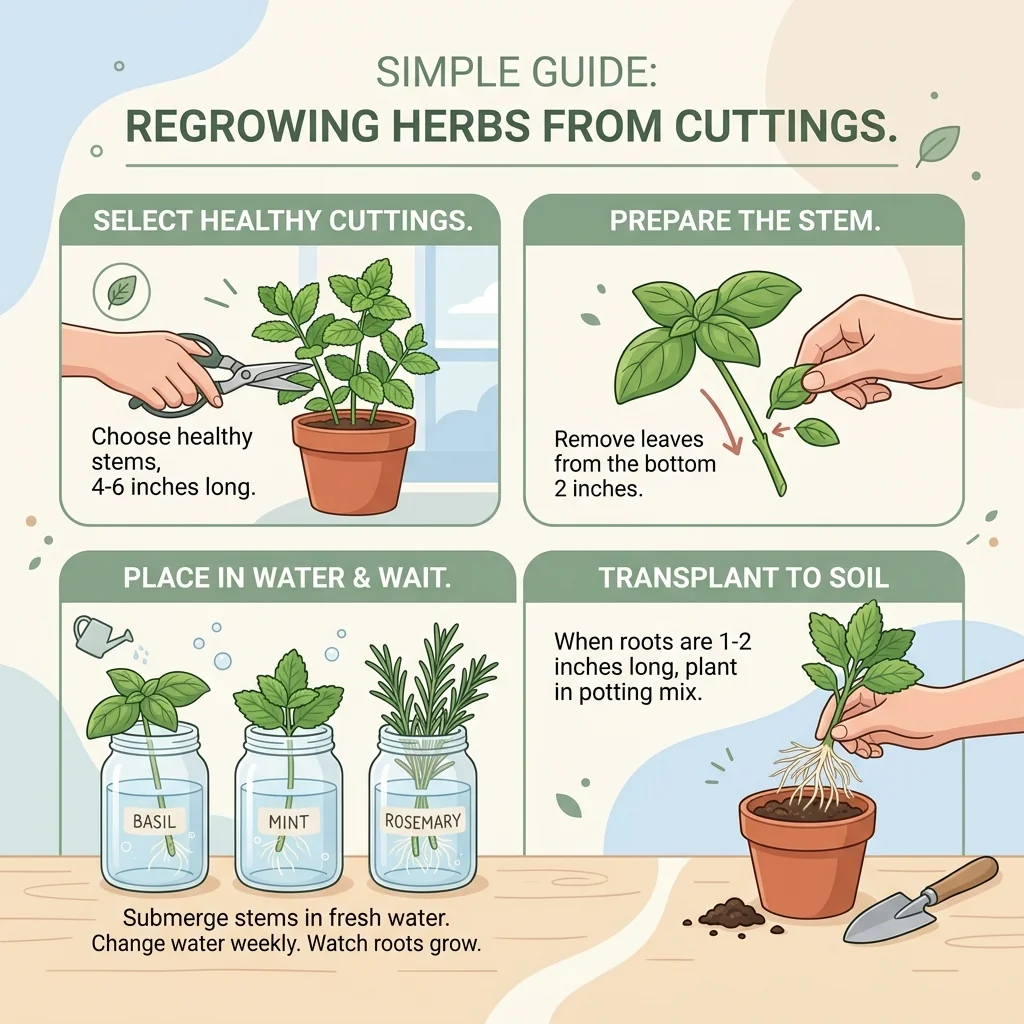
How to regrow herbs from cuttings (basil, mint, rosemary)
Many herbs root from a simple stem cutting in a glass of water. It is the cheapest way to turn one plant, or a supermarket bunch, into many.
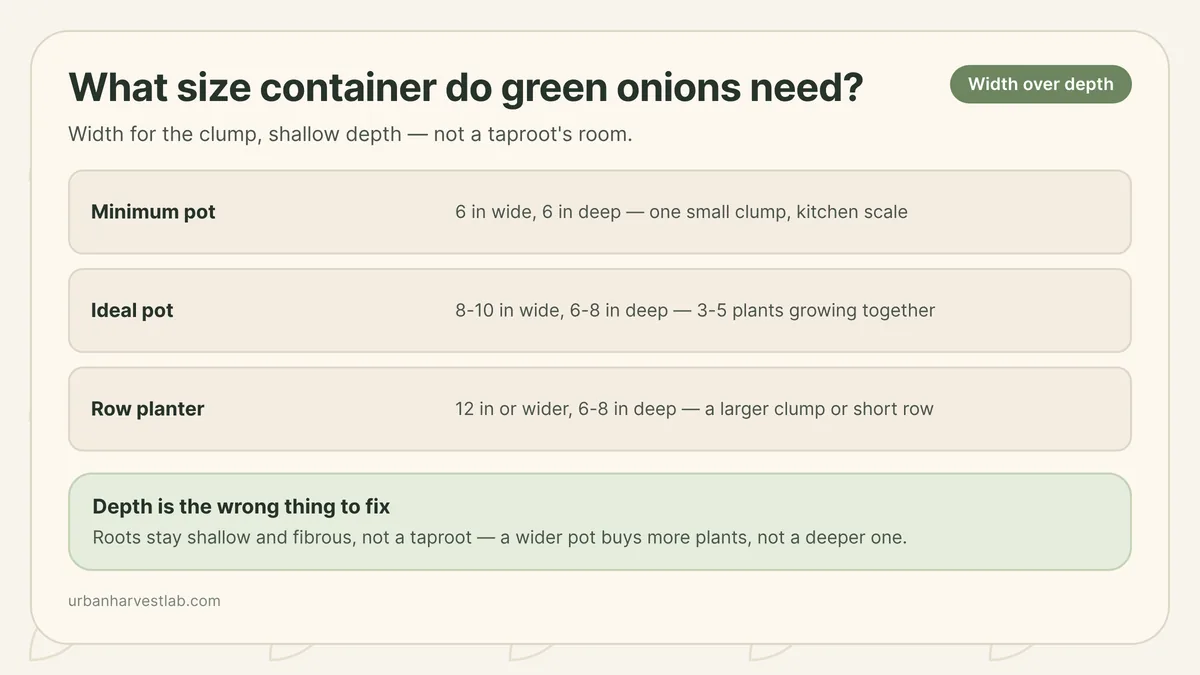
What size container do green onions need?
Green onions ask for width and shallow depth, not the deep taproot room parsley or carrots need, so one small container goes further than most growers expect.
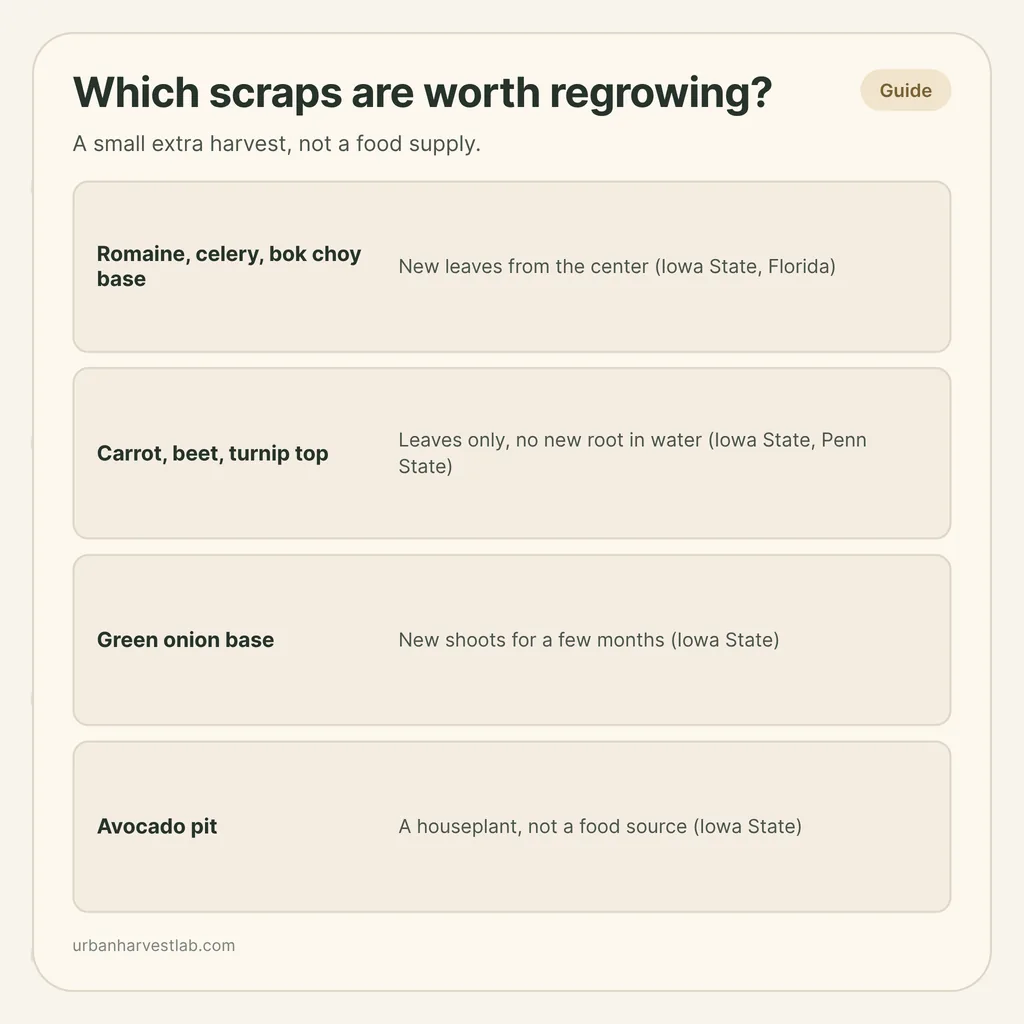
Regrow vegetables from scraps: what gives you food and what is just a project
Leafy bases resprout from the center, root tops give greens but no new root, and some scraps are only a houseplant. Here is how to sort your scrap bin.