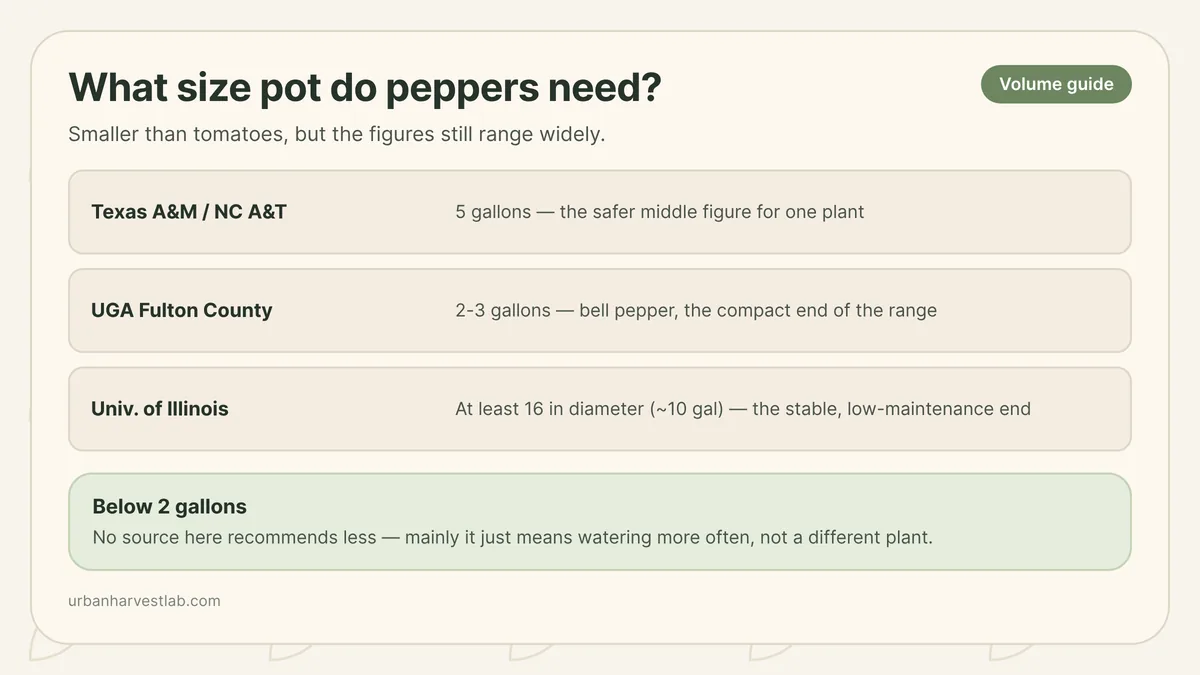
Pepper pot size, by source
| Source | Figure | Notes |
|---|---|---|
| Texas A&M AgriLife Extension | 5 gallons, 1-2 plants | General container-vegetable table |
| North Carolina A&T Cooperative Extension | 5 gallons | Grouped with tomato and eggplant, no split by type |
| University of Georgia Fulton County Extension | 2-3 gallons | Bell pepper specifically |
| University of Maryland Extension | 2-5 gallons (5-gallon minimum listed separately) | Bell and chilli types |
| University of Illinois Extension | At least 16 in diameter (roughly 10 gal on its own conversion table) | Diameter-based minimum, not a volume figure directly |
A single bell or chilli pepper plant does well in a container of roughly 5 gallons, per Texas A&M AgriLife Extension and North Carolina A&T State University’s cooperative extension — both name that figure directly for peppers. Other sources put the workable range anywhere from 2 to 10 gallons, so 5 gallons is a safe middle rather than a number every extension service agrees on. The Royal Horticultural Society’s UK chilli guidance is smaller again — pot on to a 13 cm (5 in) pot once roots show through the drainage holes, for a compact plant reaching only 20-30 cm — but that is a potting-on step for a small chilli, not a final container size for a full-season plant. Most of these sources put peppers below their own tomato figure, though Texas A&M and North Carolina A&T give both crops the same 5 gallons; no extension source here recommends less than 2 gallons for a pepper, and below that the main effect is watering more often rather than a different plant. For the wider principles behind any of these numbers — drainage, material, and how root volume behaves in a pot versus open ground — see best containers for herbs, which covers the same mechanics across crops.
Why the range is so wide
Four sources, four different pepper figures. Most of them put peppers below their own tomato figure, though Texas A&M and North Carolina A&T give tomato, pepper and eggplant the same 5-gallon figure with no split by crop. Texas A&M AgriLife Extension lists 5 gallons for 1-2 plants in its general container-vegetable table. North Carolina A&T’s cooperative extension groups tomato, pepper and eggplant together and gives all three the same 5-gallon figure, with no split by fruit size or plant habit. University of Georgia’s Fulton County Extension goes lower, putting bell pepper at 2-3 gallons. University of Maryland Extension frames bell and chilli peppers as needing 2-5 gallons, with a 5-gallon minimum called out separately in the same guidance. University of Illinois Extension does not give a gallon figure at all — it specifies at least 16 inches in diameter, which converts to roughly 10 gallons on that same source’s own diameter-to-volume table, well above every other figure here.
They are measuring different things: a minimum that keeps a plant alive, a figure sized for steady production without daily watering, and a diameter figure, which also happens to describe a pot wide enough not to tip once a loaded plant catches the wind. Texas A&M adds that a 15-gallon container gives a more productive plant with less watering than a 5-gallon one for the same plant class — the same pattern of “the minimum works, more works better” shows up here. Treat 5 gallons as the number to build around, and treat the 2-3 gallon figures as the compact end of the range and the 10-gallon figure as the stable, low-maintenance end, rather than picking whichever number is most convenient for the pot already on hand.
What changes the number for your plant
- Fruit size and plant habit. A compact chili variety carries far less canopy and root demand than a large-fruited bell type, so a 2-3 gallon figure is more realistic for a small pepper cultivar than for a full-size bell plant expected to hold several fruit at once.
- How many plants share the pot. Texas A&M’s 5-gallon figure allows for 1-2 plants in that volume; crowding a third plant in does not scale the same way, because root competition shows up exactly when fruit load is heaviest.
- Climate and watering frequency. A container at the low end of the range dries faster in full sun and wind, which means more frequent watering rather than a plant that cannot be grown at all. If you cannot check the pot daily in summer, size up rather than defaulting to the smallest workable figure.
- Container shape. Illinois Extension’s minimum is stated as diameter rather than volume for a reason: a wide, shallow pot and a narrow, deep one can hold very different totals at the same nominal size. Volume is the number to plan around; depth and diameter are just how you get there.
Depth versus total volume
Depth alone does not fix an undersized pot. University of Illinois Extension’s own minimum for peppers is stated as at least 16 inches in diameter, not a depth figure, which converts to roughly 10 gallons on that source’s diameter-to-volume table. A pot can hit that width and still fall short on total mix if it is shallow, or hit a reasonable depth and still fall short if it is narrow — volume is the number that actually predicts how long the mix holds water, not either dimension alone. No source in this comparison publishes a pepper depth on its own; this site’s container depth guide for tomatoes, peppers, and herbs gives roughly 10 to 14 inches (25-36 cm) as a working planning range for a bell or chilli pepper, rather than an extension figure, alongside the depth and volume numbers for the same group of crops.
Material and colour change how far that volume gets you
Two pots holding the same 5 gallons of mix do not dry at the same rate. University of Illinois Extension notes that porous materials — unglazed terracotta, fabric grow bags — lose moisture through the container wall and dry faster than non-porous plastic or glazed ceramic holding the same volume, and that dark-coloured or metal containers absorb more heat, which warms the root zone and can stress the plant in full summer sun. For a pepper plant already sitting near the low end of the volume range, a dark plastic pot on a south-facing balcony compounds the problem: the same 3-gallon container that is merely tight in a lighter, more porous pot both runs hotter and dries out faster in a dark one, per University of Illinois Extension, which does not publish a figure for how much faster. Sizing up one step matters more in that setup than in a shaded, light-coloured pot at the same nominal volume.
How peppers compare to tomatoes
Three of the five sources here put peppers below their own tomato figure; Texas A&M and North Carolina A&T give tomato, pepper and eggplant the same 5-gallon figure with no split by crop. Where a source does split them, the gap is real: Texas A&M adds that a 15-gallon container gives a more productive tomato plant with less watering than a 5-gallon one, well past its shared pepper figure, and University of Georgia’s Fulton County figures show tomatoes needing roughly two to three times the volume of bell pepper across the range. A pepper plant simply carries less top growth and a smaller root system than an indeterminate tomato vine, so it draws down a container’s water reserve more slowly. If you are sizing pots for both crops on the same balcony, what size pot do tomatoes need covers the tomato side of that same source disagreement, so you can plan the two side by side rather than assuming one figure covers both.
Signs the pot is too small
A pepper plant in a container that is genuinely undersized tends to show more than one of these at once, rather than a single clean symptom:
- the soil dries out within a few hours of a thorough watering, especially on hot or windy days;
- growth stalls at a modest height even with adequate light and feeding;
- flowers drop before setting fruit, or fruit stays small and slow to size up;
- the pot becomes noticeably light again soon after watering.
Moving up one container size, rather than jumping straight to the largest figure in this range, is usually enough to resolve the pattern without overcorrecting into a pot that stays soggy between waterings.
A different approach: growing peppers without soil volume at all
Everything above assumes a pepper growing in soil or potting mix, where container volume is the plant’s entire water and nutrient reserve. Growing peppers hydroponically sidesteps that constraint by delivering water and nutrients directly to the roots on a schedule, rather than storing them in a fixed volume of soil for the plant to draw down between waterings. The trade-off is a different kind of setup entirely, not a smaller version of a container garden — see growing peppers hydroponically indoors for how that changes the sizing question.
Sources
- Texas A&M AgriLife Extension — Vegetable Gardening in Containers
- North Carolina A&T State University Cooperative Extension — Growing Fruiting Vegetables in Containers: Tomato, Pepper and Eggplant
- UGA Fulton County Extension — Container Gardening: Thinking Outside the Box
- University of Maryland Extension — Growing Vegetables in Containers and Salad Tables
- University of Illinois Extension — How to Grow Fruits, Vegetables, Herbs in Container Gardens
- Royal Horticultural Society — Growing Chillies
Sizing a pepper pot? These guides go with it
Container depth across fruiting crops, the tomato comparison, and food-safe material choices.
Common questions
What size pot do peppers need?
Plan on roughly 5 gallons for one bell or chilli pepper plant. Texas A&M AgriLife Extension and North Carolina A&T both list 5 gallons; other sources put the workable range anywhere from 2 to 10 gallons depending on cultivar and how the figure was measured, so 5 gallons is the safer middle rather than a hard floor.
Do peppers need as big a pot as tomatoes?
No. Most figures for peppers run smaller than the same source's tomato figure, because a pepper plant stays more compact and carries less top growth. A determinate tomato still generally needs more room than a pepper on the same table.
Can peppers grow in a 2-gallon pot?
A pepper plant will survive in 2 gallons, and University of Georgia Extension's own bell pepper figure starts there, but expect more frequent watering and a plant that stalls sooner in hot weather than one in 5 gallons.
How deep does a pepper pot need to be?
Depth alone does not settle it. University of Illinois Extension states its pepper minimum as at least 16 inches in diameter, which works out to roughly 10 gallons on that source's own conversion table, rather than a depth figure. This site's container depth guide gives roughly 10 to 14 inches (25-36 cm) as a working planning range for a bell or chilli pepper, since no source here publishes a pepper depth on its own. A wide, shallow pot and a narrow, deep one can hold very different amounts of mix at the same depth, so check the stated volume or diameter before assuming a tall pot is automatically a big enough one.
Related guides
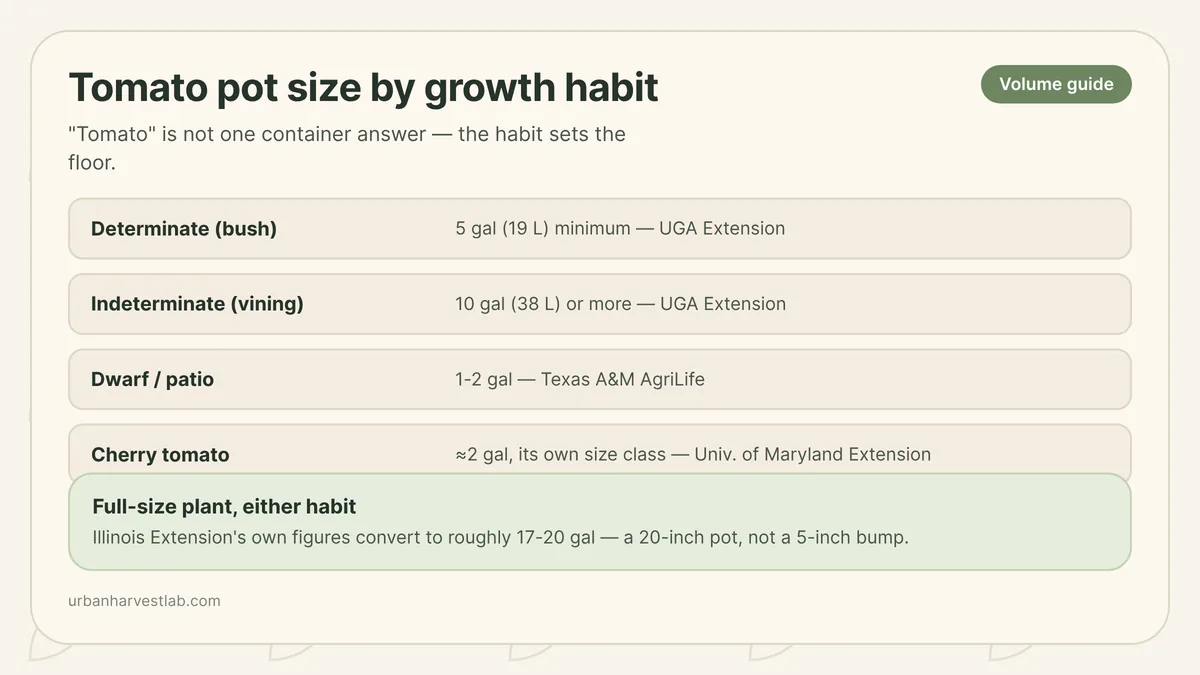
What size pot for tomatoes? Volume by growth habit
The right container for a tomato depends less on the fruit than on how the plant grows: determinate, indeterminate, or dwarf. Extension figures for the same word vary by more than three times.
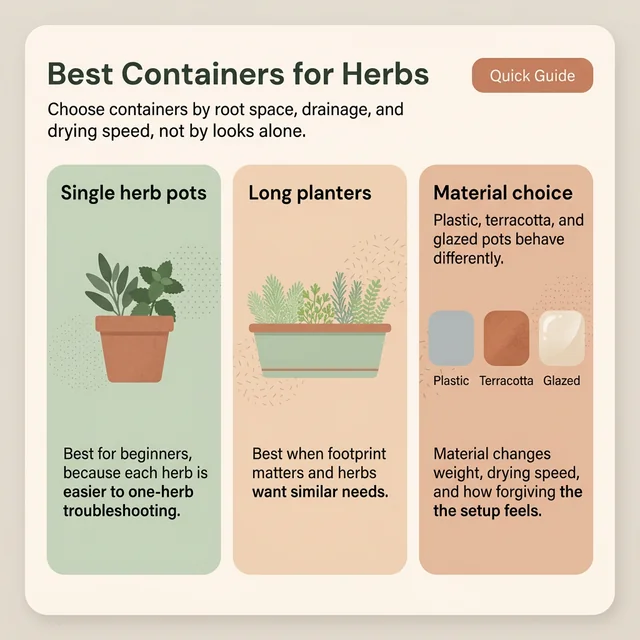
Best containers for herbs: drainage, pot size, and materials that work
A practical guide to herb containers that explains which pots work best, why drainage matters, and how material changes the way containers dry.
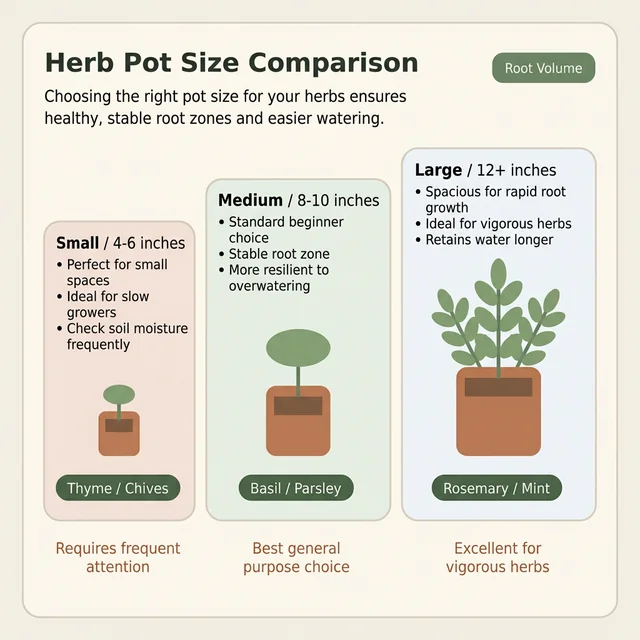
Container depth for tomatoes, peppers, and herbs: how much root space matters
Container size is one of the highest-leverage decisions in small-space gardening. When root volume is too small, every other care task becomes harder.