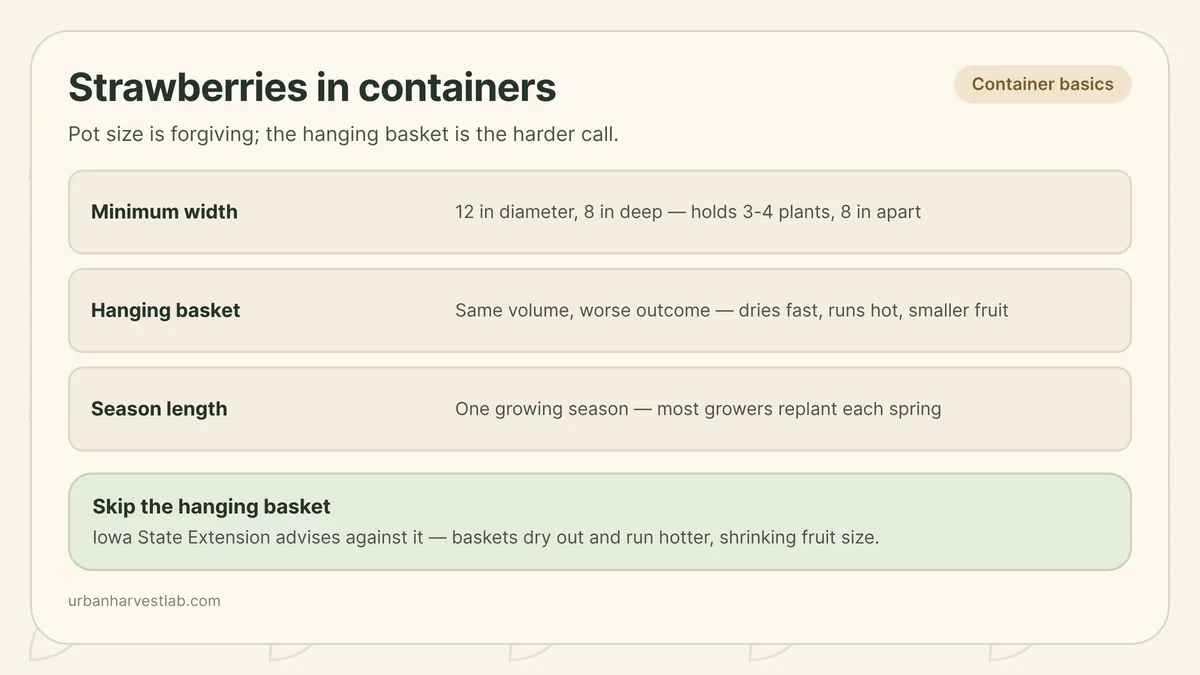
Strawberry container sizing at a glance
| Container | Size | Notes |
|---|---|---|
| Minimum width | 12 in diameter, 8 in deep | Holds 3-4 plants, 8 in apart (ISU) |
| Per-plant volume | 2-3 gal | Range framing, not a fixed pot size (UGA) |
| Hanging basket | Same volume, worse outcome | Dries fast, runs hot, smaller fruit in day-neutral types (ISU) |
| Season length | One growing season | Treated as an annual, then composted (ISU) |
A strawberry container needs to be at least 12 inches wide and 8 inches deep to hold 3 to 4 plants, and most growers plant it fresh each spring rather than carrying it over winter. Both figures come from Iowa State University Extension’s strawberry container guidance, and they run against two common assumptions: that a hanging basket is the easier way to grow strawberries, and that a strawberry planting should behave like a perennial the way it does in a garden bed. For the container basics that apply across crops, best containers for herbs covers drainage and material; strawberries add a few rules of their own on top of that.
How much container a strawberry plant needs
Iowa State University Extension’s figure is straightforward: a container at least 12 inches in diameter and 8 inches deep holds 3 to 4 plants, spaced about 8 inches apart. That is generous compared with a lot of container vegetables, and it leaves each crown enough root run to support fruiting without competing hard for water.
University of Georgia Extension frames the same crop differently, as 2 to 3 gallons per plant rather than a fixed pot size. The two figures are compatible rather than contradictory: on the diameter-to-volume conversion table published by University of Illinois Extension, a straight-sided round pot 12 inches across holds roughly 5 gallons, which is enough headroom for 2 plants at Georgia’s per-plant figure or for Iowa State’s 3- to 4-plant count in a slightly larger pot. Neither source gives a single “right” pot; use Iowa State’s diameter-and-depth number as the practical minimum and size up if you want the full 4-plant spacing. Iowa State also covers strawberry pots and jars with pockets along the side, which give more growing area from the same footprint, but notes that maintaining consistent moisture is difficult since plants sit at different levels: the upper and side-pocket plants dry out faster than those lower down, so watering both from the top and from the sides is what keeps the whole planting even.
Depth matters as much as width here. An 8-inch minimum keeps the whole root system, which is shallower than most people expect, inside moist, insulated soil rather than near the pot’s hot outer wall.
Why hanging baskets work against strawberries
Hanging baskets look like the natural way to grow a trailing, fruiting plant, but Iowa State University Extension advises against them specifically for strawberries. Baskets are “difficult to maintain,” in the extension’s own words, because they dry out quickly and run hotter than a container sitting on a surface. Rising soil temperature makes fruit size get smaller, and separately, Iowa State notes that day-neutral strawberries — the type it recommends for containers, alongside everbearing cultivars — stop flowering and fruiting when temperatures get above 80-85°F, so harvest slows or stops through the heat of summer and resumes when temperatures cool.
The mechanism is straightforward once you see it: a hanging basket is exposed to air movement and direct sun on every side, including the bottom, so it loses moisture and heats up faster than a pot standing on soil or pavement with one side shaded. A wide, shallow container set on a stand, rail, or the ground gives the same trailing habit and fruit display without that exposure. Whichever container you use, Iowa State’s two planting details apply: set the crown even with the soil surface — planting too deep is a common failure — and give the container at least 6 hours of direct sun a day. If a hanging spot is the only option available, treat it as the harder version of the setup, not the easier one, and expect to water and check soil temperature more often than a grounded pot needs.
Most growers replant every year, and that is by design
Strawberry plants in the garden are perennials that spread by runners, refilling a matted row with new crowns as older ones age out. A container does not have room for that cycle, and it shows in Iowa State University Extension’s own recommendation: strawberries grown in containers are best treated as annuals. The extension’s guidance is direct about the process — remove the plants from the container and compost them at the end of the growing season, then buy new plants and start again the following spring.
The reasoning is about the plant, not the pot. Iowa State cites the strawberry’s shallow root system and its susceptibility to disease as what makes carrying a container planting from one year to the next difficult, even for June-bearing varieties that behave as long-lived perennials in the ground. Container-grown strawberries are also, by the same source, less productive than their garden-grown counterparts to begin with, so a plant that has already used up a season of vigor in a confined root zone is a poor bet for a second one.
If you want to try carrying a plant past one season anyway
Some growers do try to overwinter a container strawberry rather than replace it, usually with a June-bearing variety they are attached to. Iowa State University Extension gives the crop-specific method directly: for June-bearing cultivars kept over, the container must be dug into the soil and covered with at least 6 inches of straw, and even with that protection the plants are highly prone to winter damage or death. University of Illinois Extension’s general mechanism explains why the risk is so high in the first place: container roots are far less cold-hardy than roots growing in the ground, because a pot has none of the soil mass that buffers temperature swings outdoors. None of this changes Iowa State’s underlying point: even with the pot sunk and mulched, a strawberry’s shallow roots and disease exposure make this a harder path than starting over, not a shortcut around it.
Material and drainage: what changes for a fruiting crop
A dark or highly porous container compounds the same heat-and-drying problem Iowa State flags for hanging baskets, so a lighter-coloured, moisture-retentive material is the safer default; plastic vs. terracotta pots for herbs covers the trade-off. Skip a gravel layer at the bottom too — it creates a perched water table that holds the root zone wetter, not drier; pot drainage holes covers why drainage holes and a uniform mix do that job instead.
Food-safe containers matter more for a fruit you eat raw
Strawberries are eaten fresh and unpeeled, straight off the plant, which makes container material a food-safety question and not just a horticultural one. University of Maryland Extension identifies plastic recycling codes #2 (HDPE) and #5 (PP) as food-safe, and recommends looking for a “food grade” or “FDA approved” label or the glass-and-fork symbol before repurposing a container. The same source is blunt about the containers to avoid: #3 (PVC), #6 (polystyrene), and #7 (polycarbonate/BPA) should not be used for growing anything edible.
Reused buckets need the same scrutiny. A bucket that once held paint, cleaning chemicals, or any other non-food substance is not food-safe again, even if it is stamped with the HDPE #2 symbol that would otherwise qualify it, according to University of Maryland Extension. If you are repurposing food-industry buckets for a strawberry planter, confirm they only ever held food.
A different way to grow strawberries: hydroponics
Container growing in soil is not the only route to a home strawberry crop. Hydroponic strawberries, grown indoors under lights with a nutrient solution instead of soil, work on a completely different set of numbers — solution EC and pH rather than pot volume and drainage. That method trades container size and annual replanting for hand pollination, precise nutrient control, and a long daily stretch of strong artificial light to fruit well. If soil, seasons, and pot sizing are not the part you want to manage, hydroponic strawberries indoors lays out what that alternative actually requires.
Sources
- Iowa State University Extension — How to Grow Strawberries in Containers
- University of Georgia Extension, Fulton County — Container Gardening: Thinking Outside the Box
- University of Illinois Extension — How to Grow Fruits, Vegetables, Herbs in Container Gardens
- University of Illinois Extension — Overwintering potted plants
- Colorado State University Extension, PlantTalk Colorado — Overwintering Container Plants
- Washington State University Extension — The Myth of Drainage Material in Container Plantings
- University of Maryland Extension — Growing Vegetables in Containers and Salad Tables
Rounding out your strawberry container setup
These guides cover the container choices, drainage physics, and growing-medium questions that come up once the strawberry pot is planted.
Common questions
What size container do strawberries need?
A container at least 12 inches in diameter and 8 inches deep holds 3 to 4 plants, spaced about 8 inches apart, according to Iowa State University Extension. On a straight-sided round pot, a 12-inch diameter works out to roughly 5 gallons on University of Illinois Extension's conversion table. University of Georgia Extension frames the same crop as 2 to 3 gallons per plant instead, which is a looser density than Iowa State's 3-to-4-plants-in-12-inches; size up if you want to hit the Georgia figure at four plants.
Can strawberries grow in a hanging basket?
They can, but Iowa State University Extension advises against it. Hanging baskets dry out quickly and run hotter than a standard pot, and that heat shrinks fruit size in day-neutral varieties. A wide, shallow container on a surface holds moisture and stays cooler.
Do I need to replant strawberries every year in containers?
Most growers do. Iowa State University Extension treats container strawberries as an annual planting: remove and compost the plants at the end of the season and buy new ones the following spring, because their shallow root systems and disease susceptibility make carrying a container planting over difficult.
What container material works best for strawberries?
Any food-safe, well-draining container works. Plastics marked recycling code 2 (HDPE) or 5 (PP) are food-safe, per University of Maryland Extension, while a bucket that once held anything non-food, like paint or cleaning chemicals, should not be reused for a crop you plan to eat, even if it carries a food-safe recycling code.
Related guides
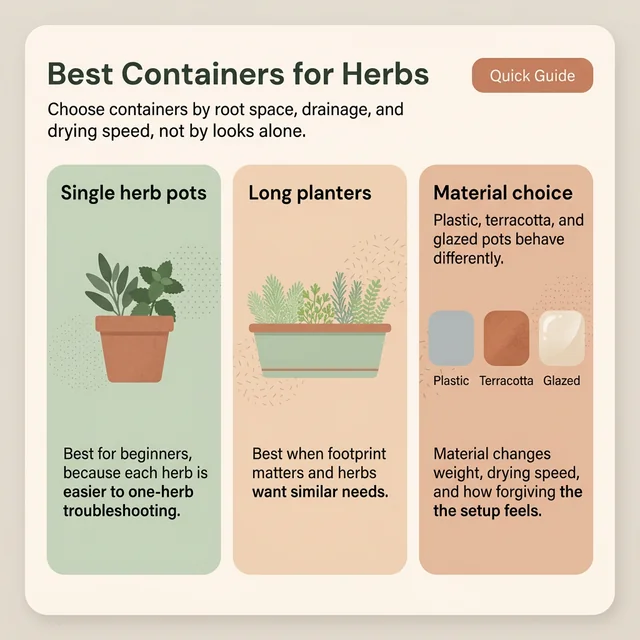
Best containers for herbs: drainage, pot size, and materials that work
A practical guide to herb containers that explains which pots work best, why drainage matters, and how material changes the way containers dry.
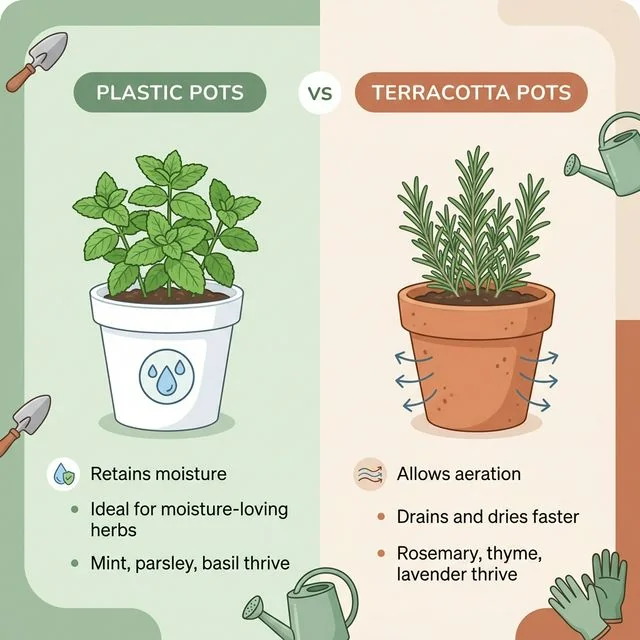
Plastic vs. terracotta pots for herbs: which makes care easier?
The material of your pot dictates how fast your soil dries out. If you put a thirsty mint plant in unglazed terracotta, you will be watering every single day. If you put rot-prone rosemary in a plastic pot, you must be extremely careful.
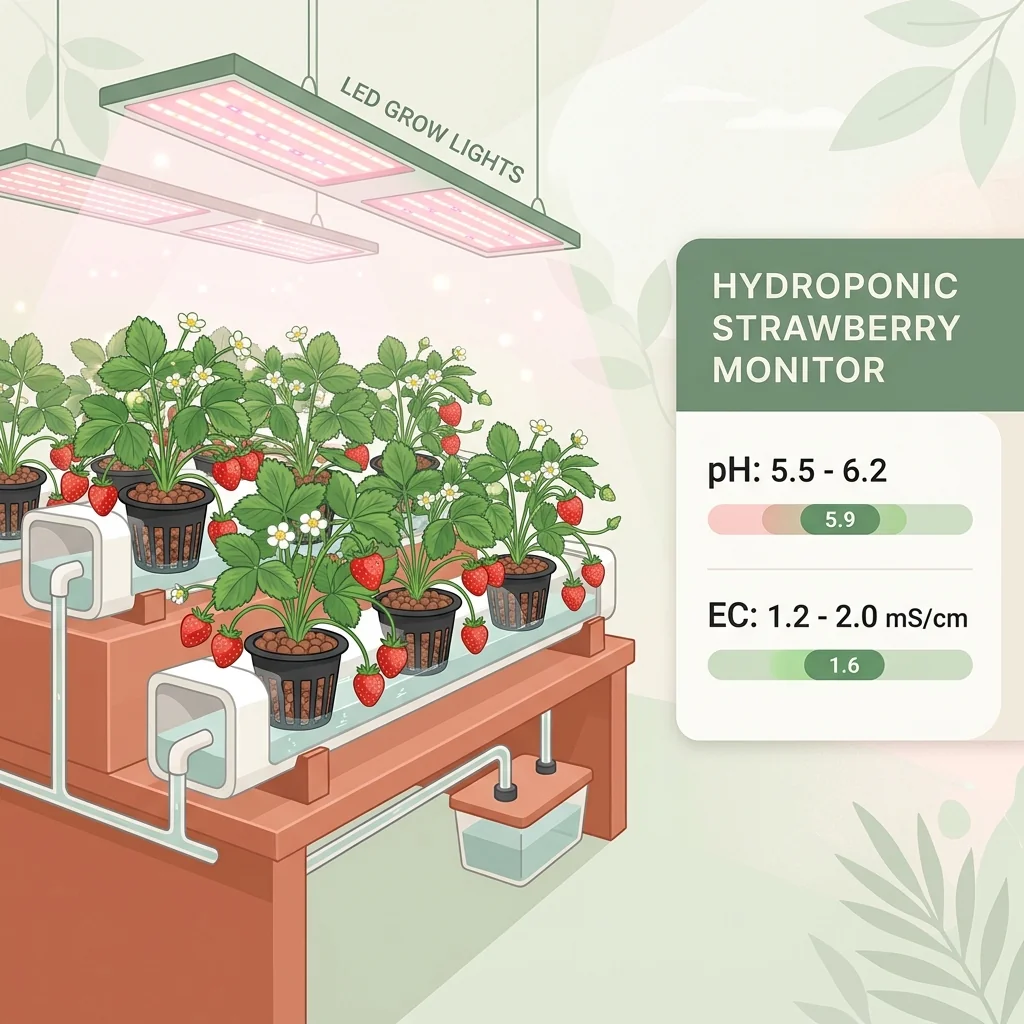
Hydroponic strawberries indoors: is it worth it?
Indoor hydroponic strawberries are rewarding but demanding: they need strong light, hand pollination, and patience. Here is an honest look at whether it is worth it.