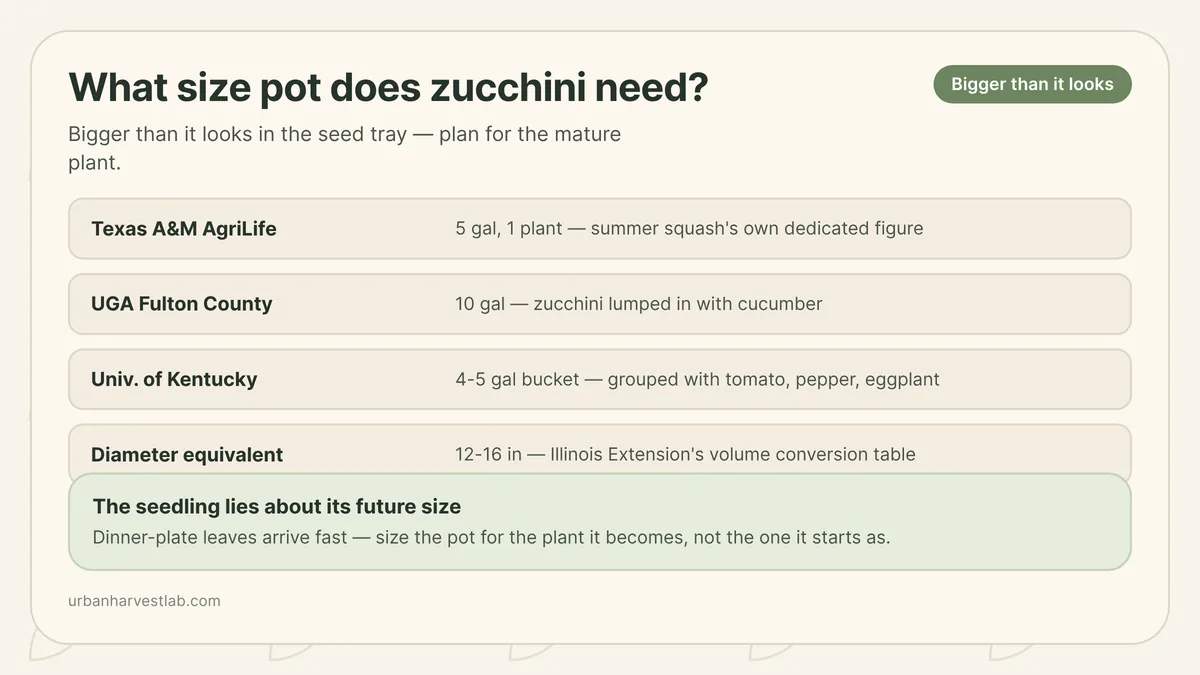
Zucchini container size, by source
| Source | Container size | Note |
|---|---|---|
| Texas A&M AgriLife Extension | 5 gal, 1 plant | Listed as summer squash's own figure |
| UGA Fulton County Extension | 10 gal | Zucchini lumped in with cucumber, not given its own number |
| University of Kentucky Extension | 4-5 gal bucket | Grouped with tomato, pepper, eggplant and yellow squash |
| Diameter equivalent (straight-sided pot) | 12-16 in | University of Illinois Extension's volume conversion table |
One zucchini plant needs 5 to 10 gallons of container space, which is roughly a 12- to 16-inch-wide pot or a large bucket. That is a wide range for one crop, and where a plant lands in it depends on growth habit: a single compact bush that stays as one upright crown, or the less common vining type that behaves more like the container size a trellised cucumber needs than a tidy patio vegetable.
A seedling that lies about its future size
For the first three or four weeks, a zucchini seedling looks like it belongs in the same small pot as a pepper or a bunch of chives. Then the true leaves come in, each one the size of a dinner plate, and the root system underneath expands just as fast to support them. By the time the plant sets its first fruit, it has gone from a seedling that fits a nursery pot to a sprawling crown with a root mass to match. A container sized for the seedling stage cannot hold enough water or nutrients for what the plant becomes six weeks later, and that gap is a common reason a container zucchini stalls, yellows, or drops fruit before it fills out.
The numbers, and why they land in a range instead of one figure
Extension sources do not converge on a single zucchini number the way they do for eggplant. Texas A&M AgriLife Extension lists 5 gallons for one summer squash plant, its own dedicated figure. UGA Fulton County Extension does not break zucchini out separately at all; it lumps summer squash in with cucumber at 10 gallons, twice the Texas A&M figure. University of Kentucky Cooperative Extension splits the difference in practice, if not in citation, recommending a 4 to 5 gallon bucket for one plant, grouped alongside tomato, pepper, eggplant and yellow squash as crops that do well in a food-grade bucket of that size.
None of those three figures is wrong; they describe the same plant at different tolerances for risk. The 5-gallon end is a workable minimum that will need closer attention to watering once the canopy fills in. The 10-gallon end buys more buffer against a missed watering day or a run of hot afternoons, at the cost of a heavier, harder-to-move container. A hot, exposed, full-sun spot pushes toward sizing up rather than down, because heat and evaporation both draw the pot down faster.
What 5 to 10 gallons looks like on a shelf
University of Illinois Extension’s own diameter-to-volume conversion table puts a straight-sided round pot at roughly 12 inches for 5 gallons and 16 inches for 10 gallons. A tapered or square container will not match that table exactly, but it gives a real number to shop against instead of guessing at “large.” A 12-inch pot is the floor, not the target; a 14- to 16-inch container gives the root system room to keep expanding through the growing season rather than filling the pot completely by midsummer and stalling there.
Buckets work, but only food-safe ones
A food-grade 5-gallon bucket is one of the cheapest ways to hit the volume figures above, and it is exactly what University of Kentucky Cooperative Extension’s own guidance assumes. University of Maryland Extension gives the plastics to look for: recycling codes #2 (HDPE) and #5 (PP) are food-safe, ideally with a “food grade” or “FDA approved” label or the glass-and-fork symbol stamped on the bottom. Avoid #3 (PVC), #6 (polystyrene) and #7 (polycarbonate). A bucket that previously held paint, solvent, or any other non-food product does not become food-safe again just because the plastic itself is a #2 HDPE bucket that started out food grade. The full material check, including wooden planters and treated lumber, is in food-safe container materials.
The gravel layer makes a thirsty pot wetter
A wide, heavy container for a thirsty crop is exactly the setup where the old advice to add a layer of gravel “for drainage” still shows up, including in a Texas A&M AgriLife Extension publication that recommends about an inch of coarse gravel in the bottom of the pot. Washington State University Extension’s research disagrees on the physics: water does not move from a fine potting mix into a coarser layer underneath it until the finer material is fully saturated, so the gravel creates a perched water table that holds the root zone wetter, not drier, than potting mix run straight to the bottom. Drainage holes and a uniform mix do the job the gravel was supposed to do.
Material and shape start to matter once the plant is heavy
University of Illinois Extension’s comparison of container materials is worth reading before buying, because summer squash pushes on both ends of it. Dark-coloured and metal containers absorb more heat, which can cook the outer root zone in full sun exactly where zucchini wants to sit. Porous materials like unglazed terracotta dry faster than plastic or glazed ceramic, which matters more on a crop that draws down a large pot quickly once it is fruiting. And plastic, resin and fibreglass containers, while lighter and easier to move, are also more prone to tipping once a broad, top-heavy plant leans into the wind on a balcony rail.
A self-watering, sub-irrigated container is one way to soften that swing. University of Maryland Extension’s own bucket-garden design needs about 2 to 3 gallons to fill the reservoir at planting and roughly 1 to 2 quarts a day to keep it topped up once the plant is growing hard, numbers that scale reasonably well to a container this size. The reservoir sits below the growing medium, so it does not count toward the pot’s soil volume — a self-watering container still needs the full 5 to 10 gallons of mix above it. The self-watering container option trades a slightly more complex setup for fewer days where the pot dries out before you notice.
Bush zucchini versus the vining type
Almost every zucchini seed packet on a garden centre shelf is a bush type: a single dominant crown that stays compact and upright, which is exactly what makes the volume figures above workable in a container at all. A smaller number of summer squash varieties, sold as climbing or vining squash, genuinely run like a vine, throwing out several feet of stem that needs a trellis or a wide floor footprint rather than a single tidy pot. That vining habit puts them in a different category from a standard bush zucchini and much closer to how a cucumber’s own container needs are usually framed, since cucumber is trellised for the same reason and shows the same kind of gap between extension figures for a compact plant and a sprawling one. Checking a seed packet’s growth habit before buying is the cheapest way to avoid discovering the difference halfway through summer.
Pollination usually needs a hand
Zucchini carries separate male and female flowers on the same plant, and a garden full of bees moves pollen between them without anyone noticing. A balcony or patio container garden often has far fewer pollinators passing through, and the result is a fruit that starts to swell, then shrivels and rots at the blossom end because no pollen reached it in time. Hand-pollinating with a small brush, or by picking a male flower and touching its centre to a female flower directly, fixes most of that. Colorado State University Extension’s Pueblo County hand-pollination guidance describes the discriminator: a female zucchini flower sits on a swollen miniature fruit, a male on a plain slender stem. The full hand-pollinating routine, including timing and brush technique, is covered in the guide to hand-pollinating balcony vegetables.
Sources
- Texas A&M AgriLife Extension E-545, “Vegetable Gardening in Containers”
- UGA Fulton County Extension, “Container Gardening: Thinking Outside the Box”
- University of Kentucky Cooperative Extension, “Vegetables Grown in Containers Improves Accessibility”
- University of Illinois Extension, “How to Grow Fruits, Vegetables, Herbs in Container Gardens”
- University of Maryland Extension, “Growing Vegetables in Containers and Salad Tables”
- University of Maryland Extension, “Self-Watering Containers”
- Washington State University Extension, “The Myth of Drainage Material in Container Plantings”
- Colorado State University Extension, Pueblo County — Hand Pollination
Sizing a container for zucchini? These guides go with it
These guides connect zucchini's container size to a similar vining vegetable, hand pollination, and the general root-volume math for container crops.
Common questions
What size pot does zucchini need?
Plan on 5 to 10 gallons of container space for one plant. Texas A&M AgriLife Extension lists 5 gallons as a workable figure, University of Georgia Extension groups zucchini with cucumber at 10 gallons, and University of Kentucky Extension recommends a 4 to 5 gallon bucket. Size toward the larger end in a hot or windy spot.
Can zucchini grow in a 5-gallon bucket?
Yes, if the bucket is food-safe and sits somewhere with full sun. University of Maryland Extension names recycling codes #2 (HDPE) and #5 (PP) as the food-safe plastics. A bucket that previously held paint, solvent, or cleaning chemicals does not become food-safe again just because the plastic type matches.
Does zucchini need a gravel layer at the bottom of the pot for drainage?
No. Washington State University Extension's research shows a coarse layer under potting mix creates a perched water table that holds the root zone wetter, not drier, even though one older Texas A&M publication still recommends it. Drainage holes and a uniform potting mix do the actual work.
Do container-grown zucchini plants need hand pollination?
Often, yes. Balcony and patio containers tend to see fewer bees passing through than an open garden bed, and zucchini carries separate male and female flowers that need pollen moved between them. Hand-pollinating with a small brush, or the male flower itself, is a common fix when fruit starts to swell and then rots at the tip.
Related guides
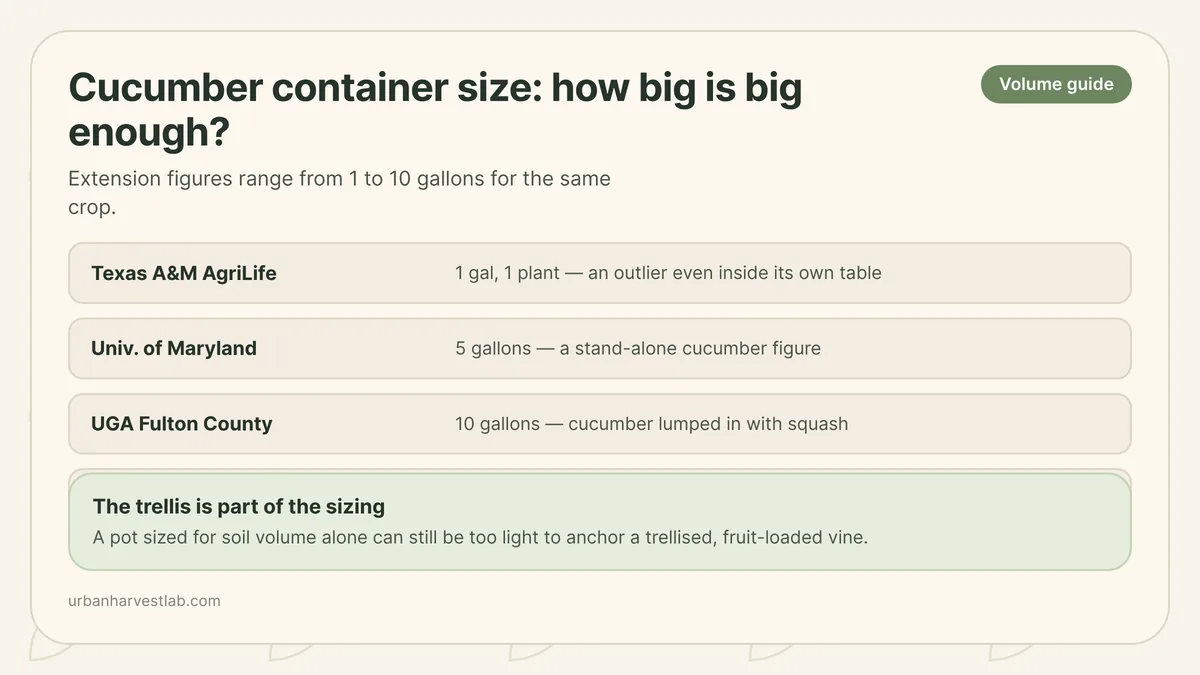
Container size for cucumbers: how big a pot do they really need
Cucumbers are vines with a fruit load to support, and extension sources disagree sharply on how much container that takes. The safer number is bigger than the smallest one you will find.
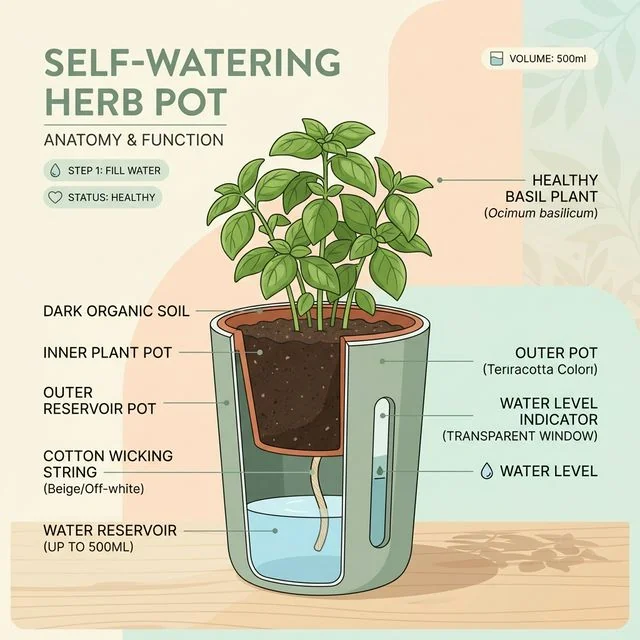
Self-watering pots for herbs: worth it or more trouble?
Self-watering pots sound like the holy grail for busy gardeners. While they are fantastic for moisture-loving herbs like mint, they can quickly turn into a swamp of rotting roots for drought-tolerant plants like rosemary.
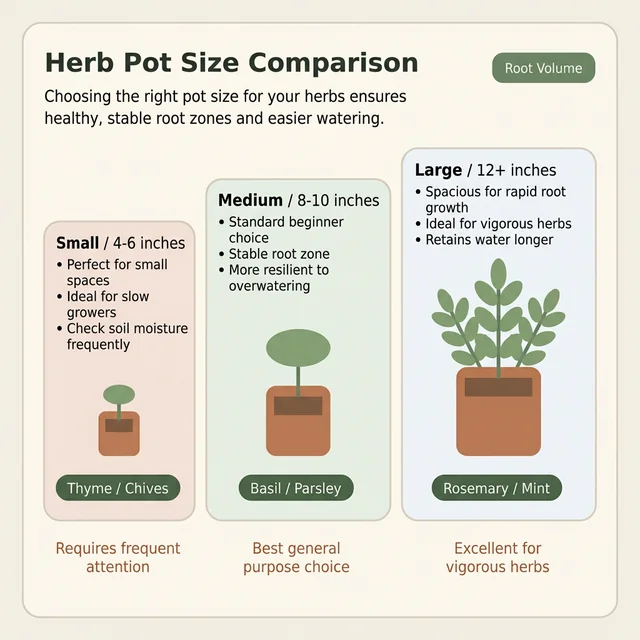
Container depth for tomatoes, peppers, and herbs: how much root space matters
Container size is one of the highest-leverage decisions in small-space gardening. When root volume is too small, every other care task becomes harder.