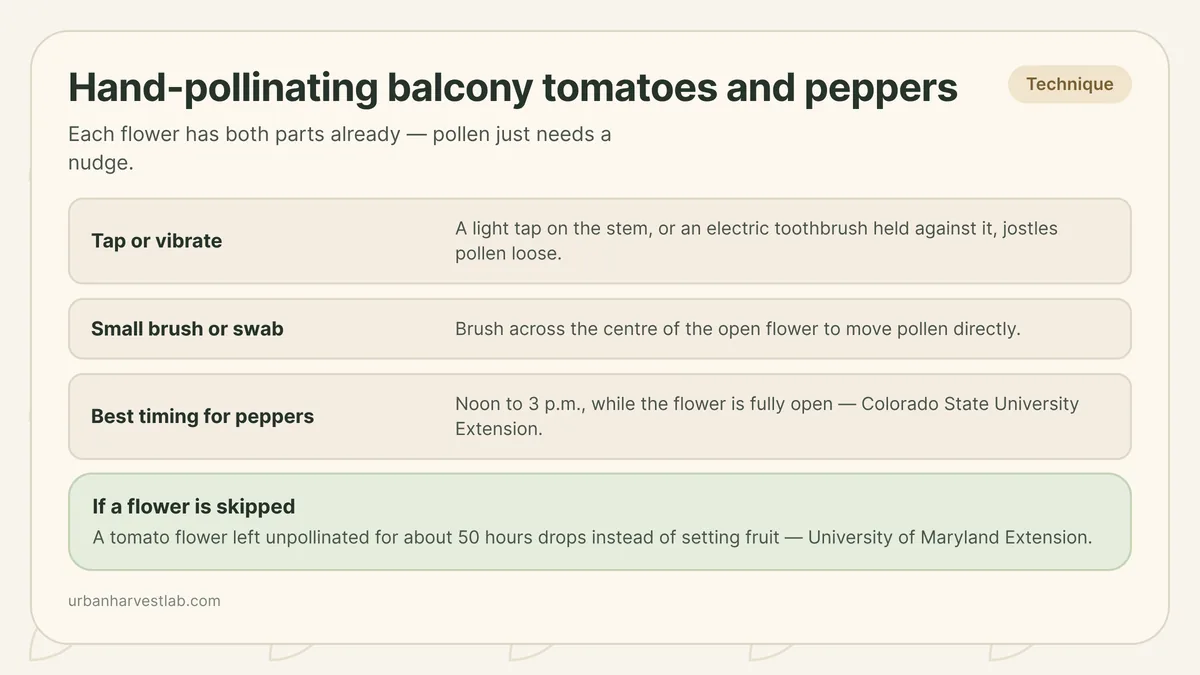
Tomato and pepper flowers carry everything they need to become fruit in one bloom: pollen-bearing anthers and a receptive stigma, sitting a few millimetres apart in the same flower. Hand-pollinating one is usually a matter of moving that pollen those few millimetres yourself — tap the stem behind an open flower, brush its centre with a small paintbrush, or hold a running electric toothbrush against the stem for a couple of seconds, then repeat every day or two while the plant is flowering. Outdoors, wind and visiting bees do this automatically. Several floors up on a balcony, with little airflow and few bees passing through, it often has to be done by hand or the flowers drop without ever setting fruit.
Why a balcony flower needs help a garden bed does not
A tomato flower holds its pollen-producing anthers wrapped closely around a short, central pistil, and pollen has to fall from one onto the other for the flower to set fruit. University of Alaska Fairbanks Cooperative Extension Service notes that how easily that happens changes with how long the pistil is relative to the anthers surrounding it. Pepper flowers are built the same way: one bloom, both parts, no separate male flower required.
The trouble on a balcony is not the flower’s design, it is the environment around it. Outdoors, wind rocks the plant and a visiting bee vibrates its wing muscles as it feeds, and either one is usually enough to shake pollen loose. A dwarf tomato or pepper plant sitting in a container against a railing several storeys up gets a fraction of both. University of Maryland Extension puts a number on what that costs: one or two bumblebee visits to a tomato flower push fruit set above 80%, against roughly 30% with no visit at all. A hand-pollinating routine is standing in for that missing visit, not adding an optional extra step.
Timing adds pressure of its own. The same University of Maryland Extension resource states that a tomato flower has to be pollinated within about 50 hours of forming or it aborts and drops. A flower skipped for a few days running is usually a lost one, not a delayed one.
The technique: tap, brush, or vibrate
Three methods work, and none of them call for anything specialised.
- Tap it. Colorado State University Extension’s Pueblo County office describes lightly tapping the flower itself, or the stem just behind it, to shake pollen loose inside the bloom.
- Brush it. A small artist’s paintbrush or a cotton swab, swirled gently inside the flower and then touched to its centre, moves pollen much the way a visiting bee would. The same office notes that dipping the tip in a little water helps when pollen is not sticking to a dry brush.
- Vibrate it. A running electric toothbrush held against the flower’s stem mimics the vibration of a bee’s wing muscles. Mississippi State University Extension answers this question directly: a vibrating toothbrush does pollinate the flower, but produces somewhat lower yields than the dedicated electric pollinators used in commercial greenhouses, a reasonable trade for a few balcony plants.
Whichever method is used, University of Alaska Fairbanks Cooperative Extension Service recommends going back over open flowers at least every other day, since new flowers keep opening through the plant’s flowering period and each one stays receptive for only a short window.
When to do it
Peppers have a narrower window than tomatoes. Colorado State University Extension’s Pueblo County office gives peppers a specific time of day: pollinate by hand between noon and 3 p.m., once the flowers are fully open. Tomatoes get a wider window rather than no window — University of Maryland Extension notes pollination usually occurs between 10 a.m. and 4 p.m.
Temperature affects tomatoes in two separate ways, and it is worth keeping them apart. University of Maryland Extension states that a tomato plant drops its flowers outright once daytime temperatures climb above 88-90°F or night temperatures stay above 70°F, and that night temperatures below 55°F can interfere with pollen tube growth or leave the pollen sterile. Separately, Colorado State University Extension’s Pueblo County office gives a temperature ceiling for the pollen itself rather than the flower: above roughly 85-90°F in the day (depending on humidity) and 75°F at night, pollen stops being viable even if the flower is still open and gets tapped on schedule. Either figure explains a balcony plant that flowered heavily in cool spring weather and then stalls in a heat wave — the pollen or the flower is reacting to heat, not to a missed pollination pass.
University of Alaska Fairbanks Cooperative Extension Service’s own working range for reliable pollination sits inside both of those figures: around 70% humidity and 60 to 85°F. A plant well outside that band on a given day is a poor candidate for hand-pollinating no matter the technique used; it is worth waiting for conditions to settle rather than tapping a flower that has already lost its pollen to heat.
Tomato, pepper, and squash side by side
| Crop | Flower type | Best pollination window | What works |
|---|---|---|---|
| Tomato | Perfect flower, both parts in one bloom | 10 a.m. to 4 p.m.; revisit at least every other day | Tap, brush, or vibrate the flower |
| Pepper | Perfect flower, both parts in one bloom | Noon to 3 p.m. | Tap, brush, or vibrate the flower |
| Zucchini and other squash | Separate male and female flowers on the same plant | Morning, while flowers are open | Move pollen from a male flower directly to a female flower |
Squash is a different problem
Zucchini and other summer squash flower the same week a tomato or pepper does, and a balcony grower running all three sometimes assumes one routine covers all of them. A squash plant carries separate male and female flowers on the same vine rather than one bloom with both parts, so pollen has to move from one flower to the other instead of being jostled loose inside a single bloom. Tapping or vibrating a squash flower on its own does nothing, because there is no second flower nearby to receive the pollen.
Telling the two apart is straightforward once you know the marker: a female flower sits on a small, swollen bump — a miniature fruit already forming — directly behind the petals, while a male flower sits on a plain, thin stalk with no such swelling. Moving pollen means touching a male flower’s centre to a female flower’s centre, either with a small brush or by picking the male flower and using it directly. The container side of growing squash on a balcony in the first place — sizing, depth, and the space a vine actually needs — is covered in the guide to sizing a zucchini container.
Give the plant room to actually carry fruit
Hand-pollinating a flower on a plant that does not have enough root volume to support fruit wastes the effort. A dwarf or patio tomato and a full-size tomato plant need very different pot sizes once fruit starts to set and swell, and the tomato pot size guide breaks that down by growth habit. Peppers have their own depth and volume needs, laid out in choosing container depth for tomatoes, peppers, and herbs. Getting a flower pollinated is the first step; the container has to be able to finish what it started.
Common mistakes
- Pollinating only once. A single tap early in the season misses every flower that opens afterward. Treat it as a daily or every-other-day pass over the plant while it is in bloom, not a one-time fix.
- Tapping the stem behind the flower rather than the bloom. University of Alaska Fairbanks Cooperative Extension Service describes holding the vibrating probe against the branch of the flower cluster, not the open bloom, and the same placement works for a tap or a toothbrush.
- Ignoring the heat. A plant that flowered well in spring and then stops setting fruit in a summer heat wave is not necessarily short on pollinating effort — above the temperature ranges given above, the pollen itself may no longer be viable, and hand-pollinating a heat-stressed flower will not fix that.
- Treating a squash flower like a tomato flower. Tapping a zucchini bloom does not pollinate it; pollen has to physically move from a male flower to a female one.
Sources
- Colorado State University Extension, Pueblo County — “Hand Pollination”
- Mississippi State University Extension Service — “Can I use a vibrating toothbrush rather than the expensive electric pollinators?”
- University of Maryland Extension — “Problems with Pollination in High Tunnel Tomatoes”
- University of Alaska Fairbanks Cooperative Extension Service — “Pollination & Fruit Development in Tomatoes”
Getting fruit, not just flowers, from a balcony plant
These guides cover the pot size and depth that keep a tomato or pepper plant healthy enough to carry fruit once a flower actually sets.
Common questions
Do balcony tomatoes need to be hand-pollinated?
Often, yes. Tomato flowers carry both male and female parts and do not need a separate pollinator plant, but their pollen still has to be physically jostled loose, which wind and visiting bees normally handle outdoors. A balcony several floors up gets much less of both, so a light tap or a few seconds of vibration against the flower stem on most days keeps fruit set going.
How do you hand-pollinate a pepper plant?
Tap or vibrate the stem just behind an open flower, or brush a small paintbrush or cotton swab across its centre. Colorado State University Extension's Pueblo County office gives peppers a specific window for this: between noon and 3 p.m., while the flowers are open.
What happens if a tomato or pepper flower does not get pollinated?
It drops instead of setting fruit. University of Maryland Extension states that a tomato flower has to be pollinated within about 50 hours of forming or it aborts, so a flower skipped for a couple of days in a row is usually lost rather than delayed.
Can you use an electric toothbrush to pollinate tomato flowers?
Yes. Colorado State University Extension's Pueblo County office names an electric toothbrush as a hand-pollination tool, and University of Alaska Fairbanks Cooperative Extension Service describes holding the vibrating probe against the branch of the flower cluster. Mississippi State University Extension notes that a toothbrush does pollinate the flower, just with somewhat lower yields than a dedicated electric pollinator, so it is a solid budget tool rather than the best case.
Related guides
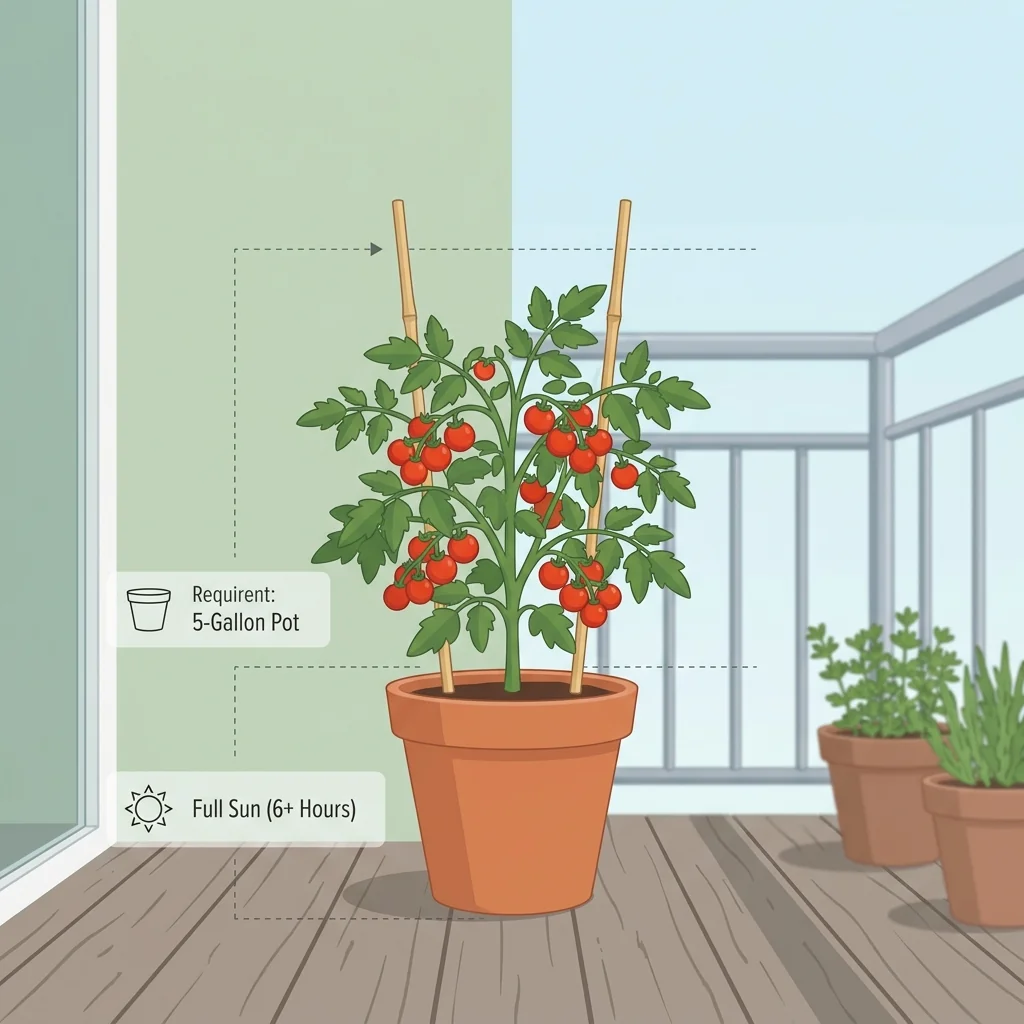
How to grow dwarf tomatoes in pots on a small balcony
Traditional tomato plants grow into massive, untameable 8-foot jungle vines that require giant cages and take over your entire balcony. But with modern 'micro-dwarf' or patio tomato varieties, you can grow heavy yields of sweet cherry tomatoes on a plant that stays under 2 feet tall. Here is the dwarf tomato container blueprint.
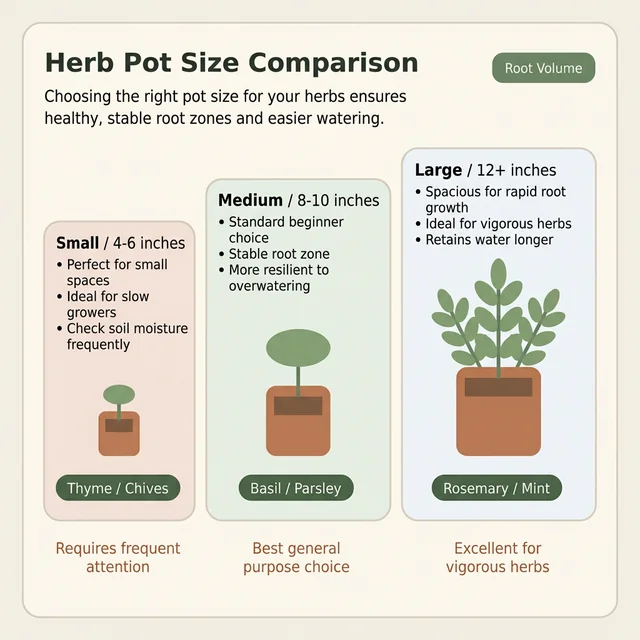
Container depth for tomatoes, peppers, and herbs: how much root space matters
Container size is one of the highest-leverage decisions in small-space gardening. When root volume is too small, every other care task becomes harder.
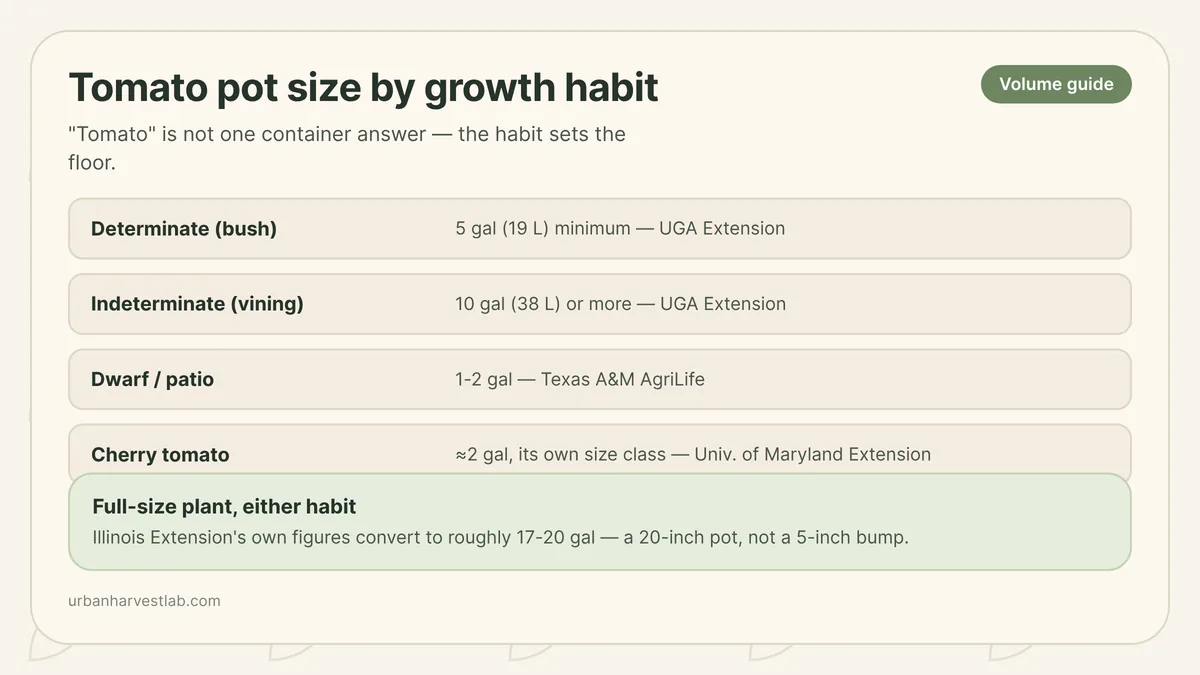
What size pot for tomatoes? Volume by growth habit
The right container for a tomato depends less on the fruit than on how the plant grows: determinate, indeterminate, or dwarf. Extension figures for the same word vary by more than three times.