Cucumber container size at a glance
| Source figure | Volume | Context |
|---|---|---|
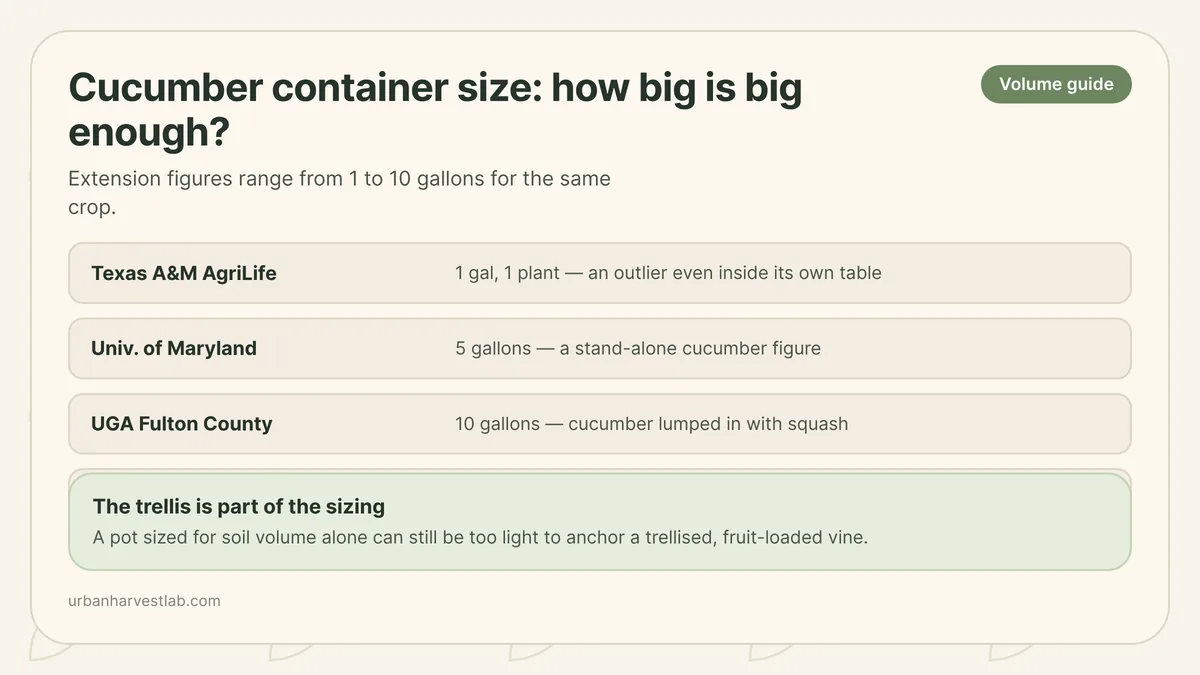
| Texas A&M AgriLife Extension | 1 gallon, 1 plant | Its own cucumber row; the same table gives summer squash 5 gal |
| University of Maryland Extension | 5 gallons | Stated as a stand-alone cucumber figure |
| UGA Fulton County Extension | 10 gallons | Cucumber lumped together with squash, a similarly vigorous vine |
| Working recommendation | 5 to 10 gallons | Accounts for full vine size, fruit load, and a trellis anchored in the pot |
One cucumber plant needs somewhere between 5 and 10 gallons of container once it is carrying a full vine and a season of fruit, even though a published figure as low as 1 gallon exists. Texas A&M AgriLife Extension lists cucumber at 1 gallon per plant, University of Maryland Extension gives 5 gallons, and UGA Fulton County Extension puts it at 10 gallons — grouped with squash, a similarly vigorous vine. That is a ten-fold spread for the same crop, and none of the three figures is a typo. The practical answer sits toward the larger end, because a cucumber vine under a trellis, loaded with fruit, behaves nothing like the seedling that first goes into the pot.
Why the numbers scatter so widely
Texas A&M’s own table puts summer squash — a cucurbit with the same sprawling habit and water demand — at 5 gallons per plant while listing cucumber at 1 gallon, so the 1-gallon entry is an outlier inside its own table rather than a figure explained away by the table’s scope. Two of the three figures are stated for cucumber specifically — Texas A&M’s 1 gallon and Maryland’s 5 gallons — while UGA Fulton County’s 10 gallons is the one that lumps cucumber in with squash, a similarly vigorous vine, rather than naming cucumber on its own.
None of that makes one source wrong. It means the question “how big a pot does a cucumber need” has a different answer depending on whether you are asking what keeps a seedling alive, what a mature vine’s water and root demand actually calls for, or what a similarly-built cucurbit needs. For a balcony or patio grower planting one cucumber to actually fruit through summer, the 5 to 10 gallon range is the one worth building around; see the tomato container size guide for the depth and volume figures cucumber can be compared against.
Going by pot diameter instead of a gallon marking
Not every container is labeled in gallons. University of Illinois Extension’s diameter-to-volume conversion — built for straight-sided round pots, not tapered or square ones — puts a 12-inch pot at roughly 5 gallons (matching Maryland’s cucumber figure, and close to a standard 5-gallon bucket), a 14-inch pot at roughly 7 gallons, a 16-inch pot at roughly 10 gallons, and an 18-inch pot at roughly 15 gallons. For the 5-to-10-gallon cucumber range, that means looking for something in the 12- to 16-inch diameter class, with 14 to 16 inches the end worth aiming for once the vine is carrying a full trellis and fruit load. Treat the conversion as an approximation specific to the pot shapes Illinois modeled, not a fixed rule for every container on the shelf.
Depth matters less than total volume
University of Kentucky Cooperative Extension groups cucumber with beets, kale, lettuce, onions, radish, spinach, chard, and turnip at a 6- to 8-inch minimum depth. That figure describes the shallowest end of what those crops tolerate, and several of the others in that list are shallow-rooted, quick-cycling greens that have little in common with a vining fruit crop carrying a trellis all season. No source in this range gives a cucumber-specific depth beyond that grouping, so treat 6 to 8 inches as a floor rather than a target. A wider, deeper container in the 14- to 16-inch range gives the root system more to draw on and gives the pot itself more weight and stability once a trellis and a loaded vine are pulling against it.
Cucumbers are vines — the trellis is part of the sizing decision
A cucumber left to sprawl takes up far more container-adjacent space than one trained upward, and a trellised vine keeps its fruit off the surface and its footprint off the floor. That means the container decision and the support decision happen together, not in sequence: a pot chosen for soil volume alone can still be too light or too shallow to anchor a trellis once the vine and its fruit load are pulling on it. For a renter or anyone who cannot drill into a wall or railing, renter-friendly trellis solutions covers the actual building options — a tension-mounted pole, a tripod or obelisk set into the pot, or a free-standing A-frame that carries its own weight. Whichever support you choose, plan for its footprint before you fill the pot rather than after the vine starts reaching.
One plant, one container
Texas A&M states its figure as one gallon per plant, and container volume figures of this kind describe a single plant. Cucumbers are vigorous enough that two plants sharing a container will compete for water and root space long before either one runs out of space to climb, and the shortfall shows up as competition for water and root volume rather than an obviously stunted plant. If you want more than one cucumber vine, give each its own container rather than splitting one larger pot between them.
A plain bucket can do the job
A 5-gallon bucket is a common, inexpensive way to hit the size University of Maryland Extension names for cucumber, and it is sturdy enough to anchor a lightweight trellis once drainage holes are drilled in the bottom. The one condition that matters is that the bucket is food-grade: University of Maryland Extension notes that a bucket which previously held anything non-food, such as paint or cleaning chemicals, does not become food-safe again just because it is made from a food-grade plastic; University of Kentucky Cooperative Extension separately puts a food-grade bucket in its own recommended container list for one cucumber plant. Look for a recycling code #2 (HDPE) or #5 (PP), or a “food grade” label, and skip anything without a documented history.
Material changes how often you will water
Cucumbers pull a lot of water through a vine that size, so a light-colored plastic or glazed ceramic pot is the easier default over dark or highly porous materials that dry faster and run hotter; plastic vs. terracotta pots for herbs covers the trade-off. Skip a gravel layer at the bottom too — pot drainage holes covers why it holds the root zone wetter rather than drier, and drainage holes plus a uniform mix do the job instead.
How cucumber compares to other fruiting vegetables in a container
Cucumber’s 5-to-10-gallon range sits close to a determinate tomato’s roughly 5-gallon figure and well under an indeterminate tomato’s roughly 10-gallon-or-more figure; the tomato container size guide breaks down that comparison crop by crop, including the same kind of source disagreement seen here. Both crops share the same underlying logic: size the container for the mature, fruiting, trellised plant, not for the transplant that first goes into it. If you are still deciding what to grow before you buy pots at all, best vegetables for small balconies is the better starting point.
Sources
- Texas A&M AgriLife Extension E-545, “Vegetable Gardening in Containers”
- University of Maryland Extension, “Growing Vegetables in Containers and Salad Tables”
- UGA Fulton County Extension, “Container Gardening: Thinking Outside the Box”
- University of Illinois Extension, “How to Grow Fruits, Vegetables, Herbs in Container Gardens”
- University of Kentucky Cooperative Extension, Daviess County, “Vegetables Grown in Containers Improves Accessibility”
- Washington State University Extension, “The Myth of Drainage Material in Container Plantings”
Sizing a container for a vining crop
These guides cover the volume, support, and comparison decisions that go with a cucumber container.
Common questions
What size pot does a cucumber need?
Texas A&M AgriLife Extension lists 1 gallon, University of Maryland Extension gives 5 gallons, and UGA Fulton County Extension puts it at 10 gallons grouped with squash. A 5 to 10 gallon container is the more reliable working range once the vine is carrying a full season of fruit and a trellis.
Can cucumbers grow in a 5-gallon bucket?
Yes, a 5-gallon bucket is a commonly cited size for one cucumber plant and matches a figure published by University of Maryland Extension. Make sure the bucket is food-grade, and skip one that previously held anything non-food, since that residue does not wash out.
How deep does a cucumber container need to be?
University of Kentucky Cooperative Extension groups cucumbers with shallow-rooted crops like lettuce and spinach at 6 to 8 inches deep, but that figure describes a bare minimum, not an ideal. Total volume matters more than depth alone, and a wider, deeper container gives the vine and its trellis more to root against.
Does a cucumber need its own container, or can it share with other plants?
Plan on one cucumber plant per container. Texas A&M states its figure as one gallon per plant, and container volume figures of this kind describe a single plant, so a vining, fruiting crop competing with anything else in the same root zone will show it as competition for water and root volume.
Related guides
What size pot for tomatoes? Volume by growth habit
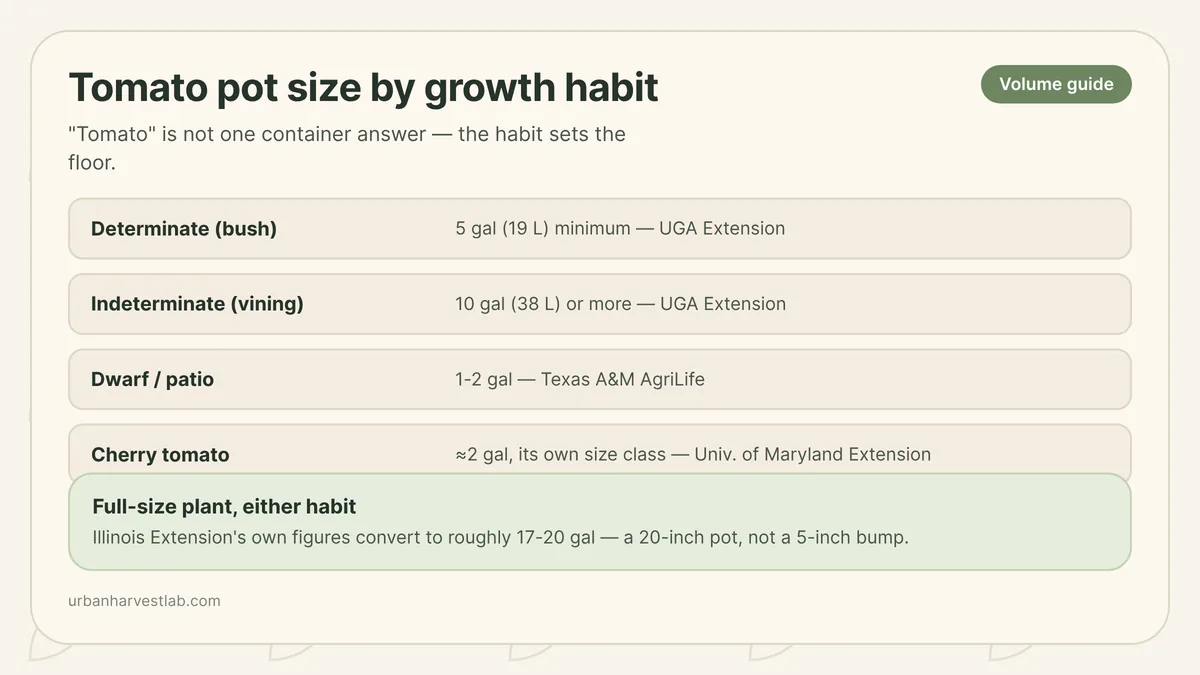
The right container for a tomato depends less on the fruit than on how the plant grows: determinate, indeterminate, or dwarf. Extension figures for the same word vary by more than three times.
Container depth for tomatoes, peppers, and herbs: how much root space matters
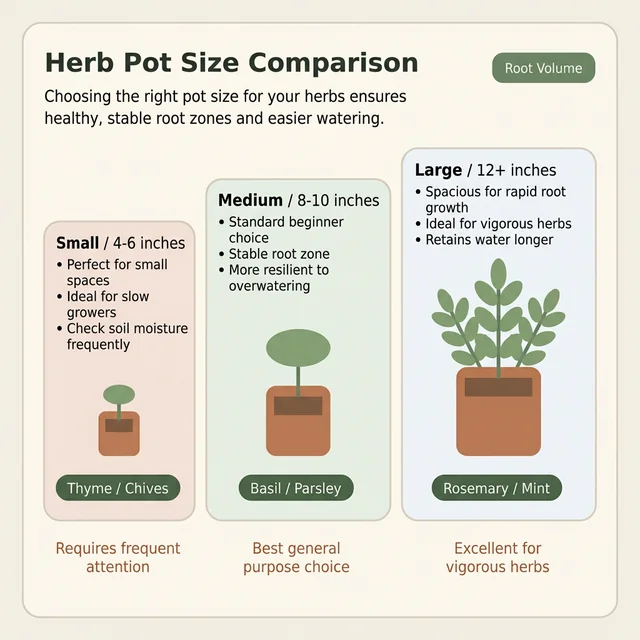
Container size is one of the highest-leverage decisions in small-space gardening. When root volume is too small, every other care task becomes harder.
Growing lettuce in containers: pot size and spacing for soil
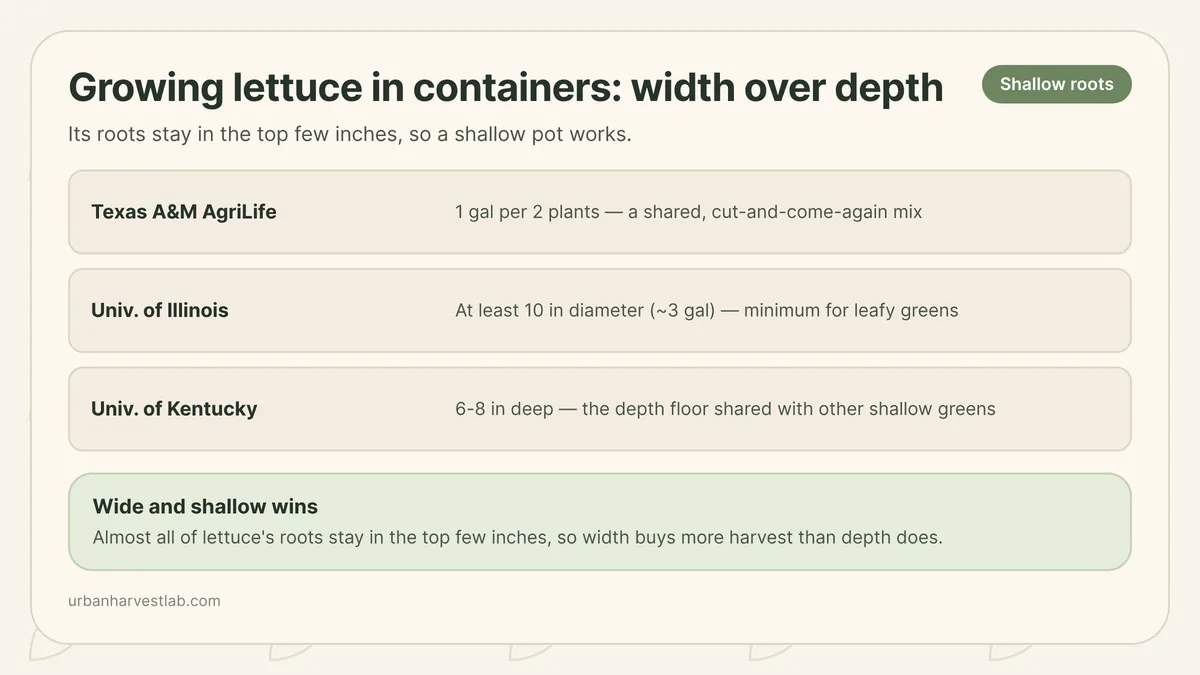
Lettuce keeps its roots in the top few inches of soil, which changes the whole container math. Here is how wide, how deep, and how far apart to space it.