Worked monthly examples at €0.25/kWh
| Actual draw | Hours/day | Monthly use | Monthly energy cost |
|---|---|---|---|
| 30 W | 14 | 12.6 kWh | €3.15 |
| 60 W | 14 | 25.2 kWh | €6.30 |
| 100 W | 14 | 42.0 kWh | €10.50 |
| 200 W | 14 | 84.0 kWh | €21.00 |
To calculate a grow light’s monthly electricity cost, use its actual wall draw, timer hours, number of operating days, and your all-in electricity rate. The basic calculation is transparent:
monthly cost = (watts ÷ 1,000) × hours per day × days × price per kWh
Calculate your own setup
Live estimate
Use wall watts when you have them. Add fans, pumps, or controllers separately so the result describes the whole growing setup.
Estimated energy cost
€6.83
30-day run
- Energy used
- 27.3 kWh
- Per operating day
- €0.23
- 12 similar periods
- €81.90
65 W × 14 h × 30 days ÷ 1,000
Cost alone does not tell you whether a fixture is useful. Pair this calculation with the measurement method in PPFD and DLI for indoor herbs so you know what the purchased electricity delivers to the canopy.
Find the four honest inputs
Actual wall watts
Use a plug-in electricity meter if possible. Otherwise, find “input power” or actual consumption in the technical specification. Ignore model names such as “1000” and incandescent-equivalent marketing. A dimmable fixture also needs a measurement at the setting you actually use.
Include associated equipment when budgeting a system. Fans, pumps, heat mats, and smart plugs may be small individually but operate for many hours. Measure them separately so you can see where changes matter.
Daily operating hours
Read the timer rather than estimating. If a light runs from 06:00 to 20:00, that is 14 hours. For a weekly schedule with different days, add the week’s hours and divide by seven.
Do not reduce hours blindly just to save money. A shorter photoperiod lowers daily light unless intensity increases. Review how many hours grow lights should run for herbs before changing the plant’s schedule.
Days per billing period
Use the actual billing period for reconciling with a bill or 30.4 days for an average month. A seedling setup running for six weeks should be calculated for 42 days rather than projected as a permanent annual cost.
All-in electricity price
Divide the relevant variable electricity charges by kWh on your bill when tariffs are complex. Fixed connection charges usually exist whether the lamp runs or not, so they should not be attributed entirely to the garden. Time-of-use rates require separate calculations for hours in each rate band.
Work through one example
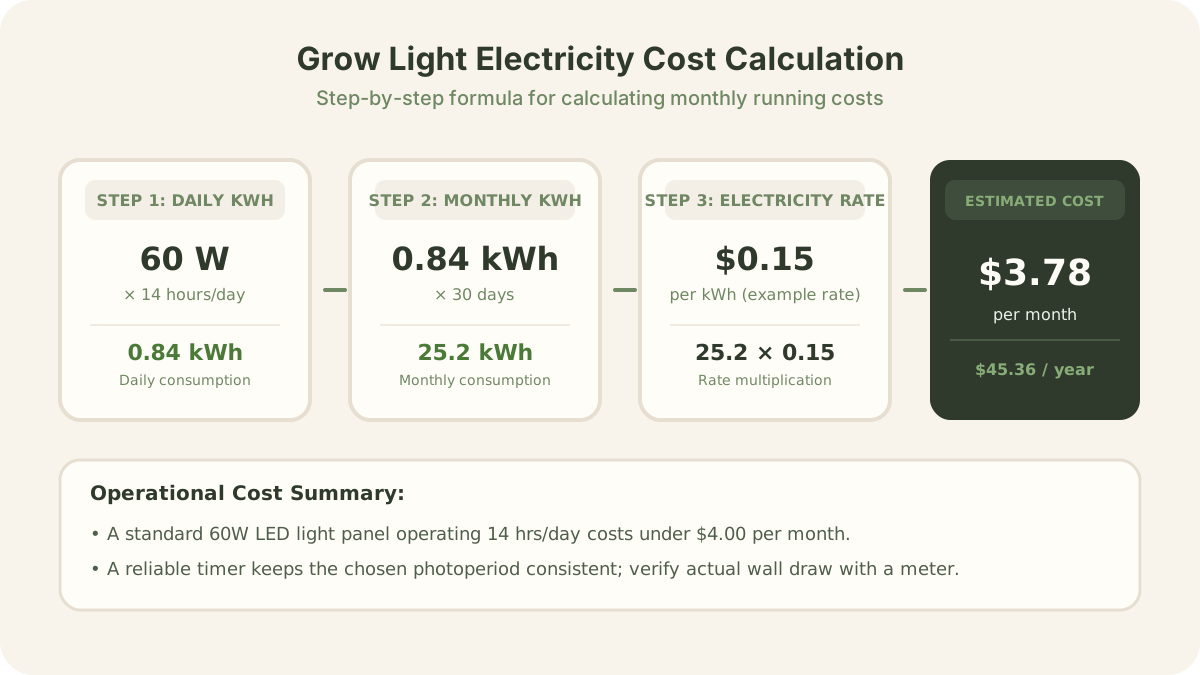
A fixture measured at 60 W runs 14 hours daily for 30 days:
60 ÷ 1,000 × 14 × 30 = 25.2 kWh
At €0.25/kWh:
25.2 × €0.25 = €6.30 per month
If a 5 W fan runs for the same period, it adds 2.1 kWh and €0.53. The combined energy cost is about €6.83. Round only at the end.
Calculate annual and crop-cycle cost
Annual cost is not always monthly cost multiplied by twelve. Many growers use seedling lights only in spring or reduce indoor growing in summer. Add the actual seasonal periods.
For crop-cycle cost, multiply daily kWh by the number of growing days. A 30 W microgreens light used for 12 hours across a 10-day light period consumes 3.6 kWh. Divide by saleable or consumed harvest mass only if you measure that mass consistently.
The purpose is not to prove indoor food is cheaper than outdoor agriculture. It is to understand the convenience, learning, freshness, and cost of your particular system.
Compare fixtures without false economy
A 40 W bar is not automatically cheaper than a 60 W bar if two 40 W bars are required for even coverage. Compare the power needed to deliver a chosen PPFD across the same usable area.
Map both fixtures at canopy height. Note average and minimum PPFD, footprint, mounting height, heat near leaves, and wall watts. A useful comparison metric is watts per adequately lit shelf area, supported by the full light map.
Purchase price also matters. Calculate a simple first-year cost:
fixture price + timer + mounting + first-year electricity
Do not assume projected harvest value will repay the fixture unless you keep real yield records.
Reduce cost without starving plants
First prevent light from missing the canopy. Align bars with rows, keep plants at similar height, and use safe reflective surfaces where appropriate. Improving coverage can allow a lower dimmer setting.
Second, light only the area in use. An empty half-shelf under a full fixture wastes energy. Consolidate young plants while maintaining airflow.
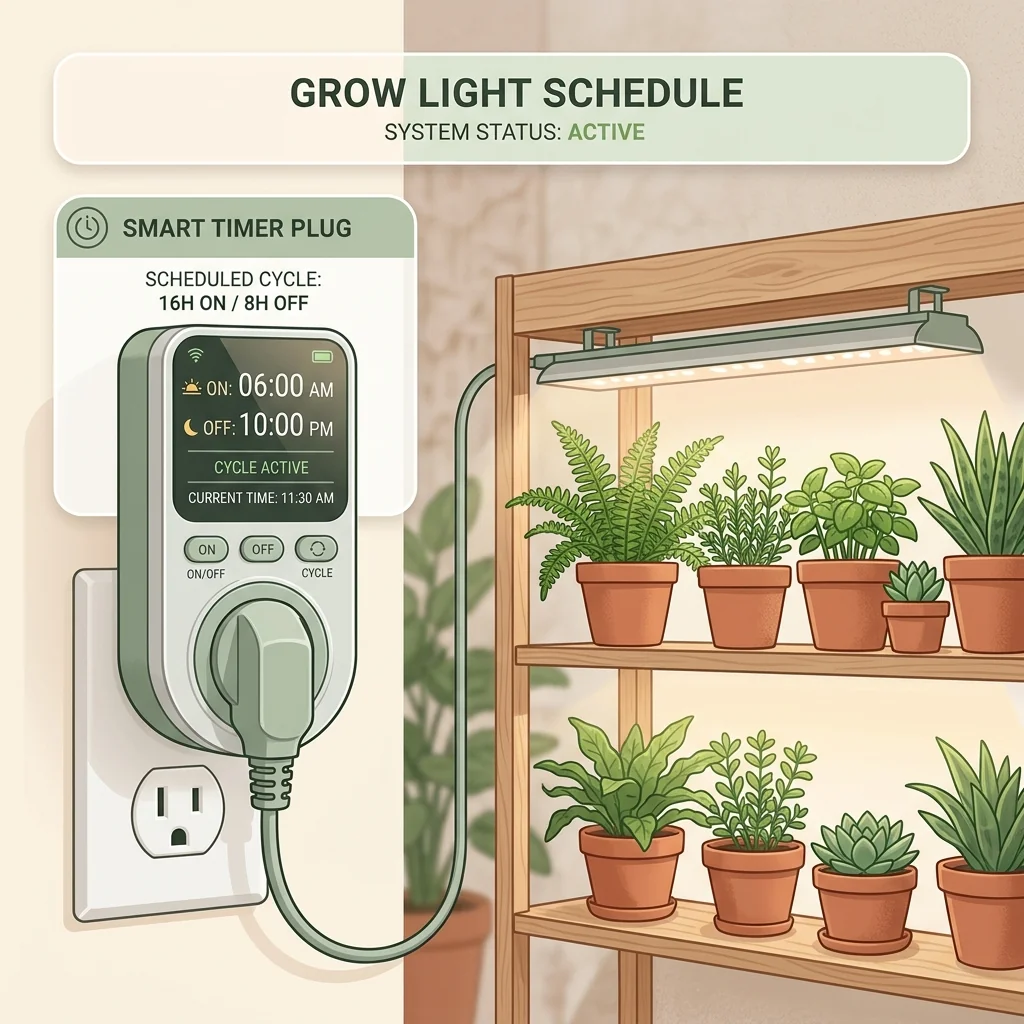
Third, use a reliable timer. Manual switching leads to accidental long days and inconsistency. See best grow-light timers for the selection logic.
Fourth, manage heat as part of the room. Electrical energy eventually becomes heat. In winter that heat may partly offset space heating; in summer it may add cooling demand. Do not claim this as a saving without measuring the household system.
Common calculation mistakes
- Using equivalent watts rather than input watts.
- Forgetting to divide watts by 1,000.
- Multiplying by 24 hours when a timer runs 14.
- Comparing tariffs without taxes and variable fees consistently.
- Ignoring fans and pumps in a complete setup.
- Assuming dimmer percentage equals power percentage.
- Comparing cost without comparing delivered light and area.
Keep a one-line monthly record
Record the meter reading, timer setting, tariff, calculated kWh, and crop area once per month. If the bill changes unexpectedly, this gives you a real baseline. It also makes fixture upgrades testable rather than speculative.
Handle variable tariffs and standby power
If electricity has peak and off-peak prices, split the schedule into separate calculations. A 60 W fixture running ten off-peak hours and four peak hours uses the same energy as any other 14-hour schedule, but not necessarily at the same cost. Move the photoperiod only if the timing still provides a consistent dark period and does not create unwanted heat or light in the home.
A smart plug, timer, or driver can draw power while the lamp is off. A meter that records cumulative kWh captures this automatically. For a manual calculation, measure standby power and add its off-hours separately.
Compare cost per useful outcome
For seedlings, divide crop-cycle energy by the number of healthy transplants, not cells sown. For herbs, record usable harvest mass. For a decorative kitchen garden, the outcome may be convenience rather than the cheapest leaves.
These comparisons matter only when plant quality is acceptable. Cutting DLI until basil stretches lowers the bill while potentially increasing cost per useful harvest. Pair financial records with the light and harvest log.
Home solar needs its own marginal price. Electricity used when panels would otherwise export may cost the lost export credit; energy drawn after sunset costs the import tariff. Calling solar electricity automatically free obscures that difference.
Recalculate whenever the tariff, timer, dimmer, or growing area changes; an old estimate is not a meter reading.
Sources and further reading
- U.S. Energy Information Administration: Measuring electricity explains watts, watt-hours, and kilowatt-hours.
- University of Minnesota Extension: Lighting for indoor plants provides plant-light context for duration and intensity decisions.
Design a measurable lighting system
Pair the cost calculation with measured light delivery, timer choices, and fixture fit.
Common questions
How much does a 100-watt grow light cost per month?
At 14 hours daily for 30 days it uses 42 kWh. Multiply 42 by your all-in electricity price; at €0.25 per kWh the energy charge is €10.50.
Should I use advertised watts or actual watts?
Use measured wall draw or the manufacturer's actual input power. Model names and equivalent-watt claims are not valid inputs.
Does dimming save electricity?
Usually yes, but not always in exact proportion to the dial. Verify with a plug-in meter and remeasure PPFD because lower consumption also changes delivered light.
Related guides
Best grow light timers (buyer's guide)
Consistency is everything in indoor horticulture. If you forget to turn your grow lights on, your plants will starve. If you leave them on too long, your greens will stress and bolt. Automating your photoperiod with a reliable outlet timer is the single easiest upgrade you can make. Here are our top picks.
PPFD and DLI for indoor herbs: a practical measuring guide
PPFD is a snapshot; DLI is the daily total. Used together, they turn grow-light setup from a distance rule into a measurable map.
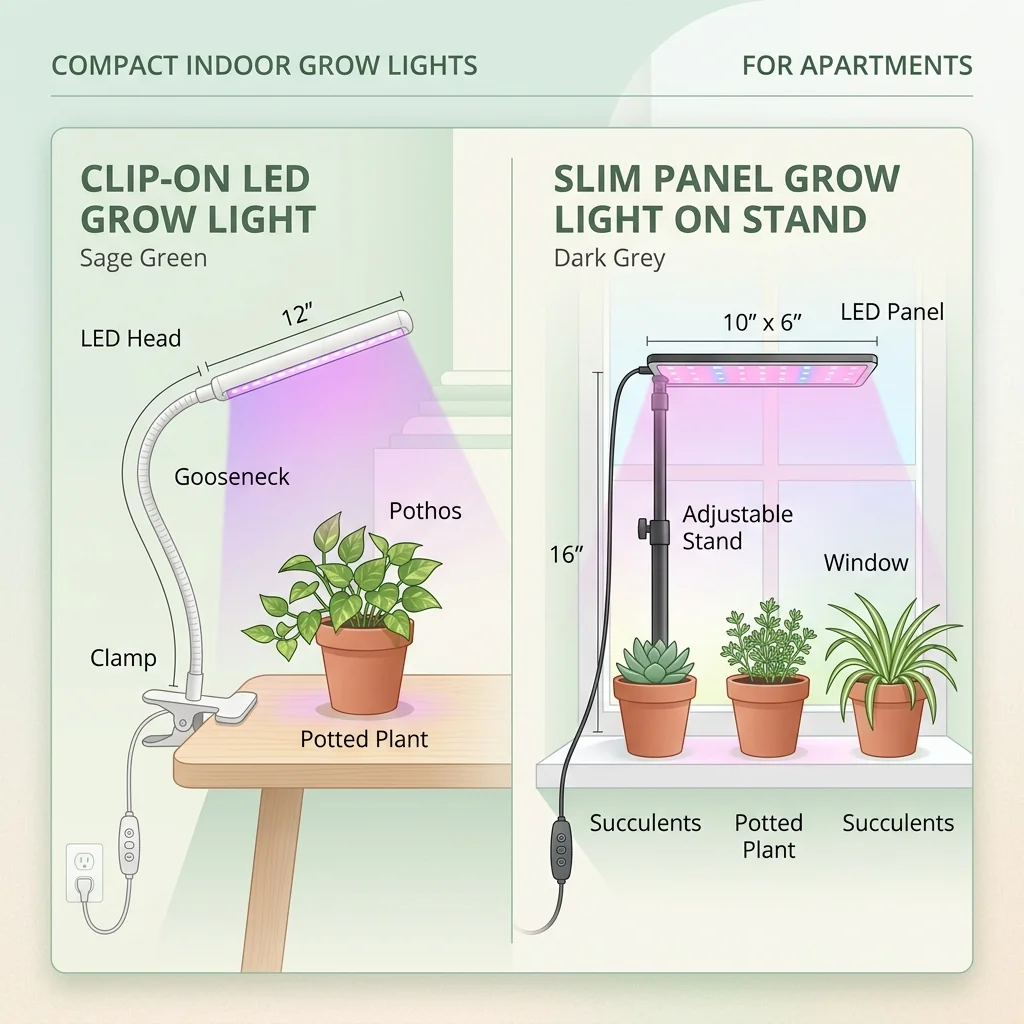
Best grow lights for apartments and windowsills
Apartments need grow lights that fit a small space and look acceptable in a living room. Here are the best compact LED types and what to check before buying.