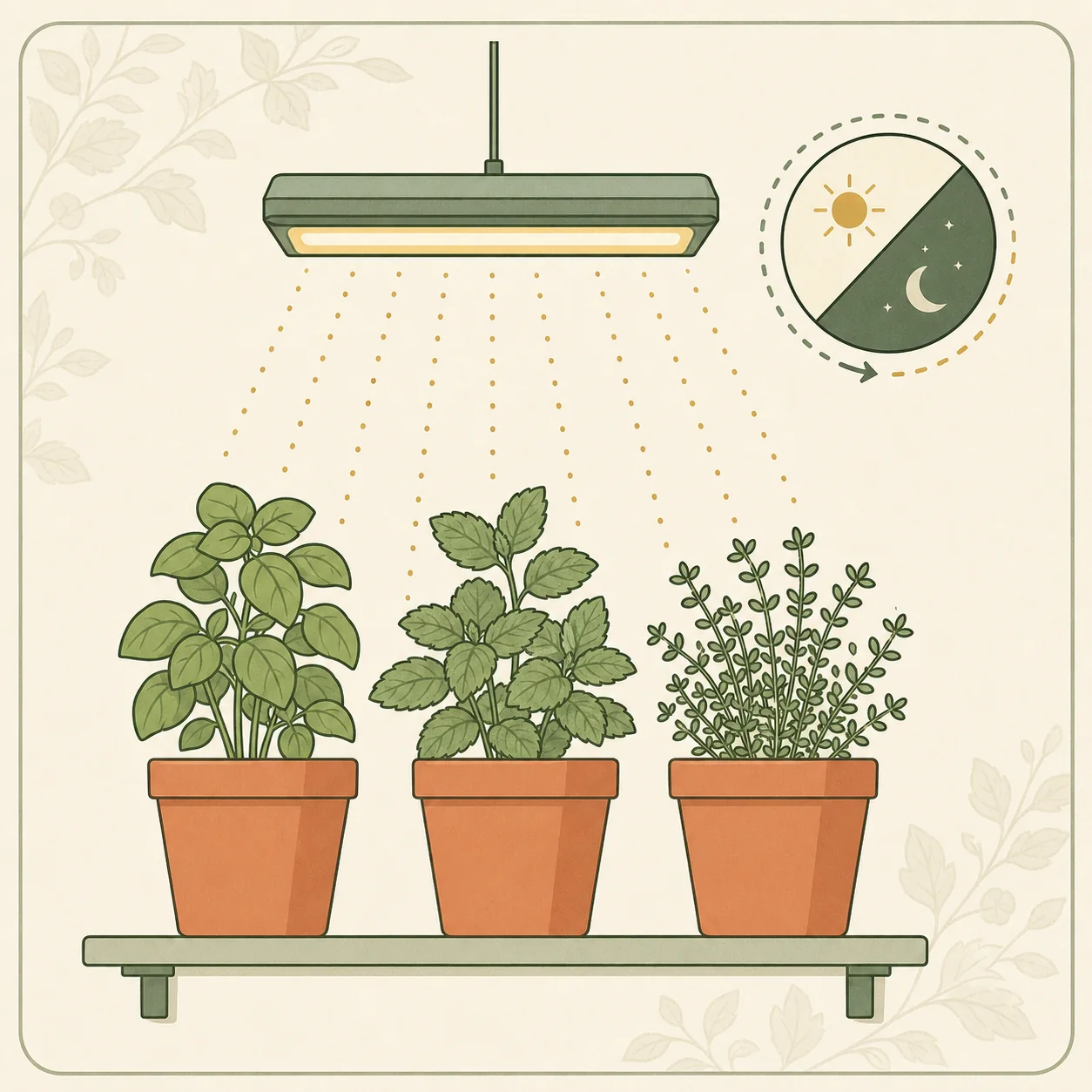
What each light measurement tells you
| Measure | Unit | Best use | Main limitation |
|---|---|---|---|
| Lux | lx | Comparing visible brightness from similar white LEDs | Weighted for human vision |
| PPFD | µmol/m²/s | Mapping useful photon intensity | Only a moment in time |
| DLI | mol/m²/day | Comparing total daily delivery | Depends on accurate PPFD and hours |
PPFD and DLI are useful because herbs respond to delivered light, not to the wattage printed on a box or the brightness perceived by a person. PPFD measures the photon flow reaching a square meter each second. DLI adds those photons across the full photoperiod.
You do not need laboratory precision to improve a shelf. You need repeatable measurements, a grid, and a willingness to adjust the weakest useful area. Start with how much light herbs need for plant-level context, then use this method to evaluate the actual fixture.
Understand the two numbers
Photosynthetic photon flux density, or PPFD, is expressed in micromoles per square meter per second. A reading of 200 µmol/m²/s means that rate is arriving at the sensor at that moment. It says nothing about how many hours the light stays on.
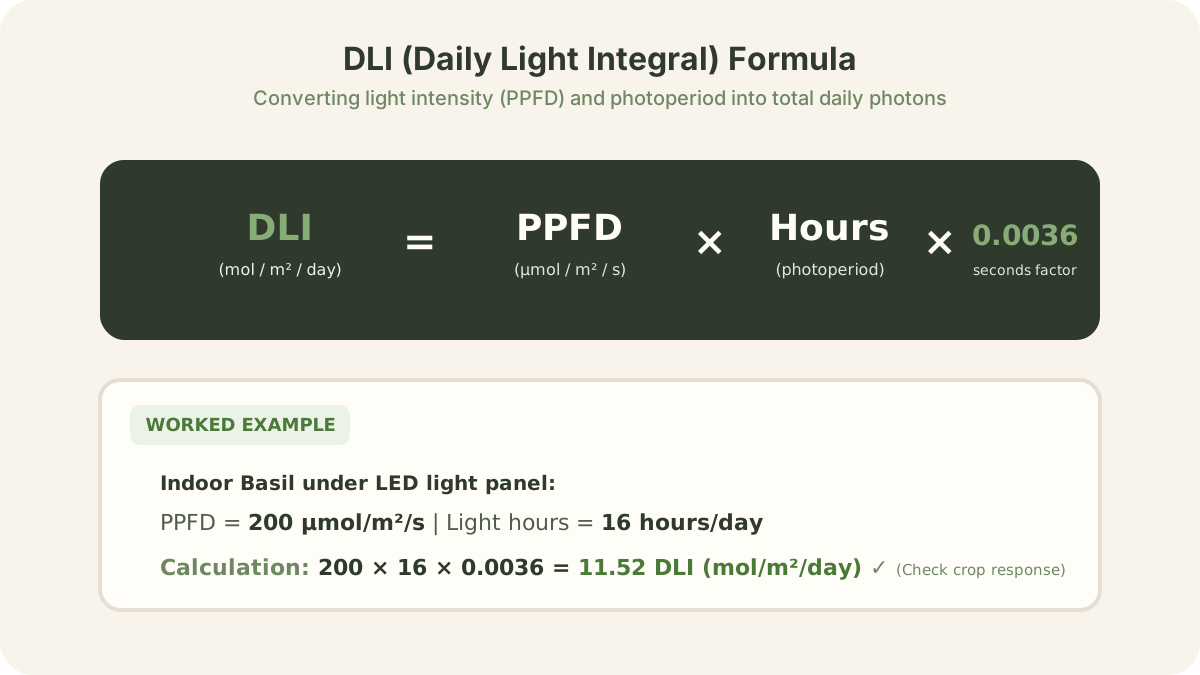
Daily light integral, or DLI, is expressed in moles per square meter per day. For a constant electric light:
DLI = PPFD × lit hours × 0.0036
At 200 PPFD for 14 hours, DLI is about 10.1 mol/m²/day. At the same PPFD for 8 hours, it is about 5.8. The formula is straightforward, but it assumes the sensor reading represents the plant’s position and the output remains stable.
Use ranges as hypotheses, not pass marks
Indoor culinary herbs are diverse. Mint grown for tender leaves, compact basil harvested repeatedly, and slow woody rosemary do not share one exact requirement. Stage and environment also change the result.
A practical starting experiment for many leafy herbs under white LEDs is roughly 150–300 PPFD for 12–16 hours, giving a DLI of about 6.5–17.3. This broad band is intentionally not a universal prescription. Begin toward the lower-middle area for recently transplanted or shade-tolerant herbs and observe new growth.
If leaves bleach, curl upward, or develop dry patches closest to the fixture, the combination of light, heat, and acclimation may be too aggressive. If stems stretch and new leaves remain small, delivery may be too weak. Water, root health, temperature, and nutrition can produce overlapping symptoms, so do not diagnose from PPFD alone.
Map the entire canopy
Warm the fixture according to its normal routine, then measure at the top of the leaves. Create a grid with the center, four corners, and midpoints along each edge. Record distance from fixture and reading at every point.
Calculate three values: center PPFD, minimum PPFD, and average. The minimum tells you whether edge plants are being left behind. The center-to-edge ratio shows uniformity. A dazzling center with dim corners is often less useful than a slightly lower but even map.
Repeat at the height of short plants if the canopy is uneven. Light intensity can change substantially over a small vertical distance. Raise shorter pots on stable platforms rather than lowering the entire fixture until tall leaves are stressed.
Phone app or quantum sensor?
A calibrated quantum sensor is designed for this measurement, but it may cost more than a small home shelf. A phone app can be useful for comparing points and repeating setup changes, especially under a conventional white LED. Accuracy varies with phone hardware, diffuser method, and lamp spectrum.
If using a phone, follow the app’s diffuser and calibration instructions, hold it level, avoid shading the sensor, and treat the result as an estimate. Consistency is the value: the same device can show that one corner is roughly half as bright as another even if the absolute number is imperfect.
Lux meters also help compare positions under the same white fixture. Do not convert lux to PPFD with one universal factor across different lamp spectra.
Adjust the right lever
Lowering a fixture increases intensity but usually shrinks the evenly lit footprint. Raising it broadens coverage but reduces intensity. Before changing the timer, optimize height and spacing so plants receive a reasonably even field. Review grow light distance for seedlings for the same geometry.
After coverage is acceptable, adjust duration. Many herbs do well with a consistent day and an uninterrupted dark period. Extremely long photoperiods are not a free substitute for insufficient intensity, and they increase electricity use.
Reflective side surfaces can recover some spill light, but keep materials away from water, heat, and electrical connections. A second bar may improve uniformity more effectively than driving one central fixture harder.
Validate with plant records
Record date, crop, PPFD grid, photoperiod, calculated DLI, fixture height, and one weekly photo from the same angle. Evaluate new growth, not old damaged leaves. Measure internode length, leaf size, color, and harvest mass when possible.
Change only one major light variable for a full observation interval. Basil may show direction within a week, while slow herbs need longer. If growth does not improve after a measured light correction, investigate roots, temperature, and nutrition instead of continuing to increase intensity.
Common measurement errors
- Measuring at the shelf rather than leaf height.
- Reporting only the brightest center point.
- Shading the sensor with a hand or phone.
- Comparing readings from different apps as if calibrated equally.
- Forgetting that natural window light adds a changing contribution.
- Changing fixture height and hours simultaneously.
- Treating a target range as proof that every other condition is correct.
Account for window light and canopy growth
An electric shelf beside a window receives a variable second source. Measure with the grow light off at several representative times, then with it on. Do not add a noon window reading to an electric reading and call it the daily average; daylight changes continuously. Log the electric-only map as the dependable baseline and note whether the window adds meaningful light.
A seedling measurement also expires as herbs grow closer to the fixture. Recheck after raising platforms, pruning, moving pots, or changing the dimmer. Measure height from the highest living leaf, not the pot rim, and keep the manufacturer’s safe clearance.
Run a controlled home comparison
When a setting is uncertain, grow two groups of the same herb from similar starting material. Keep pot, mix, watering, temperature, and feeding as consistent as possible. Give the groups different measured DLIs and compare new leaf area, internode length, harvest mass, and stress.
This does not establish a universal target, but it produces a defensible local setting. A measured home trial is more useful than copying a number from a greenhouse with different temperature, cultivar, carbon dioxide, and nutrition.
Sources and further reading
- Utah State University Extension: Starting Vegetable Seeds Indoors—Materials provides a university-extension reference for seedling PPFD and lighting materials.
- University of Minnesota Extension: Lighting for indoor plants explains light intensity, duration, and plant response.
Turn the measurement into a setup
Combine a light map with distance, duration, and fixture-selection guidance.
Common questions
What is the difference between PPFD and DLI?
PPFD is the instantaneous density of photosynthetically active photons at a point. DLI is the total delivered during the lit portion of a day, so the same PPFD produces a higher DLI when used for more hours.
Can a phone measure PPFD accurately?
A phone app can help compare positions when used consistently, but sensor and spectrum corrections vary. Use it as a mapping tool unless it has been validated against a quantum sensor.
Should every herb receive the same DLI?
No. Species, growth stage, temperature, and harvest goal matter. Use broad ranges as a starting point and adjust from new growth rather than chasing one universal target.
Related guides
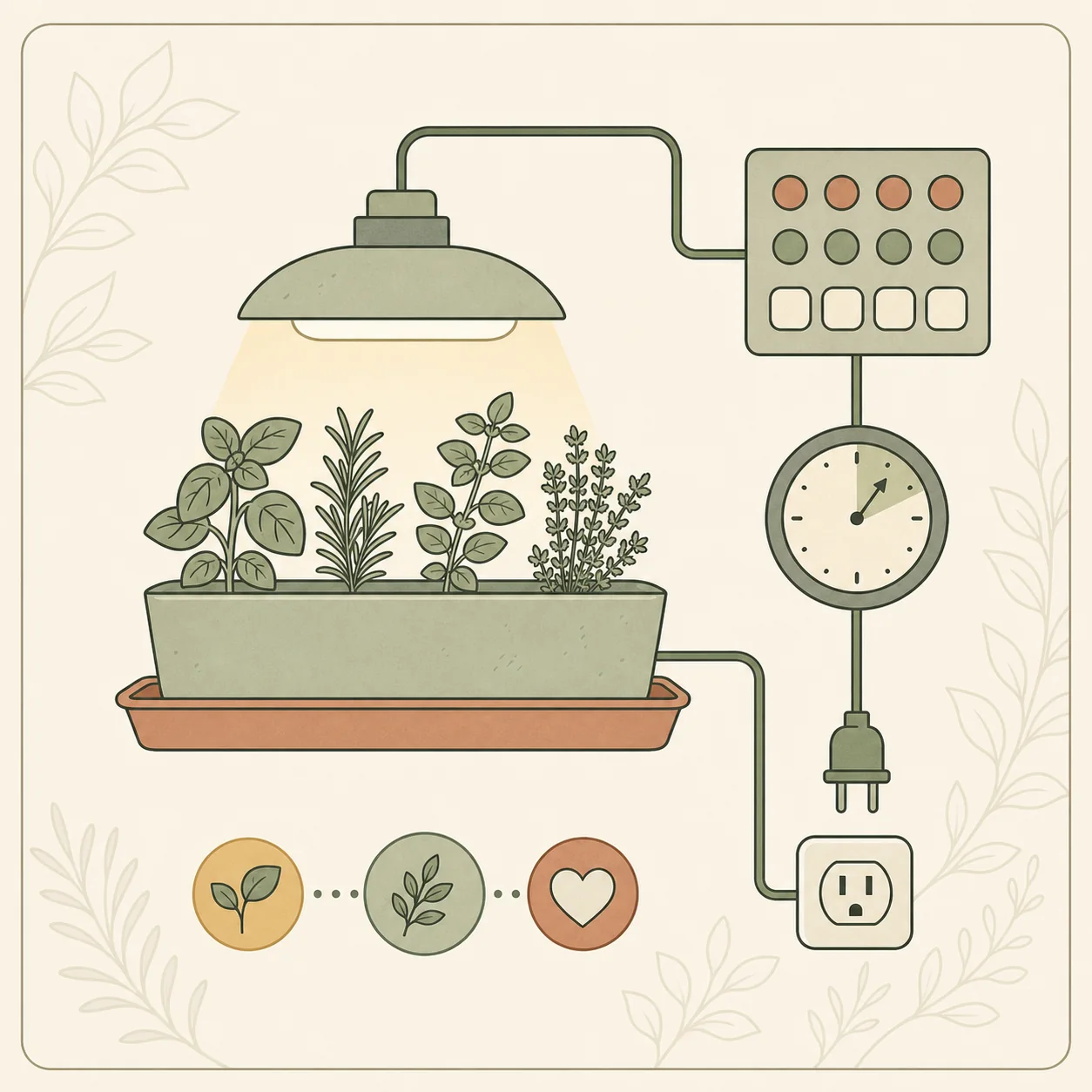
Grow light electricity cost: calculate the real monthly bill
The monthly cost of a grow light is a four-input calculation. Measure wall power when possible, then compare cost per useful growing area—not labels alone.
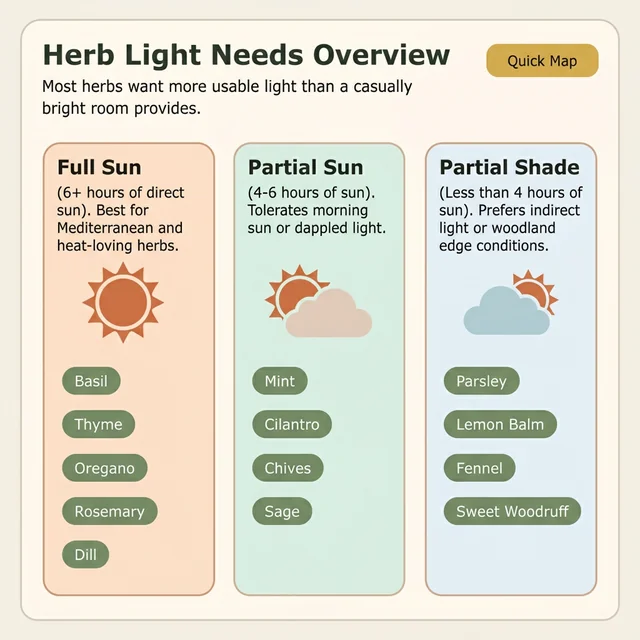
How much light do herbs need? 6+ hours of sun
A practical guide to how much light herbs need, including a quick answer for direct sun, indoor windows, and grow light setups that actually support growth.
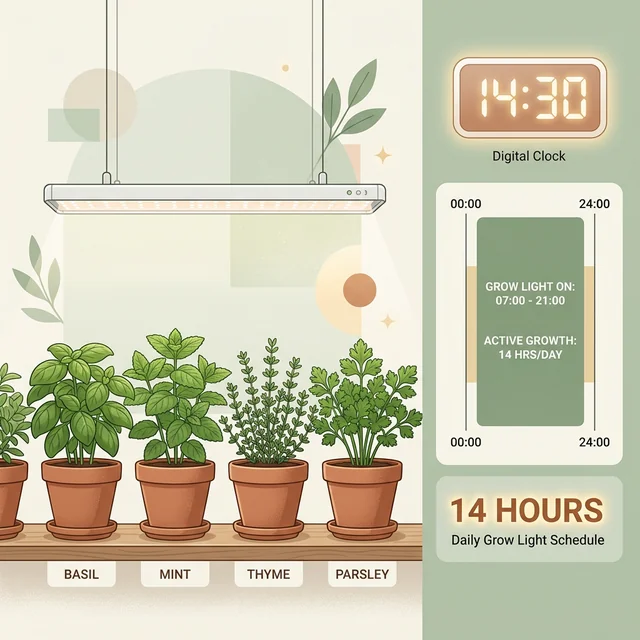
How many hours should grow lights run for herbs? 12-16
Most herb grow lights should run about 12 to 16 hours per day, but intensity, distance, and a stable dark period matter as much as the timer itself.