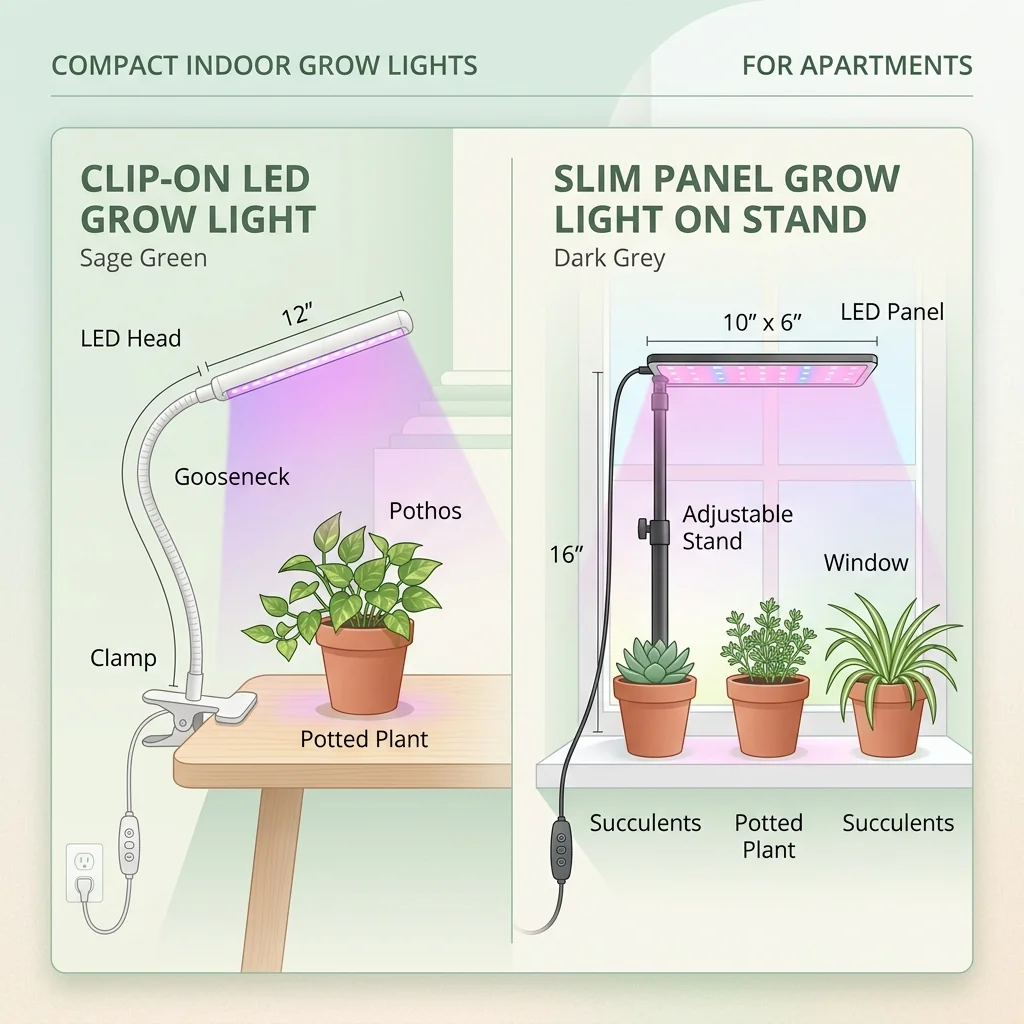
Apartment grow lights by setup
| Light type | Best for | Notes |
|---|---|---|
| Clip-on LED | 1-2 pots, a sill or desk | Easiest, flexible positioning |
| Small LED panel / bar | A shelf or windowsill row | Covers several plants |
| Grow-light shelf unit | A dedicated herb station | Most output; needs the space |
Editorial note: The retailer link is an untracked shopping reference; Urban Harvest Lab does not currently receive a commission from it. Recommendations are based on stated features and suitability criteria, not on undocumented hands-on testing.
Apartments need a grow light that fits the planted footprint, can be mounted safely, and delivers useful intensity without unacceptable glare, noise, or heat. A small panel or bar is often easier to distribute across a shelf; a clip-on can work for one compact pot only when its measured coverage supports that claim. Before buying, set the light target with how much light do herbs need?.
Match the light to your setup
- Clip-on LED — clamps to a sill, shelf, or desk and bends to aim at one or two pots. The easiest, most flexible apartment option; covered in detail in best clip-on grow lights for herbs.
- Small LED panel or bar — sits above a shelf or windowsill row and covers several plants at once.
- Grow-light shelf unit — a dedicated herb station with the most output, if you have the space for it.
Browse apartment grow lights on Amazon
What to look for
- Published input power and coverage. Ignore model names and “equivalent watts.” Prefer a PPFD map at a stated distance, or plan to measure the installed shelf.
- A replaceable timer. A plug-in timer is easier to replace than a fixture whose built-in controller fails. Use how many hours grow lights should run to set the photoperiod.
- Adjustable height or angle. So you can keep the light close as plants grow.
- Managed heat. Efficient LEDs can still warm leaves, shelves, and drivers. Maintain the manufacturer’s clearances and check canopy temperature.
- Electrical safety. Look for certification appropriate to your market, strain relief, a dry plug location, and a cable route that cannot collect runoff.
- Living-room fit. Check fan noise, visible flicker on a phone camera, glare from seated eye level, and whether the fixture has a true off state.
Measure the shelf before buying
Record the planted length and width, the maximum mounting height, and the distance between the future canopy and fixture. Product “coverage” may refer to a lower-intensity seedling area rather than an herb harvest area. A narrow bar can illuminate a row efficiently, while a square panel may suit a deeper shelf.
Map at least five points after installation: centre and four corners at canopy height. A phone lux meter is imperfect across different spectra, but it can reveal relative hot spots and dark corners when used consistently. A quantum sensor provides PPFD if the investment is justified. Rotate pots only as a secondary correction; it does not turn a badly mismatched footprint into even light.
Calculate the real apartment cost
Use actual wall watts, not the product name:
monthly kWh = watts ÷ 1,000 × hours per day × days
Then multiply by the variable electricity rate on your bill. Include fans or controllers that run with the light. Use the grow-light electricity cost calculator to calculate a complete setup and compare currencies or billing periods without redoing the arithmetic.
Run a seven-day acceptance test
Keep the packaging while you test:
- mounting remains stable and cables stay dry;
- canopy and driver temperatures stay within manufacturer limits;
- new leaves remain compact without bleaching or curling;
- no plant spends the day outside the useful footprint;
- the timer restores its schedule after a short power interruption;
- glare and noise are tolerable during normal use.
Return a fixture that cannot cover the intended area safely. Adding hours cannot fully compensate for extremely low instantaneous intensity, and lowering a light beyond its rated clearance is not a safe fix.
Match the light to the crop
Herbs and leafy greens are generally more practical indoors than fruiting tomatoes or peppers, but crop, stage, footprint, and harvest goal still determine intensity. Do not promise that any clip-on or small panel is “plenty” without a map. For broader selection logic, see best grow lights for herbs.
The bottom line
Choose a fixture from the crop and footprint backward, verify its installed coverage, and automate a suitable light/dark schedule. “Full spectrum” is a useful description, not a performance guarantee.
Sources and further reading
Before you buy an apartment grow light, read these
These guides cover how much light herbs need, hours and distance, and the LED-vs-fluorescent question.
Common questions
What is the best grow light for an apartment?
The best fixture is one that covers the measured plant footprint at the crop's required intensity. A clip-on may suit one small pot; a bar or panel is usually easier to map across a shelf. “Full spectrum” alone does not prove adequate output.
Are clip-on grow lights good enough for herbs?
Some are adequate for one compact pot, while many lose useful intensity across a wider area. Check actual input power, mounting distance, coverage data, and plant response instead of assuming the clip-on format is sufficient.
How many watts do I need for apartment herbs?
Less than you might think. A modest full-spectrum LED is plenty for herbs and greens; intensity and distance matter more than raw wattage. Fruiting crops like tomatoes need more.
Should an apartment grow light have a timer?
Yes, ideally. Herbs want a consistent 12 to 16 hours of light, and a built-in or plug-in timer makes that automatic so you do not have to remember.
Related guides
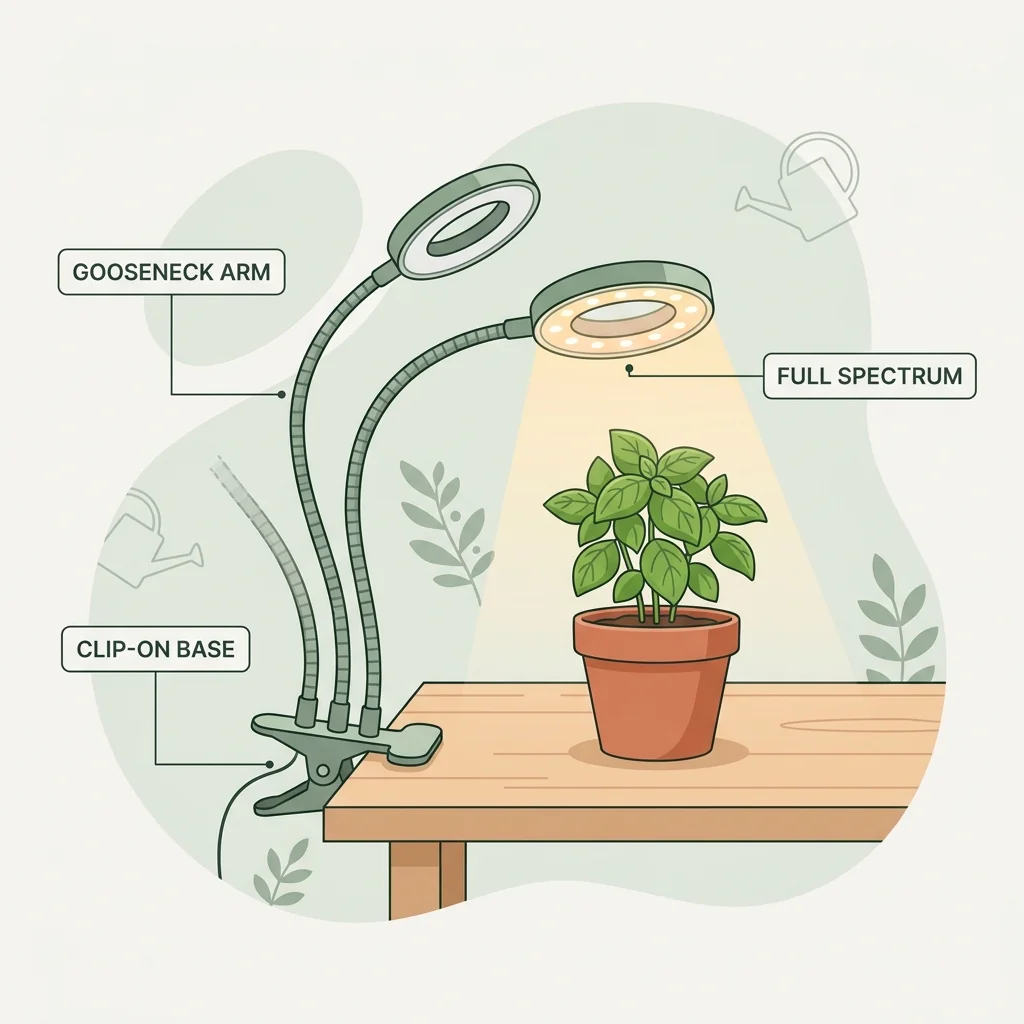
Best clip-on grow lights for herbs (buyer's guide)
You do not need to install massive ceiling-mounted grow panels or ugly industrial fixtures to keep your indoor herbs alive. With a flexible, clip-on gooseneck LED grow light, you can clamp a soft, full-spectrum light source directly onto your desk or windowsill in seconds. Here are our top-rated options.
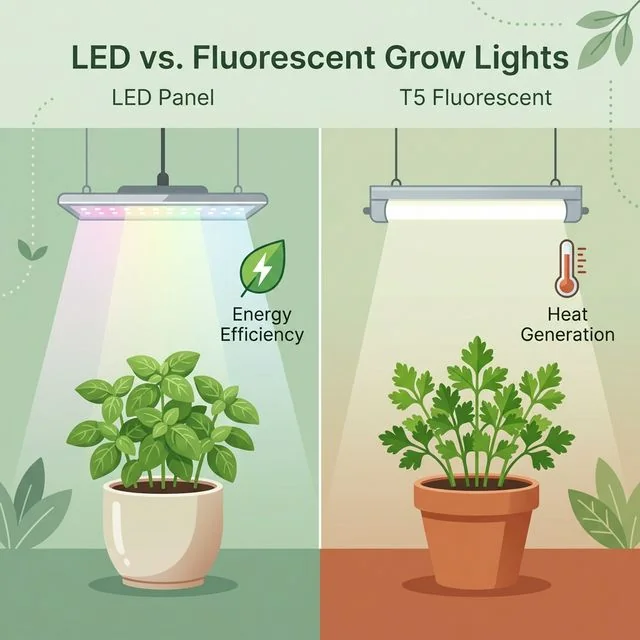
LED vs. fluorescent grow lights for herbs: which is better?
Fluorescent tubes used to be the gold standard for indoor gardeners, but modern LEDs have changed the game. Find out which technology is right for your space and budget.
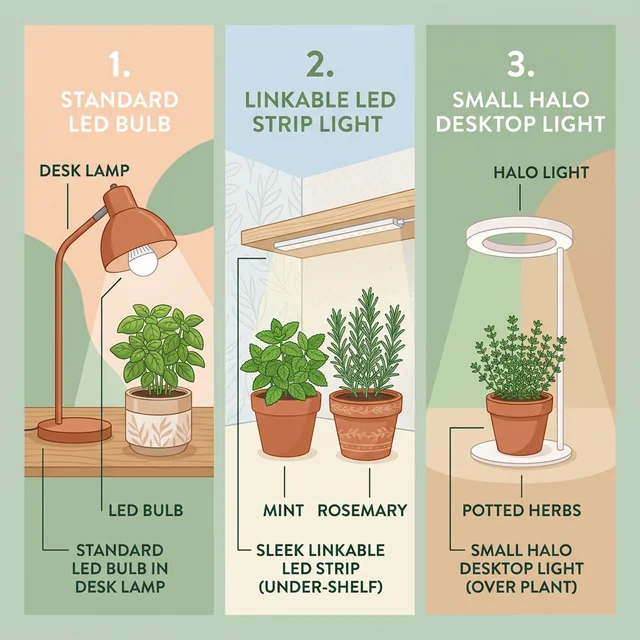
Best grow lights for herbs: what actually matters before you buy
Most indoor herbs don't need a massive, expensive grow tent light. Here is how to choose the right LED bulbs, strips, or halos for your real apartment setup.