
Search “reflective material grow light” and you will land on confident claims about exactly how much brighter your shelf gets with a sheet of mylar taped to the wall. Most of those numbers are marketing copy repeating each other, not measurements. A reflective surface genuinely can return some of the light that would otherwise land on a wall or the floor instead of a leaf, but how much it helps depends on the shape of your shelf, not on a fixed number attached to the material. On many small home setups, the surface makes far less difference than people expect, and a crumpled or dirty one can do more harm than good.
If you have not settled how much light your herbs actually need in the first place, that question matters more than what you line the walls with — see how much light indoor herbs need before spending an afternoon on reflectors.
Quick answer: is it worth reflecting light back onto your plants?
Sometimes, modestly, and not as a substitute for getting the fixture itself right. Light that misses the canopy and hits a wall, a shelf edge, or the floor is wasted; a reflective surface returns a portion of it. That is real physics, not folklore. What is folklore is the specific efficiency-gain percentage attached to any one material — no published source backs a number for mylar, foil or flat white paint in a home setup, so treat quoted figures as marketing. This comes down to where reflectors help, where they fail, and why they are a minor lever compared to fixture distance and output.
Why the same material helps one shelf and does nothing for another
Every grow light throws photons in a cone or a spread pattern, and not all of that spread lands on leaves. Inside an enclosed tent or a cupboard, nearly every photon that misses the canopy has nowhere to go but a nearby wall, which is exactly the light a reflective interior can intercept and send back. On an open shelf with no walls nearby, that same stray light simply disperses into the room and is gone for good — no reflective surface within reach captures it.
That is the first thing worth knowing before buying anything: the ceiling on how much a reflector can help is set by how much light was escaping in the first place. From there, three things decide the outcome more than the material itself: how far the reflective surface sits from the canopy, how flat and clean it stays, and how much of the fixture’s spread was missing the plants to begin with.
This is why anecdotes about reflective materials contradict each other so often. One grower crams a tight tent with a mylar liner and sees a visible difference at the edges of the tray. Another tapes foil to the back of an open shelf and notices nothing, because their setup was not losing much light to that wall. Both experiences are consistent with the physics; they are just describing different shelves.
Where reflective materials go wrong in practice
The failure modes matter more than the theoretical upside, because they are what actually shows up on a real shelf.
- Creasing. A shiny, specular surface reflects at an angle equal to the angle the light hit it, which means a flat sheet sends light in a predictable direction and a crumpled one scatters it into a mess of hot and cold patches. Counterintuitively, a flat matte surface distributes returned light more evenly than a wrinkled shiny one — the opposite of what most people assume when they picture foil as the “high performance” option.
- Hot spots. A curved or crinkled piece of foil taped to a wall can concentrate reflected light onto one small patch of a leaf, similar to a magnifying effect, rather than spreading it across the canopy. That risk is specific to specular materials and does not apply to matte paint.
- Dust. A grow shelf is a humid, dusty environment, and reflectivity of any surface degrades as it collects grime. Whatever benefit a reflective liner offers on day one fades steadily unless someone wipes it down, which most people do not keep up with.
- Blocking airflow or touching electrical parts. Reflective film draped over or against a fixture blocks the airflow the driver needs to shed heat, and foil pressed near electrical connections is a short-circuit risk. Keep any reflective material off the fixture itself and clear of the driver — that clearance is standard fixture-manufacturer guidance, not something specific to reflective surfaces. Ventilation and heat buildup on a grow shelf are covered in more depth in managing heat around a grow light.
- Cost versus effort. A tin of matte white paint applied once to the inside of a cupboard is cheap, permanent, and does not crease. A mylar sheet has to be kept taut, reattached as it sags, and eventually replaced. The ongoing fiddliness is easy to underestimate when comparing the two.
| Material | Surface type | Main practical risk | Where it tends to fit |
|---|---|---|---|
| Flat white paint | Matte, diffuse | Fades or needs repainting over years, not much else | A built-in cupboard or shelf you are not tearing down |
| Mylar or reflective film | Specular, thin | Creases into hot and cold patches; must stay off warm surfaces | A temporary tent wall, kept taut and inspected regularly |
| Aluminium foil | Specular, very thin | Wrinkles almost immediately; degrades fast in humidity | A short-term patch, not a lasting surface |
| Bare wall or raw wood | Neither, unless finished | Absorbs more light than it returns | The baseline you are comparing against |
The bigger lever: distance and light output, not reflectivity
A reflector cannot create light a fixture is not already producing — it can only redirect a fraction of the light that would otherwise be lost. That ceiling is usually lower than people hope. If a herb shelf is under-lit, the larger and more reliable fix is raising the light actually reaching the canopy: measuring and adjusting fixture distance using the method in grow light distance for seedlings, or checking whether you are hitting a sensible daily light integral target at all, covered in DLI targets for herbs and leafy greens. For the units and measurement behind both of those, see PPFD and DLI for indoor herbs.
Put plainly: if you are choosing between spending an hour taping up a reflective liner and spending that same hour lowering the fixture or confirming your light meets target, the second option moves the needle further on almost every small home shelf. A reflective surface is worth adding once the fixture itself is doing its job — not as the first thing you reach for when growth looks weak.
How to tell if your shelf is actually losing light
Before buying anything, check whether your shelf actually has light to reclaim. Turn the grow light on in a dim room and look at where its visible spread ends relative to the tray underneath it. If the brightest light already falls off just past the plants, there is little stray light nearby for a reflective surface to catch. If it clearly spills onto a nearby wall, the shelf underside, or the floor well beyond the tray, that is the light a reflector has a real chance of redirecting.
That check takes a few minutes and answers the question a materials comparison cannot: whether your particular setup has wasted light worth reflecting, or whether the fixture just needs to sit closer over the tray it is meant to cover.
Sources
- University of Minnesota Extension — Lighting for indoor plants and starting seeds covers fixture placement and light intensity for home growing setups.
- MSU Extension — Lighting Greenhouse Vegetables covers how light distribution and uniformity are managed in controlled-environment growing.
Fix the bigger levers first
A reflective surface redistributes light you already have. These pages cover the fixture placement, light targets, and heat management that decide how much light there is to work with in the first place.
Common questions
Does lining a grow shelf with mylar actually make the light more effective?
It can redirect some of the light that would otherwise hit a wall back toward the plants, and how much depends on how close the walls sit to the canopy and how flat the material hangs, not on the material itself. There is no reliable published figure for how much that improves plant growth in a home setup, and a crumpled sheet can do more harm than good by creating hot spots.
Is flat white paint better than foil or mylar for a grow shelf?
They work on different principles rather than one being categorically better. A matte white surface scatters light diffusely and stays flat and even by nature, while foil and mylar are shinier and reflect more like a mirror, which makes them far more sensitive to creasing. Paint is also permanent and cheap, while foil is fiddly and tends to get replaced often.
Can reflective material near a grow light cause a fire or damage the fixture?
Keeping any reflective film away from a warm driver, ballast, or the fixture body itself is standard fixture-manufacturer clearance guidance, not an exaggeration. Foil or film draped against a warm driver blocks the airflow it needs to shed heat, and metal foil near electrical connections is a short-circuit risk — neither depends on which reflective material you chose.
Should I add a reflective surface or just move my grow light closer?
Start with fixture placement and light output. A reflective surface can only redistribute light that is already escaping the canopy area — it cannot add light the fixture is not producing. Getting the distance and daily light integral right first, then adding a reflective surface as a minor refinement, is the more useful order.
Related guides

DLI targets for herbs and leafy greens: what to aim for
A single DLI number does not fit every herb. Here is the general target for leafy greens, and what published research on basil, sage, and mint actually measured.
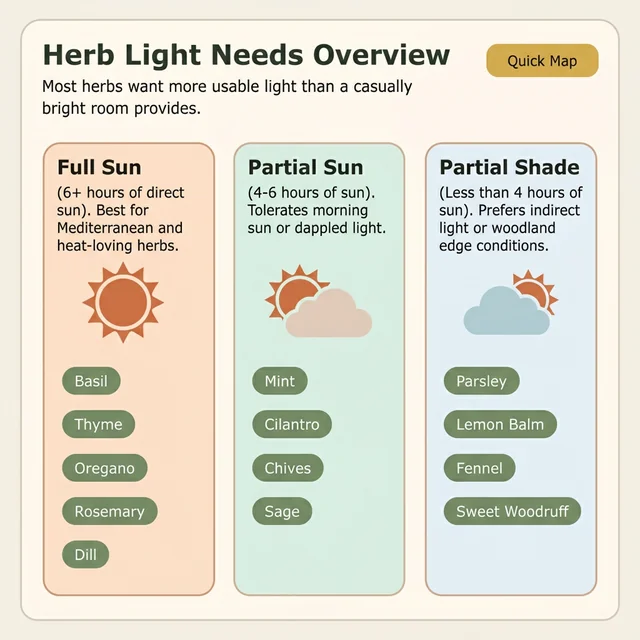
How much light do herbs need? 6+ hours of sun
A practical guide to how much light herbs need, including a quick answer for direct sun, indoor windows, and grow light setups that actually support growth.
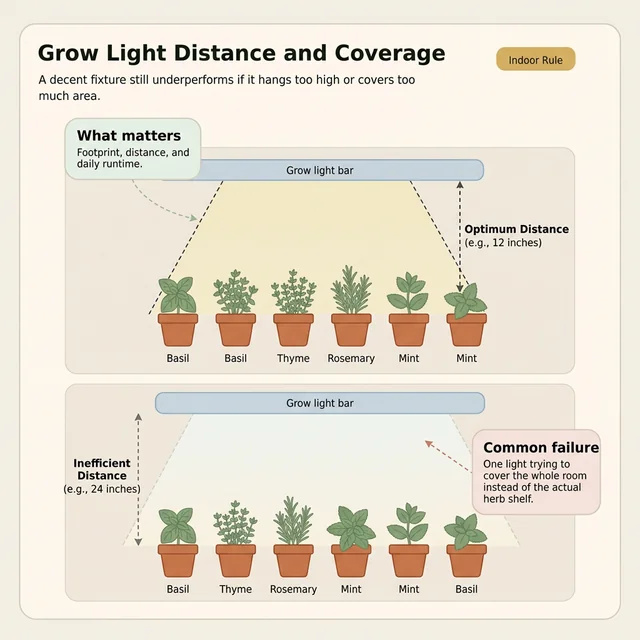
Grow light distance for seedlings: how close is too close?
Seedlings usually need grow lights much closer than beginners expect, but the exact distance depends on fixture strength, lens design, and plant response.