
Where grow light heat concentrates on a multi-tier shelf
| Location | Why heat concentrates there | What usually helps |
|---|---|---|
| Top tier and the underside of the shelf above it | Warm air rises and has nowhere to go if that space is boxed in | Leave a real air gap above the fixture; do not stack storage on top |
| The driver or power brick | Converting wall power to the diode's operating voltage sheds heat as a byproduct | Mount it in open air, not flush against a warm surface |
| Middle and lower tiers | Farther from the heat rising off the tiers above and their own fixture | Usually the least affected; a useful comparison point when troubleshooting |
If you have put a light over a shelving unit and the top tier has gotten noticeably warmer than the rest, the fixture is doing exactly what a grow light does. Grow light heat is worth managing, but not because a modern fixture is about to scorch anything the way an old incandescent bulb pressed against a leaf would. Once the basic setup is running, heat is the maintenance question that comes next: it changes how much light your herbs actually want, and it shortens how long the fixture keeps delivering that light.
It matters for three practical reasons, and each is a slow drift rather than a sudden failure: it shifts the amount of light a herb uses best, it wears down the LED and its driver faster than the fixture’s rated life assumes, and it dries out the pots underneath more quickly once air starts moving. None of that calls for elaborate cooling gear. Mostly it means knowing where the heat actually goes and giving it somewhere to leave.
No, LEDs do not run cold
“LEDs do not produce heat” is repeated often enough that it gets treated as settled, and it is not quite right. LEDs are genuinely far more efficient at turning electricity into usable light than the fixtures they replaced, and that is why you can run one close enough to sit inches above basil without burning it. But efficient is not the same as heatless. Any electricity a diode does not convert into light does not simply vanish; it comes out as heat, and with an LED that heat mostly shows up at the heatsink and the driver rather than radiating forward onto the leaves the way an older HPS or incandescent fixture does.
That distinction — less heat at the canopy, not no heat at all — is exactly why the driver end of a fixture, or the shelf directly above it, catches people by surprise. The leaves can be perfectly comfortable while the small box wired into the cord is running warm a few inches away.
Where heat actually builds up on a shelf
Heat rises, and a multi-tier shelving unit gives it exactly one direction to travel. The top tier — the one nearest the ceiling, or nearest whatever is stacked above it — collects warmth from its own fixture plus anything rising off the tiers below. If more than one light is running on the same rack, that effect compounds, which is part of the case made on how many fixtures a rack actually needs: more lights means more heat sources sharing the same space to shed it in.
The underside of the shelf sitting directly above a fixture catches the column of heat rising off the heatsink and traps it against a solid surface, so it can run warmer than the air around the plants even when the leaves feel fine. Reflective material added to bounce light back onto the plants — mylar, foil, plain white board — can make this worse if it seals the tier into a closed box rather than just lining the walls; heat buildup is one of the tradeoffs of lining a shelf this way.
Why a hot top tier changes what your herbs actually want
This is the part that gets missed when heat is treated as a simple stress to tolerate. Walters, Tarr and Lopez, publishing in PLoS One in 2023, modelled how four culinary herbs respond to both daily light integral (DLI) and mean daily temperature, and the result is not “hotter is worse” or “hotter is better” — it depends on the herb, and the two herbs the model produced a clear optimum for move in opposite directions. The other two, purple basil and spearmint, kept gaining fresh mass across the entire range tested, so no optimum could be calculated for them.
Sage’s optimum moves down as the shelf runs warmer, so a sage plant on the warm side actually wants less light per day, not more. Sweet basil moves the opposite way, wanting slightly more light as its tier warms up. Put those two side by side and the practical point is plain: a hot top tier is not a uniform penalty across every herb on the same rack. It can shift the light target up for one crop and down for another, from the exact same fixture and schedule.
That is also why a mixed four-tier rack is genuinely harder to dial in with one blanket rule for hours or intensity than a single-crop tray is — DLI targets for herbs and leafy greens has the math, and PPFD and DLI for indoor herbs has how to measure it. The number of hours the light runs each day also determines how long that heat has to accumulate before the cycle resets — how many hours grow lights need to run has the range by crop. If the top tier is both the warmest spot and running the longest photoperiod, it is worth watching that tier’s herbs specifically rather than assuming the rest of the rack behaves the same way.
The driver sheds the heat, not the diodes
The driver, sometimes just a small brick in the cord, converts household current into what the diodes need to run. That conversion sheds heat as a byproduct, and the driver’s own components — capacitors especially — degrade faster the hotter they sit. A driver zip-tied flat against a warm shelf, wedged behind a tray, or resting on top of other warm equipment sheds that heat far worse than the same driver hanging in open air with clearance on every side.
This connects directly to how long the fixture lasts. The ENERGY STAR luminaire requirements define that rated life as L70, the hours until output falls to 70 percent of initial, projected on the assumption the fixture runs inside its designed temperature range. Running it hotter does not make it fail outright, it just erodes that lifespan faster than the number on the box suggests. How long LED grow lights actually last walks through what a well-made panel is actually expected to deliver before it is worth replacing — the short version here is that giving a fixture room to breathe is not fussiness, it protects the thing you already paid for.
When passive airflow runs out, and a fan earns its place
Most of the useful work here is free. Leave a genuine air gap above the top tier instead of sealing it tight against the ceiling or a shelf above. Stand the driver off the surface it sits on rather than flush against it. Do not stack storage boxes, fabric, or anything else against the top of the unit — that is the single most common way a shelf that was fine on day one turns into a heat trap by month three.
Passive airflow has a limit, though. A unit that is genuinely enclosed on most sides — a grow tent, or a cabinet with solid doors — does not have anywhere for warm air to go on its own, because passive gaps only work when there is a real path for air to leave near the top and cooler air to replace it from below or the sides. A fan is a second step, not a first one: reach for it once the obvious obstructions are gone and the top tier is still clearly the outlier — a driver that stays hot to the touch, condensation forming where warm air meets a cooler surface, or a top tier of herbs that consistently lags the tiers below on an identical fixture and schedule. Most open shelving with a genuine gap around the fixture and nothing stacked on top does not reach that point. A genuinely enclosed unit is the exception — a tent or a solid-door cabinet has no passive path at all, so there the fan is the first step rather than the second.
A fan does not need to blast the plants directly to do useful work. Moving air across the top of the unit and past the driver, with somewhere for that air to actually exit, does most of the job.
How far the light hangs is mostly an intensity decision, not a heat one — raising a fixture an inch for airflow is fine, but it is not the tool for a heat problem. Measure what the fixture actually delivers before moving it for light reasons.
Better airflow means faster drying
Moving air dries potting mix faster than still air does, the same way a breeze dries laundry faster than a closed room. Once passive airflow improves, or once a fan goes in, the top tier’s pots will typically need checking more often than they did before — not because the plants suddenly need more water, but because the drying rate around them has changed.
People fix a heat problem and then either keep watering on the old schedule out of habit, overshooting once the mix is drying faster than it used to, or they underwater because the surface looks dry while the root zone is not, since moving air dries the top layer of mix first and fastest. Check by weight or by finger-depth once the airflow situation has changed, and expect the top tier’s watering rhythm to diverge from the tiers below it, even on the same fixture and the same schedule.
Is it heat, or is it light?
When the top tier lags behind the rest of the rack, heat and light intensity are the two usual suspects, and they show up differently. If the fixture and schedule are identical on both tiers and the top one still stalls, heat is the more likely cause — check the driver and the space above it before anything else. If the plants stretch and thin instead of stalling, do not rule heat out. UMass Extension documents legginess as having two causes, not one: seedlings stretch either without enough light or when the temperature runs too warm. On the tier that already runs warmest, that second cause deserves a look before you touch the fixture — check the driver and the space above it the same way you would for stalling. If that comes back clean, measuring the light your fixture actually delivers is the next step.
Sources
- Walters, Tarr & Lopez (2023), “Modeling purple basil, sage, spearmint, and sweet basil responses to daily light integral and mean daily temperature,” PLoS One 18(11):e0294905
- ENERGY STAR Program Requirements for Luminaires (L70, LM-80, TM-21)
- UMass Amherst CAFE: Starting Seeds Indoors: Caring for Your Seedlings
Keep the fixture running well
Once heat is under control, these cover the fixture's lifespan, its running cost, and how far to hang it in the first place.
Common questions
Do LED grow lights really not produce heat?
They produce far less radiant heat at the leaf surface than older HPS or fluorescent fixtures, which is why you can run one closer to a plant without scorching it. But that is not the same as producing no heat. Any electricity the diode does not convert into light comes out as heat instead, mostly at the heatsink and the driver rather than at the canopy. A grow light panel that feels cool to the touch at leaf height can still have a genuinely hot driver a few inches away.
Does a warm top shelf actually hurt my herbs?
Not automatically, but it changes the picture. Research modelling four culinary herbs against both daily light integral and mean daily temperature found that the amount of light a plant uses best shifts as it runs warmer, and the shift is not the same for every herb — sage wanted less daily light as temperature rose, sweet basil wanted slightly more. A warm tier is a reason to watch that tier specifically, not a reason to assume every herb on the rack is affected the same way.
When do I actually need a fan for a grow light shelf?
After you have tried the free fixes and the top tier is still the clear outlier — a driver that is hot to the touch, condensation forming on the underside of the shelf above, or plants there visibly lagging the tiers below on the same schedule. Most home setups with a genuine air gap around the fixture and nothing stacked directly on top do not reach that point.
Does adding airflow mean I need to water more?
Usually, yes, for the tier the airflow reaches. Moving air dries potting mix faster than still air, the same way a breeze dries laundry faster than a closed room. Once you add a fan or open up a shelf that used to be sealed, check that tier's pots by weight or finger-depth rather than sticking to the schedule you used before, because the drying rate has changed even though the watering can has not.
Related guides

How long do LED grow lights actually last?
An LED that still turns on is not necessarily still doing its job. Here is the arithmetic behind L70, and how to catch a fixture that is quietly falling behind.
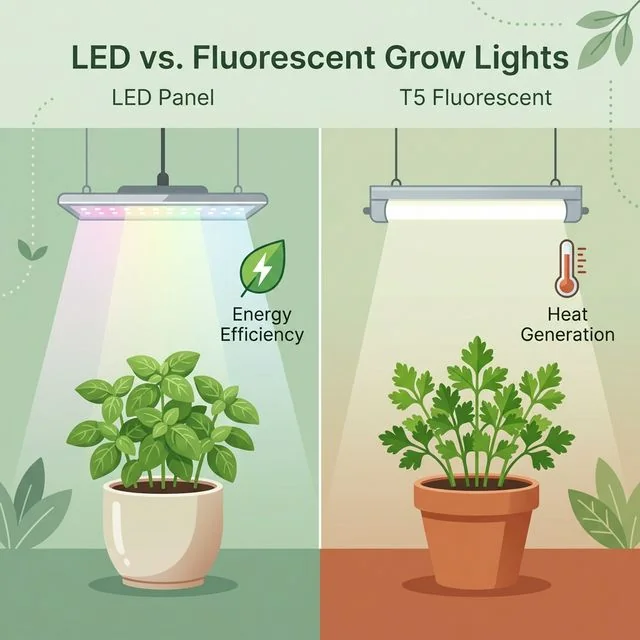
LED vs. fluorescent grow lights for herbs: which is better?
Fluorescent tubes used to be the gold standard for indoor gardeners, but modern LEDs have changed the game. Find out which technology is right for your space and budget.
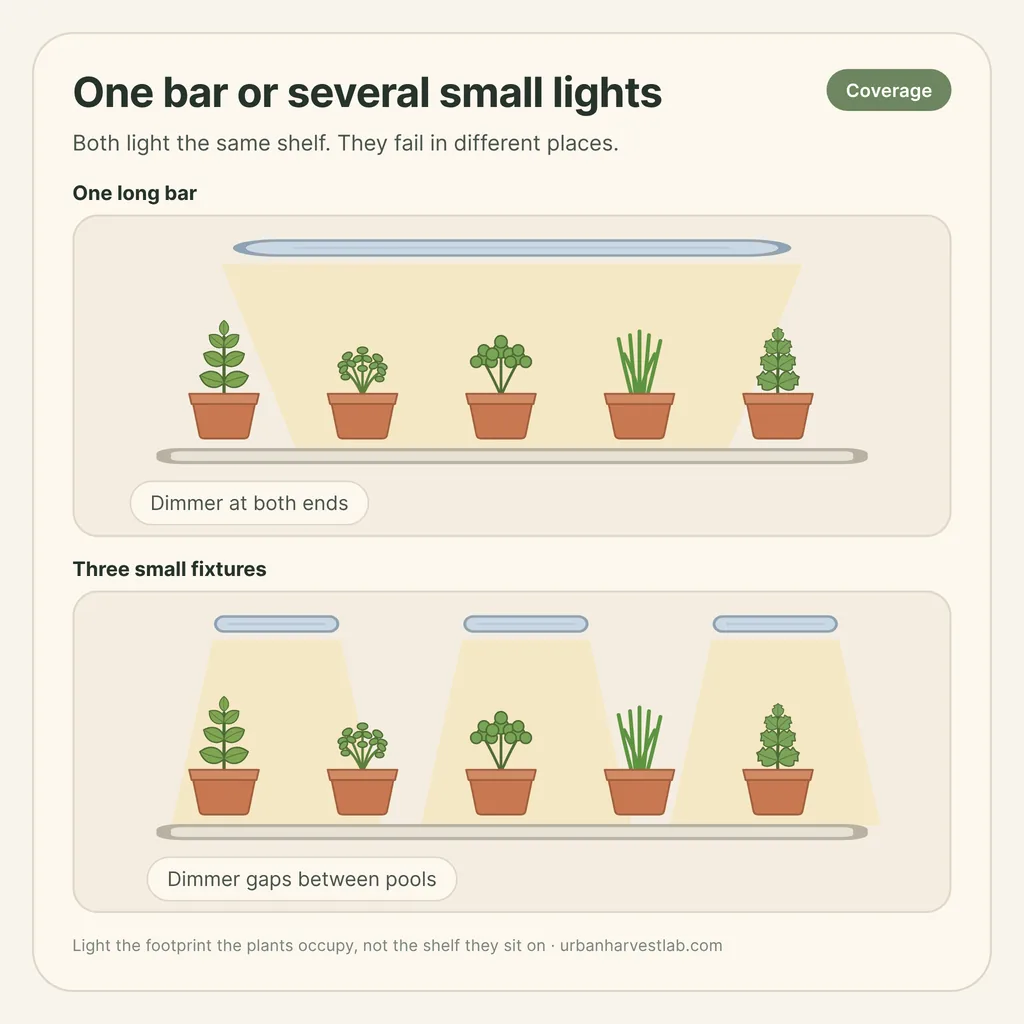
One grow light or several: how to decide
There is no fixed ratio of lights to shelf feet. The count follows from your plants' footprint and their light target, and it changes depending on whether they sit in a row or a cluster.