
Quick answer: aim for the daily light integral Michigan State University Extension gives for leafy herbs and greens in a controlled environment — at least 12 mol·m⁻²·d⁻¹ — and expect quality to suffer measurably once DLI drops below 10, which is where MSU’s low-light trials found it falls off. Treat that as a solid floor, not a ceiling — research on individual culinary herbs shows some species keep rewarding more light well past that number, while at least one moves in the opposite direction as the room warms up.
If PPFD and DLI are still new terms, start with PPFD and DLI for indoor herbs for what the units mean and how to measure them on a real shelf, since the numbers below assume that groundwork — reaching the 12 mol·m⁻²·d⁻¹ target over a 14-hour photoperiod takes roughly 240 µmol·m⁻²·s⁻¹, toward the upper-middle of the starting band that page describes rather than its lower end. For the broader question of how much light herbs need in general, including sun-only setups, see how much light herbs need.
The general target for leafy herbs and greens
Michigan State University Extension puts the DLI requirement for leafy greens and herbs grown in controlled environments at 12 mol·m⁻²·d⁻¹ or more. For lettuce specifically, the same extension source recommends a minimum of 12 to 14 mol·m⁻²·d⁻¹. Below that range, MSU Extension and Purdue Extension both put the greenhouse target minimum at 10 to 12 mol·m⁻²·d⁻¹, and MSU Extension’s own low-light trials found that quality is significantly reduced once DLI falls below 10.
Purdue Extension also bands greenhouse crops by light requirement: 3 to 6 mol·m⁻²·d⁻¹ for low-light crops, 6 to 12 for medium-light, 12 to 18 for high-light, and above 18 for very high-light. Those are floriculture greenhouse bands rather than herb or leafy-green targets, but they place the 12-plus number above at the floor of the high-light band — a way to read what the target means, not a separate target to hit.
That gives a workable anchor: somewhere around 12 mol·m⁻²·d⁻¹ is a reasonable baseline for a shelf of leafy herbs, and dropping much below 10 is where problems start showing up in the plant rather than just on a meter. What that baseline does not do is tell you whether basil wants more than that, or whether sage wants less. For that, the research narrows to specific crops.
Why one number does not survive contact with real herbs
A 2023 study published in PLOS ONE by Walters, Tarr, and Lopez modeled how four culinary herbs — sweet basil, purple basil, sage, and spearmint — responded to daily light integral across roughly 5 to 19 mol·m⁻²·d⁻¹, while also varying the mean daily temperature the plants were grown at. The point of combining the two variables was to see whether a single DLI recommendation could hold regardless of temperature.
It could not. The DLI that produced the most fresh mass moved as temperature changed, and it moved in opposite directions depending on the herb. The study does not land on one universal recommended DLI. What it does show is which herbs kept rewarding more light and which ones stopped.
What four culinary herbs actually did
| Herb | Temperature range tested | DLI that maximized fresh mass | What more light did |
|---|---|---|---|
| Sweet basil (‘Nufar’) | 24°C to 32°C | Rose from about 11.8 to 13.2 mol·m⁻²·d⁻¹ as temperature rose | Branch number increased as DLI rose from 5.5 to 13.2 |
| Sage (‘Extrakta’) | 24°C to 32°C | Fell from about 17.9 to 14.4 mol·m⁻²·d⁻¹ as temperature rose | Moved opposite to basil over the same warming |
| Purple basil (‘Dark Opal’) | Temperature varied; purple colour strongest at high DLI and lower temperature | No optimum found within the range; fresh mass still rising at 18.7 | Fresh mass increased linearly, more than tripling (+76 g) from 5.0 to 18.7, with deeper purple color at high DLI and cooler temperature |
| Spearmint (‘Spanish’) | 23°C | No optimum found within the range; fresh mass still rising at 19.4 | Fresh mass gained about 60 g from 6.1 to 19.4 |
Two patterns matter more than any single number in that table. First, sweet basil and sage move in opposite directions as the room warms up — basil wants slightly more light at higher temperature, sage wants slightly less. Second, purple basil and spearmint did not level off at any point inside the range the study tested, so their reported top figures are not ceilings; they are just where the trial stopped measuring.
Basil and sage disagree about warmth
This is the detail worth remembering if your grow space runs warm, such as a shelf near a window that gets afternoon sun or a room without much airflow. Sweet basil’s fresh-mass optimum climbed from 11.8 to 13.2 mol·m⁻²·d⁻¹ as Walters, Tarr and Lopez’s modelled temperature rose from 24°C to 32°C — warmer conditions paired with slightly more light produced more basil. Sage did the opposite: its optimum fell from 17.9 to 14.4 mol·m⁻²·d⁻¹ over that same temperature increase, so a hot shelf pushed sage’s ideal light level down rather than up.
Practically, that means the same fixture and the same DLI reading can be closer to ideal for one herb and past ideal for another, purely because of how warm the space runs. A shelf that gets noticeably warmer in summer, or one positioned close to a fixture that runs hot, is a reason to treat these DLI numbers as a starting point rather than a fixed target, and to watch the plant’s response as the seasons change rather than only the meter. For ways to bring that shelf-level heat back down, see managing grow light heat.
Purple basil and spearmint keep climbing
Purple basil and spearmint did not show this temperature trade-off in the same way, because neither one reached a point of diminishing returns inside the DLI range tested. In the same Walters, Tarr and Lopez model, purple basil’s fresh mass rose in a straight line as DLI increased from 5.0 to 18.7 mol·m⁻²·d⁻¹, more than tripling along the way, and its purple coloration deepened further at the high end combined with cooler temperatures. Spearmint, tested at 23°C, gained roughly 60 grams of fresh mass moving from 6.1 to 19.4 mol·m⁻²·d⁻¹ with no calculable optimum in that span either.
The practical reading is not “give these two unlimited light.” It is that, of the four herbs studied, purple basil and spearmint are the ones where pushing DLI higher, within reason, kept paying off, while sweet basil and sage each have a point where more light stopped helping and started depending on temperature.
So what should you actually aim for
For a home shelf growing a mix of leafy herbs, the general 12 mol·m⁻²·d⁻¹ target is the right place to start, because it is the figure backed by extension research on leafy crops broadly rather than a single greenhouse trial on one species. From there, the per-herb findings are a reason to adjust rather than a replacement table:
- If basil is the priority and the room runs on the warm side, there is little downside to nudging DLI toward the low-to-mid teens.
- If sage is struggling in a warm, bright spot, the issue may not be too little light — it could be too much light paired with too much heat, which is the opposite of the usual assumption.
- If purple basil or spearmint seem to plateau at a modest light level, the study suggests more DLI was still producing gains in the trial, so a stronger fixture or shorter distance may be worth testing before concluding the plant has topped out.
None of this replaces watching the actual plant. Stretching, pale new growth, or slow regrowth still point toward more light regardless of which species-specific number you were aiming for, and scorching or bleaching still points toward less.
Hours are not a substitute for intensity
DLI is a product of intensity and duration, so there are two levers once you have a target — but they are not interchangeable. Stretching the photoperiod is not a substitute for a fixture that cannot reach the intensity a target calls for; it mainly adds to the electricity draw covered in what grow lights cost to run.
A greenhouse figure, not a windowsill one
Average DLI inside a US greenhouse runs 5 to 30 mol·m⁻²·d⁻¹, depending on the structure, the glazing, and the season, according to MSU Extension. That range describes a purpose-built growing structure, not a windowsill. A window’s delivery swings with the glazing, the compass direction it faces, an overhang or neighboring roofline, and the season, so the only way to know what a specific window delivers is to measure it. Purdue Extension’s route does that with a foot-candle meter: multiply the reading by 0.20 for sunlight to get PAR, then multiply that figure by 0.0864 to get DLI. PPFD and DLI for indoor herbs walks through taking that measurement, and grow lights vs sunlight covers what shifts a window’s output across the seasons. The width of the greenhouse range above is itself useful context: even a structure designed for growing can swing widely on daylight alone, which is a large part of why supplemental lighting exists for herbs grown indoors year-round rather than only in winter.
Common mistakes
- Treating the 12 mol·m⁻²·d⁻¹ general target as correct for every herb, when the per-species research shows real disagreement between species.
- Assuming more light is the fix for a struggling herb, without checking whether temperature is what actually shifted its optimum.
- Extending photoperiod past 16 hours to chase a DLI number instead of raising intensity or checking fixture output.
- Reading purple basil or spearmint’s high-end figures as their reported optimum, when the study did not find one within the tested range.
- Comparing a shelf’s DLI to a greenhouse average as if the two describe the same kind of space.
Sources
- Michigan State University Extension — Daily light integral defined
- Michigan State University Extension — Lighting Greenhouse Vegetables
- Michigan State University Extension — How low can you go? Low daily light integrals impact young plant quality and production time
- Walters, Tarr & Lopez (2023), “Modeling purple basil, sage, spearmint, and sweet basil responses to daily light integral and mean daily temperature,” PLOS ONE 18(11):e0294905
- Purdue Extension HO-238-W — Measuring Daily Light Integral in a Greenhouse
Turn a DLI target into a working setup
Once you know the number to aim for, use these guides to measure it, hit it, and keep the schedule and fixture right.
Common questions
What DLI should I aim for with indoor herbs?
Aim for a daily light integral of 12 mol·m⁻²·d⁻¹ or more for leafy herbs and greens grown in a controlled environment. That figure comes from Michigan State University Extension's work on controlled-environment leafy crops, and quality drops off measurably once DLI falls below 10.
Is there one DLI number that works for every herb?
No single number fits every species. A 2023 modeling study of sweet basil, purple basil, sage, and spearmint found that the DLI producing the most fresh mass depended on growing temperature, and it moved in different directions for different herbs. The study does not report one universal recommended DLI.
Do basil and sage need the same amount of light?
They responded in opposite directions in that same study. Sweet basil's fresh-mass optimum rose from about 11.8 to 13.2 mol·m⁻²·d⁻¹ as the growing temperature increased from 24 to 32 degrees Celsius, while sage's optimum fell from about 17.9 to 14.4 mol·m⁻²·d⁻¹ over that same range.
Does a windowsill herb setup reach these DLI numbers?
Sometimes, and the only way to know is to measure — a light-meter reading at the sill converts to DLI. Greenhouses, which are built for it, run 5 to 30 mol·m⁻²·d⁻¹ on daylight alone according to MSU Extension, which is why indoor growers add a fixture rather than assume a window hits the target.
Related guides
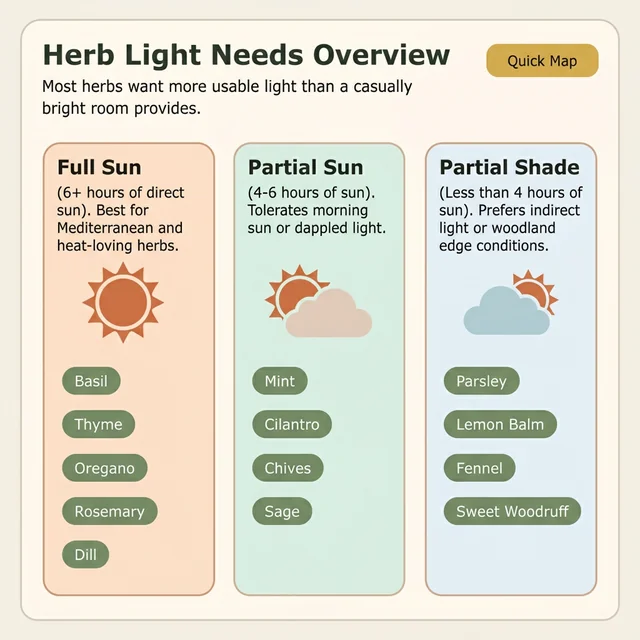
How much light do herbs need? 6+ hours of sun
A practical guide to how much light herbs need, including a quick answer for direct sun, indoor windows, and grow light setups that actually support growth.
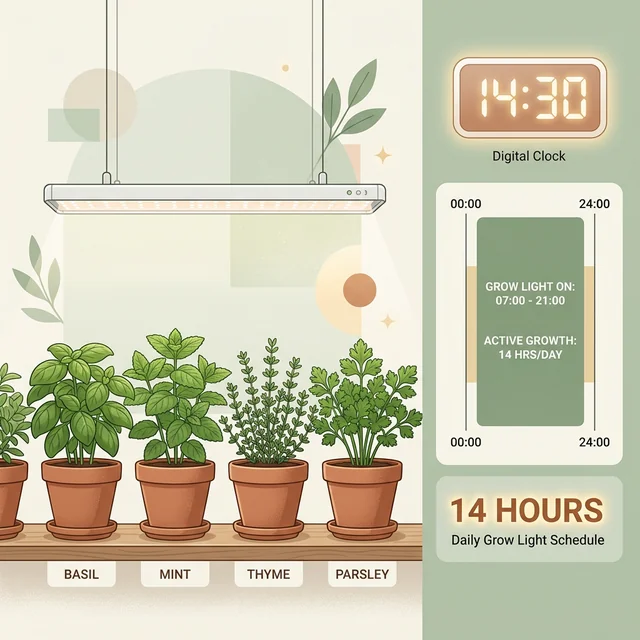
How many hours should grow lights run for herbs? 12-16
Most herb grow lights should run about 12 to 16 hours per day, but intensity, distance, and a stable dark period matter as much as the timer itself.
PPFD and DLI for indoor herbs: a practical measuring guide
PPFD is a snapshot; DLI is the daily total. Used together, they turn grow-light setup from a distance rule into a measurable map.