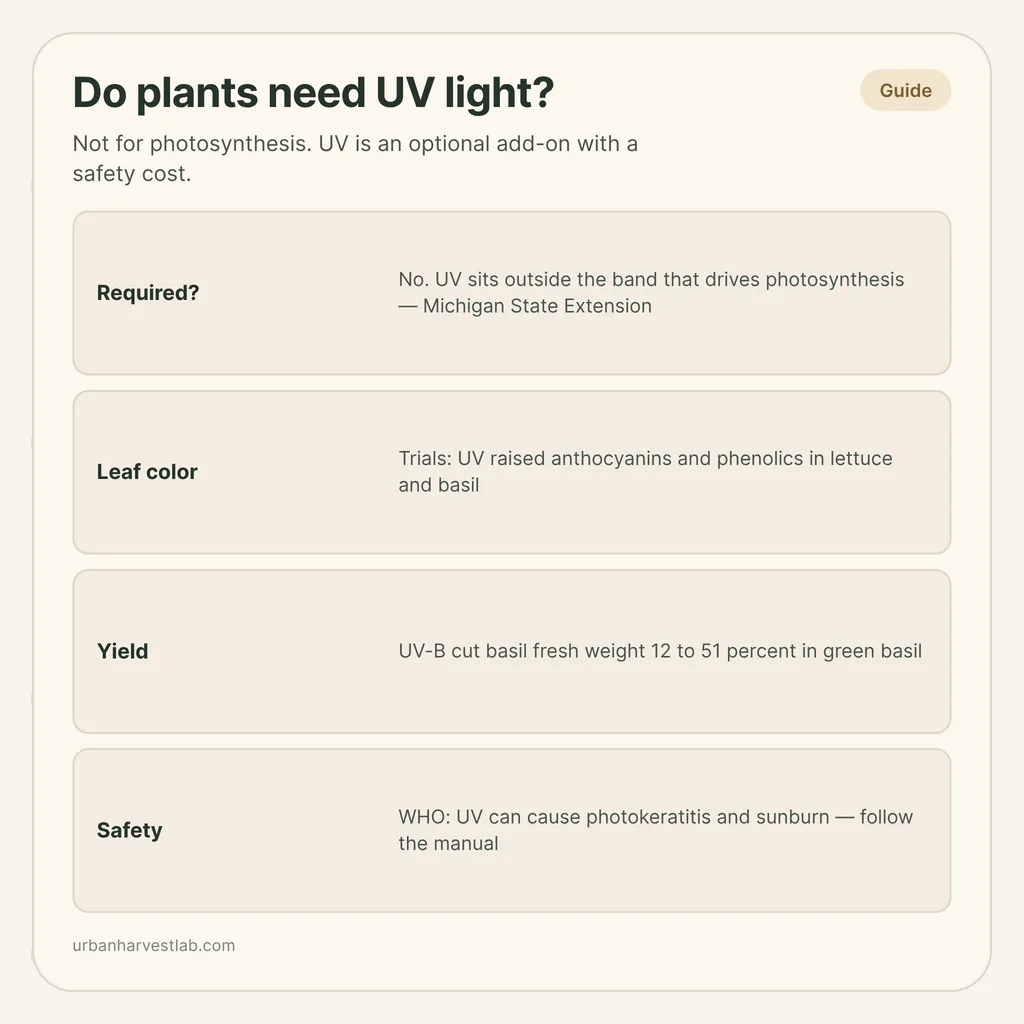
Plants do not need UV for photosynthesis, which runs on visible light, and none of the sources here treats it as a requirement. Trials with red lettuce and basil show UV can deepen color and raise phenolic compounds, but it can also cost harvest weight, and the fixtures that emit it are a hazard to your eyes and skin. For a herb shelf, UV is a specialty add-on you can skip.
Where UV sits relative to the light your plants use
Michigan State University Extension’s Erik Runkle defines the bands by wavelength: UV-A runs from 315 to 400 nm, UV-B from 280 to 315 nm and UV-C from 100 to 280 nm. Photosynthesis runs on the visible band, which is covered in the spectrum explainer. Runkle puts it this way: UV is outside the photosynthetically active waveband, but it is biologically active and regulates plant growth.
“Biologically active” is the useful phrase. UV works as a signal, not as fuel. The effects Runkle lists for UV on crops are shorter stems and smaller leaves, thicker and waxier leaves, and greater leaf coloration, especially in purple-leaved plants such as red-leaf lettuce. His assessment of using it indoors is that the opportunities in greenhouses and vertical farms are emerging but not yet well defined, and that an excessive dose will typically burn leaves.
Two practical points follow from his numbers. First, ordinary glass transmits 65 to 75 percent of UV-A but 3 percent or less of UV-B, so a sunny window already gives plants some UV-A and almost no UV-B. Second, conventional lamps put out little UV: about 1 percent of output on an energy basis for fluorescent. UV from a modern fixture generally means diodes added on purpose, and Runkle notes such LEDs exist for UV-A, UV-B and UV-C. Check what the lamp type does to your light before assuming a given fixture contributes any.
What the trials found
The studies below grew plants under visible light and then added UV as a treatment. None of them tested whether a plant can complete its life with no UV at all, and none of them is a home-shelf trial, so read them as direction, not as a recipe.
| Study | Crop | UV treatment | Quality result | Yield result |
|---|---|---|---|---|
| Zhu et al. 2025, Texas A&M (PLoS One) | Red leaf lettuce | UV-B in the last 7 days of a 28-day cycle | Anthocyanins up, total phenolics up 80 to 99.1 percent | Lowest yield of all treatments |
| Zhu et al. 2025 | Red leaf lettuce | UV-A in the same window | Not among the treatments reported to raise anthocyanin | Same or more biomass than control |
| Chen et al. 2019 (Frontiers in Plant Science) | Lettuce | UV-A throughout, three intensities | Anthocyanin up 17 to 49 percent, ascorbic acid up 47 to 80 percent | Shoot dry weight up 15 to 29 percent |
| Dou et al. 2019 (Agronomy) | Green and purple basil | Short UV-B exposures before harvest | Green basil: anthocyanin up 9 to 18 percent, phenolics up 28 to 126 percent | Shoot fresh weight down 12 to 51 percent (green), 6 to 44 percent (purple) |
Red lettuce: UV-B is potent, and costs weight
The Texas A&M trial compared red, blue, violet, UV-A and UV-B supplements in the last 7 days of a 28-day cycle, on top of white LED light. Red, blue and UV-B all raised leaf anthocyanin compared with the control, and UV-B was the most effective despite its low dosage. Total phenolics in both cultivars rose by 80 to 99.1 percent under UV-B. Ascorbic acid did not change under UV-B.
The cost was weight. Under UV-B, yield was the lowest in both cultivars, with 8.9 to 49 percent lower shoot fresh weight than the other treatments. The authors conclude there is often a tradeoff between nutritional quality and crop yield. The UV-A treatment in that trial either increased or did not significantly change biomass and leaf area compared with the control.
UV-A in lettuce: a gain, then stress at the top
A Chinese Academy of Agricultural Sciences trial (Chen et al.) grew lettuce under blue, red and far-red light and added UV-A at three intensities. Shoot dry weight rose by 27, 29 and 15 percent across the low, middle and high intensities, and anthocyanin and ascorbic acid rose by 17 to 49 and 47 to 80 percent. The authors also report that the plants under the highest intensity were stressed. Their conclusion is that UV-A stimulated biomass in a controlled environment as well as secondary metabolites.
This looks like it contradicts the Texas A&M yield finding, and it partly does: the two trials used different UV-A intensities and durations, different cultivars, different timing and different background light. What they share is the direction on chemistry. Treat yield as unsettled for UV-A and as a likely cost for UV-B.
Basil: more phenolics, lower fresh weight
Dou et al. gave basil UV-B before harvest at two light levels. In green basil, anthocyanins rose 9 to 18 percent, phenolics 28 to 126 percent and flavonoids 80 to 169 percent. In purple basil, phenolics and flavonoids rose after the 2-hour daily UV-B treatments. Shoot fresh weight was 12 to 51 percent lower in green basil and 6 to 44 percent lower in purple basil. If you grow basil for volume of leaf, that is the number that matters.
So should you add UV?
Decide by what you want from the crop.
- You want more leaves: skip UV. None of the trials above shows a harvest-weight gain from UV-B, and the UV-A trial that did report a gain also saw stress at its highest intensity. More visible light, correctly timed, is the lever covered in the spectrum and sunlight comparison pages.
- You want deeper red or purple leaf color on a lettuce or basil you already grow well: UV-A or UV-B is the lever the studies tested. It is experimental, the dose matters, and a mistake costs yield or burns leaves.
- You have a white LED shelf for herbs: nothing in the sources says it is missing something. Keep it.
Pest and disease effects are a further claim in the literature. Runkle reports that plants grown with UV generally show less insect feeding and are less vulnerable to fungal pathogens than plants grown with little or no UV, and that it is an open research question how to deliver it. That is not a reason to add a diode to a windowsill herb tray.
Eye and skin safety
UV can neither be seen nor felt. The World Health Organization lists photokeratitis and photoconjunctivitis, inflammation of the cornea and conjunctiva, as acute eye effects, and notes they are reversible and easily prevented by protective eyewear but are painful and might need treatment. It lists sunburn and DNA damage as acute skin effects, and cataract among the chronic eye effects.
Runkle’s advice for horticulture is blunt: UV is dangerous to humans, all UV devices should have warning labels, and people should not be exposed to UV treatments without protective equipment. If a fixture you own includes UV diodes, follow its manual, and read the general safety page for the rest of the shelf.
Sources
- Runkle, E. (Michigan State University Extension), “UV Radiation and Applications in Horticulture,” Greenhouse Product News, May 2018 (archived copy)
- Zhu et al. (2025), “From ultraviolet-B to red photons: effects of end-of-production supplemental light in red leaf lettuce,” PLoS One
- Chen et al. (2019), “UVA radiation is beneficial for yield and quality of indoor cultivated lettuce,” Frontiers in Plant Science
- Dou et al. (2019), “Pre-harvest UV-B radiation and photosynthetic photon flux density interactively affect … basil,” Agronomy (archived copy)
- World Health Organization, “Ultraviolet radiation” fact sheet
Light choices that matter more than UV
Spectrum, safety and lamp type decide more of your result than an ultraviolet add-on.
Common questions
Do plants need UV light to grow indoors?
No source reviewed here treats UV as a requirement. Michigan State Extension places UV outside the photosynthetically active waveband and calls the opportunities to use it in indoor farms emerging but not yet well defined. The lettuce and basil trials add UV on top of ordinary visible light as a treatment.
Does UV make plants grow bigger?
Results differ by band. In a Texas A&M lettuce trial, UV-B gave the lowest yield, with 8.9 to 49 percent lower shoot fresh weight than the other treatments. In a basil trial, UV-B lowered shoot fresh weight by 12 to 51 percent in green basil. In a separate lettuce trial, UV-A raised shoot dry weight by 15 to 29 percent, though the highest UV-A intensity stressed the plants.
Does UV make herbs and lettuce more colorful or flavorful?
Color and phenolic compounds went up in the trials: anthocyanins in red lettuce and green basil, phenolics in both. The studies measured chemistry, not flavor, so a taste improvement is not something they show.
Is UV from a grow light dangerous to look at?
The WHO says UV can neither be seen nor felt and lists photokeratitis and photoconjunctivitis among its acute eye effects, plus sunburn on skin. Michigan State Extension says all UV devices should carry warning labels and that people should not be exposed without protective equipment.
Related guides

Grow lights vs sunlight: what actually decides the comparison
Sunlight and a fixture are not competing technologies. They are two ways of delivering the same thing, and the comparison runs on three axes.

Grow light safety: what actually needs attention
A grow light is not dangerous equipment. But it does put a driver, a timer and a power strip in the one room where you deliberately add water — and that combination deserves five real minutes of attention.

Grow light spectrum explained: what actually matters for herbs
Full spectrum, blurple, enhanced red — the labels change every season, but for herbs the answer is simpler than any of them.