
White full-spectrum LED vs. red-blue (blurple) fixtures
| Factor | White full-spectrum LED | Red-blue fixture |
|---|---|---|
| What it targets | A broad band spread across the whole PAR range | Wavelengths near chlorophyll's absorption peaks |
| Evidence for herbs | No demonstrated spectrum advantage either way — DLI is what moves growth | Same — no demonstrated advantage in home herb growing |
| Reading your plants | True leaf color, easy to spot yellowing or pests early | Magenta cast hides early color changes |
| Where it shows up | Most current quantum-board panels and grow bulbs | Older or budget panels, some seedling strips |
For herbs and leafy greens, spectrum is a smaller lever than grow-light marketing suggests. A plain white full-spectrum LED already covers the band of light plants use, and the sources that give usable numbers for home herb growing are about light quantity and temperature, not color mix. The number that actually moves growth is how much light you deliver and for how long, not the color a fixture is sold on.
Shopping for a grow light means wading through “full spectrum,” “enhanced red,” and proprietary blend names that sound like they came out of a lab. Some of that language describes something real. A lot of it describes nothing measurable at all. Before comparing spectrum claims, it is worth knowing how much light herbs actually need in the first place, because that question is where the real gains sit.
What “spectrum” actually means for a grow light
Light is a range of wavelengths, and plants only use part of that range for photosynthesis. Michigan State University Extension frames daily light integral around the photosynthetically active radiation band, or PAR, spanning roughly 400 to 700 nanometers. That band is the whole relevant range. A claim about a wavelength outside it, or a vague nod to “more spectrum,” is not describing anything that drives photosynthesis.
Within PAR, plants do not use every wavelength identically. Red-blue “blurple” fixtures are built on the claim that chlorophyll absorbs red and blue light most strongly and green light least, aiming diodes at the wavelengths chlorophyll pulls in hardest. It is also the basis for the marketing leap that a purple light must therefore be doing more work. What that leap skips is whether hitting the absorption peaks harder actually grows a better herb crop on a windowsill, which is a separate question, and not one with a clear yes behind it.
Why “full spectrum” is not a specification
“Full spectrum” sounds precise. It is not. No regulatory or scientific standard defines which wavelengths, at which intensities, a fixture has to emit to earn that label. One panel called full spectrum might be a broad white LED with fairly even output across the PAR range. Another might be a red-blue array with a thin sliver of white mixed in, marketed under the exact same phrase. Both uses are technically fine, because there is nothing to violate.
Practically, that means the phrase alone tells you almost nothing about a fixture. It cannot substitute for looking at what the light actually delivers, which is closer to what PPFD and DLI measure — how many usable photons reach your plants — than anything printed on the box under “spectrum.”
Purple fixtures vs. white LED: what the color is (and isn’t) telling you
Red-blue fixtures produce that unmistakable magenta glow by combining only a handful of diode colors, tuned toward the wavelengths chlorophyll absorbs most. White LED fixtures — the quantum-board panels and grow bulbs now common on shelves — spread a broader, more even band across that same PAR range, filling in the wavelengths in between.
Both approaches are aiming at the same 400-700 nanometer target; they just get there differently. For a home herb shelf, the practical gap between the two is much smaller than the marketing gap implies, because neither is actually short of the wavelengths that matter. One concentrates output at the peaks. The other spreads it across the whole range at once.
Where white light does have a genuine, practical edge: you can see your plants under it. A leaf turning yellow, a pest starting to spread, a stem going pale — all of that shows up as color, and color is how you catch a problem early. Under a red-blue fixture, everything sits under a magenta wash and those cues disappear until you pull the tray into daylight to check it. That is a real, if unglamorous, reason to default to white — it is the setup that actually lets you watch your plants.
There is a second practical cost to the magenta cast — the cheap lux-meter shortcut for estimating PPFD only holds for white LEDs, so under a red-blue fixture you cannot even ballpark what is reaching the leaves without a PAR meter. See what a lux reading actually tells you for why that shortcut breaks down.
Why quantity beats spectrum for herbs and leafy greens
This is the part spectrum shoppers usually skip past. The strongest evidence available for home-scale herb growing is not about spectrum at all — it is about how much light arrives each day, and at what temperature.
Walters, Tarr and Lopez modeled four culinary herbs against daily light integral and mean daily temperature, publishing the results in PLoS One in 2023, and found large effects on fresh mass — effects that tracked DLI and temperature in every case, not spectrum, with the optimum for some herbs shifting one way as temperature rose and the opposite way for others. The paper found no single DLI recommendation that holds across herbs, so the usable numbers are per species, each with the temperature it was tested at.
Notice what is doing the work in that study: light delivered per day, combined with temperature. None of it is spectrum ratio.
That gap is why a white full-spectrum LED is the sensible default. It is not that white has won a head-to-head herb trial against red-blue. It is that the case for anything more exotic is thin, while the case for getting DLI and photoperiod right is unusually strong for exactly this use case.
Does spectrum matter at all, then?
A little, at the floor. Genuinely poor-quality diodes can lack useful output across large parts of the PAR range, and a fixture missing most of its red or blue output would probably underperform. That is a build-quality problem rather than a spectrum-optimization opportunity, and it is uncommon in anything sold specifically as a grow light today.
Above that floor, chasing a precise ratio is spending attention on the wrong variable. A grower who buys a plain white full-spectrum panel and dials in enough hours at a sensible distance will out-grow a grower fixated on a proprietary spectrum blend while running too few hours or too little intensity. Whether an ordinary household LED bulb can even work as a stand-in fixture is a separate, closely related question, answered here. Spectrum is only half of what makes a bulb usable for growing; the other half is whether it puts out enough total light in the first place.
Buying with spectrum in mind, without overthinking it
When you are ready to choose a fixture, a plain white full-spectrum LED remains the reasonable default for a herb shelf: it covers the PAR range, it lets you read your plants at a glance, and the case for anything more exotic rests on very little for this use case. Past that choice, put your attention on the things you can actually measure — how many hours to run the light, how far to hang it, and how much total light it delivers — rather than any spectrum diagram on the packaging. If you are choosing between specific fixtures rather than technologies, the buyer’s guide picks up from here, and the LED versus fluorescent comparison covers the efficiency and heat differences if that part is still open.
Sources
Go from spectrum to a full setup
Spectrum is one small piece of the picture. These cover how much light, how long, and whether an ordinary bulb can stand in.
Common questions
What is PAR and why does it matter for grow lights?
PAR stands for photosynthetically active radiation, the band of light roughly 400 to 700 nanometers that drives photosynthesis. Every real spectrum discussion starts and ends here: a wavelength outside this band is not doing photosynthetic work, no matter how a fixture is marketed.
Does "full spectrum" mean a grow light is better?
Not by itself. "Full spectrum" has no standard definition, so two fixtures both carrying that label can differ substantially in what they actually emit. Judge a fixture by its measured light output, not the phrase printed on the box.
Are purple "blurple" grow lights better than white LEDs for herbs?
The evidence that exists for home herb growing is about light amount and duration, not color mix. Red-blue fixtures target the wavelengths chlorophyll absorbs most strongly, but white LEDs spread a broader band across the same PAR range, and there is no comparison worth acting on for a home herb shelf. White also lets you see true leaf color, which is how you spot a problem early.
Should I worry more about spectrum or light amount?
Light amount. The stronger evidence for leafy herbs is about daily light integral and temperature, not spectrum ratio. Get the amount and duration right first, and treat spectrum as a secondary choice.
Related guides

Can regular LED bulbs grow plants? Yes, if they're close and on long enough
A straight answer for anyone eyeing the bulb already in a lamp: the spectrum is usually fine, and intensity plus daily run time are what actually decide whether it will grow something.
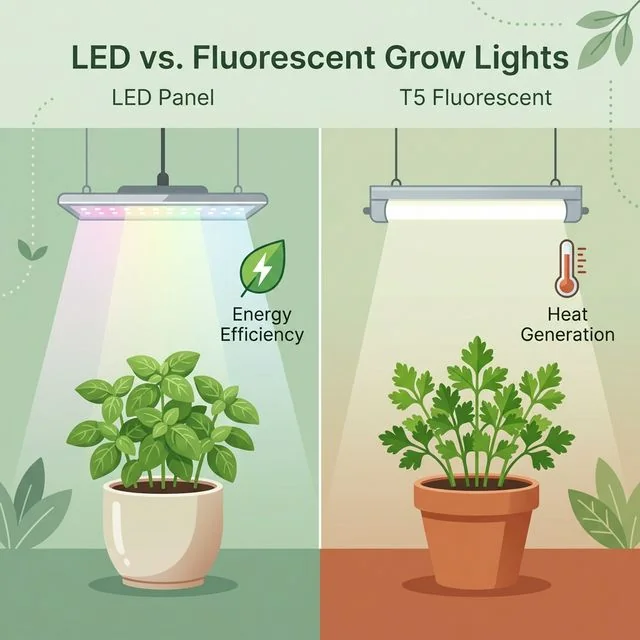
LED vs. fluorescent grow lights for herbs: which is better?
Fluorescent tubes used to be the gold standard for indoor gardeners, but modern LEDs have changed the game. Find out which technology is right for your space and budget.

DLI targets for herbs and leafy greens: what to aim for
A single DLI number does not fit every herb. Here is the general target for leafy greens, and what published research on basil, sage, and mint actually measured.