
Where grow light setups actually run into trouble
| Failure point | Why it happens | What actually fixes it |
|---|---|---|
| Driver or power strip sitting below tray height | A spill or a drip runs downhill and lands directly on it | Mount the driver and any cable joints above the water line, not on the floor under the tray |
| Cord running straight up into the socket, no dip in the run | There is no lower point in the run before the plug for a stray drip to collect at | Route the cord so it dips below the socket before it reaches it, rather than running straight up into the plug |
| One power strip plugged into another | Daisy-chaining ignores the load rating both devices carry and can put more current through the wall-connected one than it is rated for | Plug each strip or timer directly into a wall outlet, close enough that reach is not the problem |
| A heavy fixture hung from an adhesive hook or a curtain-rod fitting | The fixing was rated for a picture or a light curtain, not a powered unit hanging over a tray | Use a freestanding shelf frame or a tension rod rated for real weight instead of relying on the wall or window frame |
Grow light safety is not a special category of electrical work. It is the same ordinary indoor wiring care — keep water and live parts apart, respect the load rating printed on the device, give heat somewhere to go — applied to a shelf where you deliberately add water on a schedule. Once the fixture is set up and running, the wiring underneath it is worth five real minutes of attention, because the failure modes here are the same ones that exist anywhere else in the house. They just get less scrutiny, because the thing on the shelf is a seed tray, not a kettle.
None of this means a small LED panel over a tray of basil is dangerous equipment. It runs on the same household current as a lamp, and the diodes themselves are not the risk. What earns a look is everything around them: the driver, the cord, the timer, the strip it is plugged into, and whatever it is mounted to — because a grow shelf puts all of that in the one room where you pour water on purpose, usually right underneath it.
Where water and electricity actually meet
Trays get watered, and watering is imprecise. A can overshoots the rim, a wicking reservoir gets topped up a little too full, a humidity dome sheds condensation down the inside and off the edge of the tray. None of that is careless — it is just what growing something in a container involves — but it means the space under and around a grow light is one of the few spots in the house where a splash toward the electrics is a normal, expected event rather than a rare accident.
The fix is positioning, not paranoia. Keep the driver, the power strip and every plug or connector above the height of the trays and off to the side, not directly underneath where a drip has a clear path down. If the cord has to run past or under the tray to reach a socket, route it so it dips below the socket before it reaches it — a drip loop — rather than running straight up into the plug. It costs nothing and takes about ten seconds to arrange when you first set the shelf up.
If your system keeps a reservoir sitting permanently under the trays rather than watering by hand, that setup carries its own separate issues around standing water and root health, covered on preventing root rot in hydroponic systems — worth a look regardless of what is plugged in nearby.
It is also worth checking whether the outlet the shelf runs from already has GFCI (or RCD, outside the US) protection, which many kitchens, bathrooms and outdoor circuits do by default. The Electrical Safety Foundation International recommends this kind of protection for any indoor or outdoor area where water may come into contact with electrical products, precisely because it cuts power fast if current starts leaking somewhere it shouldn’t — a grow shelf is exactly the kind of area that description covers. If you are not sure what your outlet has, that is a question for whoever handles the electrics in the building, not a reason to avoid asking it.
Timers, power strips, and the number printed on the box
A timer and a power strip both carry a rated load, printed on the device itself or in its manual, and that number is the one to check — not a guess based on how big the plug looks. The US Consumer Product Safety Commission’s guidance on extension cords and power strips is blunt about the underlying risk: overloaded cords and strips are a genuine fire hazard, and the usual causes are too many things plugged into one unit and cords that have gone cracked or worn without being replaced. None of that requires a large setup to matter — a single fixture is rarely the problem, but adding a heater, a humidifier or a second light to the same strip without checking its total rating can add up faster than it looks.
The other common mistake is plugging one power strip into another to reach a second outlet or add more sockets, sometimes called daisy-chaining. The Office of Congressional Workplace Rights, citing OSHA’s requirement that equipment be used in accordance with the conditions under which a recognised testing organisation approved it, summarises the consequence plainly: most power strips are approved to supply four to six items, so when one is plugged into another, the strip in the wall ends up feeding far more outlets than it was approved for. If the shelf needs more outlets than one strip provides, or needs to reach farther, the fix is a strip with enough length and enough rated capacity to do the job directly from the wall — not a second strip feeding the first.
Choosing a timer, including how it handles a power cut or a Wi-Fi drop, is covered on choosing a grow light timer. For safety, the rule is short: read the rating, and do not exceed it.
Heat needs somewhere to go, especially in an enclosure
A driver that cannot shed the heat it generates is a lifespan problem first, and it stops being just a lifespan problem once heat has nowhere to escape at all — a sealed cabinet or a fully enclosed grow tent with the vents shut is a different situation from an open shelf in a room. The mechanics of where that heat actually builds up on a rack, and what fixes it before it becomes worth worrying about, are covered in full on grow light heat management; if you are running a fixture inside a tent rather than on open shelving, the enclosure changes the airflow picture and is worth reading alongside the setup notes on running herbs in a small grow tent.
The practical safety version is short: do not wedge the driver into a tight, closed space against a warm surface, do not stack anything on top of it, and if it is hot enough to notice by hand after a normal run, that is the cue to give it more room rather than to wait and see.
Renting: what you can actually do without drilling into anything
The setups that go wrong in a rental are rarely about the wiring itself — the light, the timer and the strip are the same regardless of who owns the walls. What changes is how the fixture gets mounted, and that is where the real risk sits: a heavy panel hung from an adhesive hook, a tension curtain rod pressed into service as a light bar, or a fixture balanced on a stack of books above a tray, all rated for something much lighter than a powered light hanging over water.
A freestanding shelf unit with its own frame, or a tension rod actually rated for the fixture’s weight, avoids relying on the wall or window frame to hold anything up. Setting up a shelf unit without drilling covers one common no-damage option in detail, and the broader picture of fitting a full setup into a rented apartment — light, space and what you can leave behind at move-out — is covered on grow lights for apartments and windowsills and setting up an indoor herb garden in an apartment. The wiring advice above still applies inside any of those setups; the mounting is the part that is genuinely different when you cannot put a screw in the wall.
What about looking at the light?
A grow light is bright enough that looking straight into it is uncomfortable, the same as any bright light source. Mount the fixture so the diodes point down at the tray rather than out at head height, and you will not spend time looking into it while you work. If the fixture came with viewing warnings or is sold as adding UV on top of white light, follow the instructions that came with that specific unit — a UV-supplemented fixture is not the same product as a white LED panel.
Common mistakes with grow light safety
Running the driver or the power strip on the floor directly under a tray feels tidy until the tray gets watered a little generously. Plugging a second power strip into a first one is usually done to reach a socket rather than out of carelessness, but it still overrides both devices’ ratings.
Sources
Keep the rest of the setup sound
Safety is one piece of running a grow light well. These cover the fixture's heat, its running cost, and picking a timer that can actually carry the load.
Common questions
Do I need a GFCI outlet for a grow light?
It is not a grow-light-specific requirement, but it is the same logic electricians already apply to kitchens and bathrooms. The Electrical Safety Foundation International recommends GFCI (or RCD, outside the US) protection for any indoor or outdoor area where water may come into contact with electrical products, and a shelf you water by hand qualifies. If the circuit your shelf runs from already has that protection, you do not need to add anything. If you are not sure, that is a question for whoever handles the wiring, not a reason to avoid the topic.
Can I plug my grow light timer into a power strip?
Usually, yes, as long as the strip's own rated load covers everything plugged into it, including the timer and the light. What causes problems is plugging one power strip into another to reach a second socket or add more outlets. That is called daisy-chaining, and the Office of Congressional Workplace Rights is direct about it: most power strips are approved to supply four to six items, so interconnecting them means the one plugged into the wall ends up feeding far more outlets than it was approved for, which is how it gets overloaded.
Is it safe to run a grow light near a humidity dome or a wicking tray?
The light itself does not mind humidity. The risk is the same as anywhere else water collects near a plug: condensation dripping onto a driver, or a tray that overflows onto a power strip sitting underneath it. Keep the electrical hardware above and to the side of anything that holds standing water, not directly under it, and route the cord so it cannot funnel a drip toward the socket.
Is looking at a grow light bad for my eyes?
A bright fixture is genuinely uncomfortable to look straight into, the same as any bright light. Mount the fixture so the diodes point down at the tray rather than out at head height, and you will not spend any time staring into it while you work.
Related guides
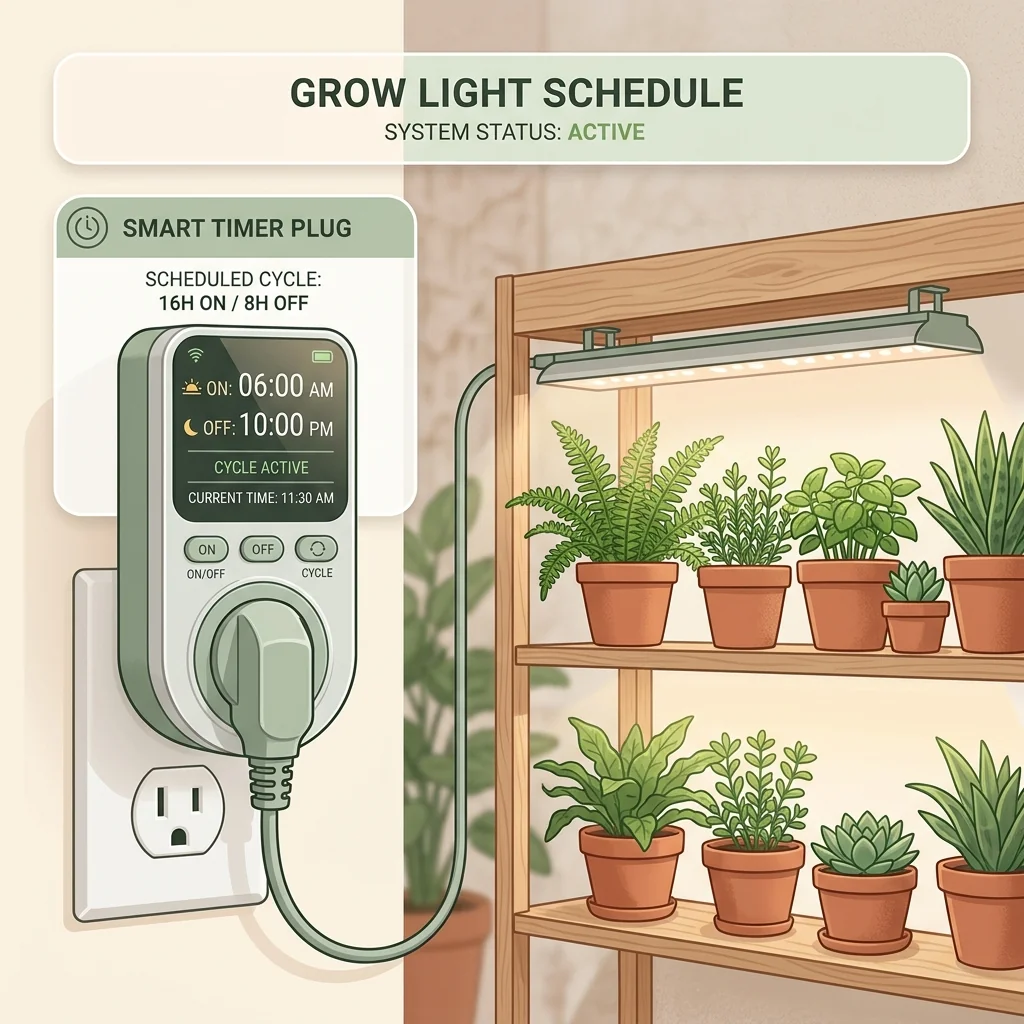
Best grow light timers (buyer's guide)
Consistency is everything in indoor horticulture. If you forget to turn your grow lights on, your plants will starve. If you leave them on too long, your greens will stress and bolt. Automating your photoperiod with a reliable outlet timer is the single easiest upgrade you can make. Here are our top picks.

Grow light heat management: what actually matters on a shelf
A warm top shelf is not just a comfort problem. It changes the light your herbs want and wears the fixture down faster, and the fix is usually smaller than a fan.
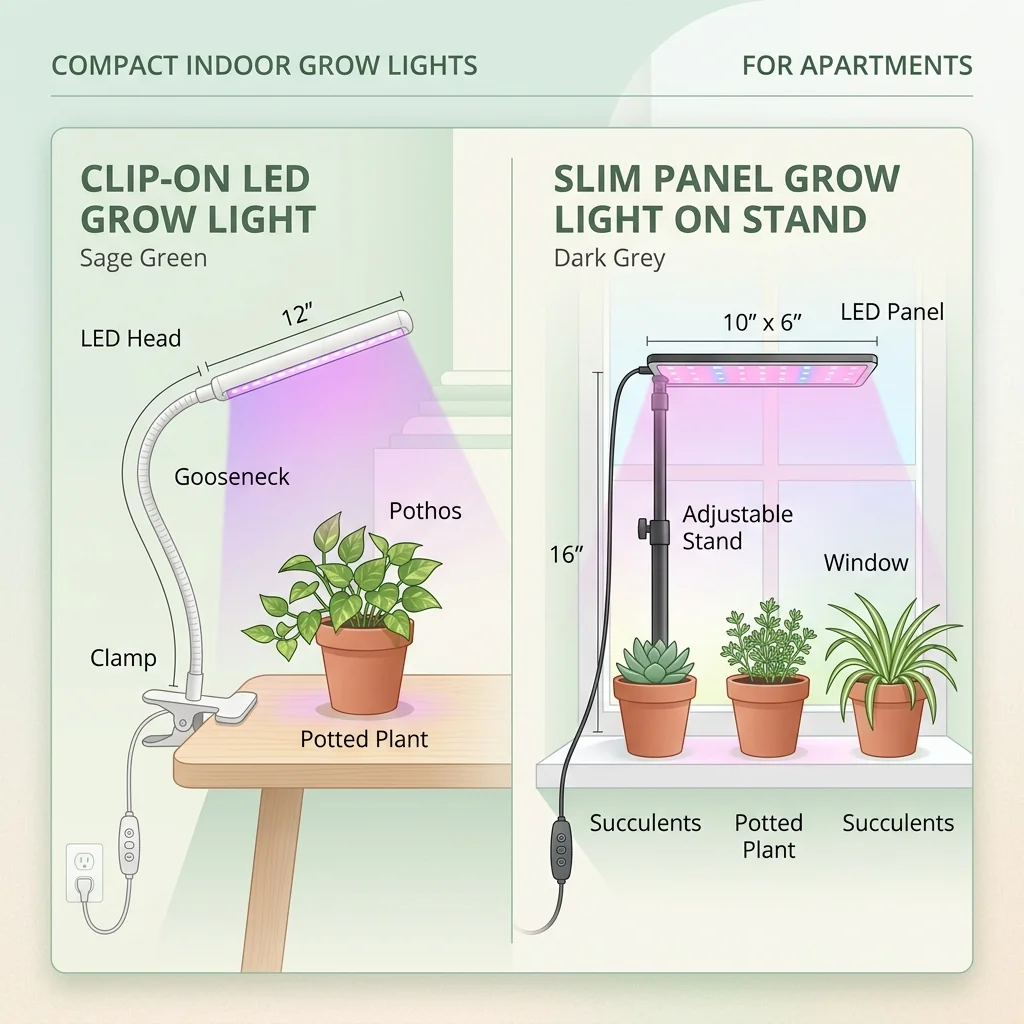
Best grow lights for apartments and windowsills
Apartments need grow lights that fit a small space and look acceptable in a living room. Here are the best compact LED types and what to check before buying.