
Sunlight through a window versus a grow light on a timer, by axis
| Axis | Sunlight through a window | A grow light on a timer |
|---|---|---|
| Intensity | Can be very strong in direct summer sun, but drops sharply once it passes through glass, and falls further with any shading | Fixed by the fixture's own output; consistent but capped, and rarely close to peak outdoor sun |
| Consistency | Changes with weather, time of day, and cloud cover; a bright morning can be followed by a dim afternoon | The same output every day the timer runs it, regardless of what is happening outside |
| Duration you control | Set by day length, window orientation, and what blocks the glass; you cannot extend it | A dial you set and can change as the plant's needs or the season shifts |
Sunlight and a grow light are not different in kind. They are different in delivery. The fair comparison is not “which is better” but how each one performs on three separate axes — intensity, consistency, and how much control you have over duration — and a window can win on one of those axes while a fixture wins on the other two. If you are trying to work out whether your own herbs can survive without direct sun at all, that question has its own answer; this is about what actually separates the two light sources once you have decided a plant needs more than it is getting.
Why “which is better” is the wrong question
Treating sunlight and grow lights as rival technologies is where most confusion starts. Light is light — a plant’s leaves do not care whether the photons came from a star ninety-three million miles away or a diode six inches above the pot. What differs is how reliably that light arrives, at what strength, and for how long. A fixture and a window are two delivery systems for the same input, and each one is strong on some fronts and weak on others.
That framing matters because it changes the question a grower should actually ask. Instead of “is my window good enough” or “should I switch to a light”, the useful questions are narrower: how intense is what I have, how consistent is it day to day, and how much say do I get over how long it runs.
Intensity: where outdoor sun usually wins
Direct outdoor sunlight is far stronger than almost any light a home fixture produces. That gap is the reason a genuinely sunny, unobstructed window can outperform a small grow light in the height of summer. There is simply more light energy arriving per square meter. Purdue Extension’s greenhouse measuring guide puts outdoor DLI across the contiguous US at 5 to 60 mol·m⁻²·d⁻¹ over the course of a year, while readings taken inside a greenhouse seldom exceed 25 — glazing, structure and overhead obstructions cut incoming light by 40 to 70%, and in the most shaded cases leave an average as low as 1 to 5 mol·m⁻²·d⁻¹. Those are outdoor and greenhouse measurements rather than a windowsill figure, but they show the size of the bite that any glass and any structure takes out of what the sun delivers. It is also the reason the same window can lose to that same small fixture by December, because the strength of outdoor light itself falls off as the sun sits lower in the sky and days shorten.
A grow light cannot claim outdoor-sun intensity as its strength. What it offers instead is a fixed, repeatable output that does not care what season it is. That is exactly the axis where a window struggles most.
Consistency: where a fixture usually wins
A grow light on a timer delivers the same light, at the same strength, every day it runs. That is the real argument for adding one in winter: the case for a grow light is rarely “my plant needs more light than the sun can ever provide.” It is usually “I need light I can count on regardless of what the sky is doing.”
A window delivers whatever the season and the weather hand it. A run of overcast days, a neighboring building that throws shade for part of the afternoon, or a curtain left half-closed all cut into what a plant actually receives. None of that shows up as a dramatic change. It shows up as a plant that quietly does less than it did the week before.
Duration: a dial with a fixture, a fact with a window
Photoperiod — how many hours of light a plant gets each day — is the third axis, and it is where the difference is starkest. With a grow light, duration is a setting. Plug it into a timer and run it for 12 to 16 hours a day — the range University of Illinois Extension gives for seedlings after germination, and the one most home herb setups settle on — and that duration holds regardless of the calendar.
With a window, duration is a fact of geography and season, not a choice. You cannot dial up an extra two hours of afternoon light in December by wanting it. How much light herbs actually need works from a practical rule of around six hours or more of direct sun, with the 12-to-16-hour grow-light range as the artificial-light path — not an hour-for-hour swap between the two.
DLI is the number that makes the comparison fair
Comparing intensity and duration separately only goes so far, because a dim light running a long time and a strong light running briefly can end up delivering similar totals. Daily light integral, or DLI, is the figure built for exactly that: it folds intensity and hours into one number, expressed in mol·m⁻²·d⁻¹, so a window and a fixture can be measured on the same scale.
For leafy greens and herbs grown in controlled environments, MSU Extension puts the useful target at 12 mol·m⁻²·d⁻¹ or more, with a common greenhouse minimum around 10 to 12 and a documented drop in quality below 10. What a specific structure delivers on daylight alone varies enormously — the DLI targets page has the documented greenhouse range and the per-crop numbers.
What a window actually delivers, and why it varies
A window’s delivery is not one number. It swings with the glazing type, the compass direction it faces, whether an overhang or a neighboring roofline cuts into the sky it can see, how clean the glass actually is, and the season. All of it, at once. Two windows that look equally bright to a person can differ enormously in what a plant on the sill actually receives.
That means the only way to know what your specific window delivers is to measure it, not to guess at it. The PPFD and DLI measuring guide walks through doing that with an inexpensive meter, which turns “is my window good enough” from a guess into a number you can actually compare against a target.
The comparison shifts with the calendar
The same window that comfortably carries a basil plant in June often cannot carry it in December, and nothing about the plant or the care routine has to have changed for that to happen. Growing herbs indoors through winter with a grow light covers what to do once that shift hits your own setup.
When a window is enough, and when it stops being
A bright, unobstructed window with several hours of strong light for a good part of the day is a legitimate light source, not a fallback. It tends to be enough when the exposure is genuinely strong, the season is favorable, and the crop is not a particularly light-hungry one. Setups like a low-light windowsill herb garden work from exactly that premise, choosing herbs and containers around what the window can realistically give.
A window is more likely to fall short when it faces away from strong direct light for most of the day, when something outside cuts into its exposure, or when the calendar has moved into shorter days. In any of those cases, adding a fixture is not an admission that the window failed — it is choosing the axis, consistency, that a window cannot deliver on its own. If it is time to add one, setting a fixture up correctly covers placement and schedule in full, and choosing a compact unit for a small apartment is the practical next step if space is tight.
Common mistakes in this comparison
The first mistake is assuming one source has to fully replace the other. Many setups use a window for most of the day and a small fixture to extend the photoperiod, rather than picking a single source and committing to it.
The second is judging a window by how bright it looks to a person rather than by how a plant performs on it over several days. Human eyes adapt to dim rooms quickly, which makes a weak window feel brighter than it is.
The third is moving a plant deeper into the room in winter to protect it from cold glass, which cuts its light further at exactly the time of year it can least afford to lose any.
Sources
- Michigan State University Extension — “Daily light integral defined”
- Michigan State University Extension — “Lighting Greenhouse Vegetables”
- Michigan State University Extension — “How low can you go? Low daily light integrals impact young plant quality and production time”
- Illinois Extension — “What’s wrong with my seedlings? Troubleshooting seed starting problems”
- Purdue Extension HO-238-W, Torres & Lopez — “Measuring Daily Light Integral in a Greenhouse”
Comparing sun and grow lights?
These guides cover measuring your own light, setting a fixture's schedule, and the per-crop targets that give the comparison a number to aim for.
Common questions
Is a grow light better than sunlight?
Neither wins outright. Outdoor sun at the canopy far exceeds what a home fixture can put out, so a bright, unobstructed window in summer can beat a lamp on intensity alone. A fixture wins on consistency and on control over how many hours of light a plant gets, which is exactly where a window is at the mercy of the season and the weather.
Can a grow light fully replace a sunny window?
For most culinary herbs and leafy greens, yes, once the fixture is run on a timer for enough hours a day. What a fixture cannot do is match the sheer intensity of direct outdoor sun, though most home growing does not need that much intensity in the first place.
How many hours of grow light equal a sunny window?
There is no reliable hour-for-hour swap between the two, because a window and a fixture deliver light at different intensities and their output changes for different reasons. The comparable measure is daily light integral, which is covered on the DLI measuring guide, not a simple hour count.
Why did my plant do fine on a window in summer but struggle in winter?
Shorter days and a lower sun cut the total light arriving through the same pane of glass — a seasonal problem, not a sign that the plant or the care routine changed.
Related guides

DLI targets for herbs and leafy greens: what to aim for
A single DLI number does not fit every herb. Here is the general target for leafy greens, and what published research on basil, sage, and mint actually measured.
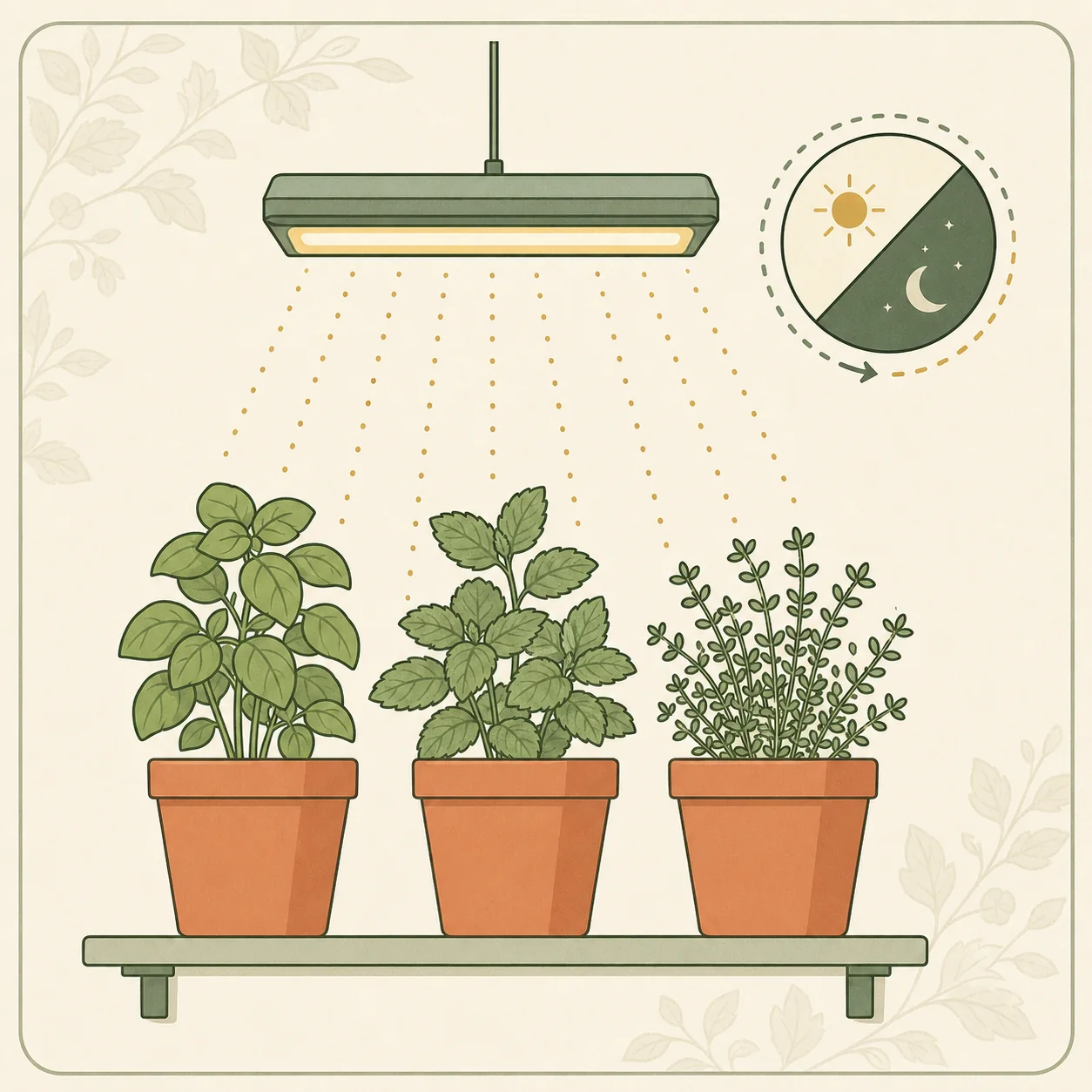
PPFD and DLI for indoor herbs: a practical measuring guide
PPFD is a snapshot; DLI is the daily total. Used together, they turn grow-light setup from a distance rule into a measurable map.
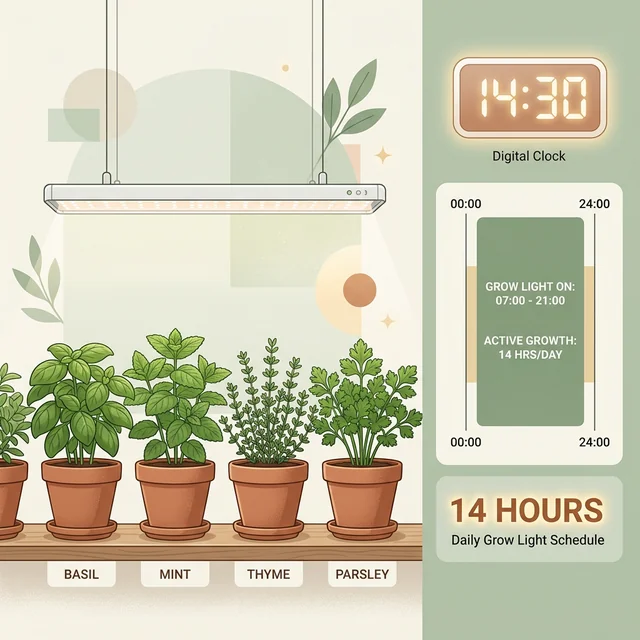
How many hours should grow lights run for herbs? 12-16
Most herb grow lights should run about 12 to 16 hours per day, but intensity, distance, and a stable dark period matter as much as the timer itself.