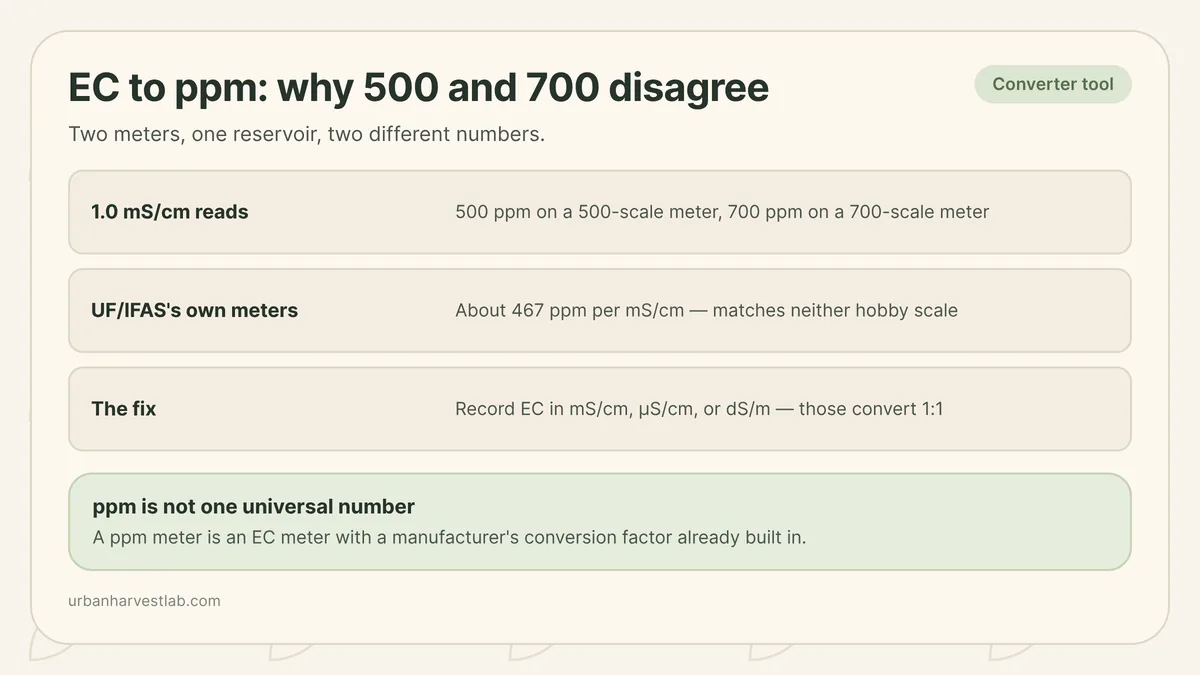
An EC reading of 1.0 mS/cm converts to 500 ppm on the “500 scale” and to 700 ppm on the “700 scale” — the same conductivity read out as two different numbers, because the two conventions assume different dissolved salts. Oklahoma State University Extension recommends recording EC in mS/cm rather than ppm for exactly this reason. Multiply your EC in mS/cm by 500 or by 700 depending on which scale your meter uses, or record EC directly and skip the disagreement.
Any handheld meter that reports a nutrient reading only in ppm or TDS is a conductivity meter with a conversion factor already applied before the number reaches the screen. That factor is a choice a manufacturer made, not a property of the water. Start with EC and pH basics for a hydroponic system if the units themselves are unfamiliar; the calculators below convert between them.
Convert EC to ppm (500 scale and 700 scale)
EC → ppm
Enter a conductivity reading. The result shows both hobby-market conventions side by side, plus the actual factor an extension lettuce recipe works out to.
500 scale
—
- 700 scale
- —
- UF/IFAS lettuce factor (467)
- —
- Same EC in µS/cm
- —
Doing it by hand takes one multiplication once you know your meter’s convention:
ppm (500 scale) = EC in mS/cm × 500
ppm (700 scale) = EC in mS/cm × 700
A reservoir sitting at 1.8 mS/cm — the top of Oklahoma State University Extension’s lettuce range — reads 900 ppm on a 500-scale meter and 1,260 ppm on a 700-scale meter, a gap of 360 ppm for water that has not changed at all. The gap grows with concentration, so it matters most exactly where precision matters most: near the top of a fruiting crop’s target range.
Convert ppm back to EC
ppm → EC
Pick the scale printed in your meter's manual, then enter the ppm reading it showed. Guessing the scale gives a wrong EC, so leave it unset until you have checked.
EC
—
- Same EC in µS/cm
- —
By hand, divide instead of multiply:
EC in mS/cm = ppm reading ÷ 500 (if the meter uses the 500 scale)
EC in mS/cm = ppm reading ÷ 700 (if the meter uses the 700 scale)
A reading of 900 ppm is 1.8 mS/cm on a 500-scale meter but only 1.29 mS/cm on a 700-scale meter — a real difference in how concentrated the reservoir actually is, not a rounding error.
Why 500 and 700 disagree
Both scales start from the same physical measurement — conductivity — and both convert it into an estimate of total dissolved salts using a reference solution as a stand-in for the mix of fertilizer ions actually present. They pick different reference salts, and that choice is baked into the meter’s electronics before it ever touches nutrient solution, which is why the same water reads two different ppm numbers on two different meters. Neither number is measuring anything the other one is not; they are two unit systems for the same underlying reading, the way Celsius and Fahrenheit describe the same temperature.
A third factor sits in between. University of Florida’s IFAS Extension states a general nutrient solution target of EC 1.2 to 1.8 mS/cm equal to 560 to 840 ppm on its own equipment — dividing those numbers out gives roughly 467 ppm per mS/cm, closer to the 500 scale than the 700 scale but matching neither exactly. That is one extension service’s own meter, calibrated to its own convention, and it is the clearest proof that “ppm” is not one fixed number waiting to be discovered — it depends on the instrument doing the reading.
| EC (mS/cm) | 500 scale | 700 scale | UF/IFAS factor (467) |
|---|---|---|---|
| 0.5 | 250 ppm | 350 ppm | 234 ppm |
| 1.0 | 500 ppm | 700 ppm | 467 ppm |
| 1.5 | 750 ppm | 1,050 ppm | 701 ppm |
| 2.0 | 1,000 ppm | 1,400 ppm | 934 ppm |
| 2.5 | 1,250 ppm | 1,750 ppm | 1,168 ppm |
| 3.0 | 1,500 ppm | 2,100 ppm | 1,401 ppm |
Even the unit conversion underneath ppm has tripped up a published source. Oklahoma State University Extension’s own fact sheet on electrical conductivity states that a µS/cm value “can be multiplied by 1,000” to reach mS/cm. That direction is reversed — 1 mS/cm equals 1,000 µS/cm, so a µS/cm reading is divided by 1,000, not multiplied, to reach mS/cm. Even an extension publication can print a unit conversion backward, which is exactly the kind of error that a fixed formula, checked once, removes for good.
Skip the disagreement: measure and log EC
Oklahoma State University Extension and University of Missouri Extension agree that the four EC-family units convert one to one with no ambiguity at all: 1.0 mS/cm equals 1,000 µS/cm, 1.0 dS/m, and 1.0 mmho/cm, so recording any one of them lets you reconstruct the others without a conversion factor in sight. Even a single publication can mix unit spellings — Cornell University’s Hydroponic Lettuce Handbook uses both microsiemens per centimetre and dS/cm in the same document. A meter that displays EC or µS/cm directly — Oklahoma State University Extension recommends checking against a 1.41 mS/cm calibration standard periodically — removes the 500-versus-700 question entirely. See the best pH and EC meters for hydroponics for what to look for when buying one.
Target ranges published by crop are also given in EC, not ppm, for exactly this reason — the hydroponic EC chart by crop lists ranges in mS/cm so a reading transfers between meters without needing to know anyone’s ppm convention. If your source water already carries measurable conductivity before any fertilizer is added, read hard water in hydroponics before subtracting that baseline from a target range.
Once a target is set in EC, the day-to-day work is watching where the reading sits relative to it. Hydroponic EC rising or falling covers what a drifting reading usually means, independent of which ppm scale a display happens to use.
Common mistakes with the conversion
- Assuming “ppm” is one universal number. The 500 and 700 factors are the two most hobby meters ship with, University of Florida’s own equipment works out to 467, and other conversion factors are in circulation — none of them is more correct than another; they are different arithmetic on the same reading.
- Converting a ppm figure from an unfamiliar chart without knowing which scale produced it. A lettuce target quoted as “840 ppm” means EC 1.8 mS/cm if it came from University of Florida’s IFAS Extension, but a different EC on a 500- or 700-scale meter.
- Mixing up µS/cm and mS/cm by a factor of 1,000 in either direction, the same slip that appears in one extension publication’s own fact sheet.
- Comparing a ppm reading between two different meter brands as if they used the same scale, when the manual for each has not been checked.
Sources
- Oklahoma State University Extension HLA-6722, “Electrical Conductivity and pH Guide for Hydroponics”
- University of Missouri Extension G6984, “Hydroponic Nutrient Solutions”
- UF/IFAS Extension HS1422, “Growing Lettuce in Small Hydroponic Systems”
- Cornell University CEA Program, “Hydroponic Lettuce Handbook”
Measure and target EC correctly
Once the units agree, use these to pick a meter, hit a target, and read drift over time.
Common questions
Is 1,000 ppm the same as 1 mS/cm?
No. 1 mS/cm equals 1,000 microsiemens per centimetre, 1.0 deciSiemens per metre, and 1.0 millimho per centimetre — those four units describe the same electrical conductivity and convert one to one. Turning that conductivity into ppm needs a second step, and meters do not agree on the factor: roughly 500 ppm per mS/cm on a 500-scale meter, roughly 700 on a 700-scale meter, and University of Florida's IFAS Extension publishes a worked example that comes out closer to 467.
Why do two ppm meters give different numbers for the same reservoir?
Because a ppm or TDS meter is an EC meter with a conversion factor built into its electronics, and manufacturers do not agree on that factor. A solution at 1.5 mS/cm reads about 750 ppm on a 500-scale meter and about 1,050 ppm on a 700-scale meter. The water has not changed; only the arithmetic behind the display has.
How do I find out which scale my meter uses?
Check the meter's manual, box, or the underside of the unit — manufacturers usually print it as a conversion factor such as 0.5 or 0.7. If it is not documented, measure a solution of known EC and compare the ppm reading against both the 500 and 700 scale results to see which one it matches.
Should I record EC or ppm in a grow log?
EC, µS/cm, or dS/m if the meter offers it. That reading does not depend on which ppm convention the electronics use, so a note like 1.4 mS/cm stays meaningful on a different meter or a different year, while a ppm figure only means something once the scale that produced it is known too.
Related guides
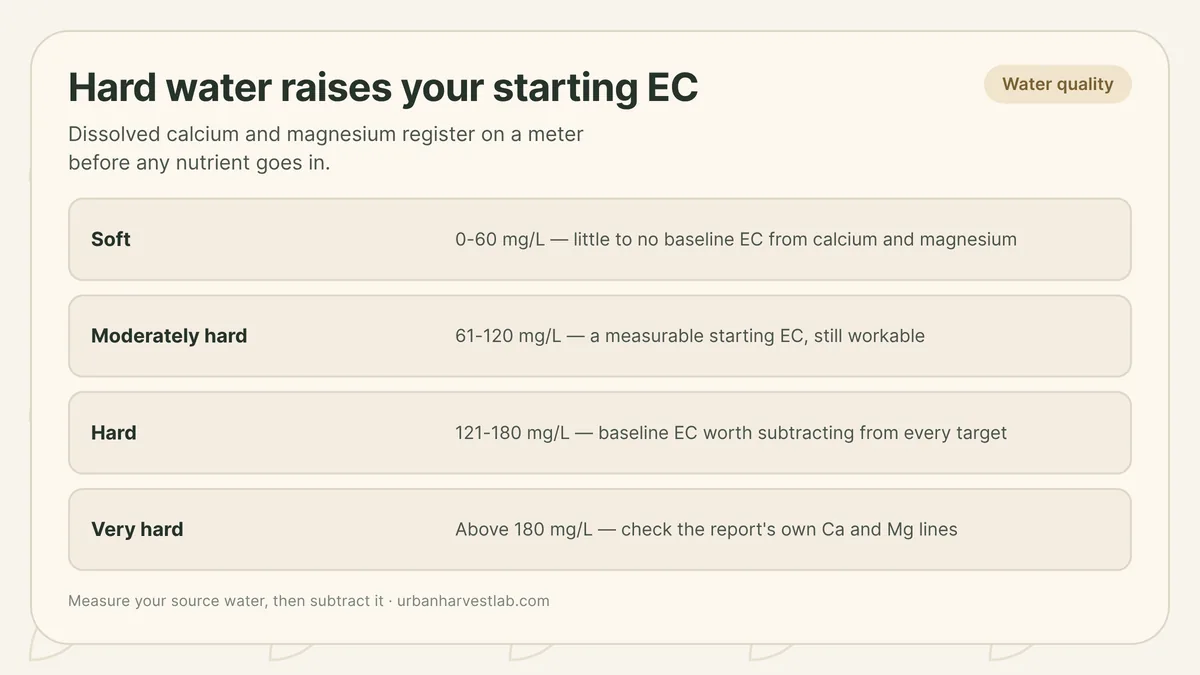
Hard water in hydroponics: how it raises your starting EC
Tap water carrying dissolved calcium and magnesium does not start at zero EC. Here is how much that shifts your baseline, and how to mix around it.
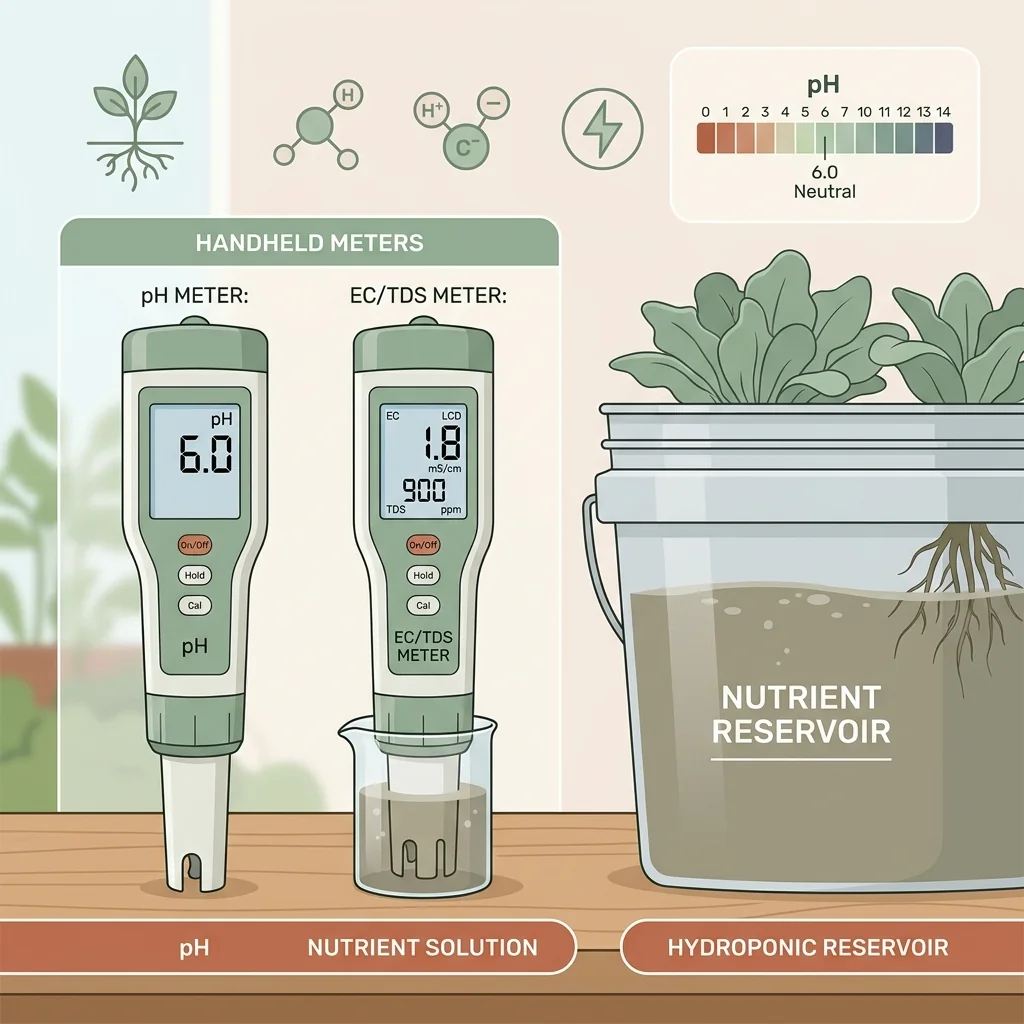
Best pH and EC meters for hydroponics: choose and calibrate
A useful hydroponic meter is easy to verify and maintain. Compare pH pens, EC meters and combination devices, then set up a calibration routine you will actually keep.
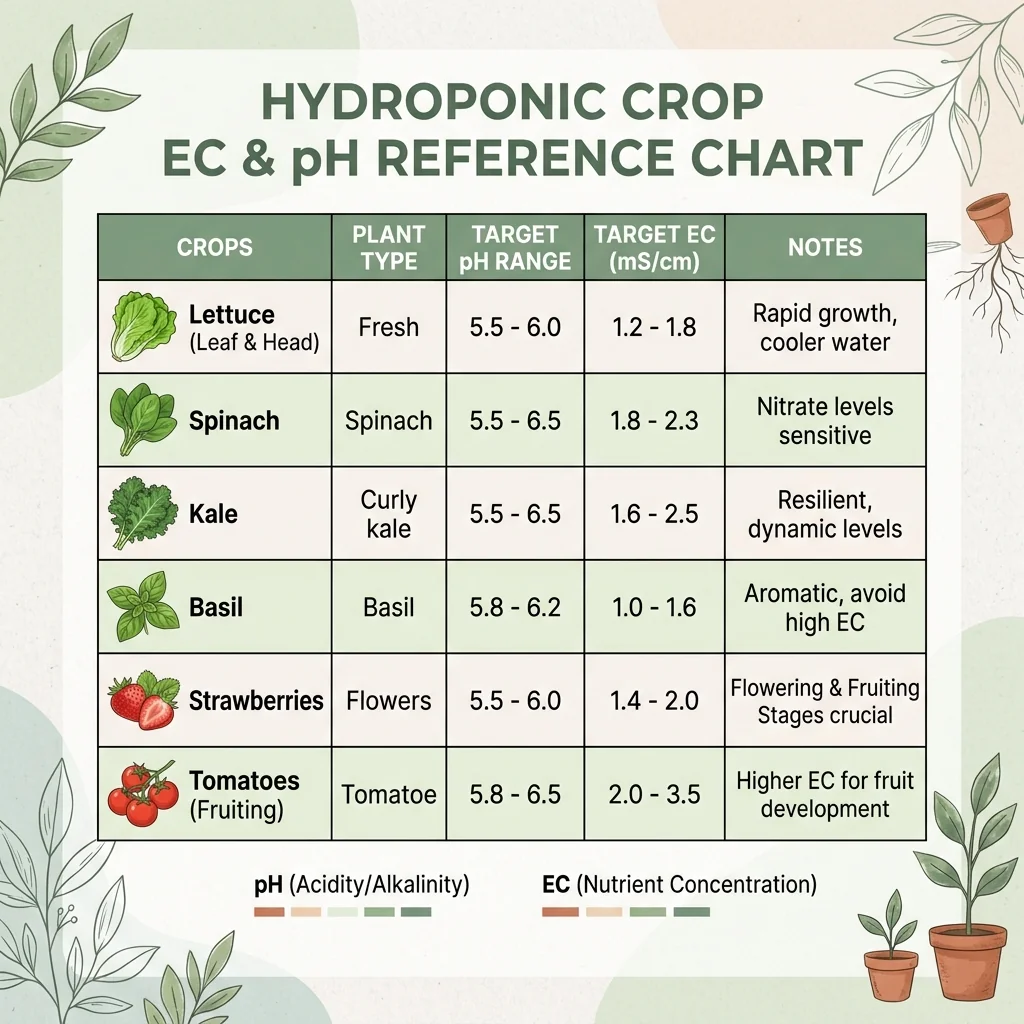
Hydroponic EC chart by crop (not just lettuce)
One reference chart for the EC and pH targets of common hydroponic crops, from leafy greens and herbs to fruiting plants, plus how to use the numbers safely.