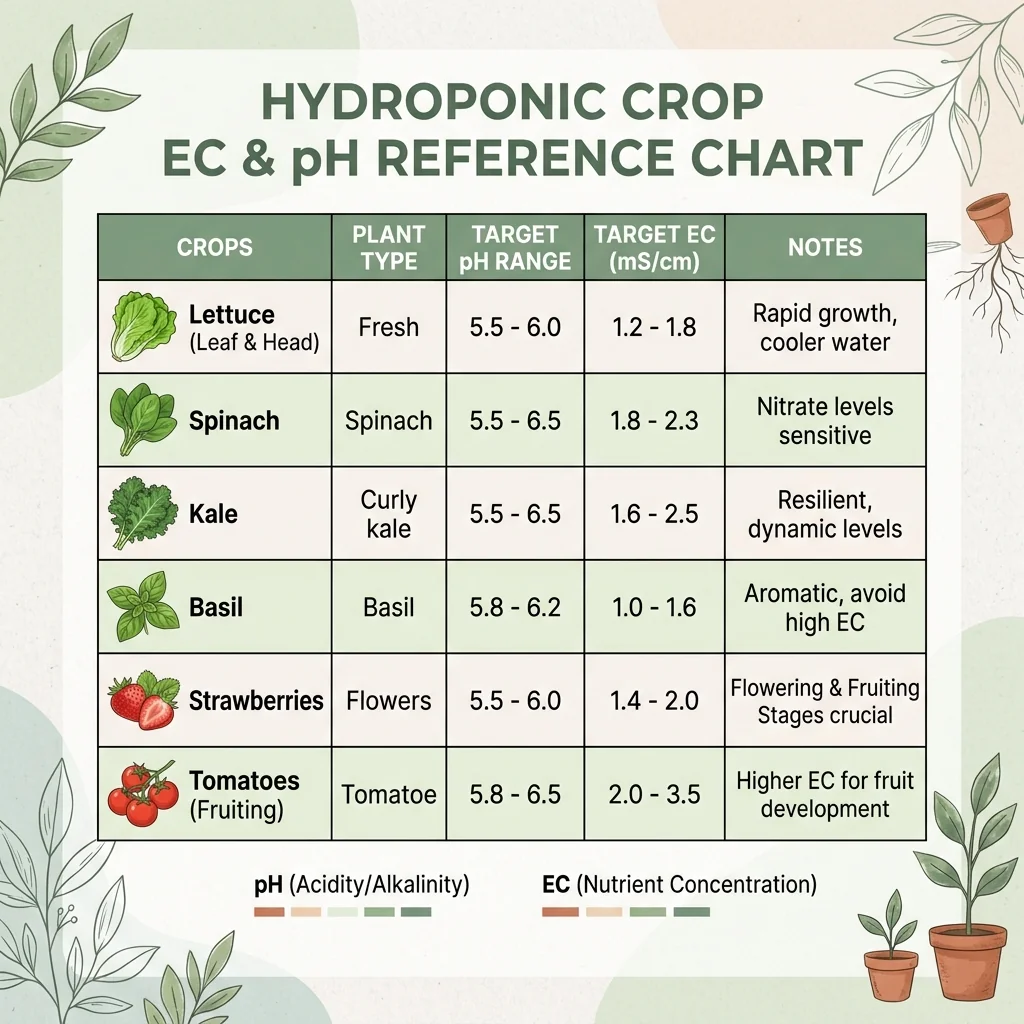
Hydroponic EC and pH targets by crop
| Crop | EC (mS/cm) | pH |
|---|---|---|
| Lettuce | 0.8-1.2 | 5.5-6.0 |
| Basil | 1.0-1.6 | 5.5-6.5 |
| Other leafy herbs | 1.0-1.6 | 5.5-6.5 |
| Strawberry | 1.0-1.4 | 5.5-6.2 |
| Kale | 1.25-1.5 | 5.5-6.5 |
| Spinach | 1.8-2.3 | 6.0-7.0 |
| Cucumber | 1.7-2.0 | 5.0-5.5 |
| Pepper | 0.8-1.8 | 5.5-6.0 |
| Tomato | 2.0-3.5 | 5.5-6.5 |
Most hydroponic EC advice is written for lettuce, but every crop has its own ideal. As a quick answer: leafy greens want a low EC (around 0.8 to 1.2), herbs a bit more (1.0 to 1.6), and fruiting crops vary widely — tomatoes up at 2.0 to 3.5, peppers as low as 0.8, with most crops happy at pH 5.5 to 6.5. Use the chart above as a starting point and adjust by plant response. If EC and pH are new concepts, read hydroponic nutrient basics first.
How to read the chart
EC (electrical conductivity) measures how concentrated the nutrient solution is. Light feeders like lettuce burn at high EC, while heavy feeders like tomatoes need a strong solution to fruit well. pH controls whether the plant can actually absorb those nutrients; drift outside the band and you get lockout even when the EC is correct.
Greens and herbs (low to medium EC)
Leafy crops and herbs make up most small-space hydroponics and sit at the gentle end:
- Lettuce is the lightest feeder; see the detailed lettuce EC and pH chart.
- Basil and other herbs run a little richer; see hydroponic basil.
- Kale and spinach are greens but feed more heavily, with spinach the strongest of the leafy group.
Fruiting crops (high EC)
Tomatoes and cucumbers are heavy feeders that need a far stronger solution and far more support, light, and space than greens. Peppers are the exception on EC — Oklahoma State University Extension puts them at 0.8 to 1.8 mS/cm, overlapping the bottom of lettuce’s 0.8 to 1.2 range in the chart above rather than sitting above it — but they need the same light and support as any fruiting crop. All three are demanding in a small indoor setup.
Use the numbers as a starting point
These ranges are starting targets, not fixed rules. Adjust for:
- Stage: start seedlings lower, raise toward the target as they grow.
- Heat: drop EC in warm conditions, when plants drink more water than nutrients.
- Response: tip burn suggests EC is too high; pale, slow growth can mean it is too low.
Once you know your target, how to mix hydroponic nutrients walks through hitting it safely, and Best hydroponic nutrients for herbs and greens covers which formula to buy for leafy crops.
Standardise the meter before using the chart
Confirm whether the instrument reports mS/cm, µS/cm, or a derived TDS/ppm scale. 1.0 mS/cm = 1,000 µS/cm, but ppm conversions vary by meter. Record EC directly whenever possible.
Calibrate with fresh conductivity standard appropriate to the working range, rinse between solutions, and allow temperature to stabilise. A two-decimal display is resolution, not proof of two-decimal accuracy.
Read EC as a trend, not a diagnosis
| Water level | EC trend | Possible interpretation | Next check |
|---|---|---|---|
| Falls | Rises | Water leaving proportionally faster than ions | Heat, airflow, starting strength, top-up method |
| Falls | Falls | Different nutrient/water uptake balance | Crop demand, formula, measurements, top-ups |
| Stable | Changes quickly | Dose, evaporation, contamination, or meter issue | Recheck calibration and log inputs |
These are hypotheses, not automatic dosing rules. EC cannot identify which element is present or missing, and tip burn or pale foliage has several possible causes. Interpret the chart with source-water baseline, complete formula, temperature, roots, and new growth.
Preserve provenance for every range
When a number is revised, record source, crop stage, units, and production context. Do not average unrelated greenhouse and home values into false precision. Crop-specific pages should narrow a range only when they explain why.
Sources and further reading
Use this chart with these guides
These guides explain how to hit and adjust the numbers in the chart for each crop.
Common questions
What is a good EC for hydroponics?
It depends entirely on the crop. Leafy greens like lettuce want a low EC around 0.8 to 1.2 mS/cm, herbs sit around 1.0 to 1.6, and fruiting crops like tomatoes want 2.0 to 3.5. Always match EC to the plant.
What pH is best for hydroponics?
Most hydroponic crops do well between pH 5.5 and 6.5. Lettuce prefers the low end (5.5 to 6.0), while spinach tolerates a higher pH (up to about 7.0).
Why does EC need to change by crop?
Different plants take up nutrients at different rates. Leafy greens are light feeders and burn at high EC, while most fruiting crops, like tomatoes and cucumbers, are heavy feeders that need a stronger solution to produce well. Peppers are the exception — their published EC target overlaps the bottom of lettuce's range rather than sitting above it, even though they still need fruiting-crop levels of light and support.
Should I change EC as the plant grows?
Yes. Start seedlings at a lower EC and raise it toward the crop's target as the plant matures. Drop it again in very warm conditions, when plants take up more water than nutrients.
Related guides
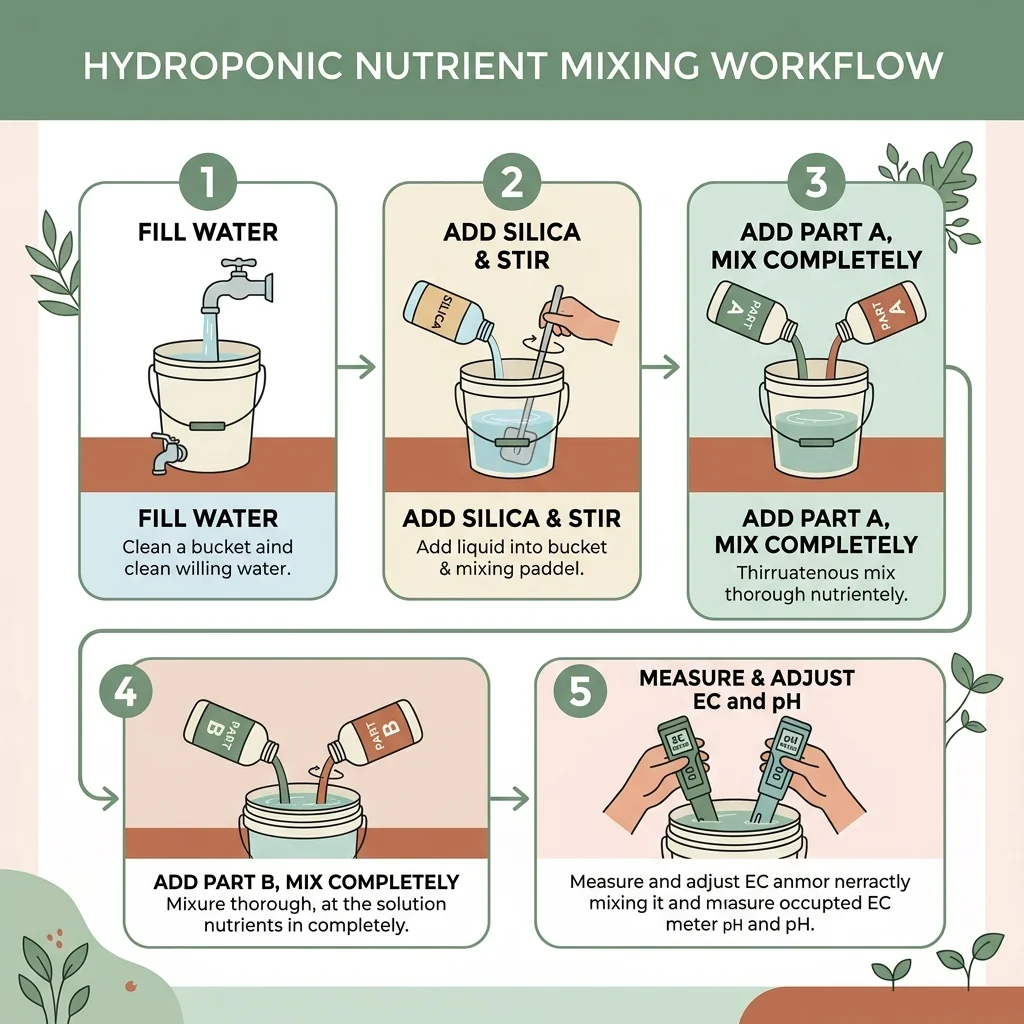
How to mix hydroponic nutrients: a beginner guide
Mixing hydroponic nutrients is simple once you know the order: water first, nutrients separately, measure EC, then adjust pH last. Here is the step-by-step.
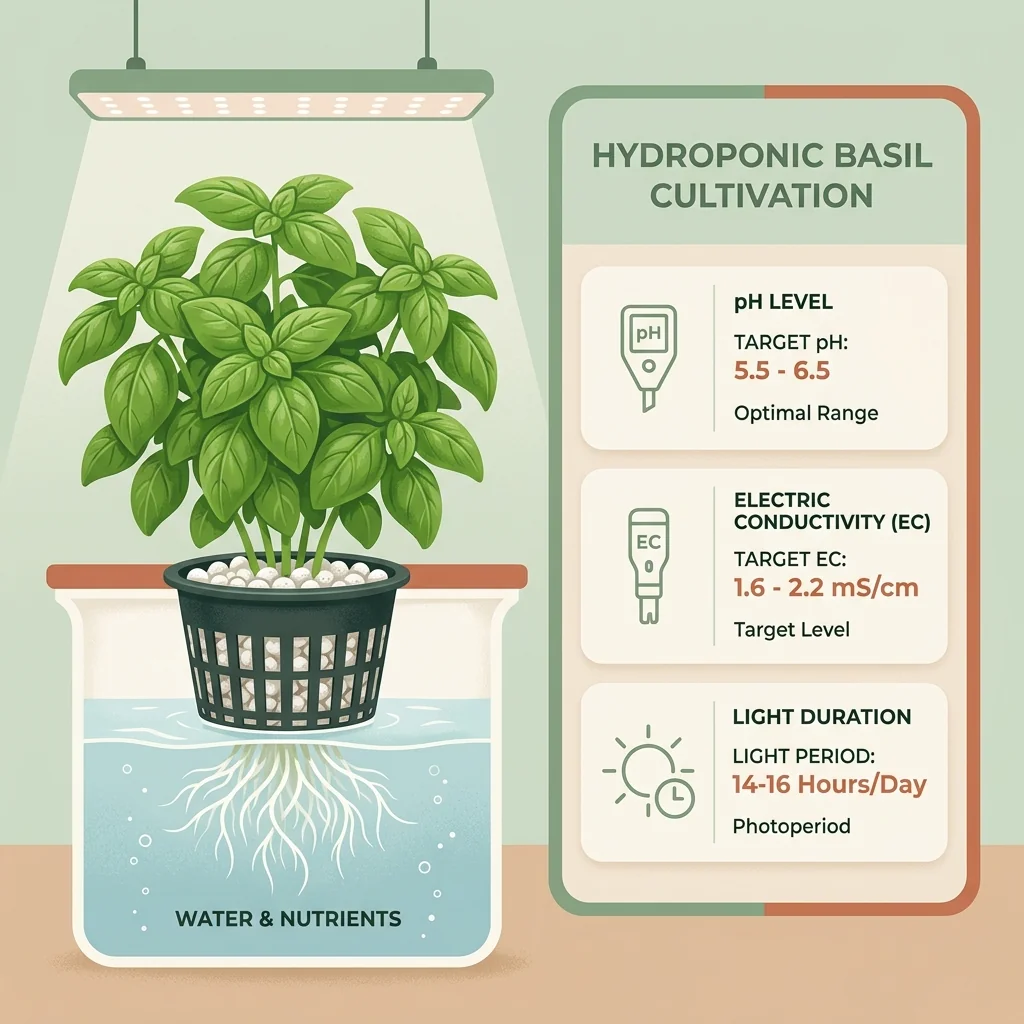
Hydroponic basil: EC 1.0-1.6, pH 5.5-6.5, 14-16 h of light
Basil is one of the fastest, most rewarding hydroponic crops once the water chemistry and light are right. Here are the exact EC, pH, and light targets to hit.
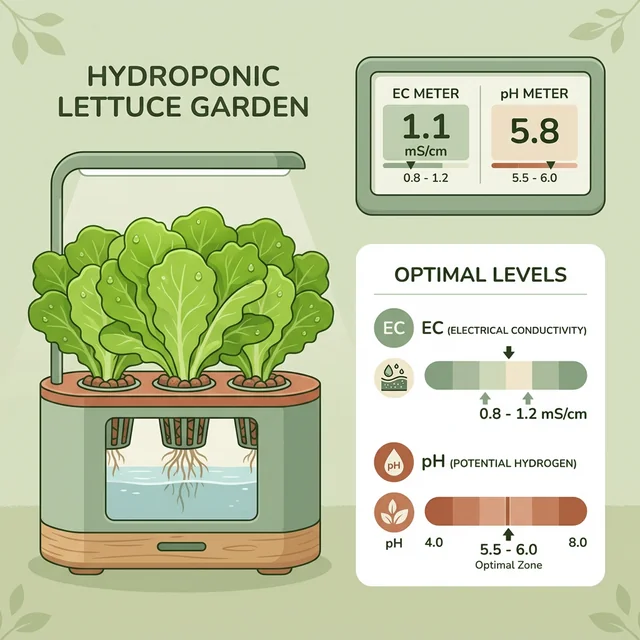
Hydroponic lettuce EC & pH chart: 0.8-1.2 and 5.5-6.0
Lettuce is the easiest crop to grow hydroponically, but it requires specific water chemistry. Use this beginner-friendly EC and pH guide to prevent tip burn and slow growth.