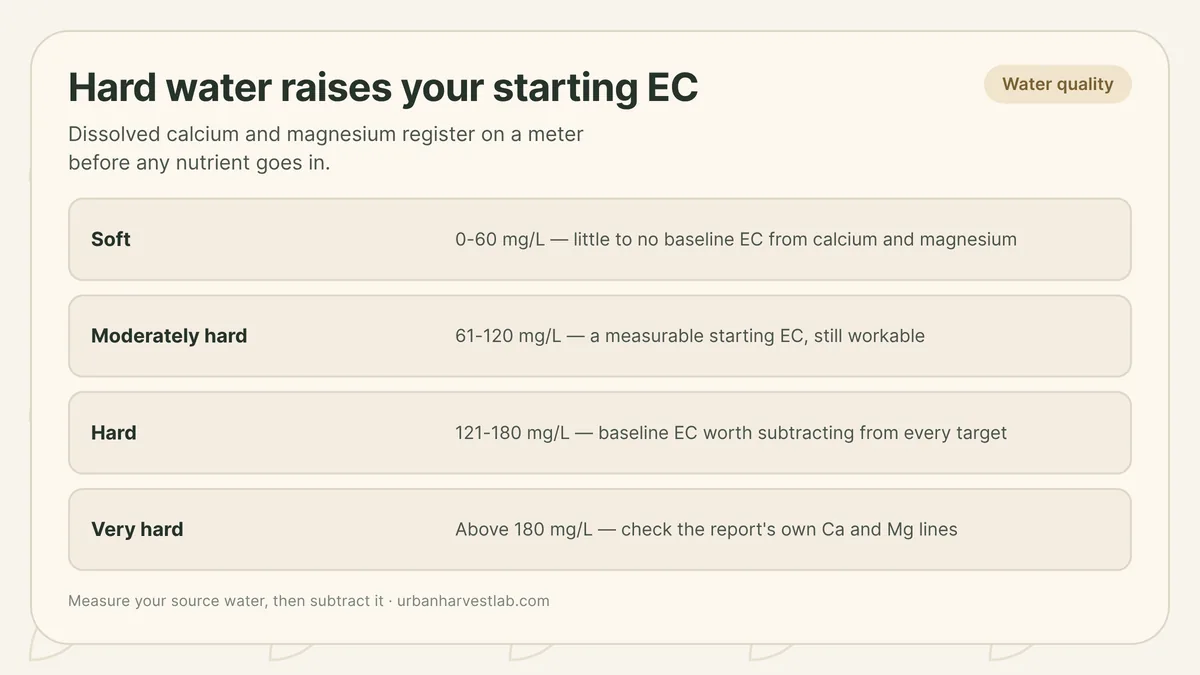
USGS water hardness classification
| Classification | Hardness (mg/L as CaCO3) | What it means for a reservoir |
|---|---|---|
| Soft | 0 - 60 | Little to no baseline EC from calcium and magnesium |
| Moderately hard | 61 - 120 | A measurable starting EC; still workable for most crops |
| Hard | 121 - 180 | Baseline EC worth subtracting from every target range |
| Very hard | More than 180 | Enough calcium and magnesium to check the report's own Ca and Mg lines against University of Missouri Extension's ceilings (150 ppm Ca, 75 ppm Mg) |
Hard water carries dissolved calcium and magnesium that register on an EC meter before any fertilizer touches the reservoir, so a nutrient mix built for soft water runs stronger than intended on hard water. The fix is measuring your source water’s own EC and subtracting it from your target, not switching nutrient brands.
Municipal water reports usually list hardness as one number and stop there, which is enough to buy the right dishwasher detergent but not enough to mix a reservoir. The basics covered in EC and pH in a hydroponic system assume the water you start with is close to zero conductivity. Hard source water breaks that assumption before a single gram of fertilizer dissolves.
What “hard” water actually measures
Hardness is the amount of dissolved calcium and magnesium in water, caused by compounds of those two minerals and a handful of other metals picked up as water moves through soil and rock — limestone and dolomite are the main sources. The U.S. Geological Survey classifies water by how much calcium carbonate it carries: soft runs 0 to 60 mg/L, moderately hard 61 to 120 mg/L, hard 121 to 180 mg/L, and very hard is anything above 180 mg/L. Heat that same water and the dissolved minerals precipitate out as solid calcium carbonate — the scale that clogs kettles and, in a reservoir, drip emitters and NFT channels. University of Missouri Extension’s optimal range for hydroponic source water keeps calcium below 150 ppm and magnesium below 75 ppm. Missouri’s ceilings are reported as elemental calcium and magnesium rather than as calcium carbonate equivalent, so a water report has to be read in the units it uses; water that exceeds either ceiling will sit at the hard end of the USGS classification, but the two numbers are not directly comparable.
Why hard water raises your EC before you add anything
EC does not measure fertilizer directly. It reads how well a solution conducts electricity, and dissolved calcium and magnesium ions conduct current the same way as the ions in a bag of nutrient salts. A reservoir filled with hard tap water carries a real EC reading before a scoop of fertilizer touches it — the opposite of the zero baseline most EC charts quietly assume.
Cornell University’s hydroponic lettuce program runs its ponds on a source water with a known baseline, and it handles the gap by working from the increment rather than the raw meter reading: measure the source water’s own EC first, then subtract it from every later reading, so the target range describes what the fertilizer added rather than the whole reservoir. Cornell’s own commercial target is a comparatively narrow 1,150 to 1,250 µS/cm above the source water, a number that only makes sense once the baseline is accounted for separately.
University of Missouri Extension puts a figure on how much headroom that leaves: the optimum range for hydroponic source water is 0.2 to 0.8 dS/m (200 to 800 µS/cm), with about 1 dS/m (1,000 µS/cm) as the ceiling, so a measured baseline can be judged against that band rather than only against zero. Staying below that ceiling keeps the rest of the range open for fertilizer without pushing the finished solution past what the crop can use. Oklahoma State University Extension’s acceptable ceiling for calcium in source water is 150 ppm, with magnesium bicarbonate capped at 50 ppm — the same hardness problem described from the nutrient-management side rather than the water-testing side.
Get your water tested before you mix anything
A hardness number on its own does not tell you enough to plan a recipe. The full water report a lab runs as one “irrigation suitability” package covers more than hardness — pH, EC, alkalinity, macronutrients and problem ions among them, detailed on tap water alkalinity — but the two lines that matter here are the hardness reading itself and the calcium and magnesium concentrations underneath it.
Run that test once, before the first reservoir is mixed, and keep the report. If it comes back in ppm rather than mS/cm or µS/cm, convert it correctly before comparing it to any EC target — the scales are not interchangeable across meters and labs, and the EC-to-ppm conversion guide covers that gap directly. The hardness line tells you how much calcium and magnesium is riding along; the number you actually subtract is the source water’s own EC, measured with your meter, as above. The rest of the report tells you whether sodium, chloride, or another problem ion is riding along with the calcium and magnesium.
Hardness is not alkalinity, even though the numbers look alike
Hardness and alkalinity are both reported in ppm of calcium carbonate equivalent, which is exactly why growers mix them up. They are not the same measurement. Hardness is calcium and magnesium content, and it is what pushes baseline EC up. University of Missouri Extension defines alkalinity as the water’s capacity to neutralize acid — mostly from bicarbonates — and that is what makes pH resist change when acid or base is dosed. A water report can show high hardness with low alkalinity, or the reverse, and neither number predicts the other.
University of Kentucky’s target for hydroponic source water alkalinity sits around 80 ppm calcium carbonate equivalent — enough buffering to keep pH from swinging with every top-off, without so much that acid dosing becomes expensive. That figure describes buffering capacity, not mineral content, and it belongs on the pH side of the ledger, alongside how a reservoir’s pH drifts with tap water alkalinity. It is a separate mechanism from the calcium and magnesium content described above, and correcting one does not fix the other. A softener that strips calcium and magnesium can leave alkalinity, and the pH-drift problem that comes with it, completely untouched.
Adjusting your nutrient recipe for hard source water
Start by measuring the source water alone, before any fertilizer, and record its EC. That number is the baseline for every reservoir mixed from that tap. Subtract it from the crop’s target range — the lettuce EC and pH chart and the wider EC chart by crop both give targets as read at the meter, not as fertilizer added, so the subtraction is what turns a chart number into an actual mixing instruction.
Mix fertilizer components in the order and separation the label calls for — calcium-supplying and phosphate- or sulfate-supplying concentrates need their own containers before they meet in the reservoir, or they react and precipitate — and check the finished EC against baseline-plus-target, not against the raw chart number (see mixing hydroponic nutrients for the order of operations). Reservoirs that seem to run “too strong” no matter how weak the fertilizer dose is are often a hard-water baseline problem rather than a mixing error; once the source water’s own contribution is known, reading whether EC is rising or falling becomes diagnostic again instead of confusing.
Softening is not an automatic fix. University of Minnesota Extension’s caution runs in both directions: softened water can start a system with excess salt, and hard water may carry excess calcium and magnesium; University of Missouri Extension and Oklahoma State University Extension both put the limit for sodium in hydroponic source water at under 50 ppm, and both conditions need monitoring and adjustment rather than a simple swap. Reverse osmosis avoids the sodium trade-off — University of Minnesota Extension prices refillable RO water at grocery stores around 39 cents a gallon, and Cornell’s own commercial system runs entirely on RO — but RO strips calcium along with everything else, so a recipe built on RO water has to supply all of a crop’s calcium itself. UF/IFAS’s tomato research is a useful caution about swinging too far the other way: Florida well water often carries 40 to 60 ppm calcium naturally, and where well-water calcium drops below 50 ppm alongside a high-potassium fertilizer program, blossom-end rot becomes more likely. Hard water is a baseline to account for, not automatically a mineral load to strip out entirely.
What hard water does to your equipment
The mineral load that raises baseline EC also precipitates out of solution over time. University of Minnesota Extension and UF/IFAS both flag the same consequence: scale builds up inside drip emitters and NFT tubing, and hard-water systems need those parts inspected more often than a soft-water setup would. Keeping the solution at its recommended pH limits how much calcium and other minerals precipitate out in the first place, according to University of Minnesota Extension, which is one more reason to hold pH in range rather than let it drift. A visible white crust at an emitter tip or along a channel seam, caught during a routine cleaning pass, is the practical sign that hardness has moved from a line on a water report to a maintenance job.
Sources
- USGS Water Science School — Hardness of Water
- University of Missouri Extension G6984 — Hydroponic Nutrient Solutions
- Oklahoma State University Extension HLA-6722 — Electrical Conductivity and pH Guide for Hydroponics
- Cornell University CEA Program — Hydroponic Lettuce Handbook
- University of Kentucky CCD-CP-63 — Hydroponic Lettuce Production in Controlled Environments
- University of Minnesota Extension — Small-scale hydroponics
- UF/IFAS Extension HS1422 — Growing Lettuce in Small Hydroponic Systems
- UF/IFAS Extension CV216 — Nutrient Solution Formulation for Hydroponic Tomatoes in Florida
Fix the water before the nutrients
Testing, mixing, and diagnosing a reservoir once the baseline is known.
Common questions
What counts as hard water for hydroponics?
The USGS classes water by dissolved calcium carbonate: soft is 0 to 60 mg/L, moderately hard 61 to 120, hard 121 to 180, and very hard is anything above 180. Hard and very hard water carries enough calcium and magnesium to raise a reservoir's starting EC before any fertilizer is added.
Does hard water mean I need a water softener?
Not necessarily. A sodium-based softener trades a calcium and magnesium problem for a sodium problem, and extension guidance treats both as conditions that need monitoring rather than a straightforward fix. University of Missouri Extension and Oklahoma State University Extension both put the limit for sodium in hydroponic source water at under 50 ppm, which is the figure to check softened water against. Testing the source water and subtracting its baseline EC usually solves more than switching equipment does.
How much does hard water raise my starting EC?
It depends on your tap, but University of Missouri Extension puts the optimum range for hydroponic source water at 0.2 to 0.8 dS/m (200 to 800 uS/cm), with about 1 dS/m as the ceiling. Measure the source water alone with an EC meter before adding anything, compare that reading against Missouri's band, and use it as your baseline. Subtract it from a crop's target EC range so the fertilizer dose you mix reflects what the plant actually needs on top of what the water already carries.
Is hard water the same thing as alkaline water?
No. Hardness is calcium and magnesium content, which raises EC. Alkalinity is the water's capacity to resist a pH change, mostly from bicarbonates. A water report can show high hardness with low alkalinity, or the reverse, and treating one as if it were the other leads to the wrong fix.
Related guides
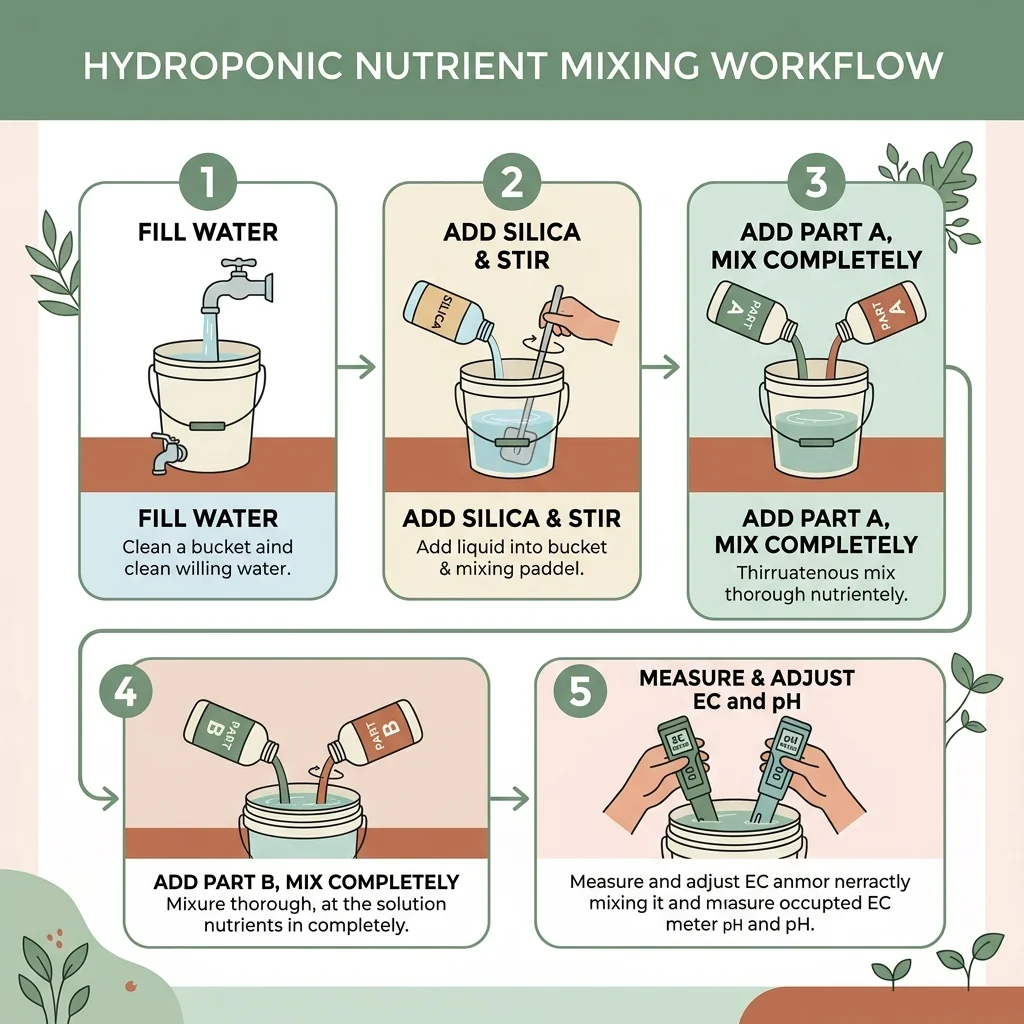
How to mix hydroponic nutrients: a beginner guide
Mixing hydroponic nutrients is simple once you know the order: water first, nutrients separately, measure EC, then adjust pH last. Here is the step-by-step.
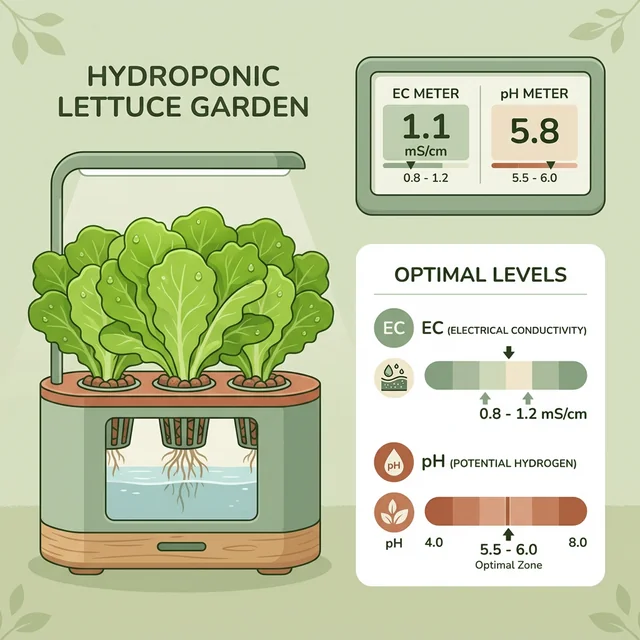
Hydroponic lettuce EC & pH chart: 0.8-1.2 and 5.5-6.0
Lettuce is the easiest crop to grow hydroponically, but it requires specific water chemistry. Use this beginner-friendly EC and pH guide to prevent tip burn and slow growth.
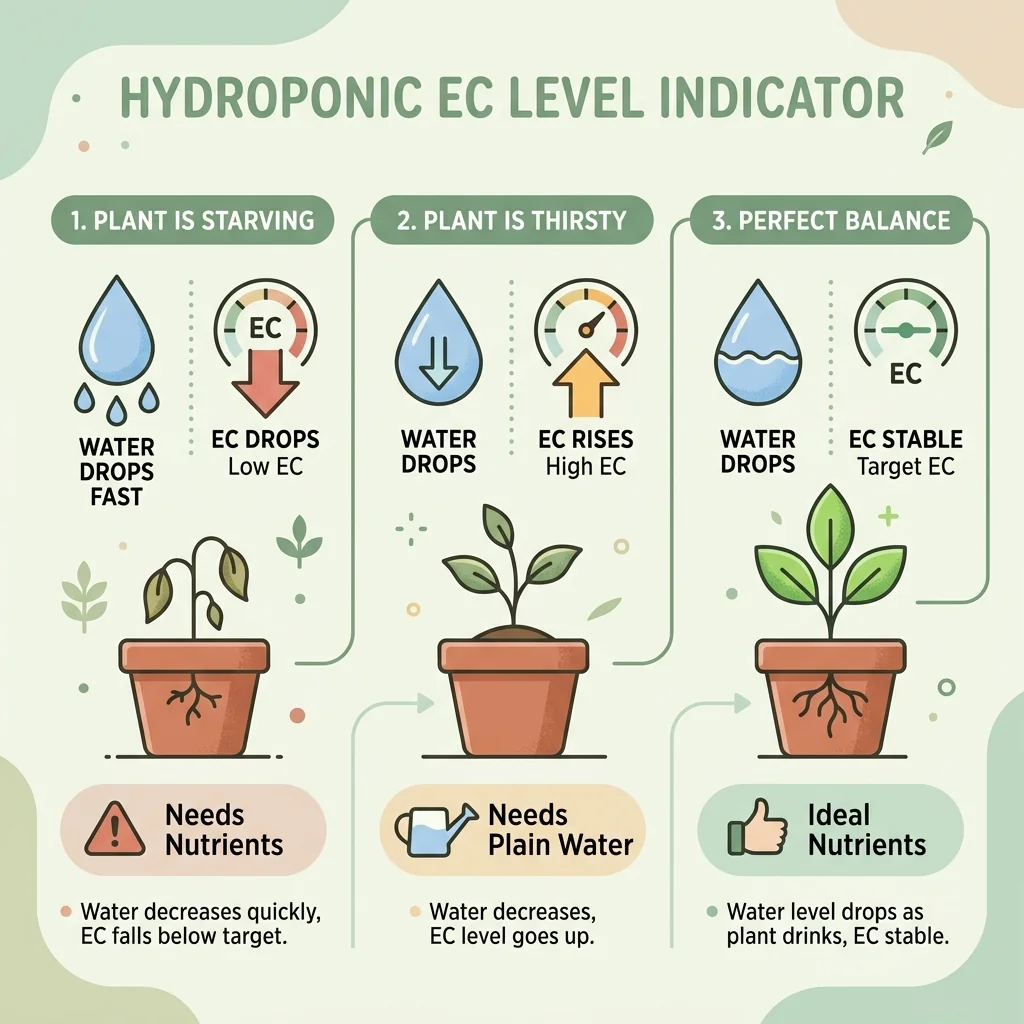
Hydroponic EC rising or falling: what it means
Your EC meter is a direct line of communication with your plants. By observing how the EC changes in relation to the water level, you can instantly determine if your plants are thirsty, starving, or perfectly balanced.