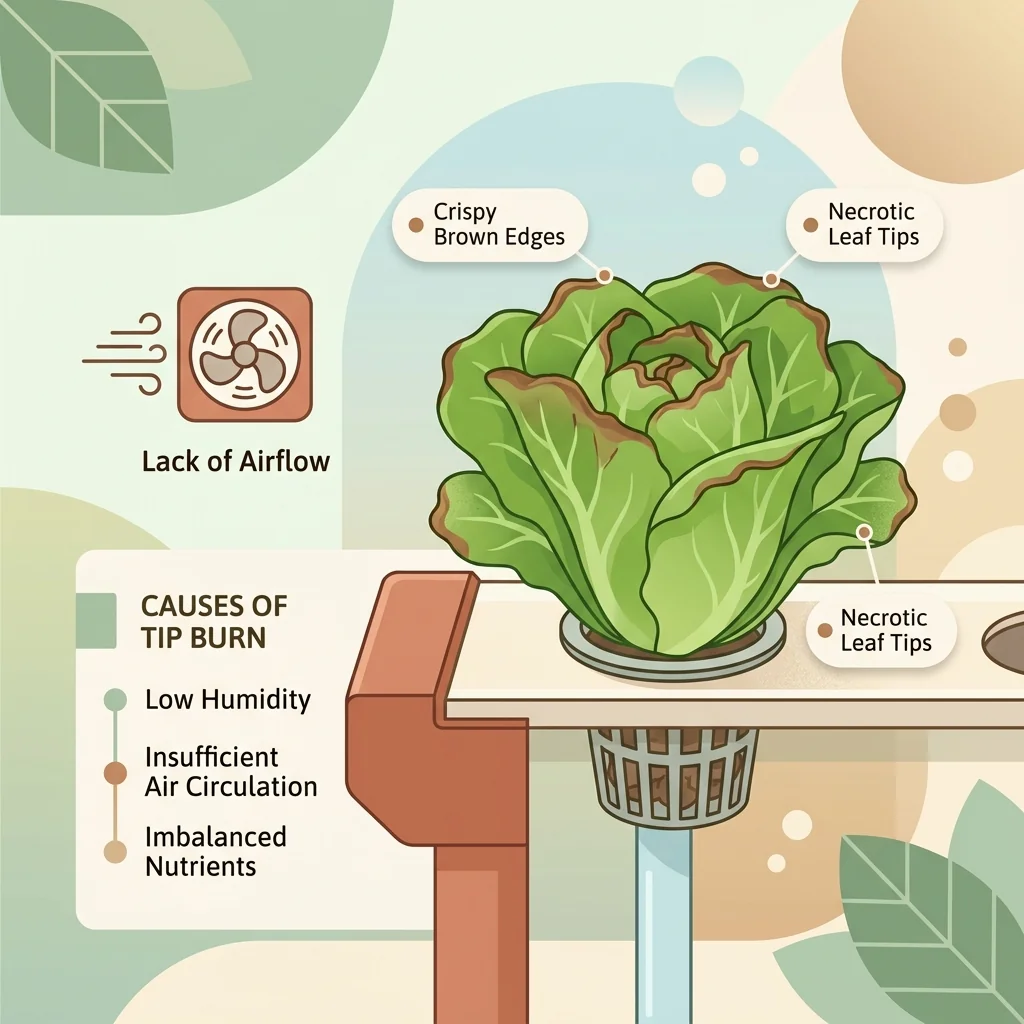
Is It Tip Burn or Root Rot?
| Symptom | Tip Burn (Airflow / Calcium Issue) | Root Rot (Pathogen / Oxygen Issue) |
|---|---|---|
| Location of Damage | Only on the very edges of the newest, innermost leaves. | Starts on the oldest, outermost leaves and works inward. |
| Leaf Texture | Crispy, dry, and papery brown. | Soft, slimy, yellow, and wilting. |
| Root Condition | Roots are bright white and smell like fresh vegetables. | Roots are brown, slimy, and smell like swamp mud. |
| The Fix | Point a small oscillating fan directly at the plants. | Change the reservoir, add hydrogen peroxide, and increase aeration. |
You have carefully measured your nutrients according to the Hydroponic Lettuce EC and pH Chart. Your lights are set perfectly. The lettuce is growing into a massive, beautiful green head.
But suddenly, you notice a terrifying detail. The very edges of the youngest, innermost leaves are turning black, crispy, and dead.
This condition is known as Tip Burn. It is the most common and most frustrating issue encountered by indoor hydroponic lettuce growers. When beginners see brown, dying leaves, their instinct is to panic, dump the reservoir, and completely change their nutrient formula.
This is a massive mistake. To fix tip burn, you don’t need new fertilizer. You need a fan.
The Biology of Tip Burn
To understand the cure, you must understand the underlying biology.
Tip burn is technically a Calcium deficiency. Calcium is the essential building block that plants use to construct cell walls. Without it, the new cells physically collapse and die, turning black and crispy.
But here is the critical catch: Calcium is an immobile nutrient.
When a plant absorbs a mobile nutrient (like Nitrogen), it can freely shuttle it around its vascular system to wherever it is needed most. Calcium cannot be shuttled. The only way a plant can move Calcium from its roots up to its top leaves is through Transpiration.
Transpiration is plant sweat. As water evaporates out of the pores (stomata) on the leaves, it creates a vacuum that pulls more water—and the Calcium dissolved in it—up from the roots.
Why the System Breaks Down
In an indoor environment, lettuce grows incredibly fast. The innermost, newest leaves are dividing cells at an explosive rate and desperately need Calcium.
However, because these leaves are curled tightly inside the center of the head, they are surrounded by a micro-climate of stagnant, 100% humid air. Because the air is completely saturated with moisture, the leaves cannot evaporate any water.
If they can’t evaporate water, transpiration stops. The “elevator” bringing Calcium up from the roots shuts down. The fast-growing cells run out of building materials, collapse, and die.
This is why tip burn almost never means your reservoir is broken (see When Should You Change Hydroponic Nutrient Solution?). It means your indoor environment is broken.
How to Fix Tip Burn
Do not immediately pour a bottle of Cal-Mag supplement into your reservoir. Fixing the environment is the only permanent solution.
1. Implement Aggressive Airflow
The primary cure for tip burn is wind. You must physically blow away that stagnant, humid micro-climate resting over the top of your plants. Purchase a small, oscillating clip-on fan and point it directly across the top canopy of your lettuce. The constant breeze will force the leaves to transpire, restarting the Calcium elevator from the roots. You should see the leaves gently trembling in the wind 24/7.
2. Lower the Room Humidity
If you are growing lettuce in an unventilated grow tent or a damp basement, a fan might just be blowing wet air around. Lettuce prefers a relative humidity of 40% to 60%. If your room is sitting at 80% humidity, transpiration physically cannot occur. Use an exhaust fan or a dehumidifier to dry the air out.
3. Check the Grow Lights
If your LEDs are sitting two inches above the lettuce canopy, you might be confusing tip burn with actual, physical heat burn. Furthermore, aggressive heat forces the plant to close its stomata to survive, which also stops transpiration. Review How Many Hours of Grow Lights Do Herbs Need? and ensure your lights are positioned at a safe distance.
4. The Last Resort: Lower Your EC
If you have a massive fan running, low humidity, and perfect lights, but you are still getting tip burn, your nutrient solution is too strong. If your EC is massive (e.g., 2.5+), the water is so salty that the plant struggles to pull it into the roots against the osmotic pressure. Dilute your reservoir down to an EC of 1.2 to 1.5. A lighter solution is physically easier for the plant to drink, increasing the volume of water (and Calcium) traveling up to the leaves.
Tip burn cannot be reversed on damaged leaves, but by adding a simple fan to your setup, you ensure every new leaf that emerges will be perfect, crisp, and fully green.
Diagnosing other lettuce issues?
If your entire plant is yellowing or collapsing, you are dealing with a more systemic problem than tip burn. Check these guides.
Common questions
Should I add a Cal-Mag supplement to my reservoir?
Usually, no. If your baseline EC is correct, there is already enough Calcium in the water. Adding more will unnecessarily raise your EC and potentially lock out Potassium. Fix your airflow first.
Are the brown, crispy leaves safe to eat?
Yes, they are entirely safe to eat, though the brown edges taste slightly papery and bitter. You can easily tear the burnt edges off before making a salad.
Can tip burn be reversed?
No. Once the tissue on the edge of the leaf dies and turns brown, it will never turn green again. You are fixing the environment to protect the *next* wave of new leaves from suffering the same fate.
Related guides
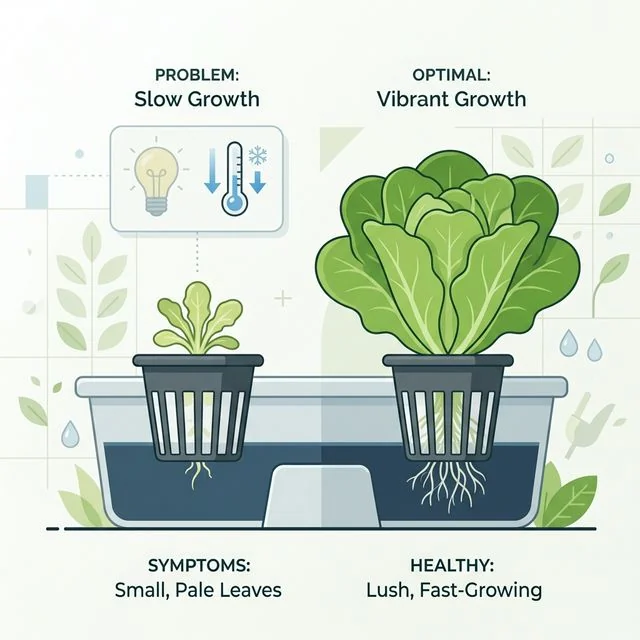
Hydroponic lettuce growing slowly? Check light, roots, and EC in order
Slow hydroponic lettuce is usually a systems problem, not a mystery deficiency. The goal is to find the bottleneck without overcorrecting five variables at once.
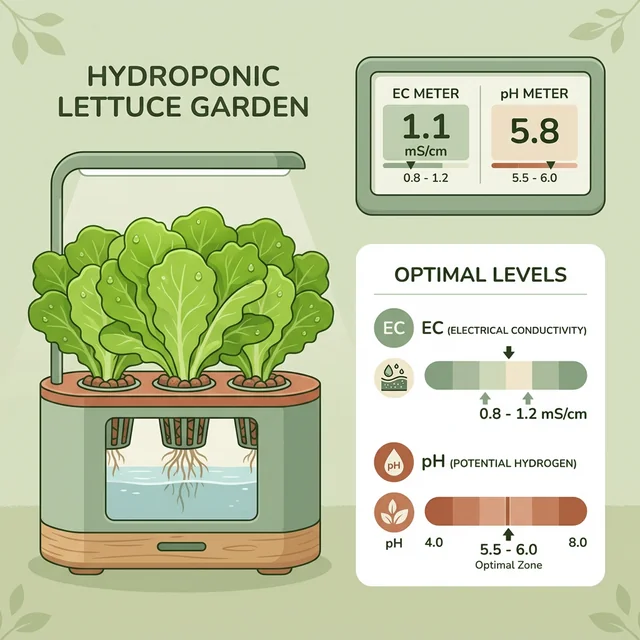
Hydroponic lettuce EC & pH chart: 0.8-1.2 and 5.5-6.0
Lettuce is the easiest crop to grow hydroponically, but it requires specific water chemistry. Use this beginner-friendly EC and pH guide to prevent tip burn and slow growth.
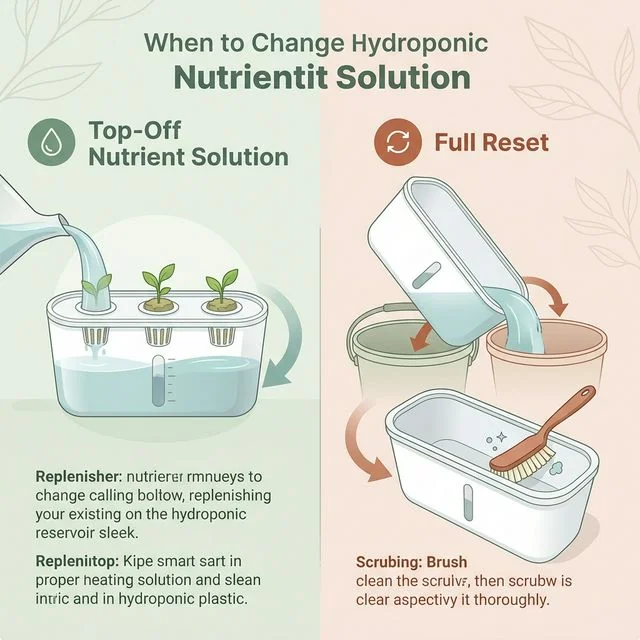
When to change hydroponic nutrient solution: top off vs full reset
A hydroponic reservoir should not be treated like a closed loop forever. This guide shows when a simple top off is enough and when a full reset is the safer move.