Troubleshoot the system before you change the inputs.
Symptoms
- Leaves droop or fold while the roots are sitting in nutrient solution
- Plants wilt in the afternoon heat and look better in the morning, or stay limp all day
- Roots look brown, soft or slimy, or smell sour when you lift a net pot
- Leaf edges are scorched or yellowing along with the wilt
Possible causes
- Low dissolved oxygen: a stopped or failing air pump, a clogged airstone, or a warm reservoir
- Pythium root rot or bacterial soft rot, both of which start as wilting
- A nutrient solution that is too concentrated, or EC that has crept up as water evaporated
- Hot, bright or very dry air around the leaves, or a solution level that has dropped below the roots
Quick fixes
- Pull one plant and inspect the roots before changing anything else
- Confirm the pump and airstone are running and the solution is actually touching the roots
- Measure EC and compare it with the target for your crop; dilute with plain water if it has risen
- Check the temperature of the solution and the air; shade or cool whichever is high
- Make one change at a time and give the plants time to respond before judging the result
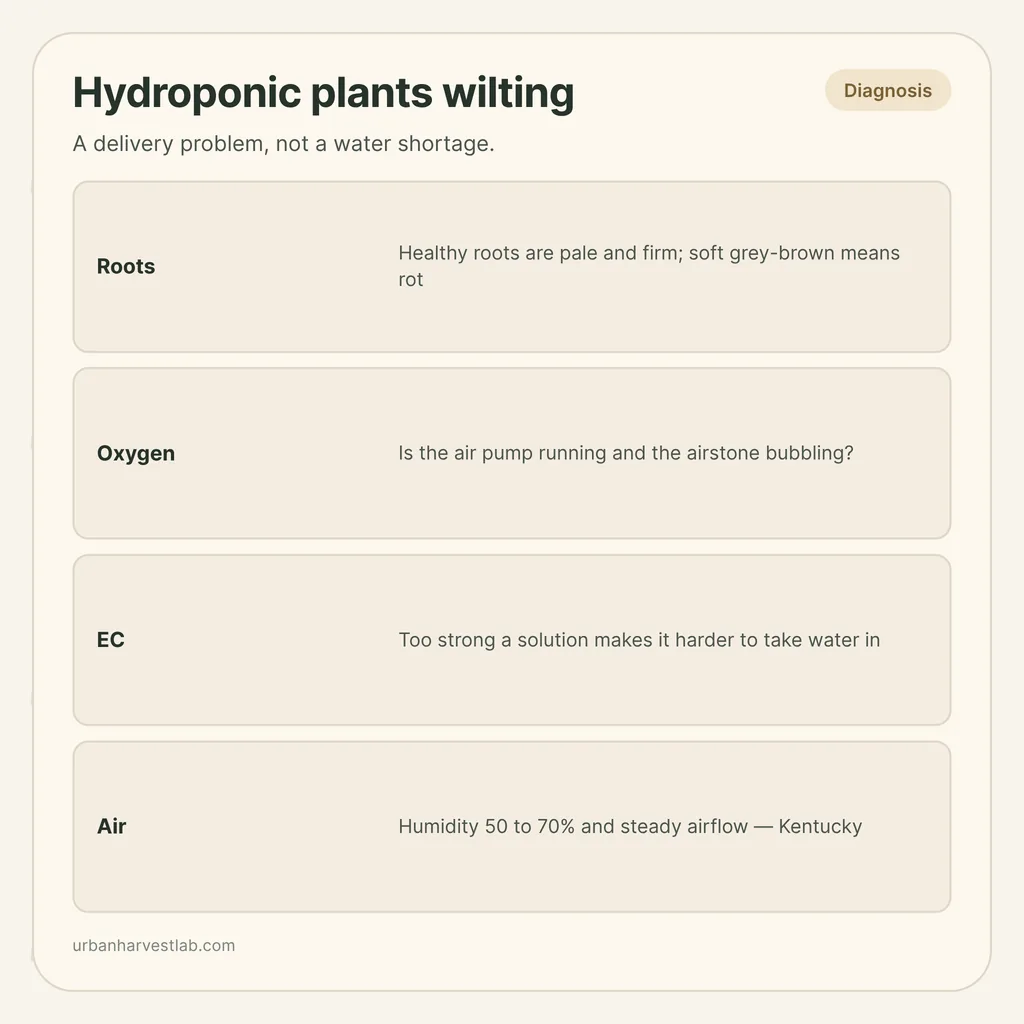
A hydroponic plant that wilts with its roots in water has a delivery problem, not a water shortage. Something stops the roots moving water up into the leaves: not enough oxygen, rot, a solution too strong, or air that pulls water out faster than the roots can supply it. Check the roots first, then the water, then the air, in that order.
Start with the one check that splits the problem in two. Lift a plant out of its net pot and look at the roots.
Step 1: Read the roots
Healthy roots are pale and firm. If yours are, rot is unlikely and you can move on to the water and air checks below.
If the roots are soft, mushy and grey-brown, the University of Kentucky describes the classic picture of Pythium root rot: roots that “become soft, mushy, and grayish-brown” while the outer layer sloughs off and leaves a thin core, the so-called rat tails. Its symptom list opens with “overall stunting or wilting”, so wilting is often the first thing you see, before the roots look obviously bad from above. Kentucky also lists bacterial soft rot, which begins “as wilting with pinkish brown discoloration of lower leaves” and favours warm, wet conditions above 77°F (25°C).
Brown does not always mean rotten, since staining from nutrients can darken healthy roots. The brown roots guide shows how to tell the two apart, and the root rot guide covers what to do once you are sure.
Step 2: Check that the roots are getting oxygen and water
Roots breathe. The University of New Hampshire puts it plainly: a plant that looks overwatered “is being suffocated by being deprived of oxygen at the roots for an extended period of time.” It adds that in stationary raft systems “aeration of the nutrient solution is critical.”
So before anything clever, go through the dull list.
- Is the air pump running, and is the airstone actually bubbling? A clogged or dead airstone looks fine from across the room.
- Is the pump moving solution in an NFT, drip or ebb-and-flow system? A stopped pump dries roots quickly in those designs, and the pump failure guide covers how fast each system fails and what to do.
- Has the solution level dropped so far that the roots hang in air?
- Is the reservoir warm? Warm water holds less oxygen and favours pathogens, though the water temperature guide and the dissolved oxygen guide explain how big that effect really is.
Cornell’s lettuce handbook gives a number for the oxygen floor: levels “should be greater than 4 ppm to prevent growth inhibition,” and “visible signs of stress may be observed at 3 ppm.” University of Florida suggests keeping small lettuce systems near 5 mg/L, with the solution between 65°F and 80°F. Without a meter you are judging by evidence: a working pump, a bubbling stone and a cool reservoir.
Step 3: Measure the EC
A solution that is too strong makes it harder for roots to take water in. Penn State Extension calls the result a chemical-induced drought: “you will see wilting of plants despite adequate irrigation.” Its description of excess soluble salts adds dark green foliage, dead and burned leaf margins, and eventually root death. Penn State writes this for growing media, but the link between salt load and wilting is the same reason to check a recirculating reservoir.
EC creeps up on its own. Cornell notes that EC “is increased when water is removed from the solution through the processes of evaporation and transpiration,” and that a high reading can be lowered by adding pure water. Subtract the EC of your tap water from the reading first, as Cornell advises, or you will chase a number that is partly your plumbing.
The reverse also exists. Penn State lists wilting among the signs of nitrogen deficiency, alongside light green foliage and stunting, and recommends watching solution EC to prevent it. A low reading with pale leaves points that way, and the EC rising or falling guide shows how to read the pattern against your water level. For the target to compare against, use the figure for your own crop rather than a generic one.
Step 4: Look at the air around the leaves
If roots, oxygen and EC all check out, the problem may be above the water. Leaves lose water through transpiration, and roots have to keep up.
Cornell’s handbook explains that humidity changes how much water a plant transpires: high humidity means “less cooling of the leaf surfaces,” and it also slows the movement of nutrients from roots to leaves. Kentucky recommends relative humidity of 50 to 70% for hydroponic lettuce and consistent airflow to keep transpiration and nutrient uptake going.
Heat is the other side. Cornell notes that above and below a plant’s preferred temperature range, “enzyme activity starts to deteriorate,” and plants become stressed. A plant that wilts only in the afternoon, then perks up overnight, usually points to heat, strong light or dry air rather than the roots. Shading the plants or moving a grow light further away will tell you quickly.
Change one thing at a time
Once you have a suspect, fix it alone. Restore the airflow, or dilute the EC, or cool the reservoir, then give the plants time to respond. If you correct three things at once and the plants recover, you have learned nothing about the cause, and it will return.
Wilting from a stopped pump or a short spike in EC can reverse. Roots that have already turned to grey-brown mush are damaged tissue, and the root rot guide covers when a plant is past saving.
Sources
- Penn State Extension, Hydroponics systems and principles of plant nutrition
- University of Kentucky Center for Crop Diversification, Hydroponic lettuce production in controlled environments
- Cornell University CEA Program, Hydroponic lettuce handbook
- University of New Hampshire Extension, Hydroponics at home
- UF/IFAS Extension, Growing lettuce in small hydroponic systems (HS1422)
Go deeper on each cause
Each of these guides owns one branch of the wilting checklist.
Common questions
Why are my hydroponic plants wilting when the roots are in water?
Because roots in water can still fail to move that water into the plant. Low oxygen at the roots, Pythium root rot, a nutrient solution that is too concentrated, and hot, dry air that pulls water out faster than roots deliver it can each produce a wilt. Check root colour first, then oxygen and EC, then the air.
Can too much fertilizer make hydroponic plants wilt?
Yes. Penn State Extension describes excess soluble salts in growing media as a chemical-induced drought, with wilting despite adequate water, dark green foliage, burned leaf margins and root death; the same salt-load effect is why you check the EC of a reservoir. Measure the solution EC and compare it with the target for your crop.
How low does dissolved oxygen have to be before plants show stress?
Cornell gives a figure for lettuce: oxygen above 4 ppm to avoid growth inhibition, with visible signs of stress possible at 3 ppm. If you do not own an oxygen meter, judge by whether the air pump is running, the airstone is bubbling and the reservoir is warm.
Will a wilted hydroponic plant recover?
It depends on the cause and on how long the roots were affected. Wilting from a stopped pump or a brief spike in EC can reverse once the cause is fixed, but roots that have turned soft and grey-brown from Pythium are damaged tissue, and the plant may not come back.
Related guides
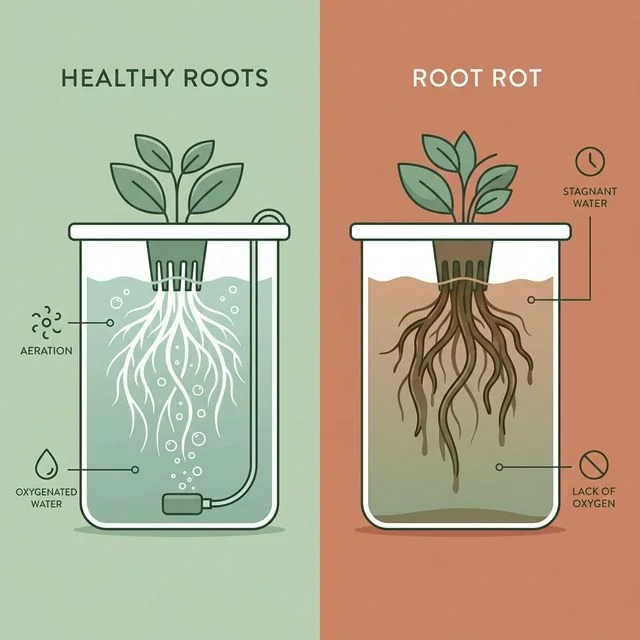
Hydroponic root rot: how to spot it early and stop it
Brown, slimy or swampy-smelling roots mean root rot. Catch it early and fix the conditions behind it — warm water, low oxygen and stagnant flow.
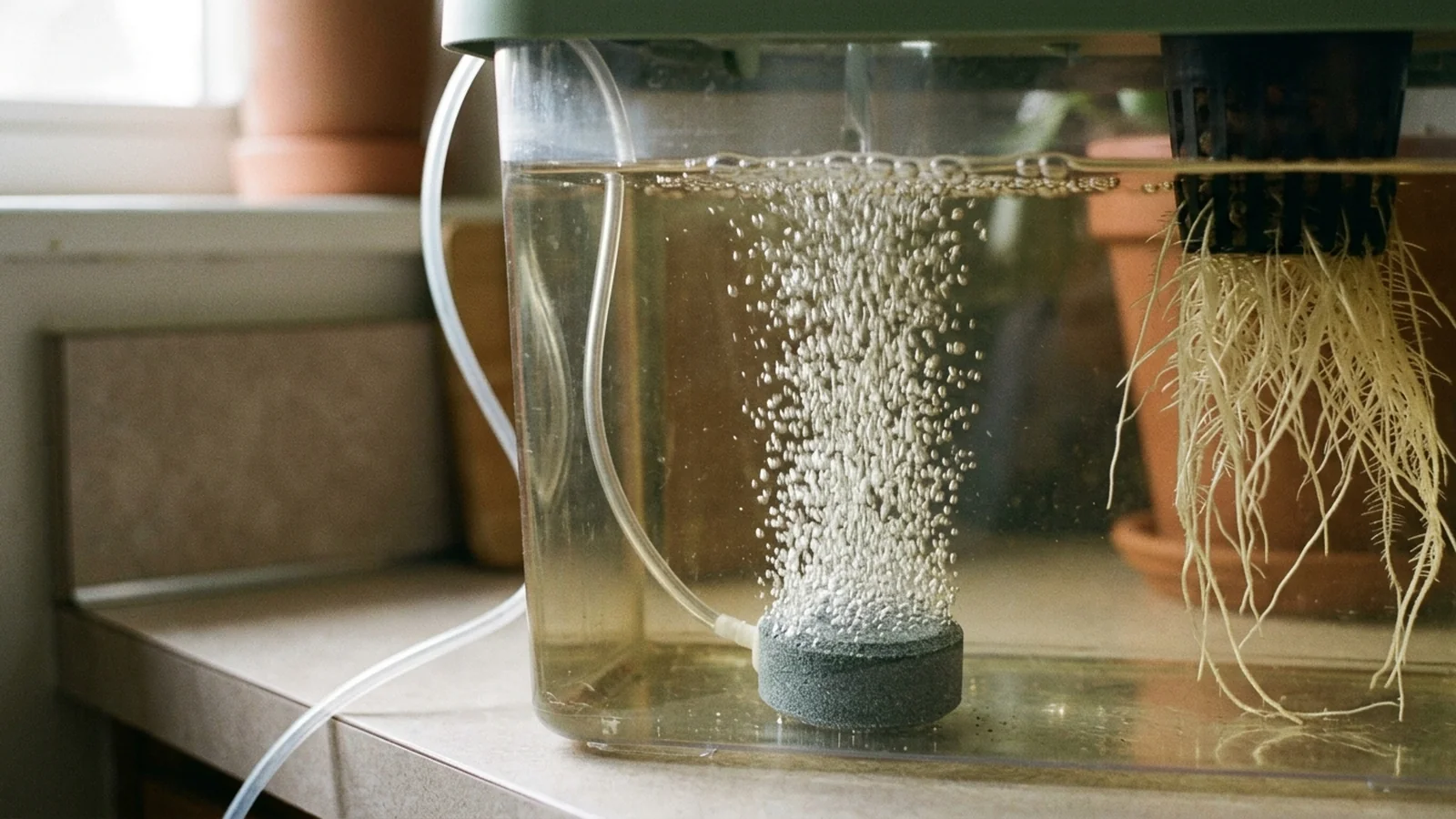
Dissolved oxygen in small hydroponic systems
Roots breathe oxygen dissolved in the water around them, not the air above it. Here are the actual targets, what temperature really does to that oxygen, and how to check yours without a lab meter.
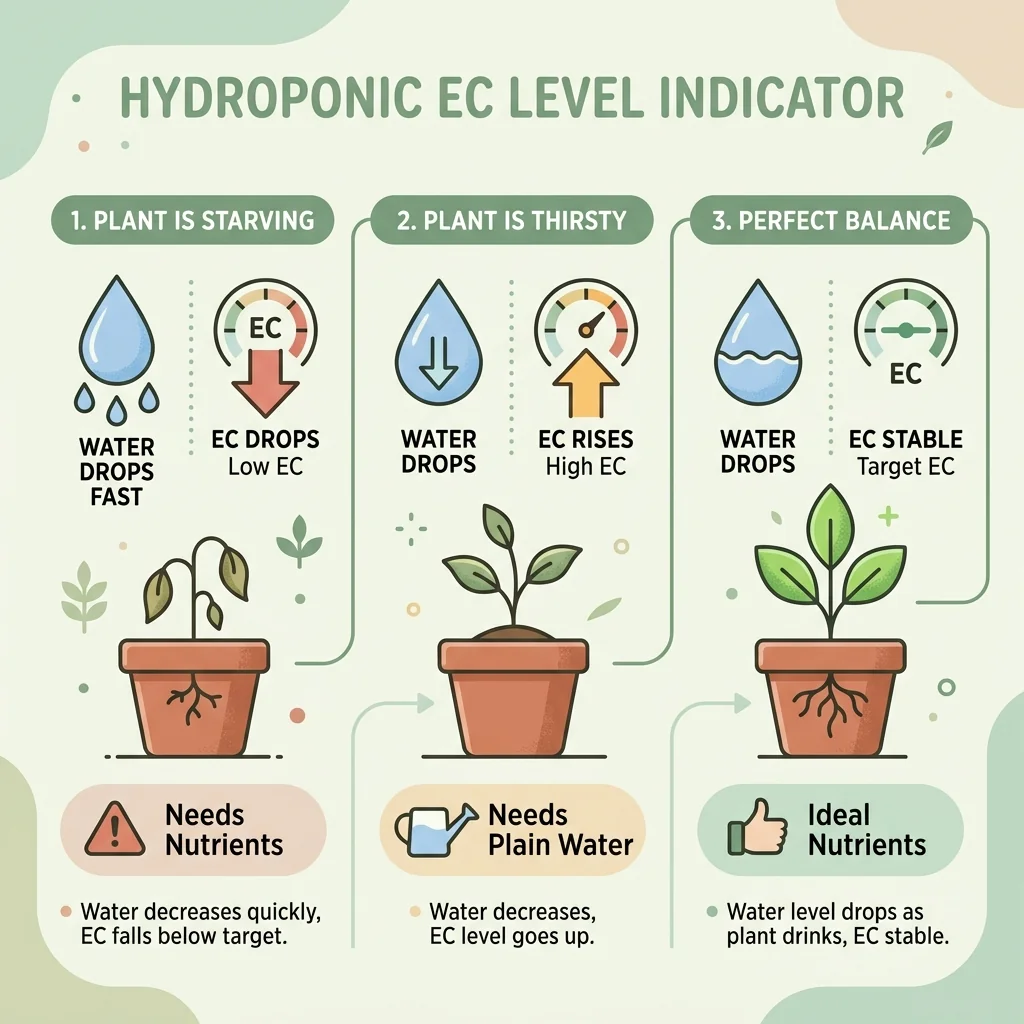
Hydroponic EC rising or falling: what it means
Your EC meter is a direct line of communication with your plants. By observing how the EC changes in relation to the water level, you can instantly determine if your plants are thirsty, starving, or perfectly balanced.