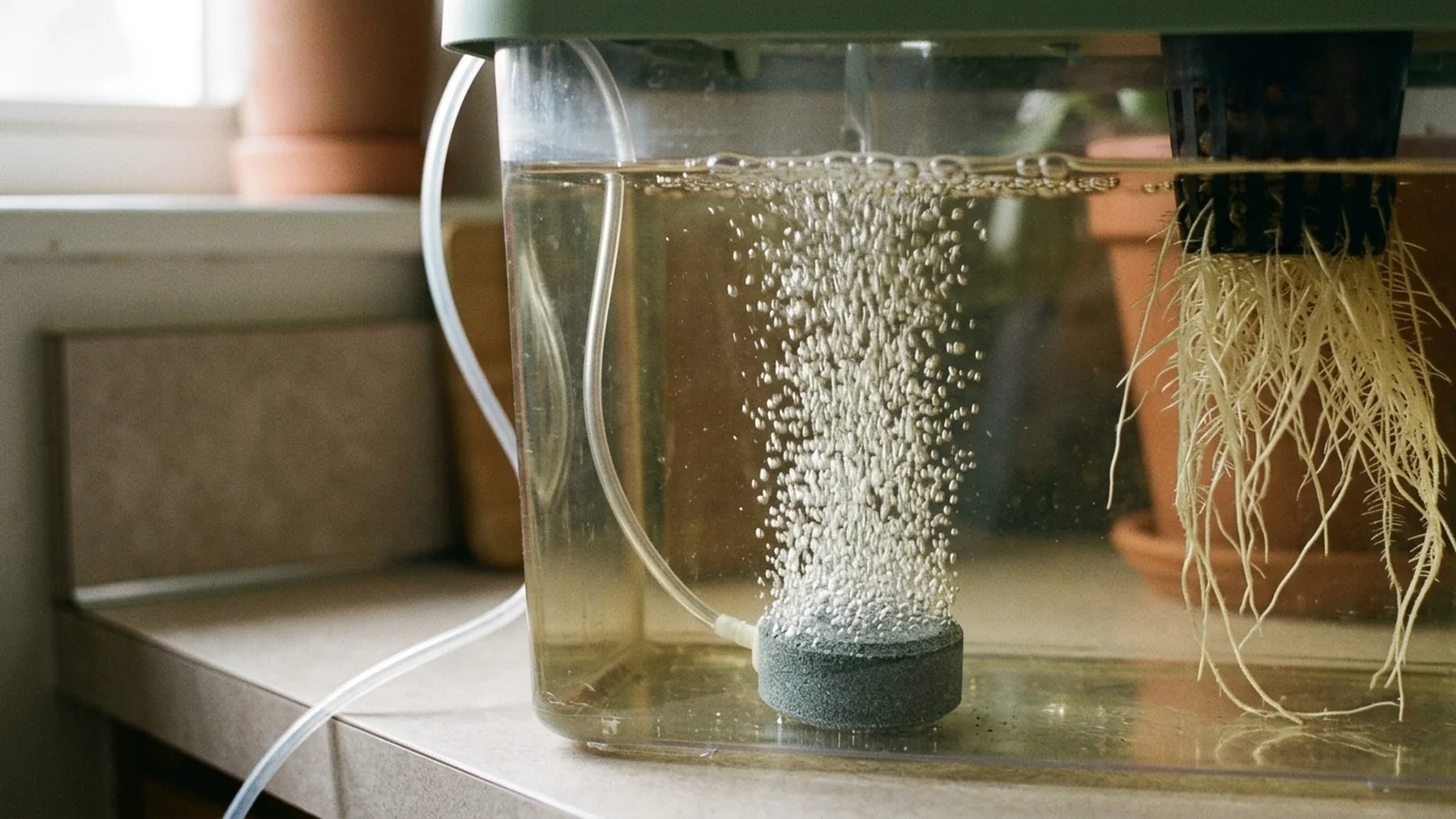
Dissolved oxygen targets for small hydroponic systems
| Level or system | Dissolved oxygen | Source |
|---|---|---|
| Viable minimum for lettuce | About 4 ppm | Cornell University; visible stress appears near 3 ppm |
| Comfortable working target | 6 to 8 ppm | University of Missouri Extension (above 6 ppm) and University of Kentucky (6-8 ppm for DWC) |
| Small home lettuce systems | 5 mg/L | University of Florida IFAS Extension |
| NFT reservoirs | No added aeration typically needed | University of Kentucky: the continuous thin film already contacts air |
Roots absorb oxygen from the water touching them, not from the air in the room, and small hydroponic systems can fall short of what a crop needs long before anyone notices. Lettuce grows satisfactorily at a dissolved oxygen (DO) level of at least 4 ppm, with visible stress appearing near 3 ppm, according to Cornell University’s hydroponic lettuce handbook. University of Missouri Extension puts the optimum above 6 ppm, and warmer water does hold less of it — but not nearly as little as it is sometimes made out to.
How roots take up oxygen from water
Roots respire the same way the rest of the plant does: they take in oxygen and release carbon dioxide, and that process drives nutrient and water uptake. In soil, air pockets between soil particles supply that oxygen even when the ground is moist. A hydroponic root has no soil pockets to draw on, so whatever oxygen the water is carrying is the entire supply.
That is why dissolved oxygen sits alongside EC and pH as one of the three numbers that describe a nutrient solution’s condition, covered in more detail on hydroponic nutrient basics. Low DO does not usually kill a plant outright. It shows up first as slower nutrient uptake, then as stalled growth, and then as the conditions that let root pathogens take hold.
Target dissolved oxygen levels for small systems
Four extension services publish DO targets and they do not agree on one number, but they cluster tightly. Cornell’s set-point for hydroponic lettuce is 7 mg/L, usually maintained around 8 ppm, with a range of 7 to 10 ppm and no measurable benefit from pushing higher — reached using injected pure oxygen in its commercial ponds. Cornell is explicit that an air pump and aquarium air stone will not reach the DO levels pure oxygen injection can, so Cornell’s 8 ppm is not the benchmark a home system should be judged against — the University of Kentucky’s 6 to 8 ppm for an aerated deep water culture bucket is. University of Missouri Extension calls anything above 6 ppm optimum for hydroponic production and notes that low oxygen both slows growth and raises ethylene production in the plant. The University of Kentucky gives 6 to 8 ppm as the target for deep water culture specifically, reached with a standard air pump and air stone. University of Florida’s IFAS Extension, writing for small home hydroponic lettuce systems rather than commercial ponds, sets the bar lower, at 5 mg/L.
Put together: 4 ppm is the floor below which lettuce growth is compromised, 5 to 6 ppm is a reasonable minimum to aim for in a small system, and 7 to 8 ppm is where the commercial targets sit with room to spare. An unaerated reservoir left to itself can fall close to 0 ppm, per Cornell’s own pond data — which is the outcome all of this is trying to avoid, not a level anyone should expect to see day to day in a maintained system.
The solubility curve, and how big the effect really is
This is the part that gets overstated. Warmer water does hold measurably less dissolved oxygen at saturation, and the U.S. Geological Survey publishes the relationship directly, as milligrams of oxygen per litre of fresh water at full saturation and near sea-level pressure. Dissolved salts lower oxygen solubility further, so a fertilised nutrient solution sits slightly below these fresh-water numbers:
| Water temperature | Dissolved oxygen at saturation |
|---|---|
| 10°C (50°F) | 11.3 mg/L |
| 18°C (64°F) | 9.4 mg/L |
| 20°C (68°F) | 9.1 mg/L |
| 24°C (75°F) | 8.4 mg/L |
| 27°C (81°F) | 7.9 mg/L |
| 30°C (86°F) | 7.5 mg/L |
| 32°C (90°F) | 7.3 mg/L |
Read across that table and the actual size of the effect becomes clear. Moving from 18°C to 27°C costs about 16% of the water’s oxygen-carrying capacity — a real drop, but a partial one. At 27°C, saturated water still holds 7.9 mg/L, above the 4 ppm floor for lettuce, though below the 8 ppm level Cornell reaches by injecting pure oxygen into its commercial ponds. University of Missouri Extension’s own worked example makes the same point from a different angle: even at 35°C (95°F) with an EC of 5 dS/m, the oxygen ceiling is 6.85 ppm, not zero. Warm water is a real constraint on how much oxygen a pump can dissolve into it, not a wall that stops oxygen from being present at all. The common framing that warm water simply cannot hold oxygen, so no pump can help, does not survive this table — the physical ceiling drops, but it does not collapse. Hydroponic water temperature for lettuce covers what that means for keeping a reservoir in range.
Why a warm reservoir still causes trouble
If the physics only cost 16%, why do warm reservoirs so reliably correlate with root problems? Because temperature does not only touch the supply side of the equation — it raises demand at the same time. Roots, algae and bacteria all respire faster as temperature climbs, so a warm reservoir is drawing down its slightly-smaller oxygen budget faster than a cool one, not starting from an empty one. The University of Kentucky’s disease-temperature data shows the pattern directly: bacterial soft rot favours warm, wet conditions above 77°F (25°C), and bottom rot from Rhizoctonia is most active between 77°F and 95°F (25 to 35°C) — the same range where oxygen demand is climbing and supply is falling, together.
Pythium, the water mould behind hydroponic root rot, favours exactly that combination — warm, stagnant, oxygen-poor water — and the University of Kentucky notes its optimal temperature is species-dependent. Diagnosing whether roots are already affected, and what to do about it, is covered on staining versus root rot and preventing hydroponic root rot. Keeping a warm reservoir moving and aerated matters more, not less, than it would in a cool one — the margin between supply and demand is thinner.
Aeration needs by system type
Aeration needs are not the same across hydroponic system types, and matching the two avoids both under- and over-engineering a small setup.
Nutrient film technique reservoirs typically need no added aeration at all: the University of Kentucky notes that the thin, continuously moving film of solution already contacts air across its whole surface as it flows. Deep water culture is the opposite case — roots sit fully submerged in standing water, so it needs an air pump and air stone to reach the 6 to 8 ppm range the University of Kentucky and Virginia Cooperative Extension both call for. Deep water culture in small spaces covers the practical side of setting that up.
Passive Kratky systems solve the same problem without electricity, by keeping roughly one-third to one-half of the root mass submerged and letting the rest sit in the humid air gap above the waterline, per University of Minnesota Extension guidance. That is a proportional rule, not a fixed gap measurement, and it is worth getting right — the Kratky method explains how the water level is meant to fall over the crop cycle. Stationary raft and float-bed systems sit in between: University of New Hampshire Extension notes that added aeration measurably improves crop health and yield even in systems where the solution’s own movement might otherwise be sufficient. Drip and ebb-and-flow systems draw oxygen from the air space in the growing substrate between irrigations rather than from the solution itself, per the University of Kentucky — ebb-and-flow basics covers how that cycle is timed.
None of this determines whether buying a pump is worth it for your particular setup — that decision, including cost and noise, is covered in full in the air pump buying guide. What matters here is simply that an air pump is not a universal requirement; it is a fix for a specific gap between how much oxygen your system’s geometry naturally provides and how much your crop and its rootzone community are actually using.
Measuring dissolved oxygen without a lab meter
Dedicated dissolved-oxygen meters are the real gap in home monitoring: University of Missouri Extension prices them at more than $500 (2025 US figures), well above the $100 to $500 Oklahoma State University Extension gives for a combination EC/pH meter (2017 US figures), covered in the EC and pH meter guide. Cornell’s commercial operation calibrates its DO sensors daily, which is a reasonable cadence for anyone running one, but it is not the entry point for most small systems.
In practice, three proxies do most of the useful work without a meter. Reservoir temperature is the leading indicator, since it drives both the solubility ceiling and the oxygen demand discussed above — a thermometer clipped to the reservoir costs a fraction of a DO meter and tells you when to pay closer attention. Visible water movement is the second: bubbling from an air stone, or a visibly flowing film in NFT, is a sign oxygen is actively being replenished rather than slowly consumed. Root appearance is the third and most direct: healthy roots in an adequately oxygenated system stay pale and keep extending; roots that turn brown, slimy or mushy are the clearest sign that oxygen has fallen behind demand somewhere in the system.
Sources
- USGS Water Science School — Dissolved Oxygen solubility table (TWRI Book 9, Chapter A6.2)
- Cornell University CEA Program — Hydroponic Lettuce Handbook
- University of Missouri Extension G6984 — Hydroponic Nutrient Solutions
- University of Kentucky CCD-CP-63 — Hydroponic Lettuce Production in Controlled Environments
- UF/IFAS Extension HS1422 — Growing Lettuce in Small Hydroponic Systems
- University of Minnesota Extension — Small-scale hydroponics
- Oklahoma State University Extension HLA-6722 — Electrical Conductivity and pH Guide for Hydroponics
- Virginia Cooperative Extension SPES-464 — Hydroponic Production of Edible Crops: Deep Water Culture (DWC) Systems
- University of New Hampshire Extension — Hydroponics at Home
Match aeration to your system
Whether you need a pump at all, and what to do if roots are already showing oxygen stress, depend on which system you are running.
Common questions
What is a good dissolved oxygen level for a small hydroponic system?
Aim for at least 5 to 6 mg/L, and treat 7 to 8 mg/L as a comfortable target. University of Missouri Extension calls anything over 6 ppm optimum for hydroponic production, the University of Kentucky gives 6 to 8 ppm for deep water culture, and Cornell University runs its lettuce ponds at a 7 mg/L set-point, with crop failure showing up below 3 ppm. University of Florida's IFAS Extension states a target of 5 mg/L for small home hydroponic lettuce systems.
Does warm water really run out of oxygen in hydroponics?
Not in the way it is sometimes described. The U.S. Geological Survey's solubility data shows saturated fresh water at 27°C (81°F) still holds 7.9 mg/L of dissolved oxygen, above the 4 ppm minimum Cornell University gives for lettuce and above the 5 to 6 ppm floor a home system with a standard air pump can realistically reach. Going from 18°C to 27°C costs about 16% of the water's oxygen-carrying capacity, not all of it. The real problem with a warm reservoir is rising demand from roots, algae and bacteria, and faster pathogen growth, not the water's physical capacity to carry oxygen.
Do I need an air pump to keep dissolved oxygen high enough?
It depends on the system. Nutrient film technique needs none, because its thin, moving film already contacts air. Deep water culture needs an air pump and air stone to reach the University of Kentucky's 6 to 8 ppm target, since the roots sit fully submerged. Passive Kratky setups use a partly-submerged root zone instead of a pump. The full buy-or-skip decision for your setup is in the air pump guide.
How can I check dissolved oxygen without an expensive meter?
Dedicated dissolved-oxygen meters typically cost more than $500, per University of Missouri Extension, which puts them out of reach for most home growers. Track the proxies instead: reservoir temperature, how visibly the water is moving or bubbling, and root appearance. Roots that stay pale and keep growing are getting enough oxygen; roots that turn brown, slimy or mushy are usually a low-oxygen signal worth investigating.
Related guides
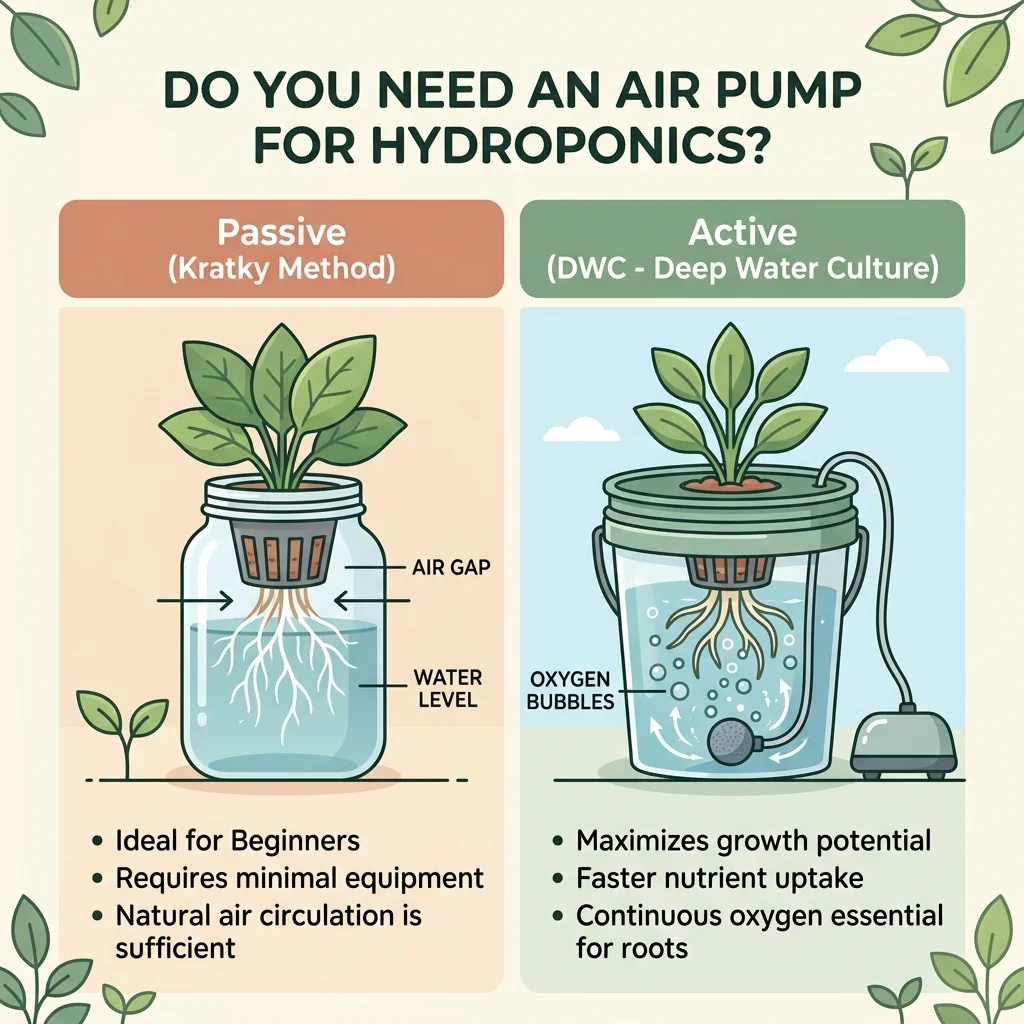
Do you need an air pump for hydroponics?
If you search for hydroponic tutorials, you will see a maze of air pumps, plastic tubing, and bubbling airstones. But do you actually need electrical aeration to grow plants in water? Here is the science of passive vs. active hydroponic setups.
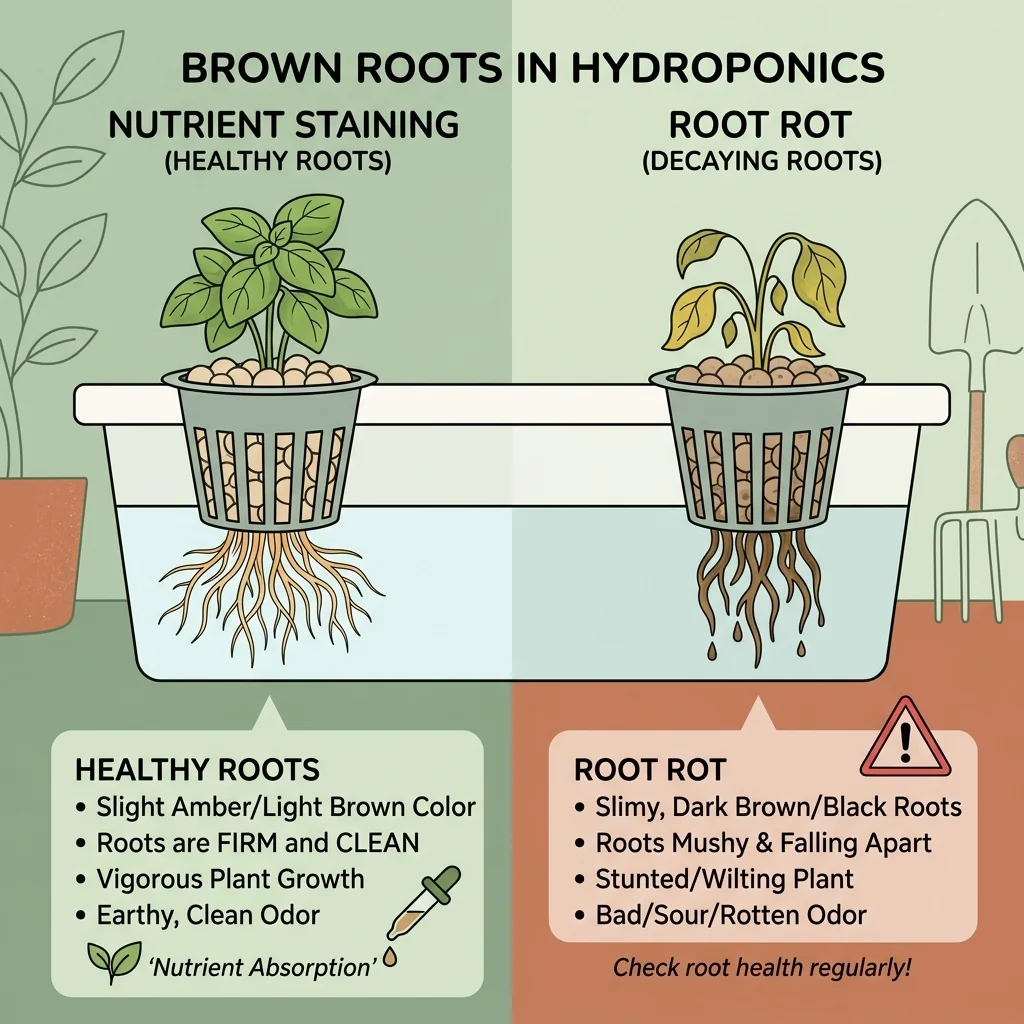
Brown roots in hydroponics: staining vs. root rot
Finding brown roots in your hydroponic reservoir can cause instant panic. But before you dump your nutrients, you need to know: is it a harmless stain or a fatal infection? Here is how to diagnose the difference in seconds.
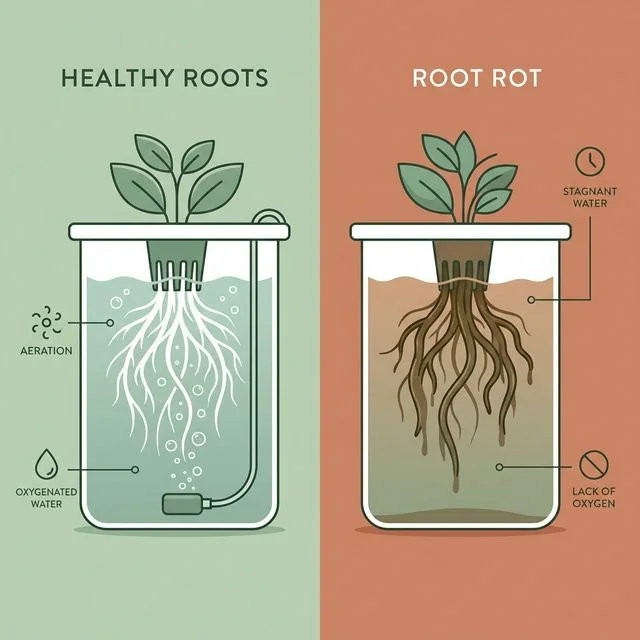
Hydroponic root rot: how to spot it early and stop it
Brown, slimy or swampy-smelling roots mean root rot. Catch it early and fix the conditions behind it — warm water, low oxygen and stagnant flow.