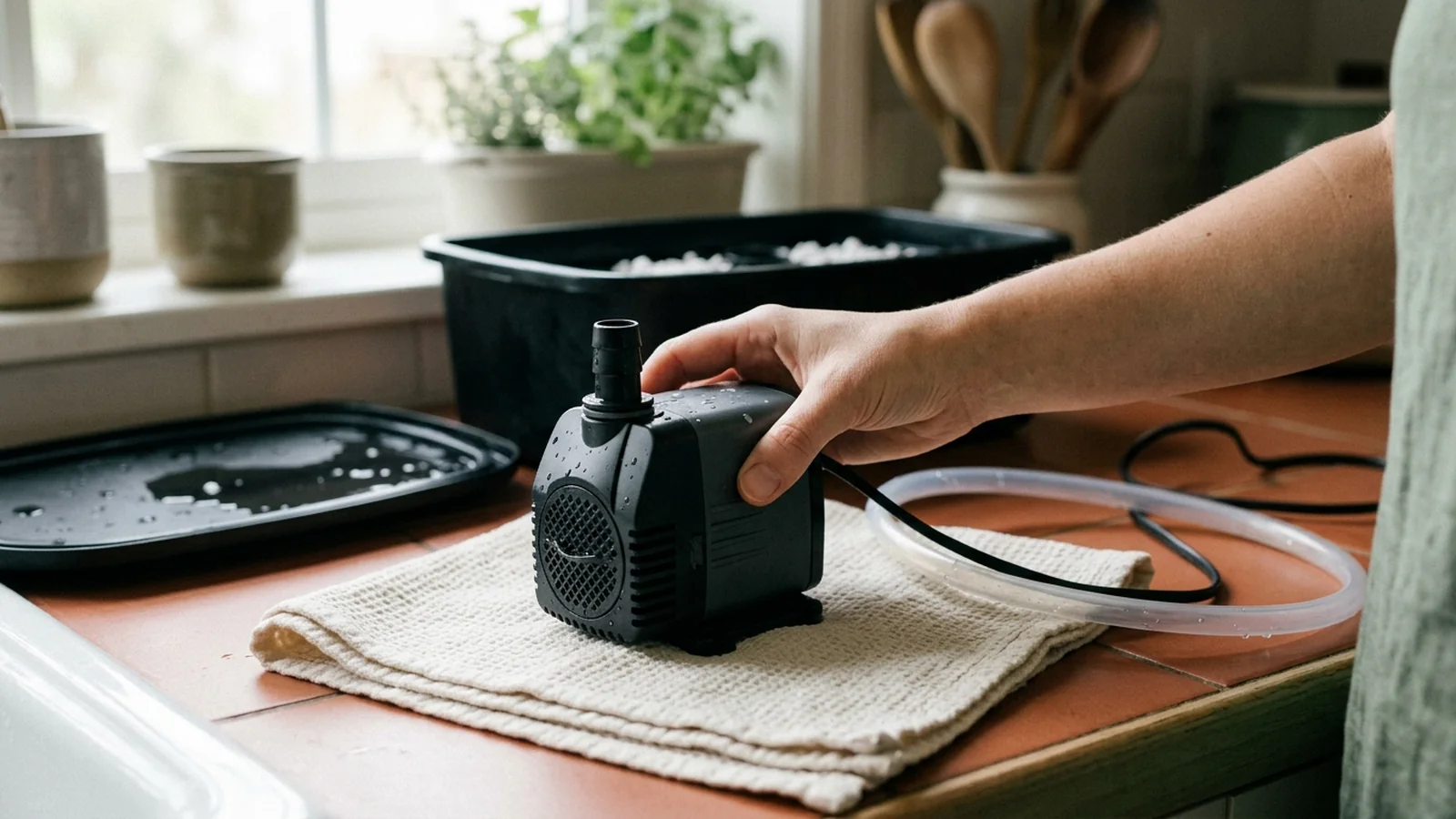
What a stopped pump actually does, by system
| System | What the pump does | What happens when it stops |
|---|---|---|
| NFT / drip | Delivers solution to the root zone; NFT as a thin film, drip through emitters into substrate | Flow stops immediately; University of Kentucky calls the result rapid dry out |
| DWC | Aerates a static reservoir the roots stay submerged in | Roots stay wet; dissolved oxygen falls, faster in warm water |
| Kratky | No pump exists in the water path | Nothing changes; the air gap keeps supplying oxygen on its own |
A hydroponic pump failure does not threaten every system the same way. What determines the outcome is whether the pump moves water or only moves air, and how much reserve the system holds once it stops. NFT has almost none; drip has a little more, buffered by the substrate. A DWC bucket has more still, but on a different clock. The Kratky method has no pump at all. That difference is the whole plan.
Two different kinds of “pump,” two different failures
Ask whether the pump in question moves water or moves air, because the failure mode is not the same.
In NFT and drip systems, the pump is the water supply. It circulates the nutrient solution through channels or tubing so the roots keep receiving fresh liquid — a thin film moving continuously in an NFT channel, solution delivered through emitters into the substrate in a drip system. Stop the pump, and that supply stops in both, though NFT’s bare film leaves less reserve than drip’s damp substrate does — see do you need an air pump for hydroponics? for how these active systems differ from a passive one in the first place.
In DWC, the pump is an air pump, and the water does not move regardless. Roots hang in a static reservoir the whole time; the pump’s only job is pushing air through a diffuser to keep that reservoir oxygenated. When it stops, the roots are still wet. What changes is how much oxygen is left in the water they’re sitting in, and that runs down on its own timetable. The small-space DWC build guide covers sizing and placement decisions that affect how much margin a given bucket has.
Kratky has neither. There is no pump anywhere in its water path, so nothing stops when the power does.
Why NFT and drip fail fastest
University of Kentucky’s hydroponic lettuce guide is blunt about this: in NFT and drip systems, “system failure will cause rapid dry out.” The reason is structural, not incidental — Kentucky describes NFT as a low-volume method built around a thin film rather than a standing pool of water, which is exactly what makes it water-efficient and exactly what removes any buffer when the flow stops. Drip earns the same “rapid dry out” verdict but a different classification: Kentucky ranks it as moderate volume, since water held in the substrate around each emitter gives a little more grace than NFT’s bare film — real time, but nothing close to DWC’s standing reservoir of more than 4 litres per plant. University of Minnesota Extension adds a related failure mode for NFT specifically: if the water level in the reservoir itself falls below the pump intake, the pump can be damaged as well as starved, which turns a temporary interruption into an equipment problem on top of a dry-out problem.
Minnesota’s broader point about complex, powered systems is worth carrying into any plan: their major disadvantage, next to a simple passive setup, is dependence on pumps and electricity during a power outage. That dependence is not a flaw specific to one brand of pump — it is the tradeoff every active system makes for faster growth and higher density.
Why DWC buys more time, and what actually runs out
The University of Kentucky’s figure for float-bed DWC systems is more than 4 litres (roughly a gallon) per plant — a real body of water the roots stay submerged in whether the air pump is running or not. That volume is the source of DWC’s extra margin over NFT, but it is margin against a different threat: dissolved oxygen, not water supply.
The mechanism is not the one most growers assume. Warm water holds somewhat less oxygen, but U.S. Geological Survey solubility data puts the drop from 18°C to 27°C at about 16%, not a collapse — the full solubility picture is in dissolved oxygen in small hydroponic systems. University of Kentucky Extension puts an aerated DWC bed at 6-8 ppm, and Cornell reports lettuce still growing satisfactorily down to about 4 ppm, with visible stress at 3 ppm and crop failure below it. In other words, the solubility ceiling on its own is not usually what kills a DWC system. The real risk is a still reservoir where root and microbial consumption outpaces the slow resupply that happens without active aeration, and that consumption runs faster in warm water. A cool, shaded, well-sized reservoir gives you longer before that balance tips than a small, warm one does — which is also why the water temperature guide and the root rot prevention guide both treat heat as the variable to control, not the pump itself.
Kentucky, Minnesota, Cornell and the USGS data above give the mechanism and the direction, not an hour count for any crop or reservoir size: bigger and cooler is slower to tip, smaller and warmer is faster. Watching your own roots and your own thermometer tells you more about your margin than a figure measured for a different reservoir ever could.
Kratky: the one system a pump failure cannot reach
The Kratky method is the one genuine exception in this comparison, and the reason is structural rather than a matter of degree: there is no pump, air stone, or powered part anywhere in its water path. A Kratky jar keeps a portion of the roots submerged in still solution and a portion suspended in the humid air gap above it — University of Minnesota’s rule of thumb is roughly one-third to one-half of the root mass submerged, with the rest breathing the air gap directly. That gap does the job an air pump does in DWC, and it does it without electricity, which is exactly why a power outage that stops every pump in the house leaves a Kratky jar unaffected.
That is not a reason to run every crop passively — Kratky has its own limits around scale, crop duration, and topping up, covered in the system comparison for beginners — but among the four systems compared here, it is the only one that was not depending on a pump in the first place.
The plan for the first few minutes
- Confirm it’s actually the pump. Check the outlet, a tripped breaker or GFCI, a kinked or disconnected line, and a clogged airstone or intake before assuming the unit itself has failed. A pump that looks dead is often just blocked.
- For NFT or drip, restore water to the roots by hand while you diagnose. Neither system holds much reserve, so the priority is getting solution back to the channel or substrate — pour it in manually, prop the channel to pool water at the root zone, or run a backup pump — rather than spending the first few minutes troubleshooting the original unit.
- For DWC, prioritize aeration over speed. The water is still there. Agitating the surface, swapping in a spare air pump, or temporarily adding an aquarium-style battery-powered airstone buys time that a frantic restart attempt does not. A second air outlet or a spare pump kept on hand turns one failed part into an inconvenience instead of a loss.
- Once flow or aeration is restored, inspect the roots before assuming the plant is fine. Look for the signs covered in the root rot guide — colour, firmness, and smell all tell you more than the clock does about what the plant actually experienced.
- Build in redundancy where the stakes are highest. A larger, cooler DWC reservoir and a spare pump or check valve reduce how often step 2 or 3 happens at all; the small-space DWC guide covers placement and sizing choices that widen this margin before a failure ever occurs.
Before the next outage, time your own reservoir: watch how long it takes the water level to drop from full to the pump intake.
Sources
- University of Kentucky Center for Crop Diversification CCD-CP-63, “Hydroponic Lettuce Production in Controlled Environments”
- University of Minnesota Extension, “Small-scale hydroponics”
- Cornell University CEA Program, “Hydroponic Lettuce Handbook”
- USGS Techniques of Water-Resources Investigations Book 9, Chapter A6.2, “Dissolved Oxygen”
Build a system that fails safely
These guides cover the aeration and water-quality decisions that determine how much margin a system has before a pump matters.
Common questions
How long can a hydroponic system go without power?
It depends entirely on which system you run. NFT and drip channels lose their water supply outright when the pump stops, so the University of Kentucky says the result is rapid dry out. DWC keeps its roots submerged and fails on falling oxygen instead, which is slower and depends on water temperature and reservoir size. Kratky has no pump to fail.
Does a DWC bucket need power to survive?
The water itself does not drain away when a DWC air pump stops, because the pump only aerates; it does not move water. The roots stay wet, but dissolved oxygen falls as the plant and any microbes in the reservoir keep consuming it faster than still water resupplies it.
Which hydroponic system handles a power outage best?
The Kratky method, because it has no pump, air stone, or powered part in its water path at all. Among active systems, a larger, cooler DWC reservoir gives more margin than an NFT or drip system, since neither holds anything close to DWC's standing reservoir once the flow stops.
What should I do the moment I notice my hydroponic pump has stopped?
Check the obvious causes first: the outlet, a tripped breaker or GFCI, a kinked line, or a clogged airstone or intake. For NFT or drip, get water back to the roots by hand while you diagnose, since that system has the least reserve. For DWC, restoring aeration matters more than restoring it instantly, so agitate the surface or swap in a spare air pump if you have one, then inspect the roots once flow resumes.
Related guides
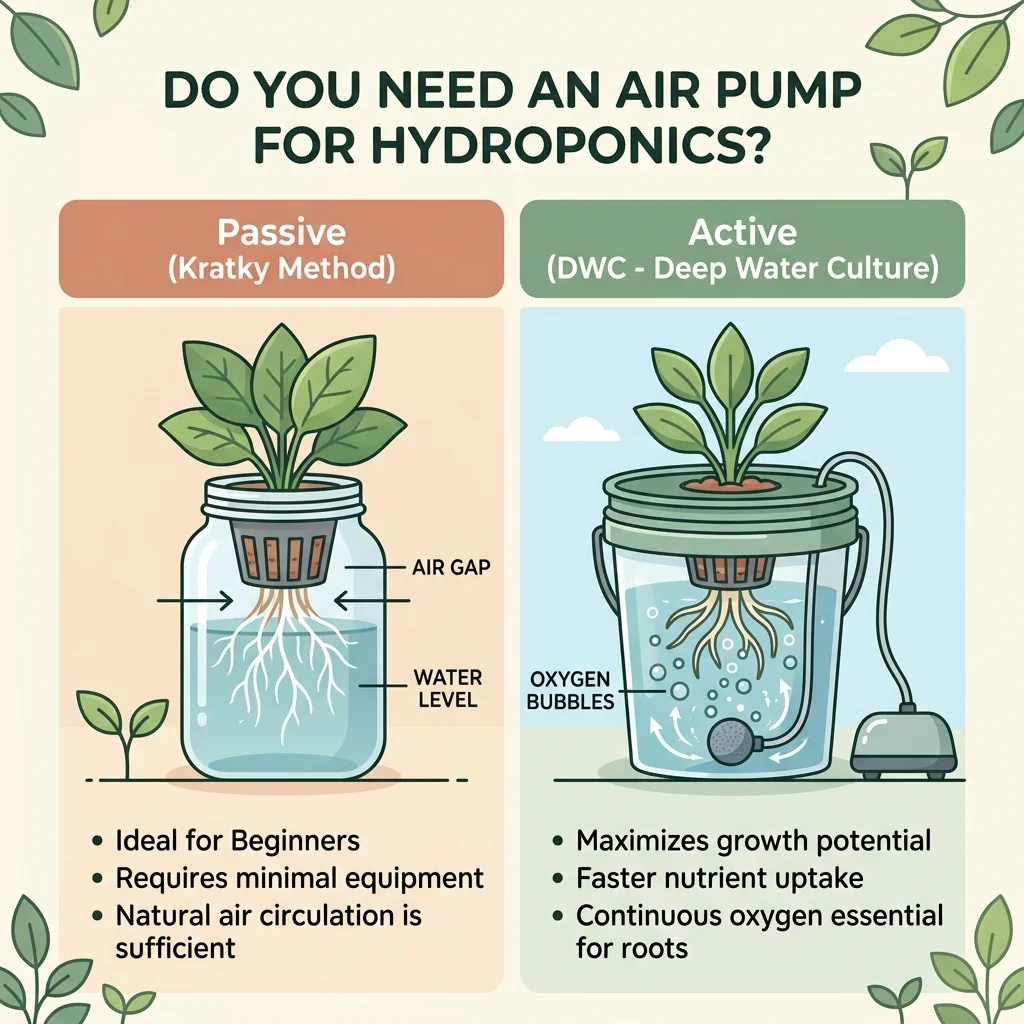
Do you need an air pump for hydroponics?
If you search for hydroponic tutorials, you will see a maze of air pumps, plastic tubing, and bubbling airstones. But do you actually need electrical aeration to grow plants in water? Here is the science of passive vs. active hydroponic setups.
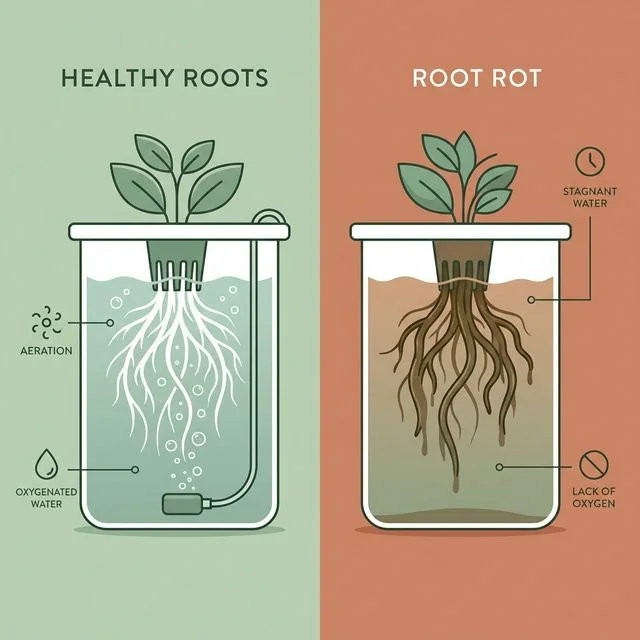
Hydroponic root rot: how to spot it early and stop it
Brown, slimy or swampy-smelling roots mean root rot. Catch it early and fix the conditions behind it — warm water, low oxygen and stagnant flow.
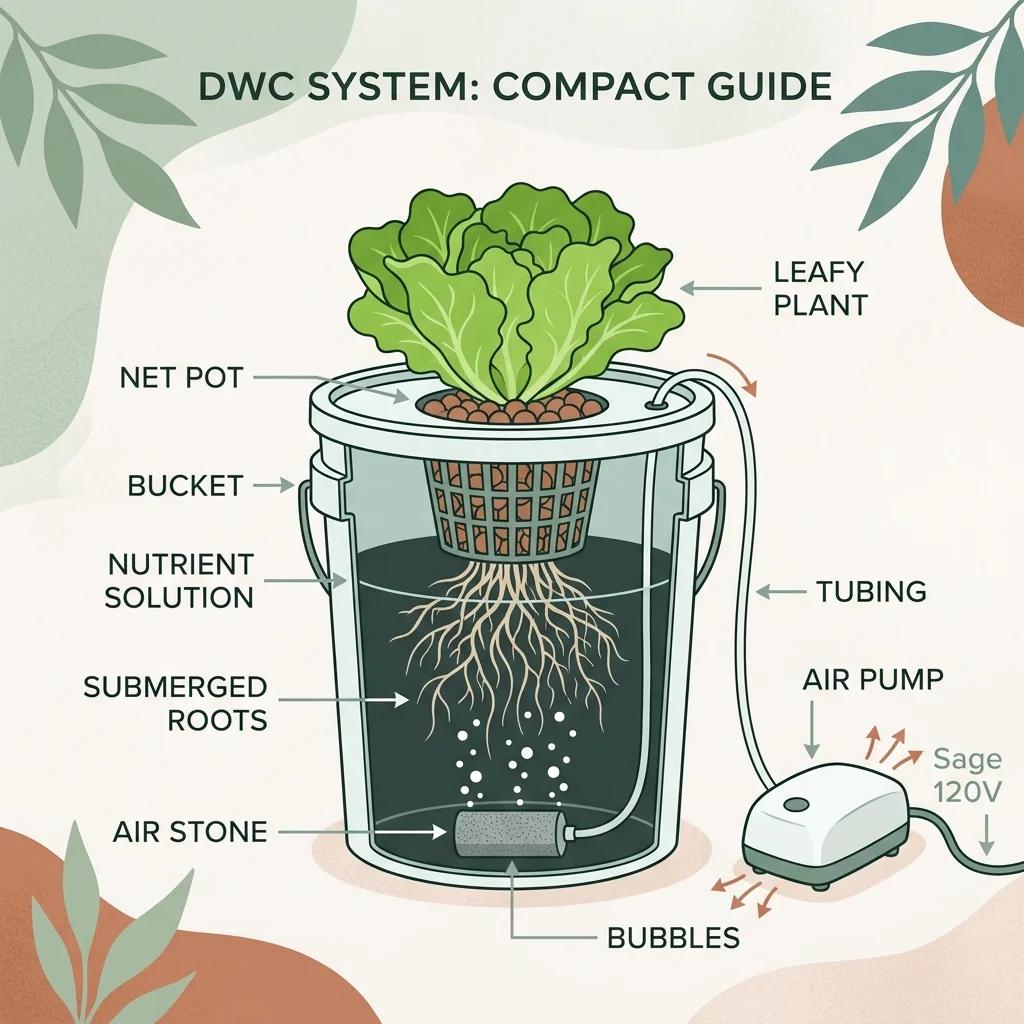
What is DWC? Deep water culture for small spaces
DWC suspends roots in aerated nutrient solution for fast growth. It is one of the best active systems for a small space, as long as you manage oxygen and heat.