
Adjusting hydroponic pH
| Goal | Product | Active ingredient | How to use |
|---|---|---|---|
| Lower pH | pH down | Phosphoric acid (usually) | Small doses, circulate, retest |
| Raise pH | pH up | Potassium hydroxide (usually) | Small doses, circulate, retest |
| Emergency lower | Citric acid / vinegar | Weak acid | Temporary; drifts back fast |
| Emergency raise | Baking soda | Sodium bicarbonate | Temporary; adds sodium |
Adjusting pH in a hydroponic reservoir is straightforward once you know which product does what. As a quick answer: to lower pH, add a “pH down” product (usually phosphoric acid); to raise pH, add a “pH up” product (usually potassium hydroxide). Add in small doses, circulate the water, and retest, aiming for 5.5 to 6.5 for most leafy crops. Why pH moves in the first place is explained in hydroponic nutrient basics.
Lowering pH (too high / alkaline)
If your reading is above the range, use pH down:
- Follow the adjuster’s label for the known reservoir volume; concentration varies too much for a universal millilitre dose.
- Let the pump circulate the water for a few minutes so it mixes fully.
- Retest and repeat until you land inside the range.
Adding a large dose at once almost always overshoots, sending you chasing the meter in the other direction. Small steps are faster in practice.
Raising pH (too low / acidic)
If your reading is below the range, use pH up the same way: small dose, circulate, retest. A steadily falling pH that needs constant correction is a symptom, not a one-off — it usually points to the nutrient mix or heavy root activity, the mirror image of the problem in why hydroponic pH keeps rising.
Always adjust pH after nutrients, not before
Adding nutrients shifts pH, so set your feeding strength (EC) first, then adjust pH last. If you adjust pH before adding nutrients, you will have to do it again anyway. Target numbers by crop are in the hydroponic lettuce EC and pH chart.
When to stop adjusting and just refresh
If pH swings wildly every day, or you are adding pH up and down constantly, the solution is often exhausted or unbalanced. Rather than fighting it, change the solution, as covered in when to change hydroponic nutrient solution. A fresh, correctly mixed reservoir holds pH far more steadily than a tired one you keep patching.
A note on household fixes
Citric acid or vinegar will lower pH and baking soda will raise it, which is handy in an emergency. But they drift back quickly and baking soda adds sodium, so keep inexpensive dedicated pH up and pH down on hand for anything beyond a one-time rescue.
Household products are not recommended as a routine nutrient-management system. Their concentration, added ions, buffering, and compatibility differ. If an edible crop cannot safely wait, replacing a small reservoir with correctly mixed solution may be more traceable than improvising.
Handle adjusters as concentrated chemicals
Read the label and safety data sheet. Wear specified eye and skin protection, work in ventilation, keep products in original labelled containers, and store them away from children, food, and incompatible chemicals. Never mix acid and base concentrates or pour water into concentrated acid.
Measure with dedicated tools over secondary containment. Add adjuster to circulating reservoir water at the labelled rate, never directly onto roots. Wait for complete mixing and temperature stabilisation before retesting.
Verify the reading before dosing
Calibrate the pH meter with fresh buffers that bracket the working range, rinse the probe, and check solution temperature. A large unexpected jump should be confirmed with a second reading or method before chemical correction.
Source-water alkalinity determines how much acid is required and how strongly pH rebounds. Water can have moderate pH yet high alkalinity; repeated “pH down” use without understanding that buffer creates dosing churn.
Set a correction limit
Record reservoir volume, product, concentration, amount, time, pH before/after, EC, and temperature. If the expected response does not occur, stop. Recalibrate, review mixing, and consider replacing the solution rather than alternating up and down.
Do not use a crop-wide band such as 5.5–6.5 to justify constant correction to one decimal. Define an acceptable operating band for the crop and formulation, observe trend, and intervene only when the measurement and context support it.
Sources and further reading
If you are adjusting pH, also read
These guides cover why pH drifts, the target numbers by crop, and when to just refresh the solution instead.
Common questions
How do I lower pH in hydroponics?
Add a small amount of "pH down" solution, which is usually phosphoric acid, to the reservoir. Circulate the water for a few minutes, then retest. Add in small increments (a millilitre or two at a time for a home reservoir) until you reach the target range, rather than dosing a large amount at once.
How do I raise pH in hydroponics?
Add a small amount of "pH up" solution, usually potassium hydroxide, circulate, and retest. Raise it gradually. If pH keeps falling and needs constant raising, the cause is usually the nutrient mix or root activity, not a one-off dose.
Can I use household products to adjust hydroponic pH?
You can in a pinch (a little citric acid or vinegar lowers pH; baking soda raises it), but they are unstable and drift back quickly. Dedicated pH up and pH down products hold the reading far more reliably and are inexpensive.
What pH should hydroponic nutrients be?
Most leafy greens and herbs do best at pH 5.5 to 6.5, with lettuce around 5.5 to 6.0. Staying inside the range matters more than hitting an exact number, because nutrient availability is stable across the band.
Related guides
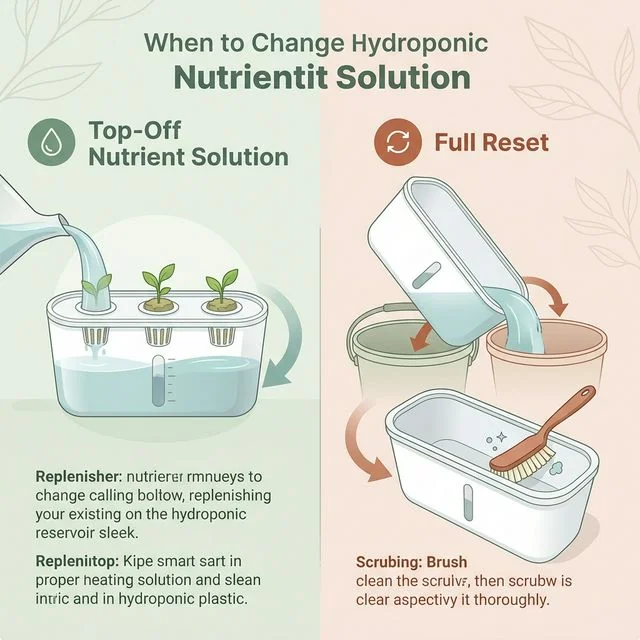
When to change hydroponic nutrient solution: top off vs full reset
A hydroponic reservoir should not be treated like a closed loop forever. This guide shows when a simple top off is enough and when a full reset is the safer move.
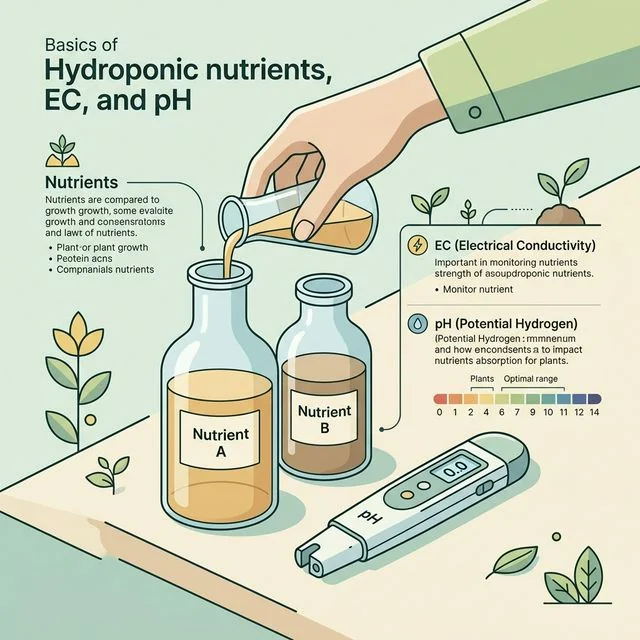
Hydroponic nutrient basics: EC, pH, dilution, and reservoir stability
Most hydroponic problems are not mysterious. They come from concentration drift, pH drift, heat, or neglected maintenance. This guide covers the basics clearly.
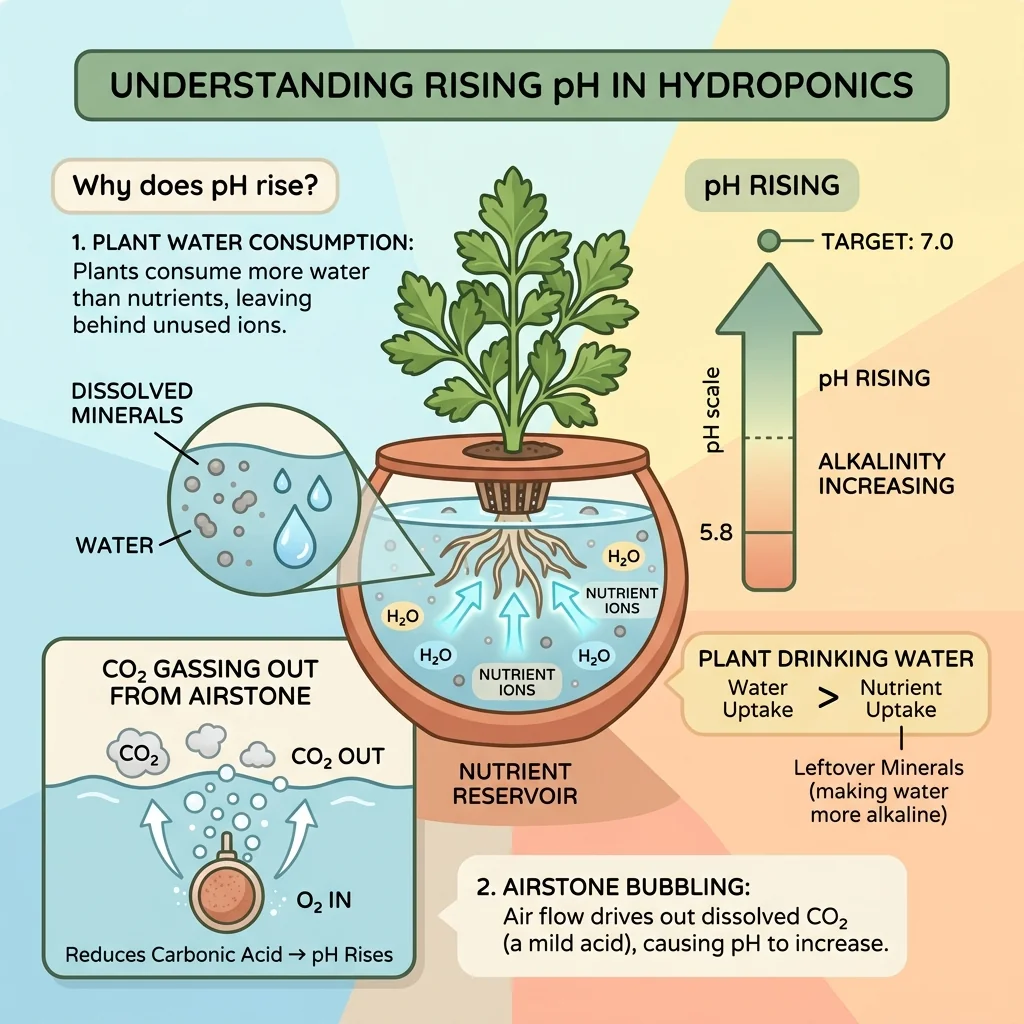
Why pH keeps rising in hydroponics (and how to stop it)
You balanced your hydroponic reservoir to a perfect 5.8 pH. Two days later, it has drifted back up to 6.8. This constant upward drift is the bane of hydroponic growers. Here is the chemistry behind why it happens and how to fix it.