Is Your pH Drift Normal or Dangerous?
| Drift Rate | The Cause | Required Action |
|---|---|---|
| 0.1 to 0.2 increase per day | Normal plant nutrient uptake and healthy airstone bubbling. | Do nothing until it reaches 6.2, then gently adjust it back down to 5.8. |
| 0.5+ increase in 24 hours | Algae bloom consuming CO2 or Pythium (Root Rot) infection. | Inspect roots immediately. Blackout the reservoir to kill algae. |
| pH is dropping (becoming acidic) | Salt buildup, toxic bacteria, or the plant is starving. | Dump the reservoir entirely and mix a fresh batch of nutrients. |
If you are new to hydroponics, you likely view the pH of your reservoir as a static number. You mix your nutrients, use your acid drops to hit a perfect 5.8, and walk away.
But when you check the meter two days later, the pH has climbed to 6.5. You add more acid. Two days later, it’s back at 6.6.
It feels like you are fighting a losing battle against the water. However, this upward drift is not a sign of failure—it is a sign of life. A constantly rising pH means your plants are actively eating, and your aeration system is working.
As established in our Hydroponic EC and pH Basics guide, controlling pH is the most important task in hydroponics — and it is only as reliable as the pen you measure it with, so if your readings feel erratic, check Best EC and pH meters for home hydroponics before blaming the reservoir. Here is the chemistry behind why it rises, and how to tell if your drift is healthy or dangerous.
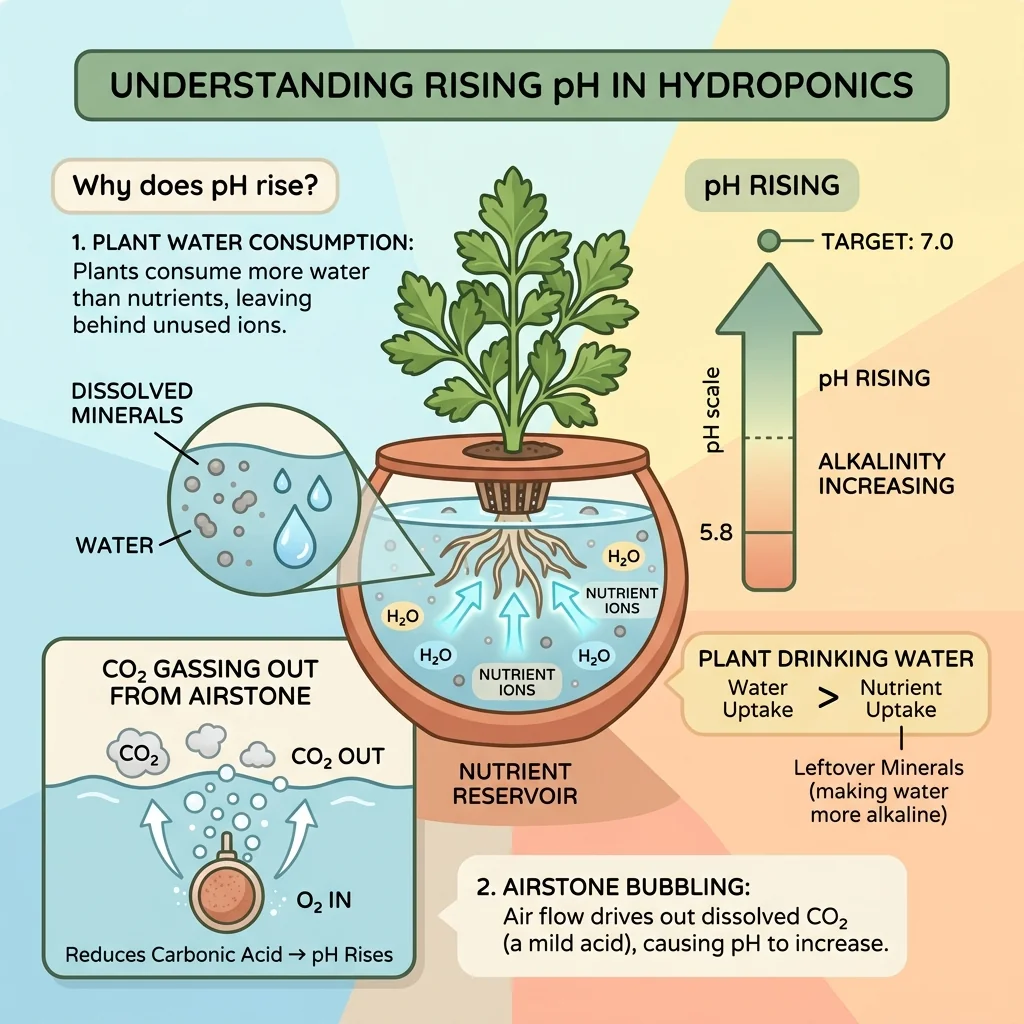
Reason 1: The Plant is Eating (Ion Exchange)
A healthy, fast-growing plant is the primary driver of upward pH drift.
When a plant absorbs a nutrient from the water, it cannot just pull a molecule in without giving something back. It must maintain an electrical balance.
For example, when a lettuce plant consumes a massive amount of Nitrogen (in the form of negatively charged Nitrate ions), it must release a negatively charged ion back into the water to keep the books balanced. The plant releases Hydroxide ($OH^-$) or Bicarbonate ($HCO_3^-$) ions.
Both of these ions are highly alkaline. As the plant eats, it is literally pumping alkalinity back into your reservoir, causing a slow, steady rise in the pH over the week.
Reason 2: Aggressive Aeration
If your plant is a tiny seedling but your pH is still rising rapidly, your air pump is the culprit.
To prevent the issues discussed in Root Rot in Hydroponics, you must aggressively bubble air through your water using an airstone.
However, tap water naturally contains dissolved Carbon Dioxide ($CO_2$). Dissolved $CO_2$ acts as a weak acid, naturally holding the pH down. When you vigorously bubble air through the water, you physically “gas off” and drive that dissolved $CO_2$ out of the liquid and into the atmosphere.
As the acid ($CO_2$) leaves the water, the water becomes more alkaline, and the pH rises.
Reason 3: The Dangerous Spikes (Algae and Bacteria)
A slow drift of 0.1 or 0.2 points per day is perfectly healthy. But if your reservoir jumps from 5.5 to 7.0 in a single afternoon, you have a biological infection.
- Algae Blooms: If light is leaking into your reservoir, algae will grow. Algae consumes massive amounts of dissolved $CO_2$ during the day for photosynthesis. As it rapidly depletes the $CO_2$, the pH violently spikes upward.
- Root Rot: If your roots are turning brown and slimy, the aggressive pathogenic bacteria (Pythium) destroying the roots release massive amounts of alkaline waste products, causing chaotic pH fluctuations.
If you see a massive spike, refer immediately to When to Change Hydroponic Nutrient Solution.
How to Manage the Drift
The secret to managing pH drift is not to fight it every day.
Beginners often suffer from “yo-yoing.” They adjust the pH down to 5.8 on Monday. On Tuesday, it is 6.0, so they add more acid. On Wednesday, they accidentally add too much acid and it drops to 5.0, so they add “pH Up.”
This violent chemical swing causes severe stress to the root system, stunting the plant (see Hydroponic Lettuce Growing Slowly).
The Rule of Thumb: Let the pH drift. Set your reservoir to 5.5. Let the plant eat, let the airstones bubble, and let the pH naturally drift upward over the course of the week. Do not touch the acid bottle until the meter reads 6.2 or 6.3. Once it hits the ceiling of the acceptable range, gently adjust it back down to 5.5 and let the cycle repeat.
This “swing” actually benefits the plant, as certain trace minerals (like Manganese) are absorbed better at 5.6, while others (like Calcium) are absorbed better at 6.1. By letting the pH slowly drift through the range, you ensure a perfectly balanced diet.
Seeing the effects of high pH?
A high pH locks out essential nutrients like Iron and Manganese. If your plants are suffering, check these diagnostic guides.
Common questions
Should I adjust the pH every single day?
No. Constantly dumping acid into your reservoir causes severe pH swings ('yo-yoing'), which stresses the roots far more than a gradual, natural drift. Only adjust the pH when it crosses 6.2.
Can I use vinegar or lemon juice to lower my pH?
You can in an emergency, but organic acids break down rapidly. The pH will shoot right back up within 24 hours. Always use commercial 'pH Down' (phosphoric acid) for stable hydroponics.
Why does my tap water require so much pH Down?
Hard tap water contains a high concentration of calcium carbonate, which acts as a massive pH buffer. It naturally resists becoming acidic, requiring significantly more acid to lower the pH.
Related guides
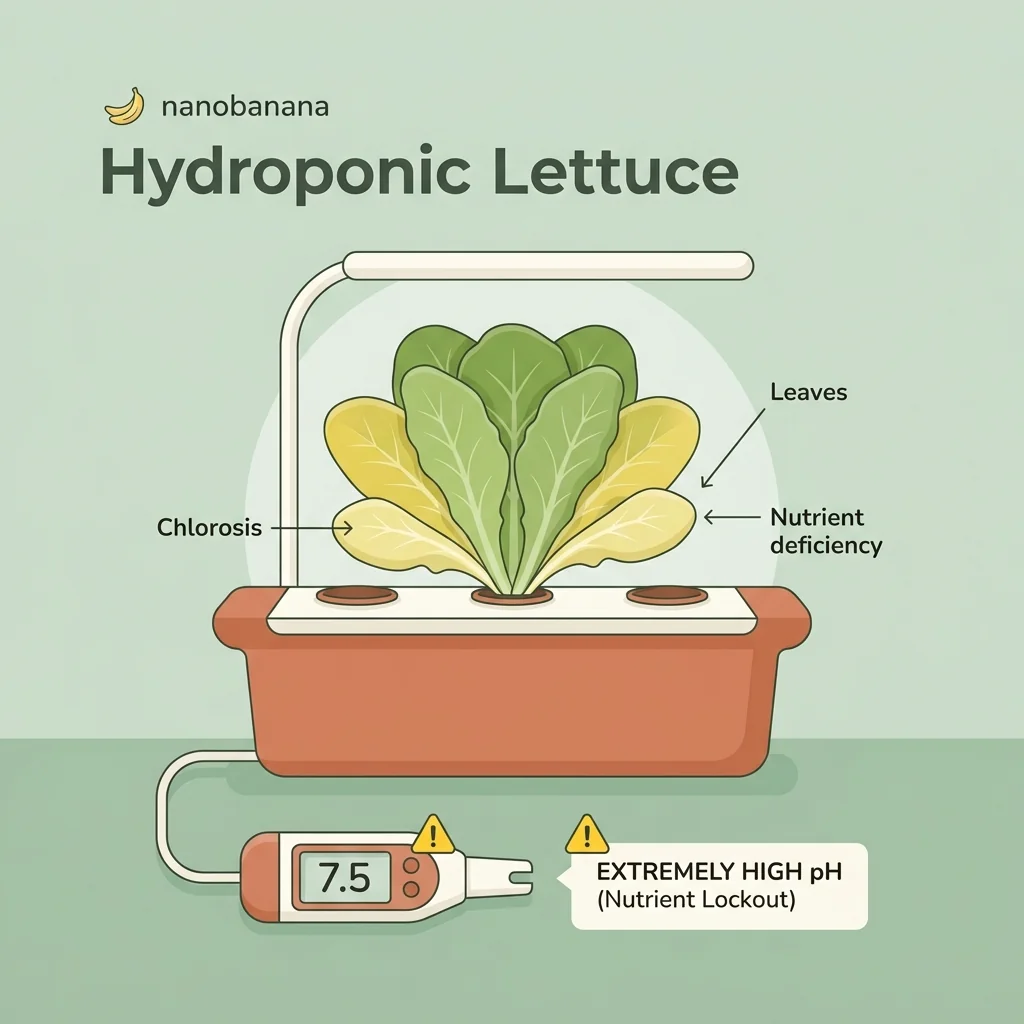
Hydroponic lettuce turning yellow? Here's how to fix it
A thriving hydroponic lettuce head should be a vibrant, deep green. If your entire crop is turning a sickly, pale yellow, the plants are starving. Here is a step-by-step diagnostic framework to find the exact cause and rescue the crop.
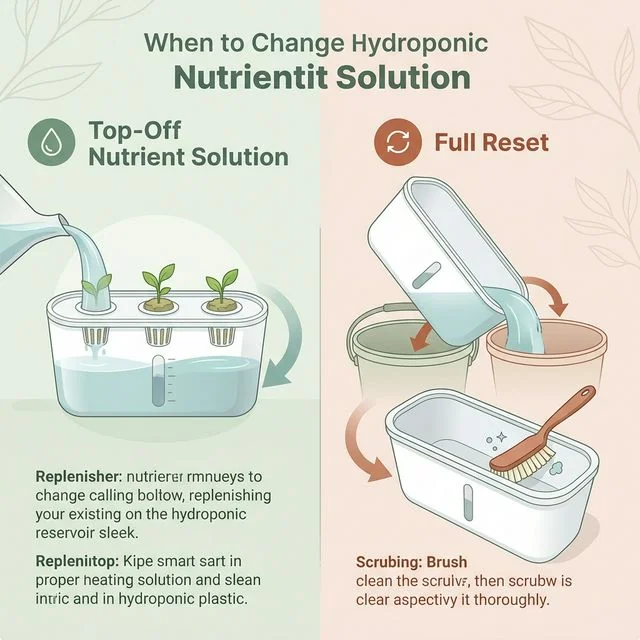
When to change hydroponic nutrient solution: top off vs full reset
A hydroponic reservoir should not be treated like a closed loop forever. This guide shows when a simple top off is enough and when a full reset is the safer move.
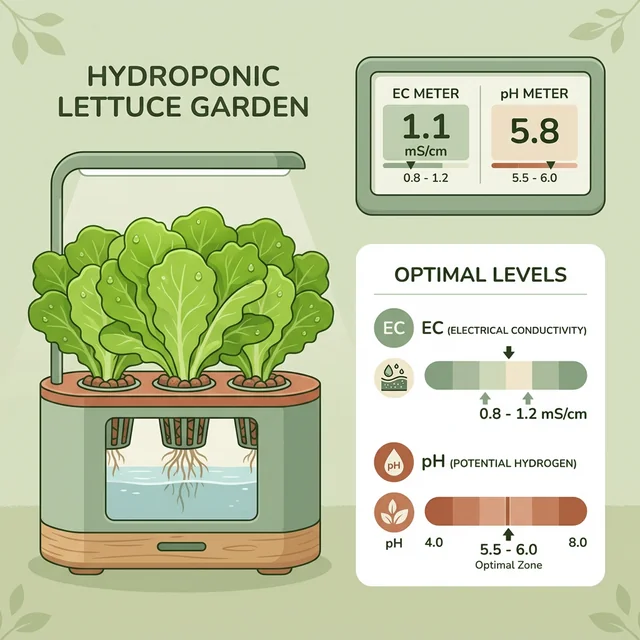
Hydroponic lettuce EC & pH chart: 0.8-1.2 and 5.5-6.0
Lettuce is the easiest crop to grow hydroponically, but it requires specific water chemistry. Use this beginner-friendly EC and pH guide to prevent tip burn and slow growth.