
Quick answer: if your hydroponic pH climbs back to the same number every time no matter how much acid you add, the tap water feeding your reservoir is probably alkaline — meaning it actively resists a pH change, not just that it happens to read high. Alkalinity and pH are two different measurements of two different things, and confusing them is why a lot of pH corrections feel like they don’t hold.
Alkalinity is one of the numbers covered in hydroponic nutrient, EC, and pH basics, and it behaves so differently from the pH reading most growers already check daily that it is easy to confuse the two.
Alkalinity is not pH, and it is not hardness either
Alkalinity is the water’s capacity to neutralize acid. It comes mainly from dissolved bicarbonates and carbonates of calcium, magnesium and sodium, plus smaller contributions from hydroxides, phosphates, silicates, sulfides and borates. It is reported in parts per million (ppm) as calcium carbonate equivalent, it is measured by titration, and a pH meter cannot read it, according to University of Missouri Extension.
That last point is the one that trips growers up: alkalinity does not correlate with pH. University of Massachusetts Amherst puts it plainly — water with high alkalinity tests pH 7 or above, but water with a high pH does not necessarily carry high alkalinity. University of Kentucky Center for Crop Diversification makes the same distinction from the other direction: pH reflects how acidic or basic a solution is right now, alkalinity measures its buffering capacity, and the two should not be confused. A tap supply can read a perfectly normal pH 7.2 and still carry enough buffering to fight every dose of pH down you add, or it can read pH 8 with almost no buffering at all, in which case a small dose of acid holds the correction easily.
A water report often carries a third number alongside these two — hardness, the water’s dissolved calcium and magnesium. It is tempting to lump all three together, but hardness affects your reservoir’s starting EC and how fast drip emitters and tubing scale up with mineral buildup, not how stubbornly pH resists a correction. A supply can test high on hardness and low on alkalinity, or the reverse; they are independent readings. That side of a water test, including the calcium and magnesium numbers, belongs on hard water in hydroponics. Buffering is what decides whether a pH correction holds.
Why an alkaline supply fights every correction
Think of alkalinity as a reserve of bicarbonate sitting in the water, ready to soak up acid before the pH number actually moves. Add a dose of pH down to a low-alkalinity reservoir and the pH drops right away, because there is little to neutralize the acid. Add the same dose to a high-alkalinity reservoir and much of it gets consumed just overcoming the buffer, so the reading barely moves — or drops for an hour and creeps back up overnight.
The sources put numbers on where that becomes a problem. Alkalinity above roughly 75 ppm CaCO₃ is enough to push a nutrient solution’s pH back up on its own, according to both Oklahoma State University Extension and University of Minnesota Extension, which is why both recommend checking pH more often once a supply crosses that line. University of Missouri Extension frames the workable range more broadly: an optimum of 40 to 160 ppm CaCO₃ equivalent for hydroponic source water. Above 160 ppm, every pH adjustment needs more acid to hold. Below 40 ppm, the reservoir swings the other way, needing near-constant monitoring because there is not enough buffer to keep pH steady between checks. University of Kentucky Center for Crop Diversification lands in the middle of that range with its own recommendation of around 80 ppm — enough buffering to keep a solution stable without turning every correction into a fight.
None of this replaces the everyday reasons pH drifts upward on a healthy reservoir. A fast-growing root system trades nutrient ions for hydroxide as it feeds, and a hard-bubbling airstone gases off dissolved carbon dioxide, both of which push an ordinary reservoir’s pH upward over the course of a week even on low-alkalinity water. That mechanism is covered in why hydroponic pH keeps rising. What alkalinity changes is not whether pH drifts, but how much acid it takes to correct it and how quickly the correction rebounds.
Test alkalinity separately — a pH reading will not show it
Because alkalinity and pH move independently, checking pH tells you nothing about whether the water is buffered. University of Kentucky Center for Crop Diversification recommends a water test for hydroponics that covers pH, EC, alkalinity, hardness, macronutrients, micronutrients and potentially harmful ions together. University of Missouri Extension’s list is close to identical, adding sodium, and it points growers toward a lab’s “irrigation suitability” package rather than a single spot check.
A municipal water utility’s annual water quality report usually lists alkalinity alongside hardness and pH, and it is worth pulling before assuming your tap water is the culprit. Well water needs an actual lab test, since there is no public report to check.
| Alkalinity reading (ppm CaCO₃) | What it means for a hydroponic reservoir |
|---|---|
| Below 40 | pH swings constantly and needs frequent monitoring, per University of Missouri Extension |
| 40 to 160 | The workable range University of Missouri Extension sets for hydroponic source water |
| About 80 | University of Kentucky Center for Crop Diversification’s general recommendation — buffered enough to stay stable without fighting corrections |
| Above 160 | Every pH correction needs progressively more acid to hold, per University of Missouri Extension |
| High pH together with high alkalinity | The combination that actually causes trouble, per University of Massachusetts Amherst — medium pH climbs over time and trace-element deficiencies follow |
High pH alone is usually not the problem
University of Missouri Extension lists 5.5 to 7 as the optimum pH range for hydroponic source water, but a tap reading above that band matters far less than the alkalinity behind it. A high-pH tap supply with low alkalinity is rarely worth fighting. University of Massachusetts Amherst notes that irrigating with high-pH water usually causes no trouble as long as alkalinity stays low, because that water has little capacity to neutralize acid or push the root zone’s pH upward over time. Acidifying it is rarely necessary. The serious case is high pH and high alkalinity together, where the water behaves like a dilute limestone solution: medium pH climbs steadily, and trace-element deficiencies and calcium-magnesium imbalances follow. Small containers and plug trays feel it hardest, because a small water volume is poorly buffered against the effect.
Moderate alkalinity is not automatically a defect either — University of Massachusetts Amherst sets a desirable irrigation-water range of 0 to 100 ppm calcium carbonate, with 30 to 60 ppm as its optimum, and points out that alkalinity in that band can supply useful calcium and magnesium that most water-soluble fertilizers do not carry on their own. Note that UMass’s own recommended range for irrigation sits lower than Missouri’s hydroponic figure, because UMass is describing container and greenhouse irrigation rather than a recirculating reservoir; use Missouri’s wider 40-to-160 band as the reference for a hydroponic system specifically. Either way, the amount of acid a supply needs to correct depends on its alkalinity, not on the pH number itself, and that amount is determined by titration or calculation rather than guesswork.
If your water tests high, this is what changes
Once you know your alkalinity, the acids that neutralize it differ in cost and handling risk. University of Missouri Extension ranks them from most to least expensive: citric or acetic acid, phosphoric acid, nitric acid, then sulfuric acid. Citric and acetic acid are safer to handle; nitric acid is the most dangerous of the group. University of Kentucky Center for Crop Diversification adds that sulfuric and phosphoric acid both contribute sulfate or phosphate to the solution, which can mean adjusting the rest of the nutrient recipe to account for it.
University of Missouri Extension also recommends reading a fertilizer label for its potential acidity or basicity: an acidic formulation helps neutralize alkalinity above 160 ppm calcium carbonate, while a basic formulation adds alkalinity to water that tests below 40 ppm — the opposite fix from acid dosing, and the one a low-alkalinity supply actually needs.
To raise pH on the rare low-alkalinity, low-pH supply, University of Missouri Extension recommends potassium bicarbonate or potassium hydroxide, both of which also supply potassium. It advises against sodium-based products, because sodium is toxic to plants, and against calcium carbonate (lime), which dissolves too slowly and wears out injectors.
The actual routine — how much to add, how long to wait before retesting, and what to do if a dose overshoots — is covered in how to raise and lower pH in hydroponics safely. What alkalinity changes is the size of the dose that routine needs, and how often you will find yourself repeating it.
Common mistakes
- Reading a normal pH number and assuming the water carries no buffering capacity, when the two are independent measurements.
- Chasing pH with repeated acid doses instead of testing alkalinity once and sizing the correction accordingly.
- Treating a container-irrigation alkalinity target, such as UMass’s 30 to 60 ppm optimum, as the ceiling for a recirculating hydroponic reservoir, when Missouri’s hydroponic-specific range runs to 160 ppm.
- Assuming alkaline water and hard water are the same line on a report, when they measure different things and need different fixes.
Sources
- University of Missouri Extension G6984 — Hydroponic Nutrient Solutions
- UMass Amherst CAFE Greenhouse & Floriculture — Water Quality: pH and Alkalinity
- University of Kentucky Center for Crop Diversification CCD-CP-63 — Hydroponic Lettuce Production in Controlled Environments
- Oklahoma State University Extension HLA-6722 — Electrical Conductivity and pH Guide for Hydroponics
- University of Minnesota Extension — Small-scale hydroponics
Test the water before you keep dosing acid
These guides cover the rest of a water report and what to do once you know your numbers.
Common questions
Why does my hydroponic pH keep climbing back to the same number no matter how much I correct it?
Your tap water is probably alkaline, meaning it resists a pH change rather than just sitting at a high pH on its own. Alkalinity above about 75 parts per million as calcium carbonate is enough to push a nutrient solution's pH back up, according to Oklahoma State University Extension and University of Minnesota Extension, and above 160 ppm every correction needs progressively more acid to hold. Testing alkalinity, not only pH, tells you whether that is what is happening.
What is alkalinity, and how is it different from pH?
pH measures how acidic or basic the water is right now. Alkalinity measures its capacity to resist a change in that number, mostly from dissolved bicarbonates and carbonates. University of Kentucky Center for Crop Diversification and University of Missouri Extension both stress that the two should not be confused, and University of Massachusetts Amherst notes that water with high alkalinity tests pH 7 or above, but water with a high pH does not necessarily carry high alkalinity.
What alkalinity level is good for a hydroponic reservoir?
University of Missouri Extension sets the workable range for hydroponic source water at 40 to 160 parts per million as calcium carbonate equivalent, and University of Kentucky Center for Crop Diversification recommends around 80 ppm as a general target. Below 40 ppm the pH swings constantly and needs frequent attention; above 160 ppm, every correction needs more acid to hold.
Is alkaline water the same problem as hard water?
No, they are two different readings from the same water report. Alkalinity is about buffering capacity and pH stability, while hardness is the water's dissolved calcium and magnesium, which affects starting EC and mineral buildup in tubing rather than pH behavior. A water report can show high hardness with low alkalinity, or the reverse, so hard water in hydroponics is worth checking as its own, separate question.
Related guides
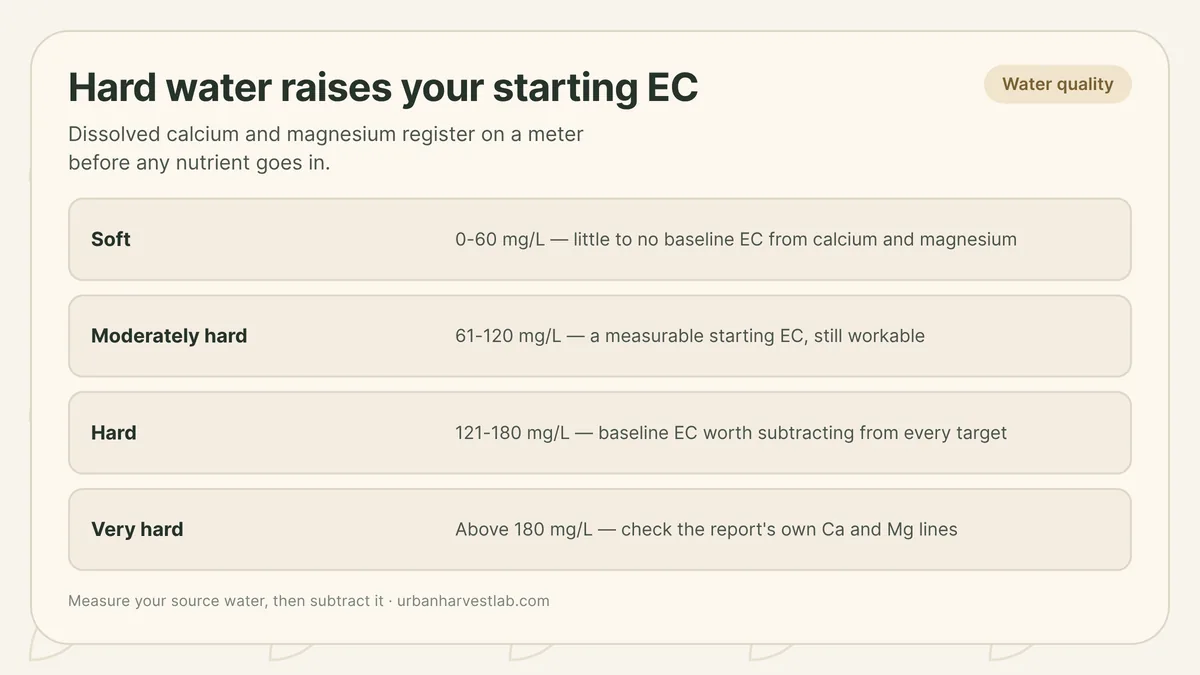
Hard water in hydroponics: how it raises your starting EC
Tap water carrying dissolved calcium and magnesium does not start at zero EC. Here is how much that shifts your baseline, and how to mix around it.

How to raise and lower pH in hydroponics (safely)
Adjusting hydroponic pH is simple once you know which product does what. Here is how to raise and lower pH safely, in small steps, without chasing the meter.
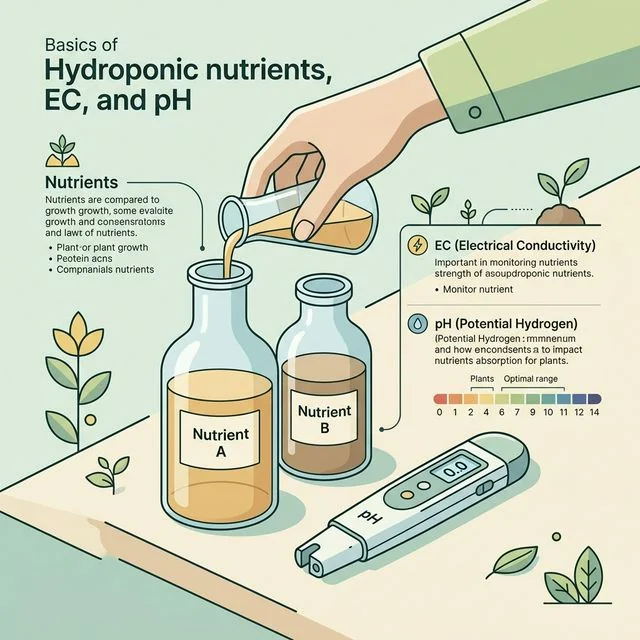
Hydroponic nutrient basics: EC, pH, dilution, and reservoir stability
Most hydroponic problems are not mysterious. They come from concentration drift, pH drift, heat, or neglected maintenance. This guide covers the basics clearly.