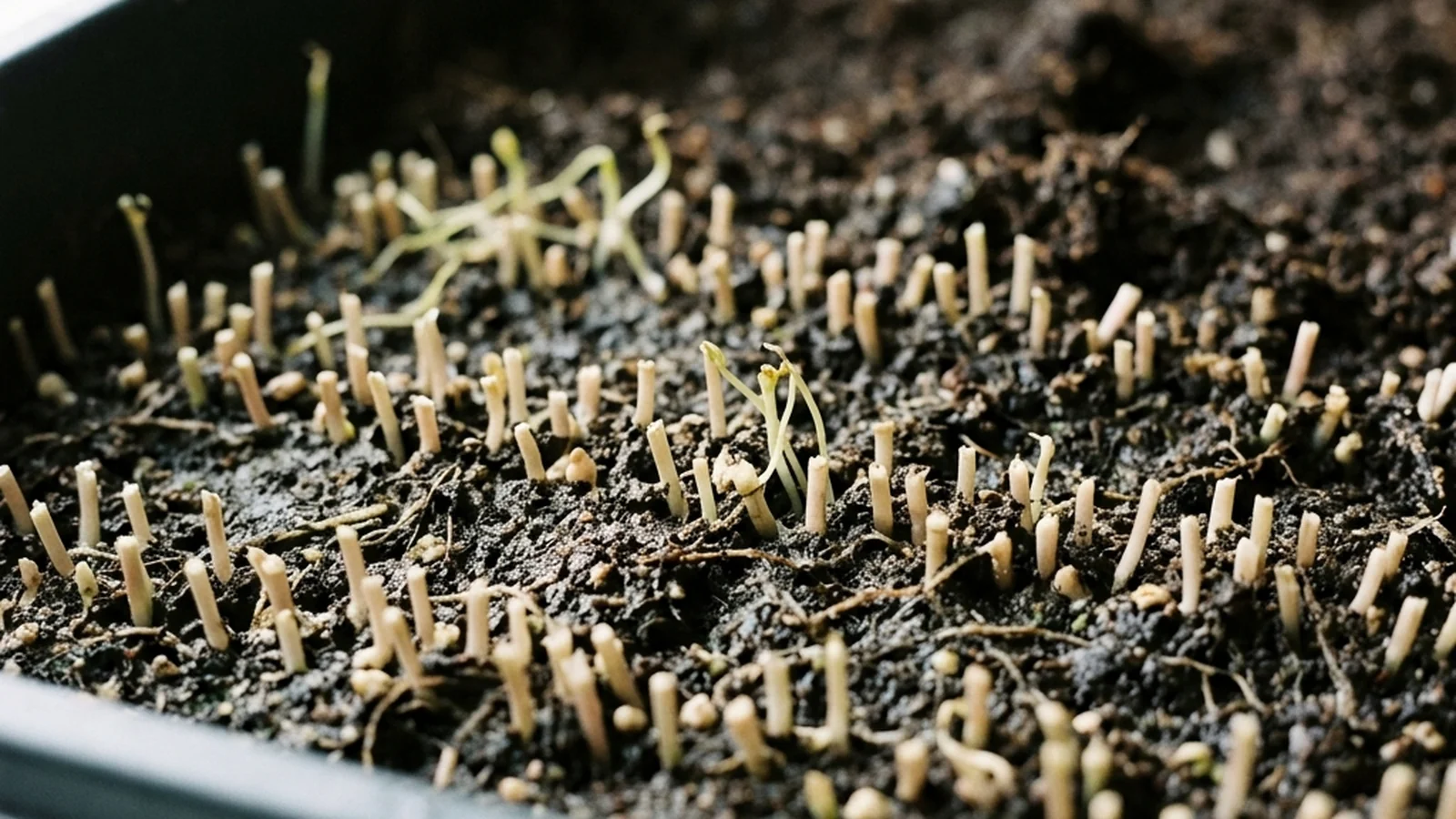
Most microgreens do not regrow after you cut them, because the standard harvest cut removes the plant’s growing point along with the greens. Pea shoots are the documented exception: cut higher up, above the lower nodes, and the plant can produce a second, smaller harvest. For every other common crop, the answer to “will this tray grow back” is no — and understanding why is more useful than hoping otherwise. If you have not made your first cut yet, the beginner microgreens method covers the general process.
The mechanism: it is about the cut, not the crop
Every microgreen plant has a growing point — the tissue at the top of the stem that produces new leaves. Penn State Extension’s harvest instruction for nearly all crops grown as microgreens is to cut at the base, just above the growing medium, once the first true leaves have emerged. That single cut removes the entire above-medium portion of the plant, growing point included.
Once the growing point is gone, there is nothing left on the stem to produce new growth. The roots may still be alive in the medium for a short time, but a root system without a growing point cannot generate new leaves. This is why the standard microgreens harvest is, by design, a one-time cut. It is not that these plants are fragile or that something went wrong — the harvest method itself is what ends the plant’s growth.
Sowing-to-harvest windows vary a lot by crop and by setup — Penn State Extension gives a general range of 7 to 21 days, and University of Tennessee Extension frames it as 10 to 14 days under good conditions — but none of that variation changes where the cut lands. A tray harvested on day 7 and a tray harvested on day 14 are both cut at the base, so both remove the growing point the same way.
The pea shoot exception
Pea shoots are grown and cut differently from most microgreens, and that difference is exactly why they can regrow. Rather than cutting at the base, the RHS suggests cutting the top two “levels” of leaves once shoots reach roughly 10-15 cm tall, cutting above the lower nodes rather than at the medium line. Those lower nodes retain living growth points, so the plant can push out new top growth and be cut again.
Where exactly that cut lands on the stem is walked through in the pea shoots grow log.
There is a trade-off built into the same plant. As pea shoots mature, the lower stem becomes increasingly fibrous, which is why only the tender top section is harvested and eaten — the base of the stem is not the part you want. A second cut draws on the same aging stem, so it tends to be smaller and less tender than the first. Pea is not among the seventeen varieties Penn State Extension has measured yield for, and that measured table covers only a single cut, so plan for some greens rather than a repeat of the first harvest.
Which microgreens regrow, crop by crop
Peas are the one crop with a published regrow technique. For everything else, the answer follows from where the cut lands.
| Crop | Standard harvest cut | Growing point removed by that cut? | Regrows? | Basis |
|---|---|---|---|---|
| Pea shoots | Above the lower nodes, top growth only | No — lower nodes keep growth points | Yes, a smaller second cut | Documented technique |
| Radish | At the base, above the medium | Yes | No | Follows the general rule |
| Broccoli | At the base, above the medium | Yes | No | Follows the general rule |
| Sunflower | At the base, above the medium | Yes | No | Follows the general rule |
| Mustard | At the base, above the medium | Yes | No | Follows the general rule |
| Basil | At the base, above the medium | Yes | No | Follows the general rule |
It is the same rule applied five times, plus the one crop where the harvest method is genuinely different. If a supplier or forum tells you that radish or sunflower microgreens “can regrow with the right care,” ask what cut they are describing — if it is still a base cut, the growing point is still gone.
Is a second cut worth the tray time?
Even where a second cut is possible, biology is not the only constraint a home grower is working with. Tray space and time are. Penn State Extension puts the fast brassicas — radish, broccoli, mustard — at 7 to 8 days, so one of those crops occupies a tray for roughly a week from sowing to harvest. Utah State University Extension’s own trays run a little longer for two of those crops — broccoli and radish at 8 to 12 days — so the exact week you get back depends on whose growing conditions your setup matches more closely. In that same window, you could resow an empty tray with fresh seed and get a full, even harvest rather than waiting on a partial regrow. Home windowsill setups often run slower still: UC Master Gardener Sonoma frames the general microgreens timeline at 2 to 3 weeks to reach 2 to 3 in. tall, well past the extension figures above, so weigh your own light and temperature before treating any single day count as a guarantee.
Peas are cut at 10-15 cm rather than the 2-4 in. most microgreens are harvested at, so a pea tray is occupied longer before the first cut — Utah State University Extension puts pea at 8 to 10 days for a tray cut at ordinary microgreen size, but a tray grown on to 10-15 cm for the regrow cut runs past that — and a second cut adds further days on top of that, for a harvest that is smaller and more fibrous than the first. If your priority is total usable greens per week of tray occupancy, a fresh brassica sowing in a clean tray is very often the better use of that space. If your priority is convenience — no new sowing, no new blackout period, just watering an existing tray — a second pea shoot cut can still be a reasonable choice.
Common mistakes
- Assuming a healthy-looking root system after harvest means the plant will regrow. Live roots do not restore a growing point that was cut away.
- Cutting pea shoots at the base like other microgreens, then being surprised the tray does not regrow. The regrow technique depends on where the cut is made.
- Waiting several extra days on a pea shoot regrow when a fresh brassica tray, started the same day, would already be ready to harvest.
- Watering a spent brassica tray “just in case.” Penn State Extension ties excess moisture and poor drainage to mold, and a cut tray has nothing left to use the water.
- Expecting the second pea shoot cut to match the first in size or tenderness. Plan for less, not the same.
- Trying the pea technique on another crop. At the size radish, sunflower or basil are harvested, the growing point sits at the top of a short stem, so there is no cut that takes the greens and leaves it behind. The RHS technique works on peas because a pea shoot is tall enough to have spare nodes below the cut.
What to do once you have harvested
The harvest and storage guide covers handling the cut greens. If you are keeping a rotation going, matching the new sowing to your blackout schedule by crop keeps the turnaround short.
Sources
- Penn State Extension: Growing Microgreens
- Penn State Extension: The ABCs of Microgreens
- RHS: Grow pea shoots with children
- University of Tennessee Extension W1261: Regulatory Considerations for Marketing Sprouts, Microgreens and Baby Greens
- Utah State University Extension: Grow Your Own Microgreens
- UC Master Gardener Program of Sonoma County: Growing Microgreens
Get more from every tray
Learn to harvest correctly the first time, then decide when a fresh sowing beats a second cut.
Common questions
Do microgreens grow back after you cut them?
Most do not. The standard harvest cut is made at the base, just above the growing medium, which removes the plant's only growing point. Once that tissue is gone, the stem has nothing left to produce new leaves from.
Which microgreens regrow after harvest?
Pea shoots are the crop with a documented regrowth technique. Cutting the tender top section above the lower nodes, rather than at the base, leaves growth points intact and the plant can produce a further harvest.
Is it worth waiting for a second cut of pea shoots?
Sometimes, if you value the convenience of not resowing. But the second cut is smaller and more fibrous than the first, pea is not one of the seventeen varieties in Penn State's measured yield table, and neither Penn State nor Utah State puts a figure on a second cut. A fresh 7-8 day brassica tray often produces more usable greens in the same amount of time.
Why don't radish or broccoli microgreens grow back?
Because the harvest cut for these crops is made at the base, right where the growing point sits. Removing that point at ground level is what makes the harvest a one-time cut, regardless of how healthy the roots below look afterward.
Related guides
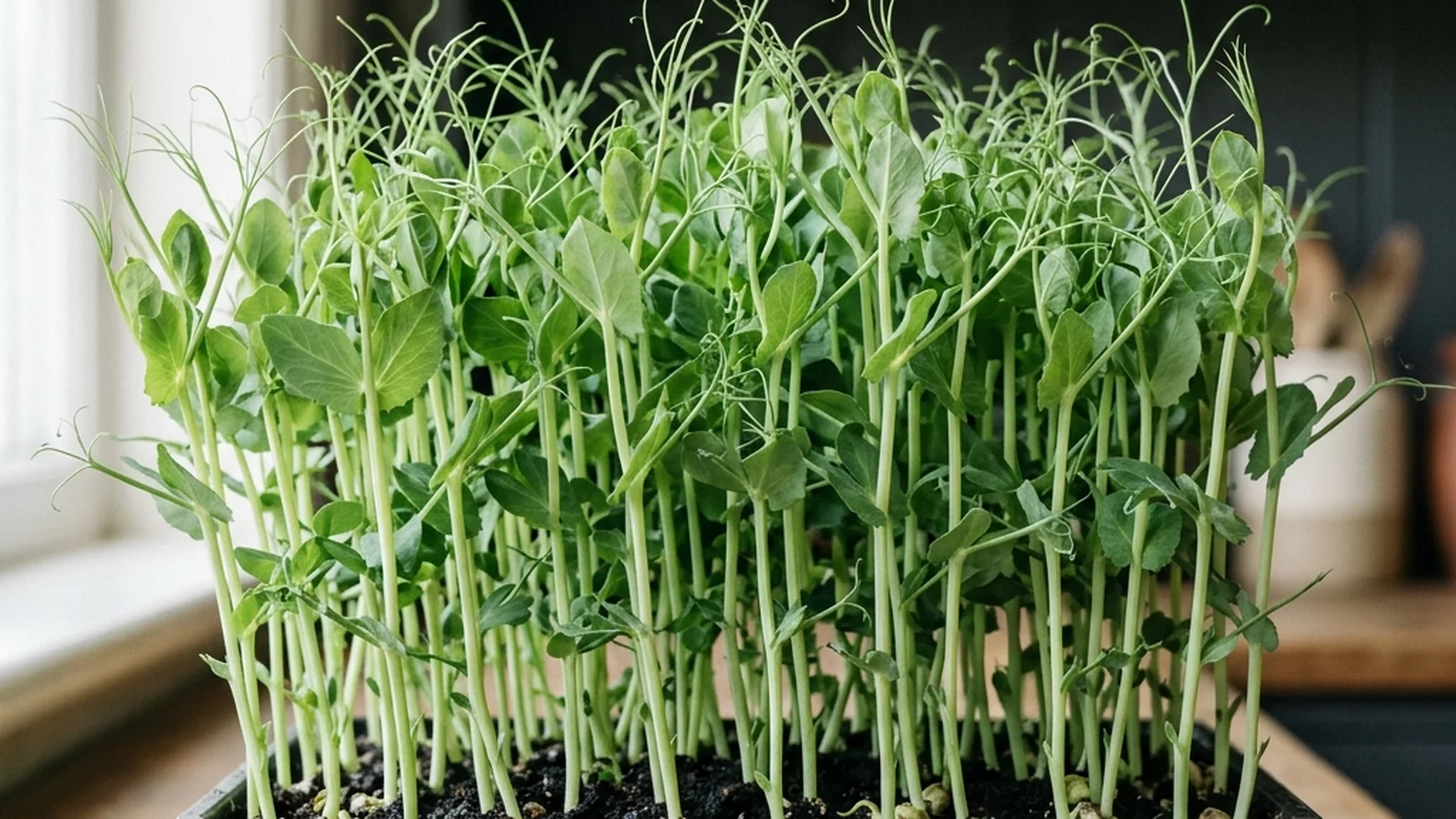
Pea shoots grow log: the timeline and the regrow cut
Pea shoots are the one microgreen documented to regrow. Here is the realistic day-by-day timeline, the long soak they need, and exactly where to make the cut.
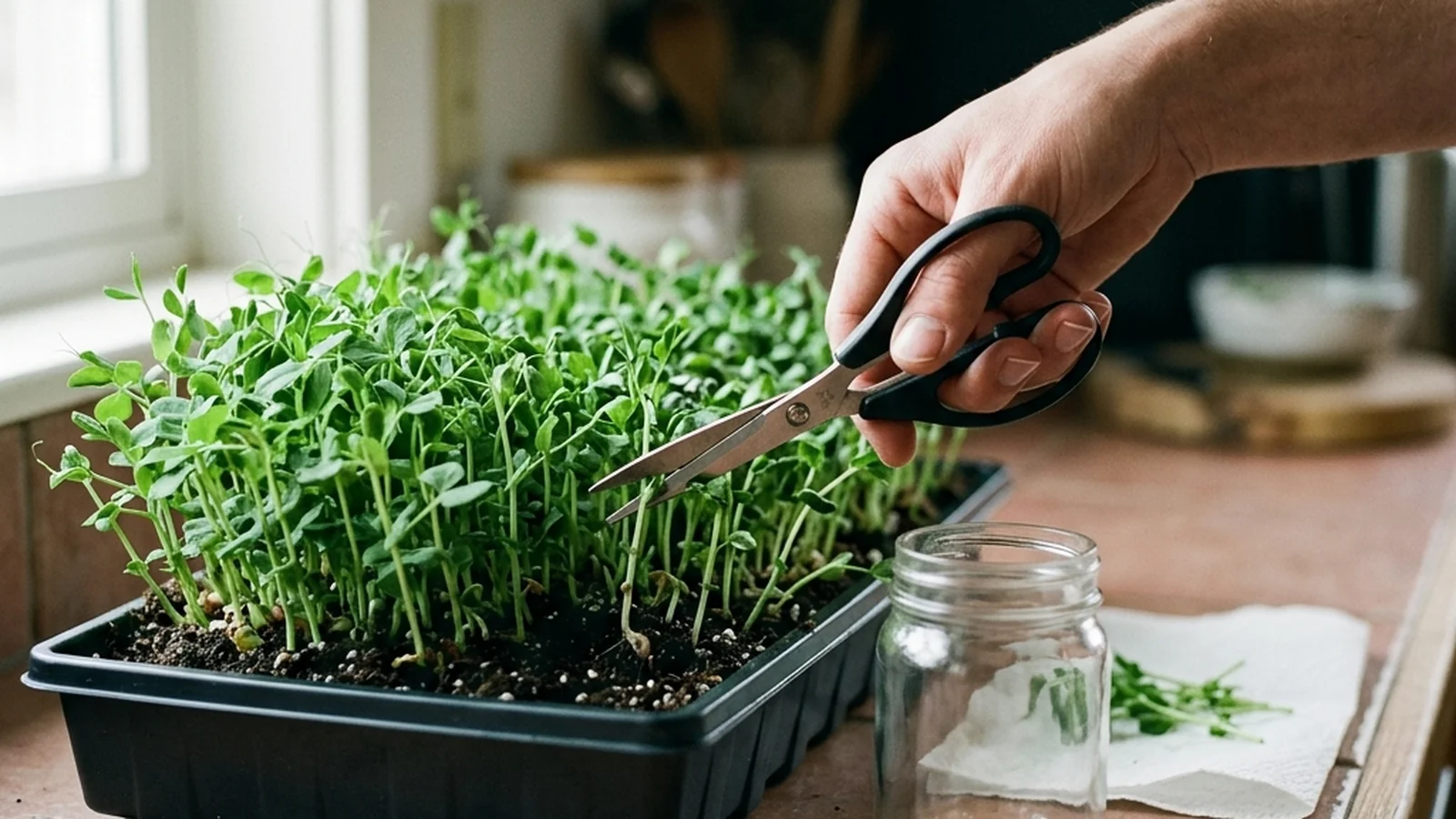
How to harvest and store microgreens safely
The cut and the fridge decide how long a tray lasts. Here is when to harvest, why you should not wash before storing, and what the shelf-life data actually shows.
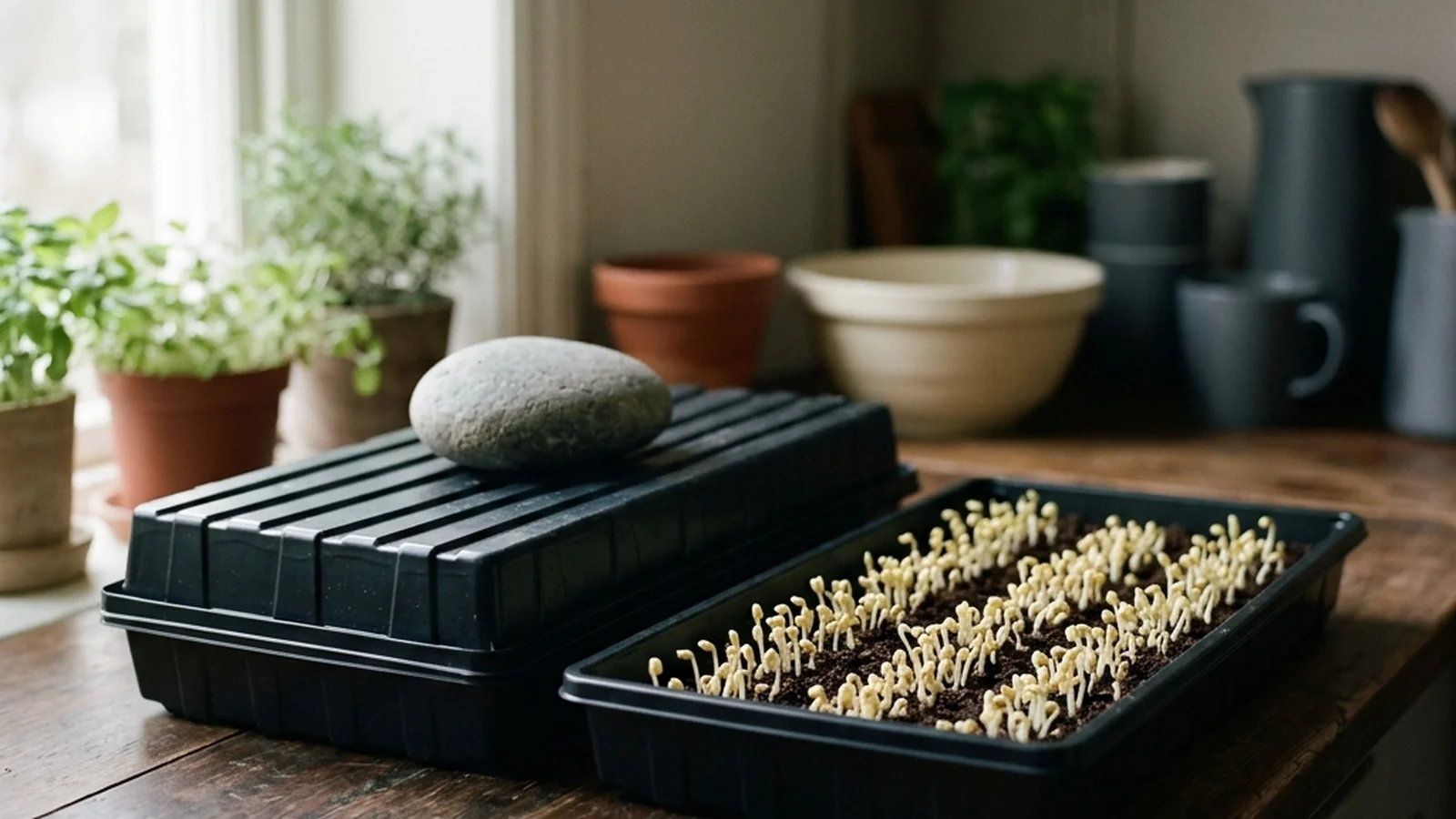
Microgreens blackout time by crop: what varies and why
Blackout time varies by crop — Utah State's table runs from 1-2 days for arugula to 7-14 for cilantro. Here is how that compares to the documented blackout methods, and how to judge readiness by the tray instead of the calendar.