Reported shelf life by temperature and crop
| Crop | Temperature | Reported shelf life | Source |
|---|---|---|---|
| Mustard microgreens | 5 °C | ~14 days, good sensory quality | Kou et al., mustard microgreens study |
| Mustard microgreens | 10 °C | ~4 days | Kou et al., mustard microgreens study |
| Mustard microgreens | 15 °C | ~2 days | Kou et al., mustard microgreens study |
| Arugula microgreens | 5 °C | Safe for consumption within 10 days (packaging varied) | Arugula microgreens postharvest study |
Quick answer: cut most microgreens at the base once the first true leaves show, do not wash them before storing, and refrigerate promptly in a lidded container. Expect a fridge life measured in days, not weeks — Kou et al.’s study on packaged mustard microgreens shows quality dropping from about 14 days at 5 °C to just 2 days at 15 °C. The cut and the cold chain matter more than any single “how long do they last” number.
The steps below assume the tray is already grown and ready. For sowing, blackout, and light, start with how to grow microgreens at home.
When to cut
University of Tennessee Extension puts harvest at 1 to 4 in. tall, cut once one or two true leaves have formed above the seed leaves. Penn State Extension and UC Master Gardeners of Sonoma County phrase it as 2 to 4 in. with true leaves just emerging. Either way, cut once true leaves appear — this applies to most crops except pea shoots, which are treated differently below.
Penn State Extension gives seed-to-harvest timing of 7 to 21 days, depending on species and growing conditions, and puts fast brassicas — broccoli, radish, arugula, and mustard — at around 7 to 8 days. Utah State University Extension’s own per-crop figures run a little wider for that same group — arugula 6 to 8 days, broccoli and radish 8 to 12 — which is a reminder that any single day count is a starting point, not a deadline. If you are unsure whether a tray is ready, height and leaf stage are more reliable signals than the calendar date, since light, temperature, and seed density all shift the timeline.
How to cut
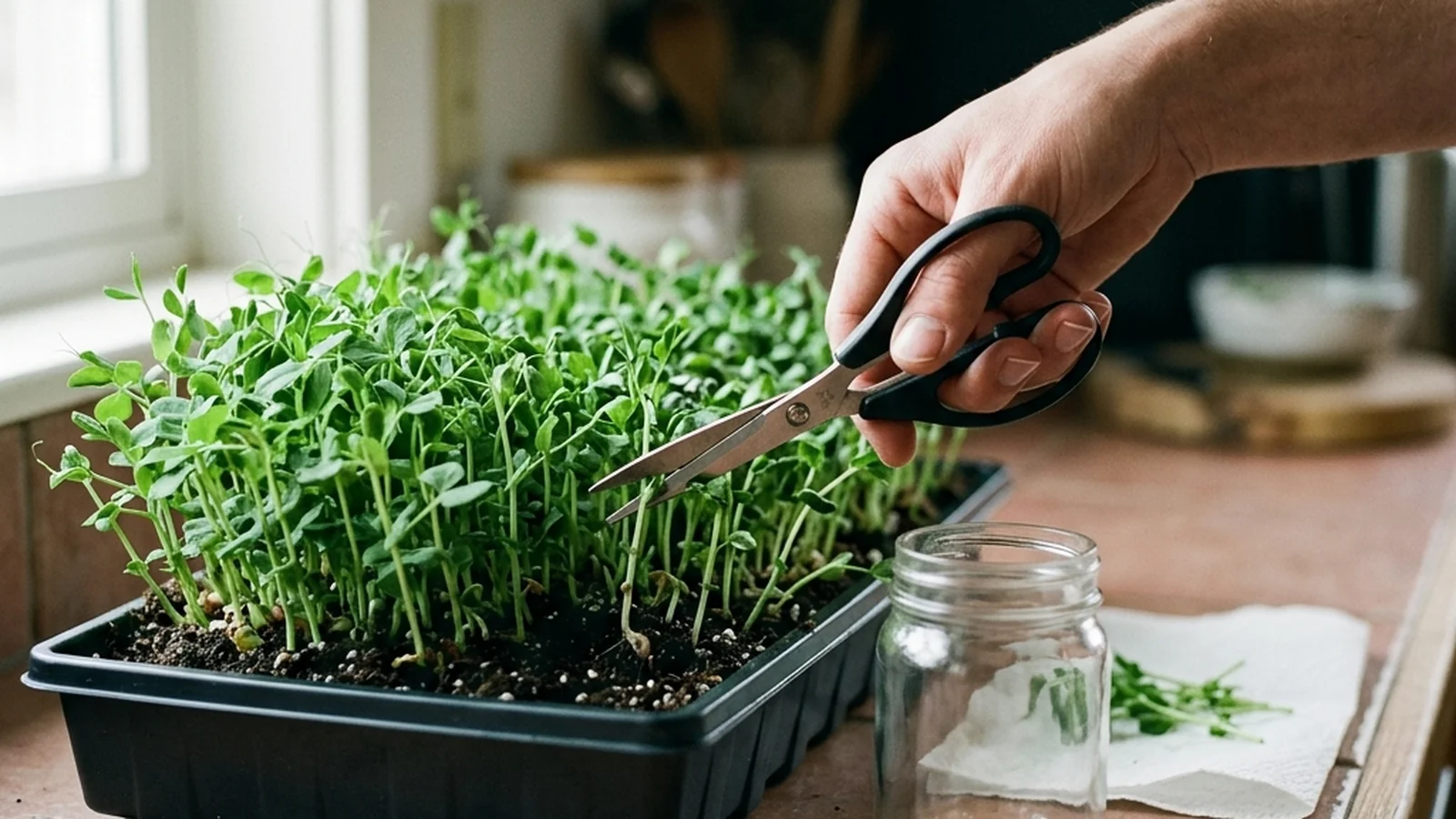
Cut at the base, just above the growing medium, with clean scissors or a sharp knife. This single cut removes the growing point along with the stem, which is why most microgreens do not regrow after harvest — the plant has no meristem left to push new growth from.
Pea shoots are the documented exception. The RHS suggests cutting the tender top section above the lower nodes once shoots reach roughly 10 to 15 cm, taking the top two “levels” of leaves — cutting lower gets into stem tissue that has already turned fibrous. The plant can then produce a second, smaller flush from the nodes left behind. The full mechanics — and why this does not extend to other crops — are covered in can microgreens regrow.
Work over a clean surface and cut in one pass with sharp scissors rather than sawing at the stem.
Should you wash before storing?
No. This is the single most consequential step in the whole process, and it runs against instinct: Penn State Extension and University of Tennessee Extension both say to wash right before use, not before storage, because the added moisture creates conditions that favor pathogen growth while the greens sit in the fridge for days.
This matters more for microgreens than it might for other produce because of how they are grown and eaten. University of Tennessee Extension identifies seeds, growing substrate, and water as the main sources of pathogens on a tray, and microgreens are typically eaten raw, young, and without cooking to reduce risk further. Keeping the cut greens dry in storage, and rinsing only right before eating, is a deliberate control point — not a shortcut.
For the sanitation side of this — cleaning trays, choosing seed, where contamination risk actually comes from during growing, why a correct base cut makes microgreens lower risk than sprouts, and the hydroponic exception to that — see microgreens food safety and sanitation.
How to store what you cut
Bag or box the cut greens and refrigerate them promptly. Beyond “cold and dry,” two variables show up clearly in the available research: temperature, and container type.
Turner et al.’s review of microgreen shelf life describes microgreens as cut, tender tissue highly susceptible to dehydration — which is why temperature is the biggest lever. Kou et al. tracked sensory quality in packaged mustard microgreens across three storage temperatures: about 14 days at 5 °C, dropping to 4 days at 10 °C and 2 days at 15 °C — roughly a sevenfold difference in shelf life between a properly cold fridge and a mild room-temperature-adjacent 15 °C. These figures are specific to mustard microgreens in that study — they are not a general rule for every crop, but they are the clearest illustration available of just how much a few degrees of storage temperature can matter. A separate study on arugula microgreens found them safe for consumption within 10 days at 5 °C across the packaging types tested, which lines up with the same cold-is-critical pattern.
Container type also measurably affects quality. A packaging study on radish microgreens found that rigid PET clamshells outperformed LDPE self-seal bags on weight loss, respiration rate, electrolyte leakage, and microbial counts. In practical terms, a rigid clamshell-style container is a reasonable default if you are choosing between that and a soft sealed bag. The study compared a firm container against a soft bag; it did not test ventilation, so a punched lid is not what the result is about.
No single published figure covers every crop, temperature, and container, but expect a window measured in days to roughly two weeks under good cold storage, not weeks by default. If a tray develops an off smell, sliminess, or discoloration during storage, that is a food-safety signal, not a texture inconvenience. Microgreens mold vs. root hairs covers how to tell normal growth from contamination if you are unsure whether cut greens or an unharvested tray are still safe to use.
Common mistakes
- Washing the whole harvest before bagging it “to save a step” — this is the opposite of the food-safety guidance and shortens usable life.
- Leaving cut greens at room temperature for hours before refrigerating, especially in a warm kitchen.
- Sawing at the stem with dull scissors instead of a clean cut.
- Assuming every crop behaves like the best-documented one; mustard’s temperature curve is a guide to the pattern, not an exact number for radish or basil.
- Storing cut greens in a soft sealed bag instead of a rigid container — a radish microgreens study found bags underperform on weight loss and other quality measures.
Sources
- Kou et al., “Effect of Storage Temperature on Storage Life and Sensory Attributes of Packaged Mustard Microgreens”
- “Postharvest Quality of Arugula (Eruca sativa) Microgreens…”
- “Effect of Packaging and Coating Technique on Postharvest Quality and Shelf Life of Raphanus sativus L. … Microgreens”
- University of Tennessee Extension W1261, “Regulatory Considerations for Marketing Sprouts, Microgreens and Baby Greens”
- Turner et al. (2020), “Microgreen nutrition, food safety, and shelf life: A review,” Journal of Food Science 85(4)
- Penn State Extension, “A Step-By-Step Guide for Growing Microgreens at Home”
- Penn State Extension, “The ABCs of Microgreens”
- Penn State Extension, “Growing Microgreens”
- UC Master Gardener Program of Sonoma County, “Growing Microgreens”
- Utah State University Extension, “Grow Your Own Microgreens”
- RHS, “Grow pea shoots with children”
Get the harvest and the storage right
Confirm the crop is ready, then handle it the way food-safety sources actually recommend.
Common questions
Should I wash microgreens before putting them in the fridge?
No. Penn State Extension and University of Tennessee Extension both say to wash right before use, not before storage, because added moisture creates conditions for pathogen growth during the days the tray sits refrigerated. Store them dry and rinse just before eating.
How long do microgreens actually last in the fridge?
It varies by crop, temperature, and packaging, which is why a single number for every microgreen is misleading. The clearest published figures come from mustard microgreens: about 14 days at 5 °C, dropping to 4 days at 10 °C and 2 days at 15 °C. Arugula microgreens were reported safe for consumption within 10 days at 5 °C. Treat these as the ballpark, not a guarantee for every crop.
What container keeps microgreens fresher, a clamshell or a bag?
In a packaging study on radish microgreens, rigid PET clamshells outperformed LDPE self-seal bags on weight loss, respiration rate, electrolyte leakage, and microbial counts. A firm, rigid container is a reasonable default over a soft bag if you have the choice.
Can I cut microgreens and get a second harvest?
Almost never, and it depends on the cut. Most microgreens are cut at the base, removing the growing point entirely, so they do not regrow. Pea shoots are the documented exception. See can microgreens regrow for the full explanation.
Related guides
Microgreens food safety: sanitizing trays, seed, and water
Sprout recalls do not automatically make microgreens risky. The harvest method is what separates them, and one hydroponic setup can erase that gap.
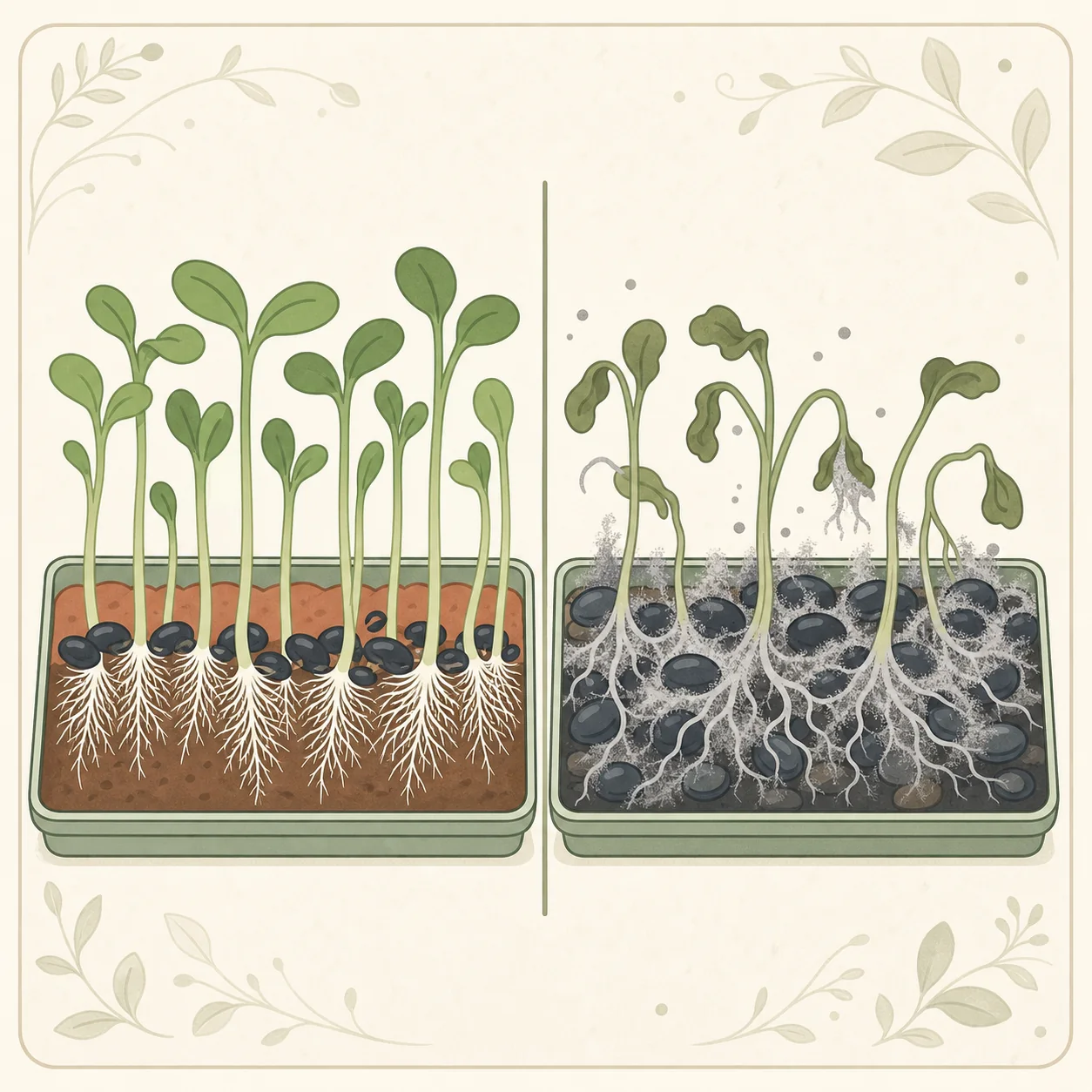
Microgreens mold or root hairs? How to tell safely
White fuzz around newly emerged roots is often normal root hair growth. Irregular spread, bad odor, slime, or collapsing stems changes the decision.
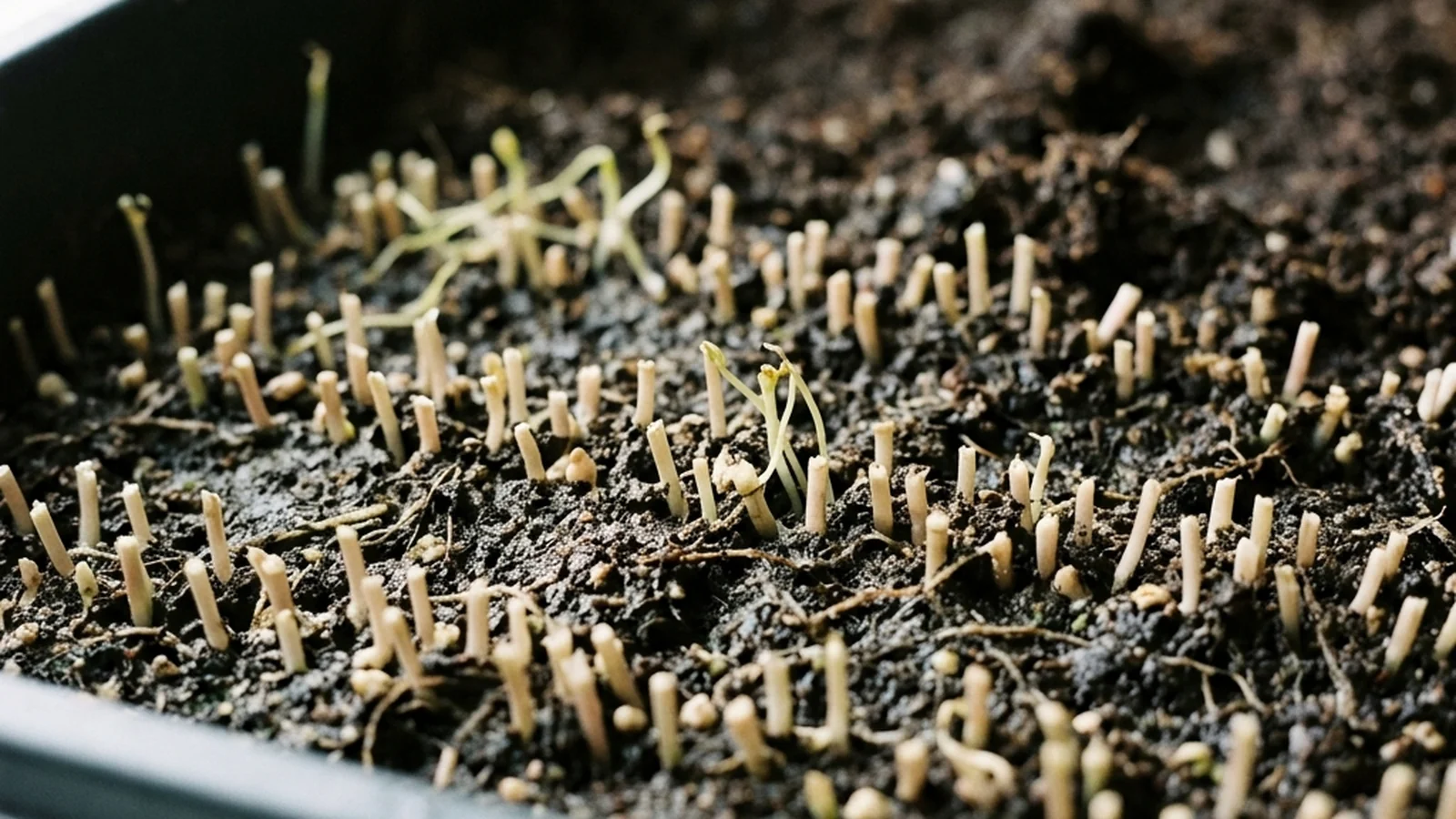
Do microgreens regrow once you cut them?
The cut you make decides everything. For almost every crop it removes the one part of the plant that could grow back.