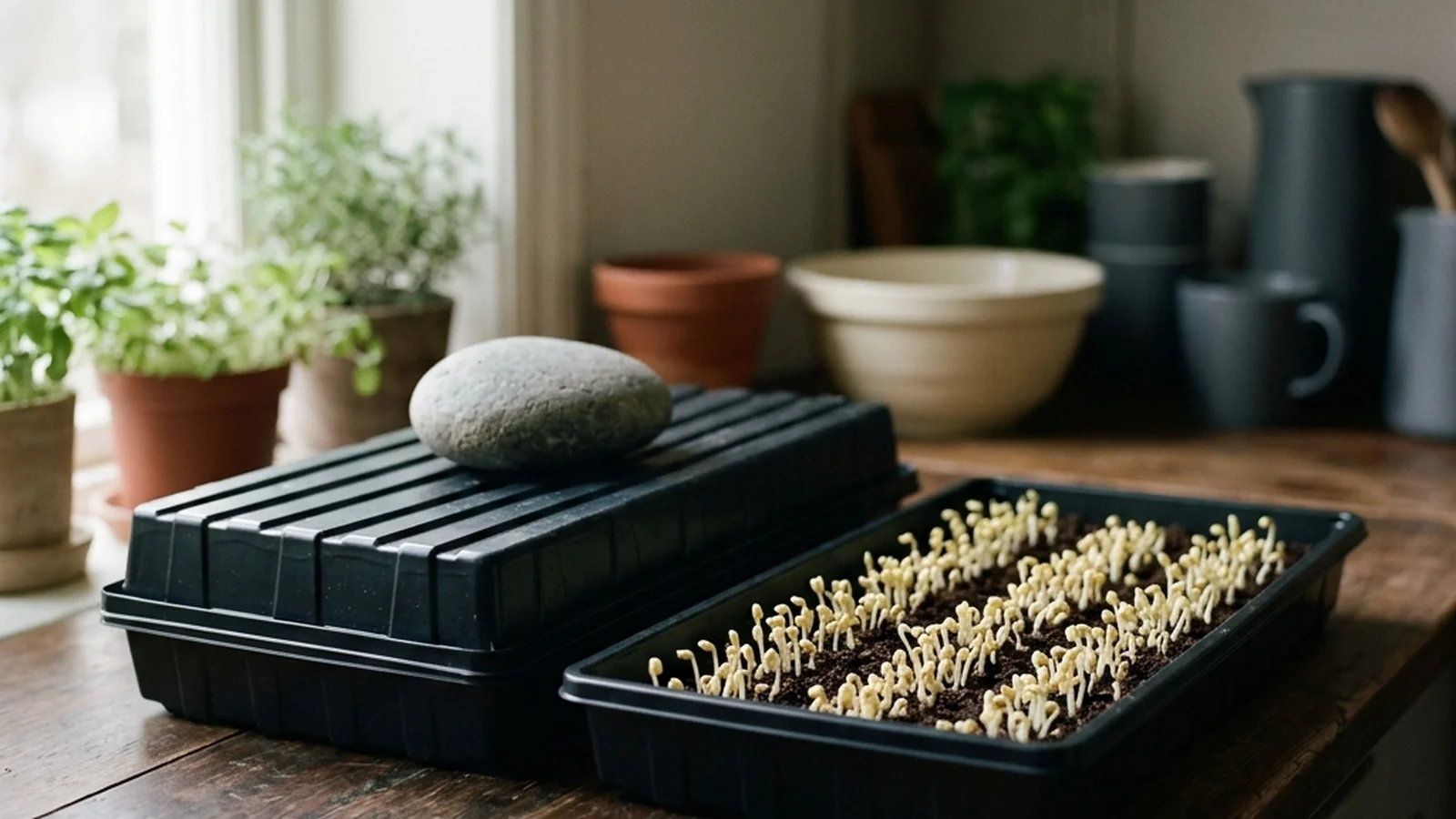
Quick answer: Utah State University Extension publishes a covered time for each variety it grows: 1 to 2 days for arugula, kale, radish and rutabaga, 2 to 4 for broccoli, 3 for pea and sunflower, 3 to 5 for a mesclun mix, 4 to 7 for basil and 7 to 14 for cilantro. UC ANR’s two-stage method runs a weighted solid cover for 2 to 3 days and then a flipped, unweighted cover for 1 to 2 more, so it lands longer than Utah State on the fast brassicas — treat 1 to 3 days as the window there and let the tray decide inside it. For crops in neither table, including mustard, where Penn State’s photos show the cover off by day 3, judge by the tray.
Blackout is one stage inside a longer sequence. If you have not sown a tray yet, start with the full beginner microgreens method, which covers sowing depth, watering, and what comes before and after this step.
What blackout is actually for
After sowing, most home microgreens methods cover the tray and keep it dark for a short period before introducing light. The point is not to hide the tray from moisture or pests. It is to let the seedling push upward looking for light, which stretches the stem before the leaves open. A longer, more even stem at this stage makes the eventual cut easier and the yield more consistent, because you are cutting one clean line across upright stems instead of a tangle of short, uneven ones.
That is also why blackout duration is not a fixed universal number. It depends on how fast a given seed pushes through the medium and how long you want that stretch to run before light takes over and the stem stops elongating.
Documented ways to run it
The sources that describe blackout describe different levels of structure, and they do not fully agree on detail.
The two-stage method. UC ANR’s Coastal Gardener guide to indoor winter microgreens describes blackout as two separate stages. Stage one: cover the freshly seeded tray with a second, solid tray and add a small weight on top, and leave it for 2 to 3 days. Stage two: once the seed has sprouted, flip that top tray upside down (so it no longer presses down) and keep the tray dark for 1 to 2 more days. The weight in stage one presses the seed into good contact with the medium; the unweighted dark period in stage two lets the stem stretch further before light exposure.
The looser method. Penn State Extension’s step-by-step home guide describes blackout more simply, as keeping the tray in “a dark environment for a few days” under a light-blocking cover, without naming a stage split or a fixed day-count. Its own photographs show the cover coming off by around day 3 for both mustard and peas — useful because mustard is not in Utah State’s table, so this is the only day number any source ties to that crop.
The per-crop table. Utah State University Extension publishes a “covered time” for each variety in its own protocol, covering eleven varieties against Penn State’s two. They are reproduced below.
Purdue Extension puts the weighted-cover phase at days 1 to 3, a weighted lid set over larger seed to aid germination — which lines up with UC ANR’s stage one and against Utah State’s 1 to 2 days for the fast brassicas.
Illinois Extension runs it without a duration at all: cover the seed with a moistened towel or a stacked tray, lift it daily, and take it off once the seedlings have rooted and are pushing the cover up. Illinois also warns not to cover seed with potting soil, which sticks to the leaves, and notes the cover is no longer needed once the seedlings sprout.
Put them together and the general shape is roughly 1 to 3 days of full dark for a fast crop, with an optional 1 to 2 additional days of unweighted dark for extra stretch, and considerably longer for the slow ones. The sources do not fully agree on the fast end: UC ANR’s stage one and Purdue’s weighted-cover phase both run 2 to 3 days where Utah State covers arugula, kale and radish for only 1 to 2. All are describing the same window on different setups, which is why the cover lifting off the tray is a better signal than any single number.
Covered time, crop by crop
Utah State University Extension’s covered times are below, with what the other two sources say about the same crop alongside.
| Crop | Utah State covered time | What the other sources add |
|---|---|---|
| Arugula | 1-2 days | Inside Penn State’s fast brassica group |
| Kale | 1-2 days | Inside Penn State’s fast brassica group |
| Radish | 1-2 days | Both the champion and purple varieties in Utah State’s table |
| Rutabaga | 1-2 days | — |
| Broccoli | 2-4 days | Overlaps UC ANR’s 2-3 day stage one, and runs a day longer at the top end |
| Pea | 3 days | Penn State’s photos show the cover off by around day 3 for peas |
| Sunflower | 3 days | Large seed, but the same covered time as pea |
| Mesclun mix | 3-5 days | A blend, so the figure covers whatever Utah State’s mix contains rather than any one crop |
| Basil | 4-7 days | Sown dry — the seed coat turns gelatinous in water |
| Cilantro | 7-14 days | The longest in the table, matching its 21-28 day cycle |
| Mustard | not in Utah State’s table | Penn State’s photos show the cover off by around day 3 |
| Beet, chard, spinach, amaranth, lettuce, celery | not in Utah State’s table | Penn State says only that they run longer than the 7-8 day brassica group |
Three things to take from that table. First, the spread is much wider than a single “few days” suggests — cilantro can sit covered for longer than a whole radish crop takes from seed to scissors. Second, seed size does not predict covered time: pea and sunflower, the two largest seeds here, come off cover at 3 days, while basil, one of the smallest, runs 4 to 7. What predicts it is how long the crop takes overall. Third, Utah State runs the fast brassicas shorter than UC ANR’s stage one does, so treat 1 to 3 days as the window for those and let the tray decide inside it.
If you are working through the crop-specific logs for sunflower, pea shoots, radish, or broccoli, use this table as the blackout context and the grow log for what happens once the cover comes off.
Why the seedlings look pale and stretched when you uncover them
Seedlings that spend days in the dark grow tall, thin, and pale — sometimes closer to yellow-white than green. That is etiolation: a normal growth response to the absence of light, not a symptom of mold or disease. Microgreens turning yellow covers why the colour looks like that and how to tell it apart from a real problem.
Once the tray is uncovered and put under the setup described in how much light microgreens actually need, the color corrects within a day or two as chlorophyll develops. Do not confuse this pale, stretched look with the surface fuzz and odor issues covered in telling mold from normal root hairs — etiolation is about color and stem length, not about smell, slime, or spreading white growth on the medium.
Judge the tray, not the calendar
Utah State’s covered times are that lab’s figures on that lab’s conditions, and UC ANR’s stage one disagrees with them on the fast brassicas, so treat the number as a window and check the tray daily inside it rather than committing to a day in advance.
Illinois Extension’s cue is the seed coat lifting and the cover being pushed upward from underneath — a sign that stage one has done its job and the seedling has enough contact and moisture to keep going. If you are running the two-stage method, that push is the cue to flip the top tray rather than remove it, so the seedling gets another day or two of stretch without direct weight on it. If nothing has visibly emerged after several days, do not extend the blackout indefinitely on the assumption that “more dark” will fix slow germination; check seed viability, sowing depth, and moisture instead.
Watering also needs attention during this stage. Keep the medium moist enough for germination without pooling water, since a covered, humid tray is exactly the environment where excess moisture is most likely to cause problems later.
Common mistakes
- Applying the mustard-and-pea day-3 figure to every crop, when Utah State’s own table runs from 1-2 days to 7-14 depending on the variety.
- Assuming a bigger seed automatically needs a longer blackout; peas and mustard follow the same schedule in the source photos despite the size difference.
- Treating pale, stretched seedlings straight out of blackout as a problem to fix, rather than the expected result of growing in the dark.
- Leaving the weighted cover on well past the point where the tray is pushing back against it, which delays the crop without adding documented benefit.
- Skipping the daily check on slower crops like basil and cilantro, where the covered window is days wide, and running blackout on autopilot for a fixed number of days regardless of what the tray shows.
Sources
- Utah State University Extension — Grow Your Own Microgreens publishes a per-variety covered time for eleven varieties, from 1-2 days for arugula, kale, radish and rutabaga to 7-14 days for cilantro.
- UC ANR Coastal Gardener — Your Indoor Winter Garden: Fresh Microgreens for Gloomy Days describes the two-stage blackout: a weighted solid cover for 2-3 days, then an unweighted flipped cover for 1-2 more days.
- Penn State Extension — A Step-By-Step Guide for Growing Microgreens at Home describes blackout as a dark environment “for a few days” and shows the cover removed by around day 3 for mustard and peas.
- Penn State Extension — The ABCs of Microgreens groups brassicas as a fast 7-8 day crop and notes that beet, chard, spinach, amaranth, lettuce, and celery take longer, without giving a specific figure.
- Purdue Extension — Grow Microgreens at Home puts the weighted-cover phase at days 1 to 3.
- Illinois Extension — Growing Microgreens describes an unfixed-duration cover, lifted daily and removed once the seedlings push it up.
- UC Master Gardener Program of Sonoma County — Growing Microgreens is the source for basil being sown without a presoak because of its mucilaginous seed coat.
Build the blackout step into a full grow method
Blackout is one stage in a larger sequence. These guides cover the full method and the crop logs where blackout timing shows up in practice.
Common questions
How many days should microgreens stay in blackout?
Utah State University Extension publishes a covered time per variety, from 1-2 days for arugula, kale, radish and rutabaga to 7-14 for cilantro, so the answer depends on the crop. One documented method runs a solid, weighted cover for 2-3 days and then flips the top tray upside down for 1-2 more days; a looser method calls for a dark environment for a few days, with the cover off by around day 3 for mustard and peas. Confirm with the tray, not the clock.
What happens if I skip blackout entirely?
None of the primary sources test skipping blackout, so there is no documented outcome for doing that. What blackout does document is stem stretch and an easier, more even cut later. Going straight to light instead removes that deliberate stretch phase.
Why are my microgreens yellow when I take the cover off?
That is etiolation, the normal look of a seedling that grew without light. It is not mold, disease, or a sign anything went wrong. The color corrects within a day or two once the tray is uncovered and exposed to light.
Do larger seeds like peas and sunflower need a longer blackout than radish or broccoli?
Utah State University Extension covers pea and sunflower for 3 days, radish for 1-2 and broccoli for 2-4, so on its protocol the large seeds do sit covered slightly longer — but the gap is one or two days, and basil, one of the smallest seeds in its table, runs longest at 4-7. Size is a weak predictor; total crop length is a better one. Watch the tray rather than assuming a bigger seed means a longer blackout.
Related guides
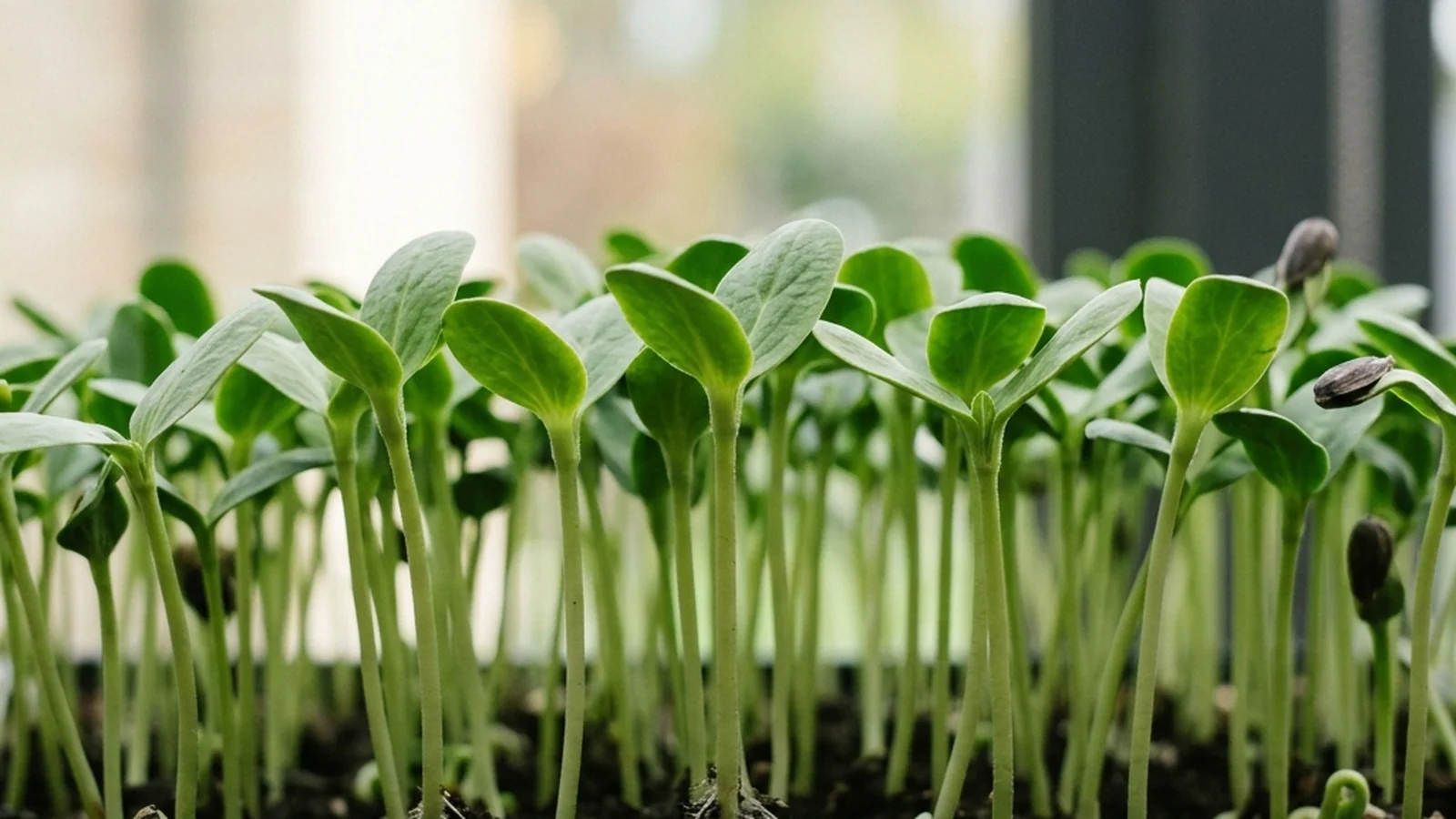
Sunflower microgreens grow log: a day-by-day timeline
Sunflower microgreens follow the same basic method as other crops, but the seed changes the process — a real presoak, a heavier blackout weight, and hulls that often do not let go of the cotyledons on their own.
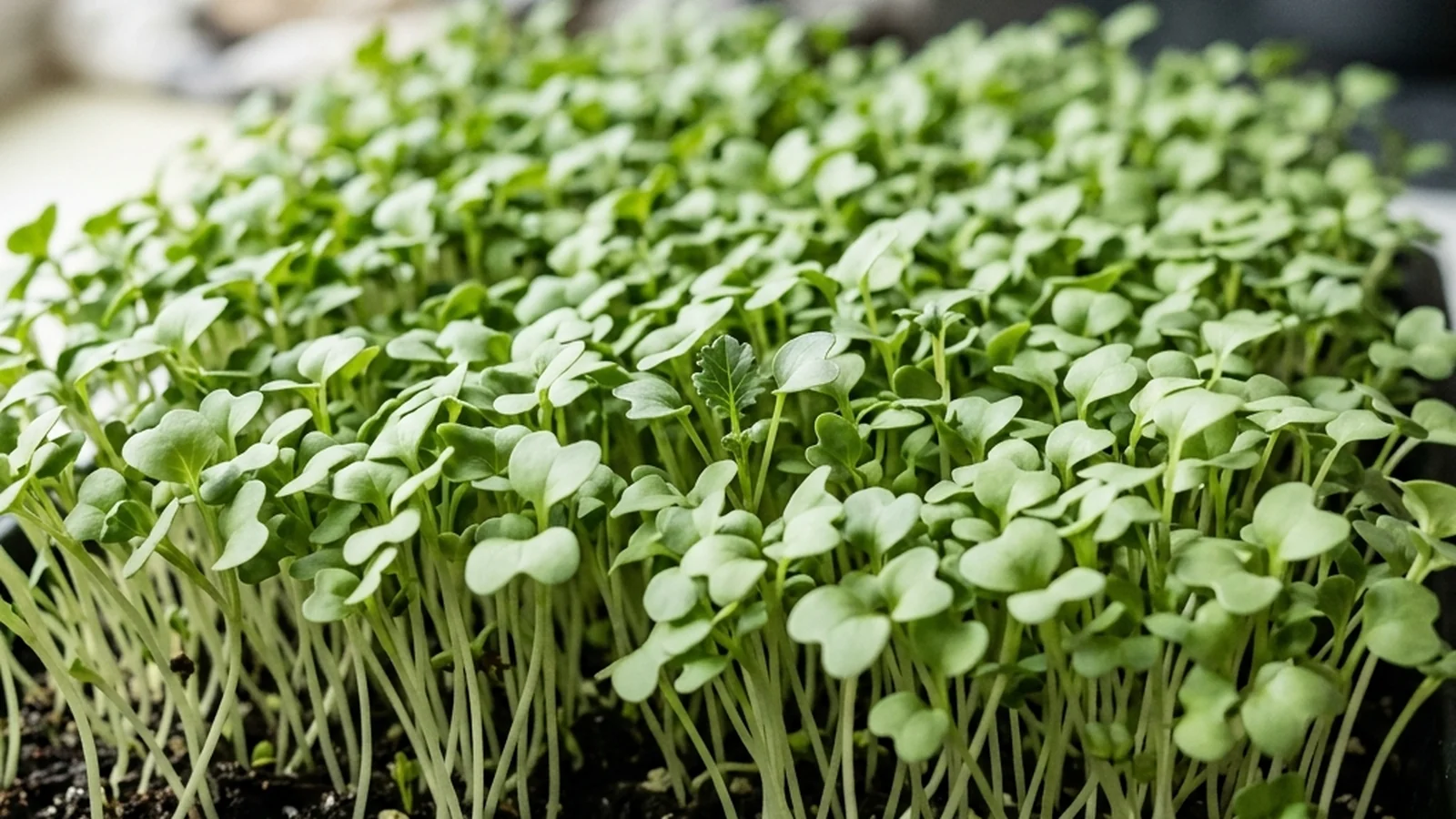
Broccoli microgreens grow log: a day-by-day timeline
Broccoli microgreens follow the same fast brassica schedule as radish, but the reason people search for them is different. Here is the typical timeline, and what the nutrition claims actually support.
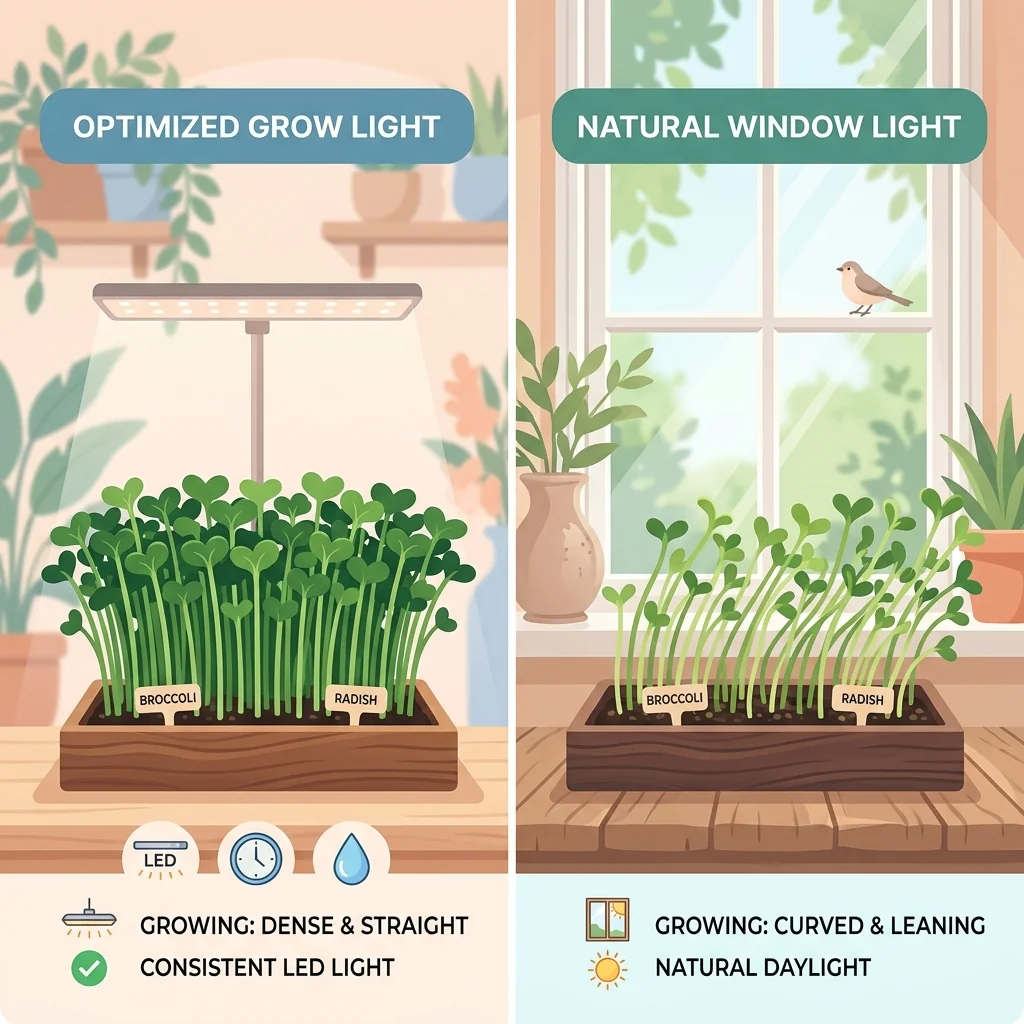
Microgreens light requirements and a simple setup
Microgreens are kept dark to germinate, then need good light to stay short and green. Here is how much light they need and the simplest windowsill or LED setup.