Relative risk: sprouts, soil or pad microgreens, and hydroponic microgreens
| Factor | Sprouts | Microgreens (soil or pad) | Hydroponic microgreens |
|---|---|---|---|
| Seed contact with water | Fully submerged 12-16 hours | Moist medium, not submerged | Direct contact with recirculating water |
| Light during growth | Grown in the dark | Grown in light after a short blackout | Grown in light after a short blackout |
| Edible part harvested | Seed, root, and shoot together | Cut above the medium, seed and root left behind | Cut above the water, but stems have touched water |
| Relative risk pattern | Higher — favors pathogen growth | Lower when harvested correctly | Can approach sprout-like risk if stems contact recirculating water |
Microgreens carry less food-safety risk than sprouts, but that gap depends entirely on how they are grown and cut. University of Tennessee Extension describes sprout seed as fully submerged for the first 12-16 hours, grown without light, with the semi-germinated seed and root eaten along with the shoot. A correctly harvested microgreens tray is grown in light and cut above the medium, so pathogens on the seed tend to stay in the growing medium rather than travel with the leaf and stem you eat. That advantage narrows for hydroponic setups where the edible tissue sits in recirculating water, and it depends on decent sanitation of your trays, seed, and water at every stage.
Everything below assumes a tray grown the usual way — sown into a shallow moist medium, kept dark for a few days, then cut above the medium — which is the method set out in how to grow microgreens at home.
Why sprouts carry more risk than microgreens
The difference comes down to how the seed is treated and what ends up on your plate. Sprout production fully submerges the seed for the first 12-16 hours, then grows it wet and without light for the rest of the cycle. Wet, warm, and dark are the conditions many foodborne pathogens need to multiply, and the final product includes the semi-germinated seed and root, which is exactly where seed-borne contamination is most likely to concentrate.
Microgreens are handled differently at almost every step. The seed germinates in a shallow layer of moist medium rather than a submerged soak, the crop is grown in light for most of its life rather than kept dark, and harvest means cutting the stem above the medium with scissors or a knife. That single cut is doing real work: it separates the edible leaf and stem from the seed hull and root system, which is where seed-borne pathogens are most likely to be sitting. Grown and harvested this way, microgreens are lower risk than sprouts for that reason specifically, not because they are a fundamentally different food.
This is a pattern, not a guarantee. It describes what tends to happen under normal handling, and it still depends on clean seed, a clean tray, and a harvest cut that does not drag contaminated medium up into the leaf mass.
The hydroponic exception
The risk pattern above assumes the edible part of the plant does not sit in water. That assumption breaks down for hydroponic microgreens grown on a pad or mat where water recirculates through a reservoir and up through the growing surface.
If leaves and stems are in ongoing contact with that recirculating water, the crop keeps a sprout-like risk profile even though it looks and is eaten like a microgreen. Water that touches the plant repeatedly, rather than being applied and drained once, gives any contamination in that water more opportunity to reach the part you eat. That is the tradeoff of growing microgreens without soil: cleaner to grow and harvest, but only as safe as the water you recirculate through it.
The practical takeaway is not to avoid hydroponic microgreens. It is to treat the water itself as a control point. University of Tennessee Extension names water, alongside seed and substrate, as one of the three main pathogen sources for both sprouts and microgreens, and ties hydroponic risk specifically to water that recirculates against leaves and stems rather than being applied once and drained away. Purdue Extension’s general sanitation guidance applies directly here: keep every piece of equipment that touches the crop clean and sanitised. A hydroponic setup where the water supply itself is kept clean and sanitised is being run more carefully than the table’s general pattern implies.
Where contamination actually comes from
For both sprouts and microgreens, the main sources of pathogens are the same three things: the seed itself, the growing substrate, and the water. Seed can carry pathogens picked up during harvest or handling long before it reaches your tray. Substrate — soil, coir, or a hydroponic pad — can harbor organisms from a previous grow. Illinois Extension treats the growing medium as single-use, instructing growers to compost the stems and medium once a tray is fully harvested, and Purdue Extension states that growing media and substrates are not reusable, with stainless-steel screens the exception, because reusing substrate raises the risk of mould. What gets sanitized and reused is the tray itself, not what was growing in it. Water introduces risk anywhere it touches the crop repeatedly rather than being applied and drained.
None of the three sources is optional to manage. A clean tray with dirty seed is still a risk, and clean seed in an unsanitized tray reused from a failed grow is still a risk. Treat all three as a checklist rather than picking the one that feels easiest.
Sanitizing trays and equipment between grows
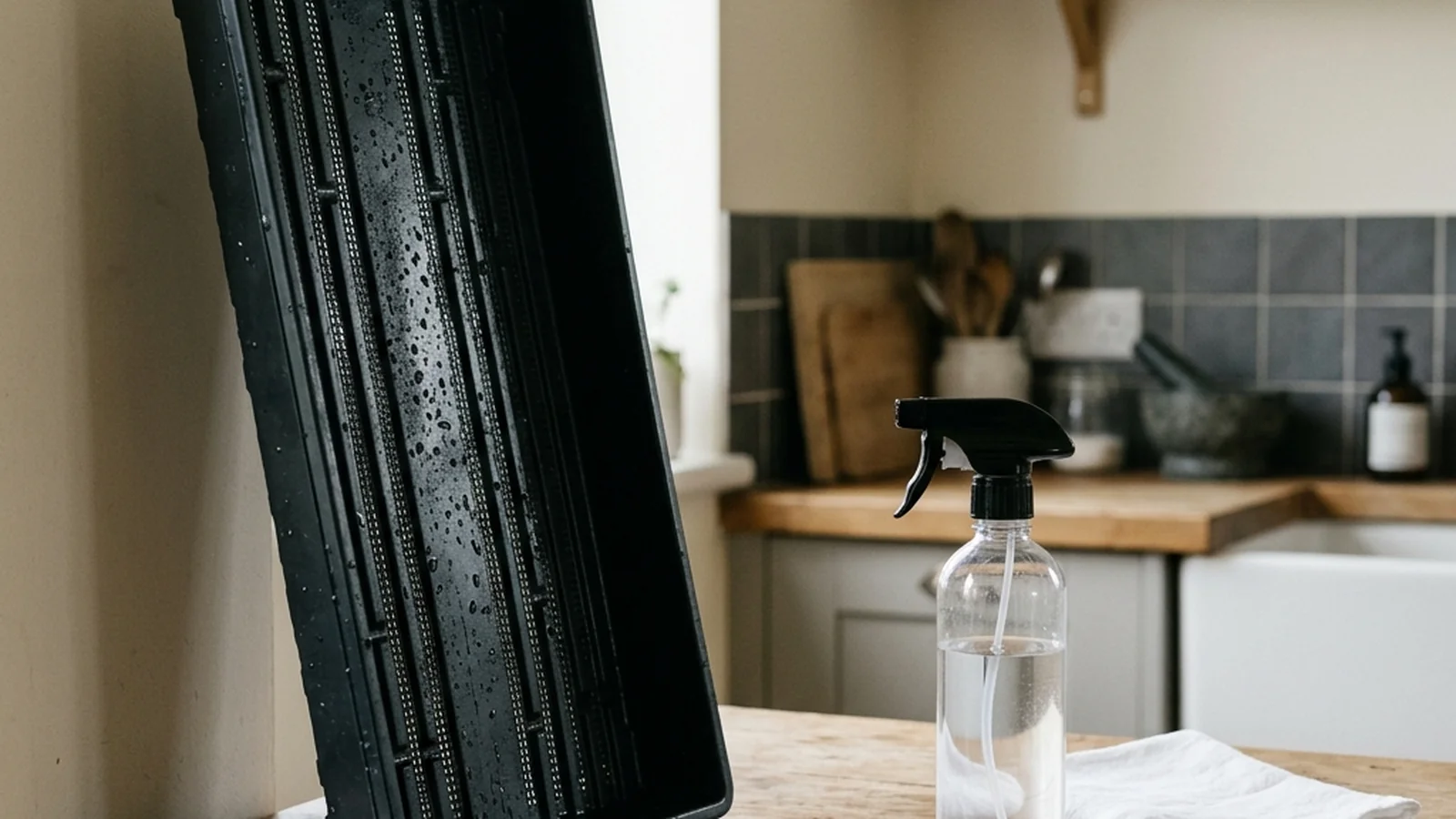
Reused trays are the easiest source to control, and the protocol is specific rather than a vague “clean it well.” University of Minnesota Extension gives the protocol: wash all growing medium off a reused tray first — leftover seed hulls and medium residue from the previous crop can shield organisms from the sanitizer and make the next step ineffective — then sanitize it in a 10% bleach solution for 30 minutes, and let it air dry completely before sowing again.
This is the same sanitation step used to control damping-off, the seedling disease that shows up as collapsed stems and rotted roots in young trays. If you want the full diagnosis of that problem — what it looks like, what causes it, and how it differs from normal root hairs or surface mold — that is covered on its own troubleshooting page and on the mold-versus-root-hairs comparison.
The same guidance calls for a steam-sterilized or pasteurized, lightweight, fast-draining starting mix rather than reused, unsterilized medium. Purdue Extension is specific about garden soil: do not use it indoors unless it has been sterilised first, since it is not formulated for the fast, contained grow cycle and has not been through any process meant to reduce pathogen load.
Choosing seed for food safety
Penn State Extension’s advice is to buy seed marketed specifically for sprouting or microgreens production, processed under food-safety standards, rather than a general garden seed packet bought for outdoor planting. This matters because sprout- and microgreens-grade seed lots are held to that standard with this exact contamination pathway in mind — seed intended for a garden bed has no such requirement, because it is not eaten raw at the seedling stage.
This single sourcing decision does more for food safety than any amount of sanitizing after the fact. A clean tray cannot compensate for seed that was contaminated before it ever reached you.
Washing: two extension positions, not one
Penn State Extension and Purdue Extension say to store microgreens unwashed and wash them right before eating. University of Tennessee Extension gives the reason: washing before storage adds surface moisture, and that moisture is exactly the condition that lets bacteria and mold establish and spread on greens that then sit in the fridge for days. Illinois Extension takes the opposite approach at harvest, instructing growers to wash the crop thoroughly in a colander or salad spinner to remove seed coats and any soil still clinging to the leaves.
The two positions are not really a coin flip between right and wrong — they answer different questions. Penn State, Purdue and Tennessee are describing a crop that goes into the refrigerator for the rest of the week; Illinois is describing a crop that gets washed and eaten close to harvest. Washing and then storing adds moisture to greens that sit for days, which is the condition Tennessee warns about. Washing and eating soon after skips that window before it matters. If your harvest is going in the fridge, hold off on washing until you take it back out. If you are eating it the same day, washing at harvest the way Illinois describes is fine.
If you are also deciding how long a tray is good for once it is cut, storage temperature and expected shelf life are covered separately in the harvest and storage guide.
Who should be extra careful
The FDA publishes sprout-specific guidance for growing, harvesting, packing and holding, while microgreens harvested with a single cut fall under the FSMA Produce Safety Rule, as University of Tennessee Extension sets out. That regulatory split reflects the same risk pattern described above, not a claim that microgreens carry no risk at all.
People who are more vulnerable to foodborne illness — due to age, pregnancy, or a weakened immune system — should follow current public-health guidance on raw sprouts and microgreens rather than relying on a home grower’s sanitation routine alone. Good hygiene at home meaningfully reduces risk. It does not replace medical or public-health advice for someone in a higher-risk group.
Common mistakes that raise risk
- Reusing a tray without stripping the old medium and sanitizing it first.
- Using garden soil instead of a steam-sterilized or pasteurized starting mix.
- Buying general garden seed instead of seed sold for sprouting or microgreens.
- Washing the harvest before it goes into the fridge instead of right before eating.
- Letting recirculating water touch leaves and stems without keeping the reservoir and equipment clean and sanitised.
- Assuming a clean-looking tray means the seed and water behind it were also clean.
Sanitize the system, not just the tray
Risk concentrates wherever standing water, seed, and the part you actually eat stay in contact. A well-run microgreens tray keeps them apart by design; a hydroponic tray only does it if you manage the water deliberately, rather than assuming the growing method itself makes the crop safe.
Sources
- University of Tennessee Extension, W1261 — Regulatory Considerations for Marketing Sprouts, Microgreens and Baby Greens
- Penn State Extension — The ABCs of Microgreens
- University of Minnesota Extension — How to prevent seedling damping-off
- Illinois Extension — Growing Microgreens
- Purdue Extension — Grow Microgreens at Home
Related safety and process guides
Pair this with the tray disease it is often confused for, the harvest and storage steps, and full setup guidance.
Common questions
Are microgreens as risky as sprouts?
Generally no. Sprout seed is fully submerged in dark, wet conditions for 12-16 hours and the product includes the semi-germinated seed and root, all of which favors pathogen growth. Microgreens are grown in light and are cut above the medium, so seed-borne pathogens tend to stay behind rather than travel with the harvested leaf and stem. The exception is a hydroponic setup where the edible tissue sits in recirculating water.
Do I need to sanitize my microgreens trays between every grow?
Yes, for any tray you reuse. Wash all growing medium off the tray, sanitize it in a 10% bleach solution for 30 minutes, then let it air dry completely before the next sowing. This is the same sanitation protocol used to control damping-off.
Should I wash microgreens before I put them in the fridge?
It depends on whether you are storing the crop or eating it soon. Penn State Extension and Purdue Extension say to store microgreens unwashed and wash them right before eating, and University of Tennessee Extension gives the reason - washing before storage adds surface moisture, and that moisture is what lets bacteria and mold establish on greens sitting in the fridge for days. Illinois Extension instructs washing thoroughly at harvest, in a colander or salad spinner, which works fine if you are eating the crop soon rather than storing it. If your microgreens are going into the fridge for more than a day, wash them after you take them out, not before.
What kind of seed is safest for growing microgreens?
Seed sold specifically for sprouting or microgreens production, processed under food-safety standards, rather than a general garden seed packet. Sprout- and microgreens-grade seed lots are handled with this specific contamination risk in mind, which a packet intended for outdoor planting is not.
Related guides
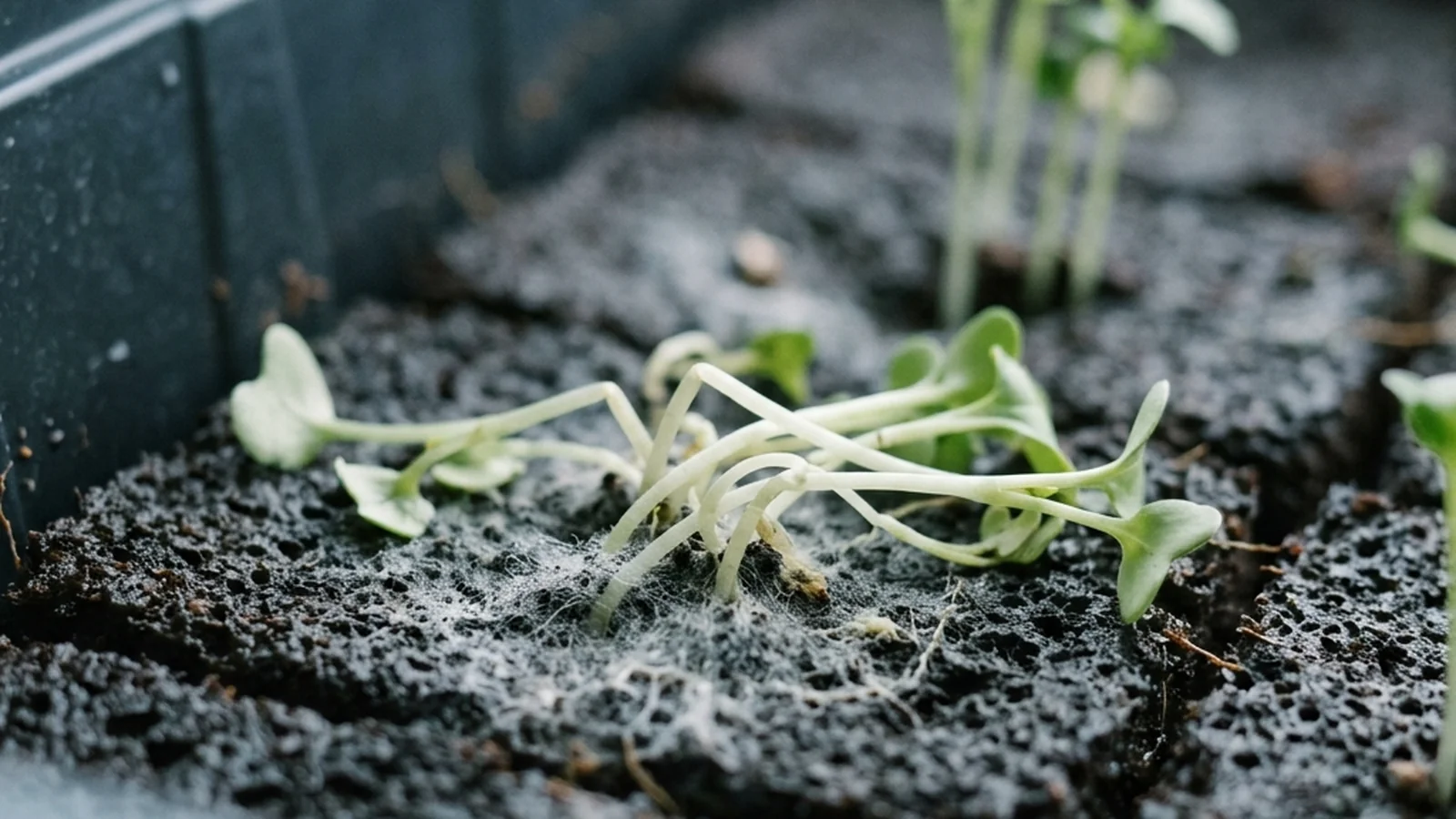
Damping-off in microgreens: symptoms and control
Damping-off attacks the seedling itself, not the tray surface. Here is how to recognize pre- and post-emergence stages and control outbreaks with sanitation, not fungicide.
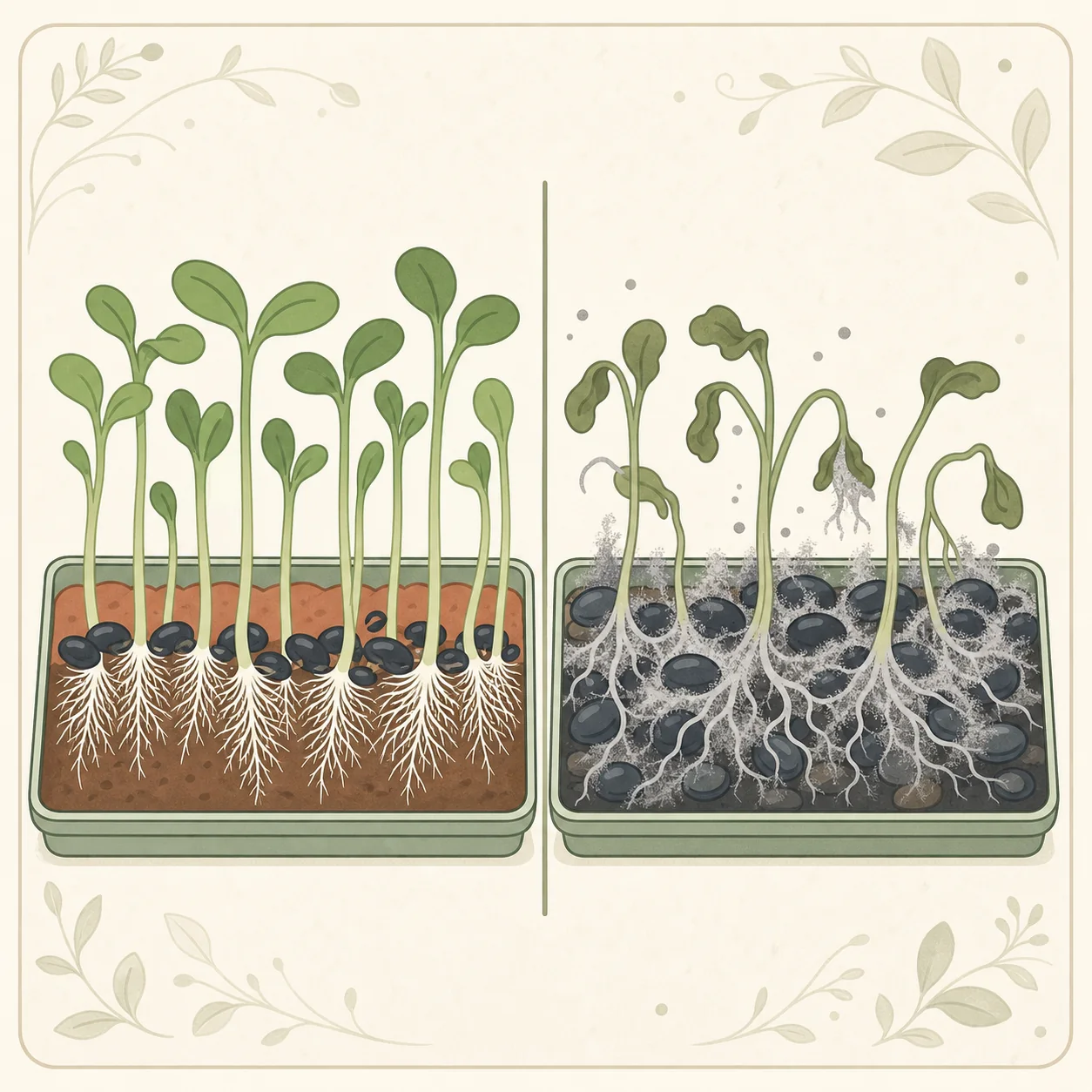
Microgreens mold or root hairs? How to tell safely
White fuzz around newly emerged roots is often normal root hair growth. Irregular spread, bad odor, slime, or collapsing stems changes the decision.
How to grow microgreens at home: a beginner's guide
Microgreens are the fastest crop you can grow indoors. This beginner guide walks through sowing, watering, light, and harvesting your first tray in about ten days.