What the trials found, by medium
| Medium | Yield in trials | Harvest | Pathogen evidence |
|---|---|---|---|
| Peat-based mix | Heaviest trays for pea (Penn State) and for coriander, kohlrabi and pak choi (Cyprus and Naples) | Soil or perlite bits can end up on the cut stems | Declined in a plant-free lab test; rapini grown on peat had the highest E. coli count in one trial |
| Coco coir, loose | Equal to peat mix for radish, lower for pea; salt-sensitive coriander lagged | Same grit issue as any loose medium | Declined in the plant-free lab test; Listeria undetectable by day 10 |
| Coco coir mat | Higher dry weight than jute, bamboo or recycled-plastic mats (conference abstract) | Cleaner cut | Not tested separately |
| Jute-kenaf mat | Matched peat for rapini (1502 g per square metre) | Cleaner cut | Higher yeast-and-mold counts than recycled textile and synthetic mats, as with peat |
| Hemp mat | Not in the yield trials reviewed here | Cleaner cut | Salmonella and Listeria persisted at the starting level in the plant-free lab test |
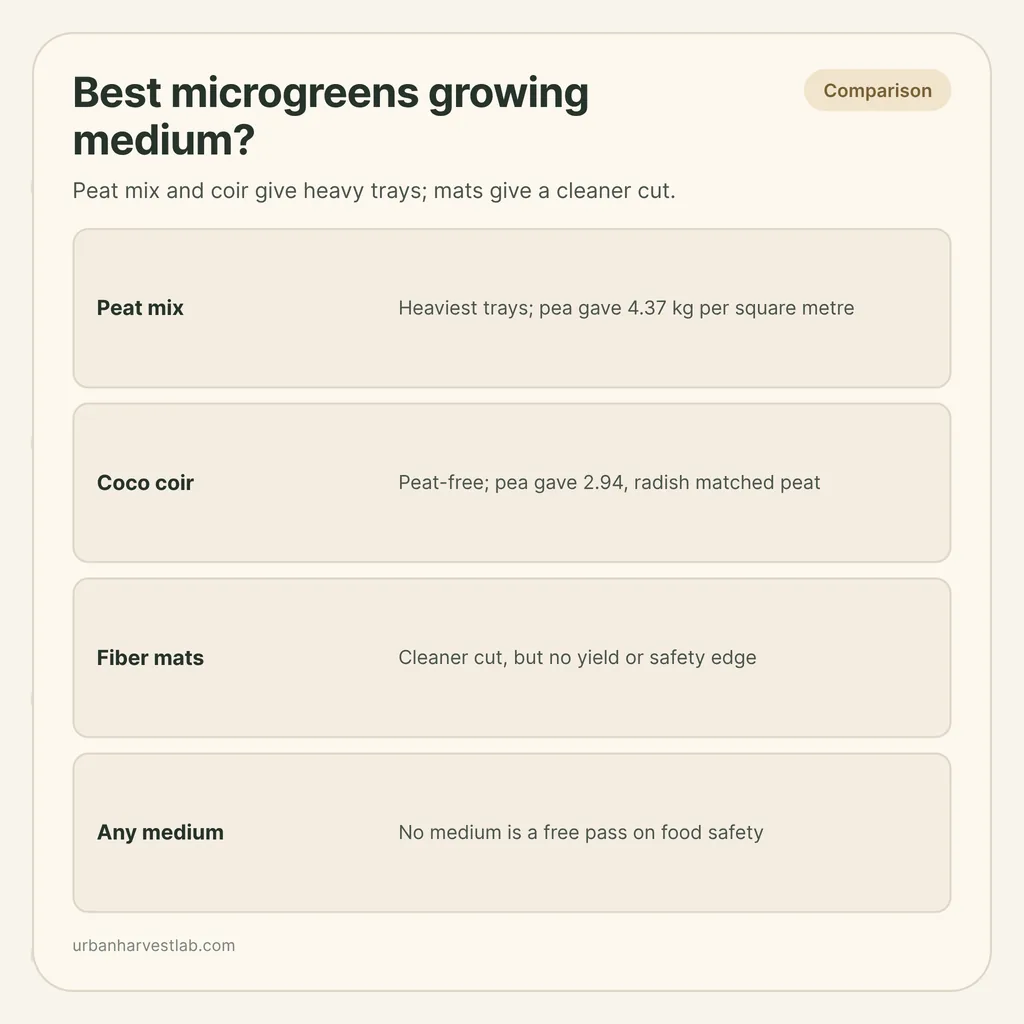
Peat-based seed mix and coco coir give the heaviest trays; a fiber mat gives the cleanest cut but no yield or safety edge. For a first tray, a fresh bag of seed-starting mix or coir is the choice the research backs best.
Penn State Extension lists the popular options as “peat-based mixes, coconut coir, and mats constituted of natural (cotton, kenaf, hemp) or synthetic fibers.” Its advice on choosing is plain: use what is readily available and inexpensive, as long as it is environmentally sustainable, clean and safe. The trials below show what that choice costs and buys you. If you only want the soil-free method itself, see growing microgreens without soil.
Yield: peat mix leads, coir depends on the crop
Three peer-reviewed trials and one conference abstract compared media head to head. None tested every medium here, so read them as pieces of a picture.
Peat mix against coir. A Penn State trial with Francesco Di Gioia as senior author grew pea and radish microgreens on peat-perlite mix and on coconut coir. Pea gave 4.37 kg per square metre on peat mix and 2.94 on coir. Radish gave 2.66 and 2.78, and the two were not significantly different. Both media held about 82 percent water by volume, and they were the only two of the eight media with a pH in the ideal range. The authors still wrote that a single material like coir is unlikely to fully replace peat with similar yield and quality.
Peat mix against fibers. A trial at the Agricultural Research Institute of Cyprus and the University of Naples grew coriander, kohlrabi and pak choi on peat moss, coconut fiber, agave fiber, a capillary mat and a cellulose sponge. All three species did “outstandingly” on peat, a 55.1 percent increase over the other four. Coconut fiber came second for kohlrabi and pak choi but not for coriander. The authors tie that to the coconut fiber’s high initial electrical conductivity (a measure of dissolved salts), which delayed coriander germination. If a salt-sensitive crop stalls on coir while a radish tray does fine, that is a suspect.
Mats against each other. A 2025 conference abstract reported that peat and a coco coir mat gave higher dry shoot weight than jute, bamboo or recycled-plastic mats across four species. It also found the best substrate varied by species.
Mats can match peat. In the 2017 Di Gioia et al. rapini trial (Journal of the Science of Food and Agriculture), fresh yield averaged 1502 g per square metre on peat, a recycled textile mat and a jute-kenaf mat (85 percent jute, 15 percent kenaf), and was 13.1 percent lower on a synthetic polyethylene-terephthalate mat. Hemp mats were not part of these yield trials, so no yield figure here speaks for them.
The cleaner cut is real
Penn State Extension says that “harvested microgreens are cleaner” on seeding mats than in potting soil. In loose mix, bits of soil or perlite end up on the stems and are hard to remove. Penn State also says washing before sale shortens post-harvest life. For home use, its home-growing guide still recommends washing in drinking water before eating, so a mat saves you grit more than it saves you a rinse.
Food safety: no medium is a free pass
The best food-safety evidence is a University of Arkansas lab test by Grace Misra and Kristen Gibson. They inoculated coco coir, a Sphagnum peat-vermiculite mix, Biostrate (a commercial mat) and hemp mat with Salmonella and Listeria, with no plants or fertilizer, and counted survivors for 10 days. On hemp and Biostrate both bacteria held at the starting level through day 10. On coir, peat and plain buffer, Salmonella dropped by 1 to 2 log units. Listeria fell to 1 log unit on peat and below detection on coir.
A follow-up grew sunflower and pea shoots on inoculated Biostrate and peat. The authors concluded that transfer to the greens depends on both the medium and the crop. The follow-up used Biostrate and peat, not coir or hemp, and neither study says anything about a clean mat, clean seed and clean water in a kitchen tray.
Other results do not line up neatly. In the rapini trial, greens grown on peat had the highest E. coli and Enterobacteriaceae counts, and E. coli was not detected on the other media. Peat and the jute-kenaf mat had higher yeast-and-mold counts than the recycled textile and synthetic mats. Medium matters, but no medium here is clean enough to skip sanitizing. Purdue Extension says garden soil indoors should be sterilized first. The steps for trays, seed and water are in microgreens food safety and sanitation.
Choosing
- Maximum yield, simplest watering: fresh peat-based seed-starting mix. Peat is also a non-renewable resource, which the Penn State authors raise as a sustainability concern.
- Peat-free: loose coir. Expect the same pea yield penalty seen in the Penn State trial, and watch salt-sensitive crops like coriander.
- Least mess: a mat. Pick coco coir or jute-kenaf if yield matters, given the trial results above. Hemp is the one with the least yield data and the worst pathogen persistence in the lab test. Buy sealed and use each mat once. If you are weighing options, browse microgreens grow mats on Amazon.
- Any medium: start it fresh. Purdue says growing media “are not re-usable although many are compostable.” Penn State says medium can be reused but new is better for avoiding disease. Why is covered in can you reuse microgreens soil.
How to grow on a mat step by step is in microgreens without soil, and the rest of the kit is in what you need to grow microgreens.
Sources
- Di Gioia, De Bellis, Mininni, Santamaria and Serio (2017), Journal of the Science of Food and Agriculture: alternative growing media for rapini microgreens
- Poudel, Duenas and Di Gioia (2023), Frontiers in Plant Science, Penn State: compost and coconut coir growing media for pea and radish microgreens
- Kyriacou et al. (2020), Antioxidants: natural fiber and synthetic substrates for coriander, kohlrabi and pak choi microgreens
- ASHS 2025 conference abstract: microgreen species as affected by five growing substrates
- Misra and Gibson (2020), Journal of Applied Microbiology, University of Arkansas: pathogen survival by cultivation matrix
- Deng, Misra, Baker and Gibson (2021), Horticulturae: pathogen transfer to sunflower and pea shoot microgreens
- Penn State Extension: a step-by-step guide for growing microgreens at home
- Penn State Extension: growing microgreens
- Purdue Extension: grow microgreens at home
Set up and run the tray
The soil-free method, the supply list, and what to do with the spent medium.
Common questions
Which is better for microgreens, soil or coco coir?
Close, and it depends on the crop. In a Penn State trial, peat-perlite mix produced 4.37 kg per square metre of pea microgreens against 2.94 for coconut coir, while radish gave 2.66 on peat mix and 2.78 on coir, which was not a significant difference. Both held about 82 percent water by volume.
Are hemp mats better than soil for microgreens?
They are cleaner, not higher-yielding or proven safer. Penn State Extension says harvested microgreens are cleaner on seeding mats than in potting soil. The yield trials summarized here tested peat, coir, jute-kenaf and other mats but not hemp, and a lab test found Salmonella and Listeria persisted on hemp mats where they declined on coco coir and peat.
Is it safe to grow microgreens on coco coir?
Coir did well in the one lab comparison: in the University of Arkansas test, Salmonella declined by 1 to 2 log units over 10 days on coco coir and Listeria fell below the detection limit. That was a plant-free bench test, so it does not make any medium safe. Buy it fresh, keep it clean, and follow the sanitation steps.
Can I reuse the medium for a second crop of microgreens?
Purdue Extension says growing media are not reusable for microgreens, though many are compostable. Penn State says some growers reuse medium but that new medium each cycle minimizes disease.
Related guides
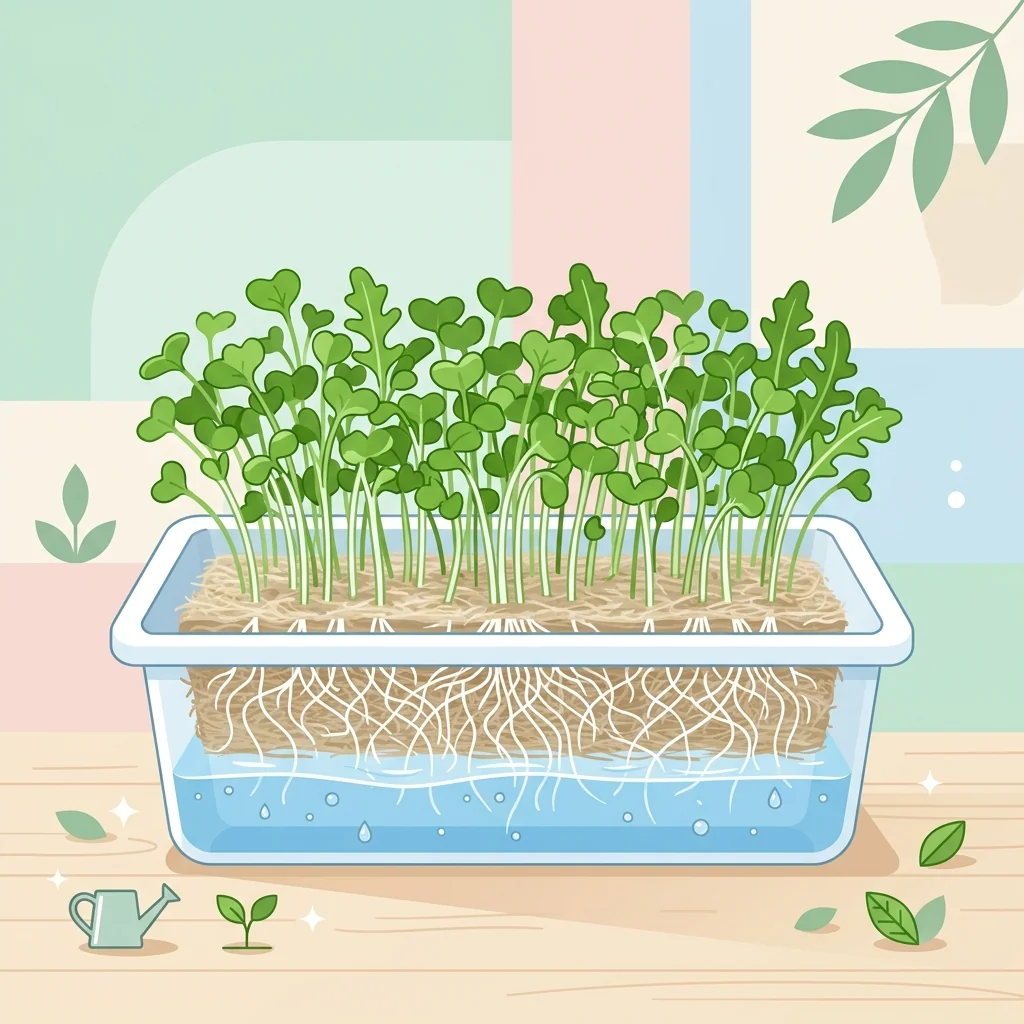
How to grow microgreens without soil (hydroponic)
No soil, no mess. Grow microgreens hydroponically on a grow mat or pad for clean, tidy trays indoors. Here is how the soil-free method works and where it shines.
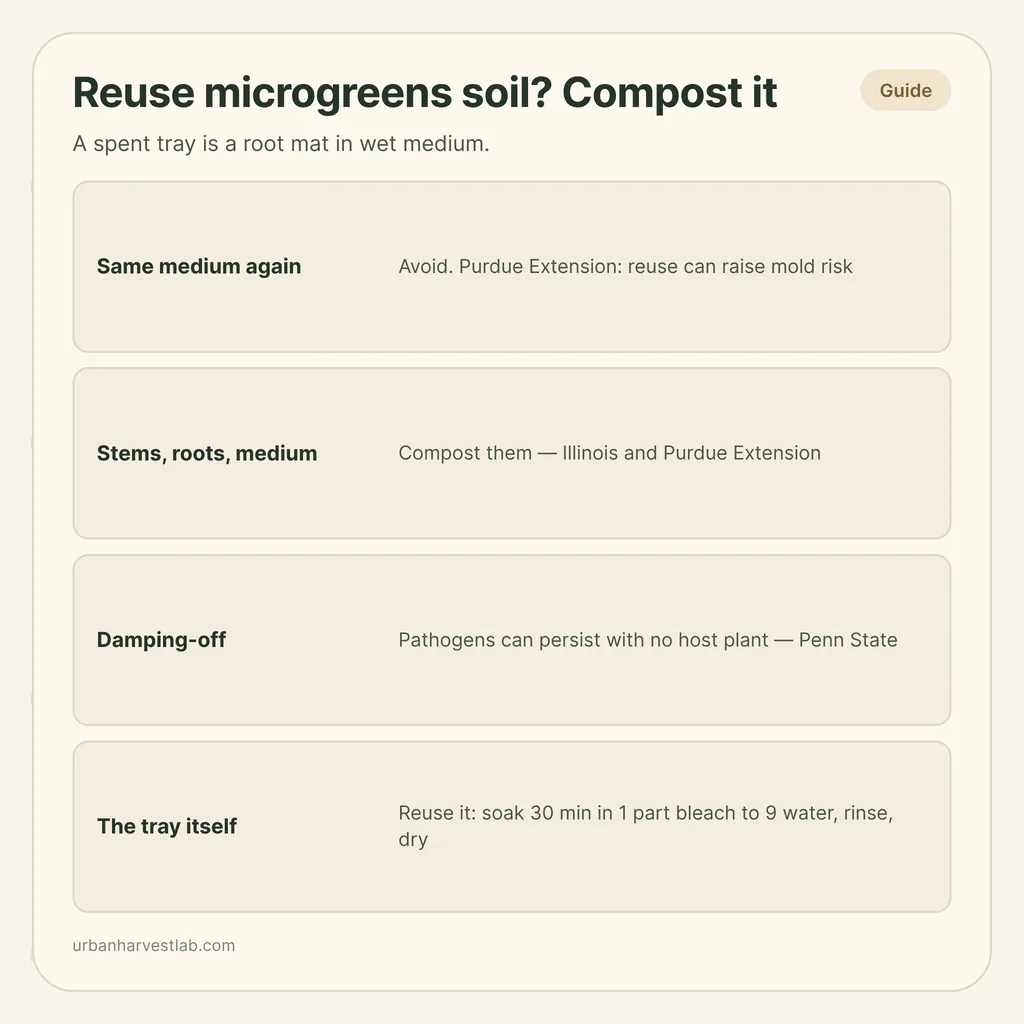
Can you reuse microgreens soil? Why a spent tray is single-use
A harvested tray leaves a dense mat of roots in wet medium. Purdue and Illinois Extension both point it to the compost, not back into the next tray.
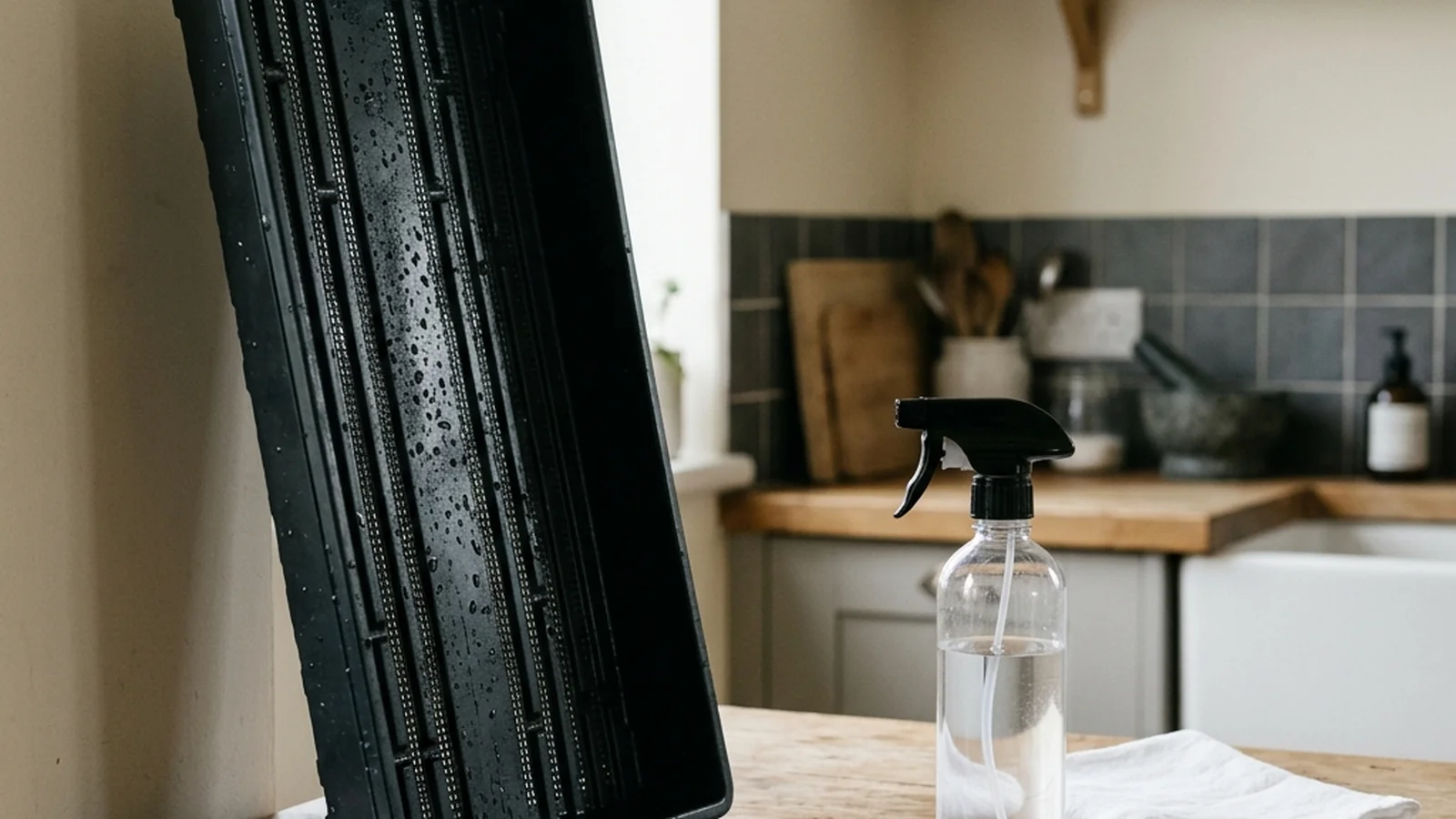
Microgreens food safety: sanitizing trays, seed, and water
Sprout recalls do not automatically make microgreens risky. The harvest method is what separates them, and one hydroponic setup can erase that gap.